
What Is Tian Hua Fen? Medicinal Parts, Identification, and Common Formulas
Many overseas users seeing the name “Tian Hua Fen” for the first time might mistake it for some kind of pollen product. In fact, Tian Hua Fen is the dried root of Trichosanthes kirilowii (or Trichosanthes rosthornii), and has nothing to do with pollen. Understanding its origin, appearance identification, and traditional use directions can avoid misunderstandings and provide a reference for subsequent selection and learning.
What Does Tian Hua Fen Look Like? How to Identify It?
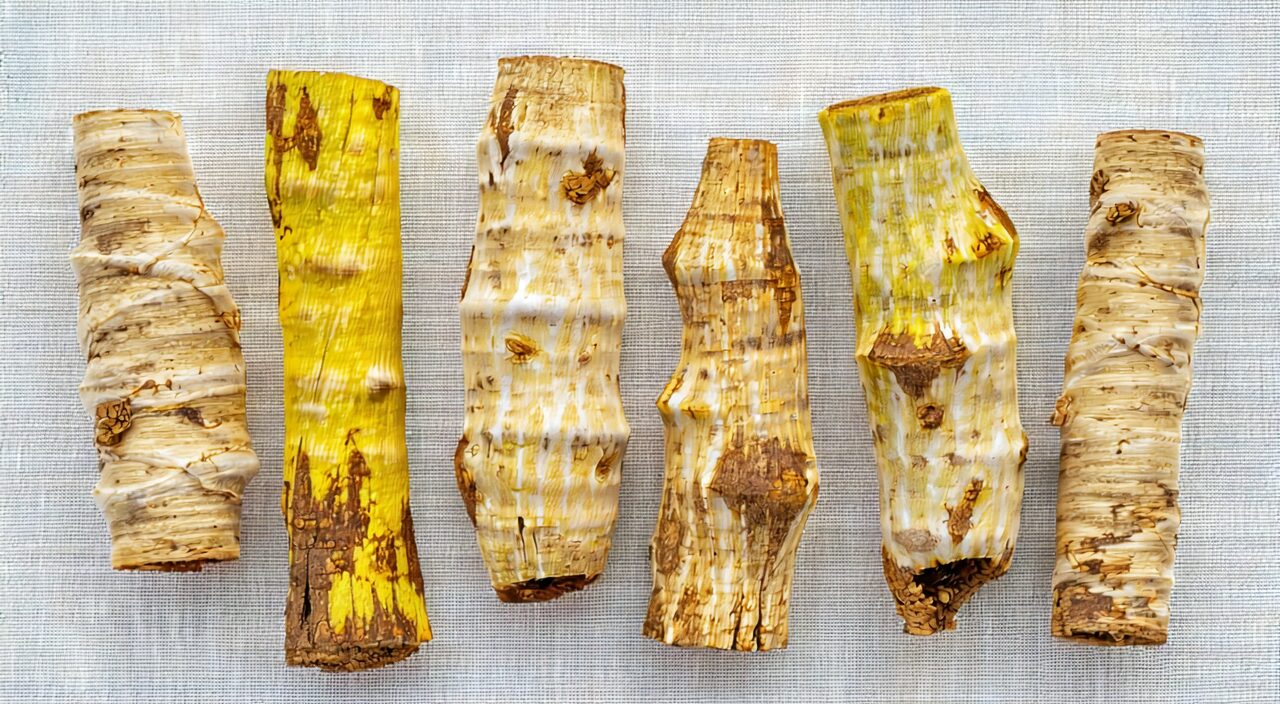
The medicinal form of Tian Hua Fen is usually irregularly cylindrical, spindle-shaped, or in block-like pieces. The surface is yellowish-white or pale brownish-yellow, with longitudinal wrinkles, fine root scars, and depressed transverse lenticel-like marks. Some pieces retain a yellowish-brown outer bark. The texture is firm and not easily broken. The cut surface is white or pale yellow with strong mealiness; in cross-section, yellowish small pore-like vessels can be seen, arranged somewhat radially, hence often called “radial striations.” In longitudinal section, yellowish vascular streaks are visible. The odor is slight and the taste is slightly bitter. By focusing on the yellowish-white appearance, mealy fracture surface, and radial striations, one can preliminarily identify Tian Hua Fen among many white root-like medicinal materials.
What Is the Medicinal Part of Tian Hua Fen?
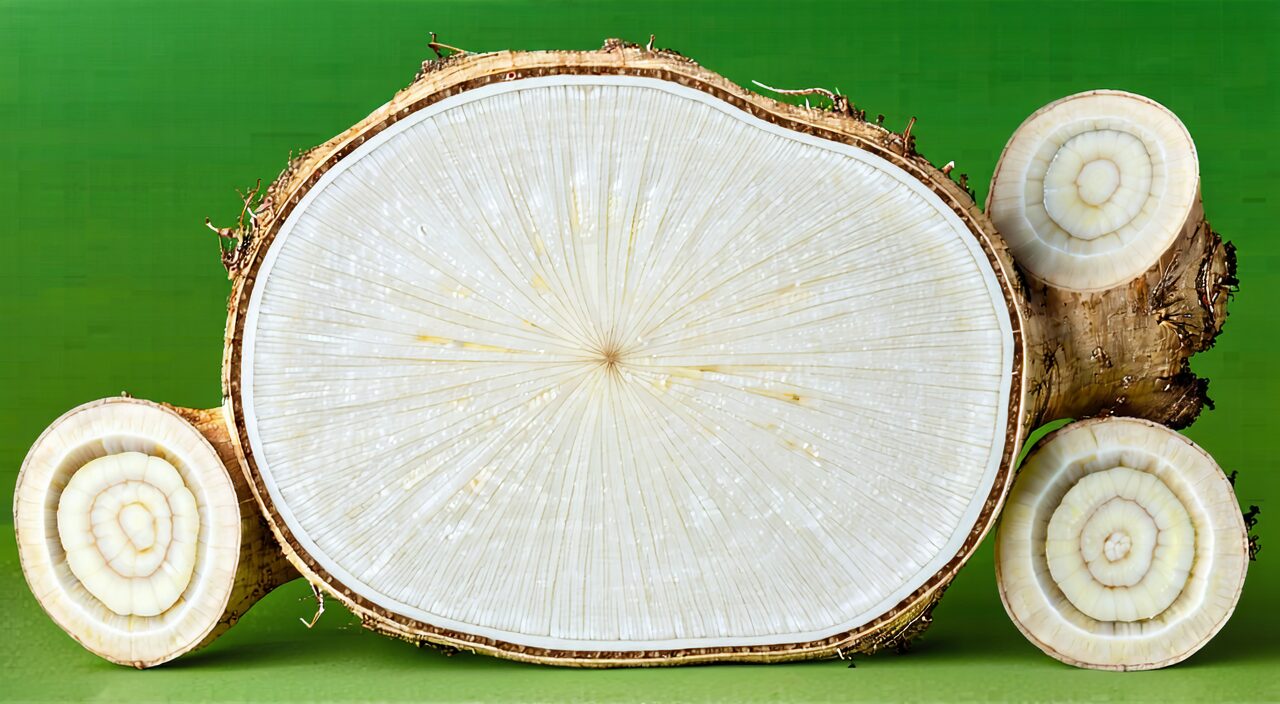
The medicinal part of Tian Hua Fen is the dried root of Trichosanthes kirilowii, harvested in late autumn to early winter. At that time, the above-ground parts have withered, and the medicinal constituents in the root are considered more concentrated. During processing, soil and sand are removed, the outer bark is scraped off or partially retained, and the root is cut into blocks or thick slices and dried. The commonly seen decoction pieces in the market are roughly round, thick slices; their cut surface characteristics are consistent with the previously described mealiness and radial striations. Clarifying that the medicinal part is the root helps users distinguish it from similarly named herbs, avoiding confusion between pollen products and Tian Hua Fen.
How Does Traditional Chinese Medicine View Tian Hua Fen?
Traditional Chinese medicine considers Tian Hua Fen to be slightly cold in nature, sweet and slightly bitter in taste, and to enter the Lung and Stomach meridians. Its core actions are often summarized as clearing heat, draining fire, generating fluids to quench thirst, and reducing swelling and expelling pus. During febrile diseases, when high fever, extreme thirst, and dry mouth and tongue occur, ancient formulas use Tian Hua Fen to help generate fluids. For dry cough and sticky phlegm caused by lung heat, Tian Hua Fen can be combined with other moistening and phlegm-resolving herbs. Additionally, when sores or abscesses are just beginning but not yet ruptured, or when they have ruptured but heal slowly, Tian Hua Fen is often used to assist in reducing swelling and expelling pus. It should be noted that these uses target heat patterns and fluid damage states, and are not suitable for individuals with spleen-stomach deficiency cold or cold-damp constitutions.
What Clues Does Modern Research Provide?
Modern research has isolated components such as trichosanthin, polysaccharides, and saponins from Tian Hua Fen. Trichosanthin has specific uses in certain biomedical research, but it belongs to a different level from the everyday-use decoction pieces. Some in vitro and animal experiments suggest that Tian Hua Fen polysaccharides may possess immunomodulatory and antioxidant activities, but these findings are still preliminary and cannot be directly equated with effects after human ingestion. For general consumers, research findings can serve as a reference for understanding traditional usage, but should not be exaggerated or regarded as efficacy claims.
What Are the Differences Between Tian Hua Fen, Kudzu Root, and Chinese Yam?
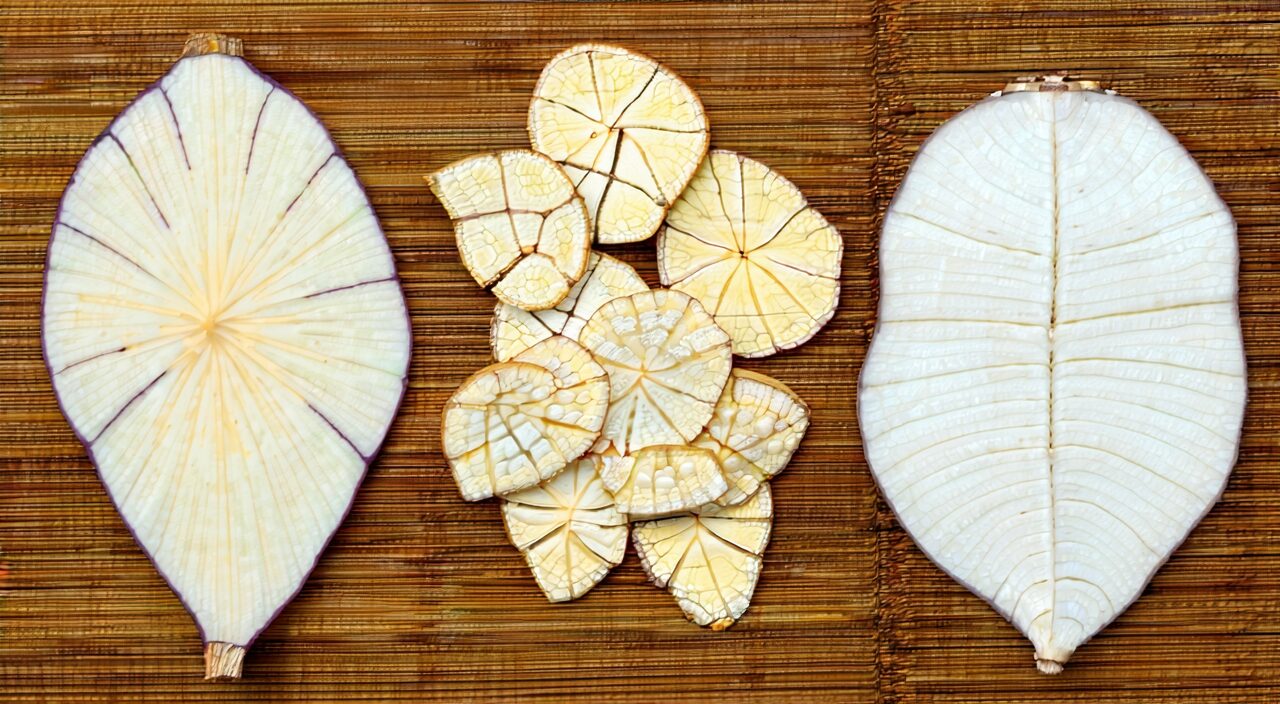
These three medicinal materials are all plant roots or rhizomes with strong mealiness, but their origins and uses differ significantly. Tian Hua Fen is the root of Trichosanthes, Kudzu root comes from the legume plants Pueraria lobata or Pueraria thomsonii, and Chinese Yam is the rhizome of Dioscorea opposita. In terms of characteristics, Tian Hua Fen has radial striations on the cut surface and a slightly bitter taste; Kudzu root cut surface is more fibrous, some appearing woolly, with a slightly sweet taste; Chinese Yam also has strong mealiness but lacks radial striations, is sticky when chewed, and tastes bland and slightly sour. In application, Tian Hua Fen emphasizes clearing heat from the lung and stomach and generating fluids to moisten dryness; Kudzu root is often used to release the exterior, reduce fever, relieve stiff neck and shoulders, and generate fluids to quench thirst; Chinese Yam is more inclined to tonify the spleen and stomach and boost lung qi. Understanding the differences among the three helps make more accurate judgments when faced with powdered or sliced products.
Which Formulas Include Tian Hua Fen?
Tian Hua Fen appears as a component in many traditional formulas. Below are a few common examples for understanding its traditional scope of use.
- Beimu Gualou San (Fritillaria and Trichosanthes Powder): Originates from “Medical Insights” (Yixue Xinwu), combined with Beimu (Fritillaria), Gualou (Trichosanthes fruit), Fuling (Poria), etc. It is often used for cough with sticky phlegm and dry throat caused by dryness-heat damaging the lung; Tian Hua Fen assists in clearing heat and moistening dryness.
- Yuye Tang (Jade Fluid Decoction): From “Records of Chinese Medicine with Reference to Western Medicine” (Yixue Zhongzhong Canxi Lu), used together with Huangqi (Astragalus), Zhimu (Anemarrhena), Gegen (Kudzu root), etc. Traditionally applied to thirst and excessive drinking, fatigue, and weakness due to dual deficiency of qi and yin; Tian Hua Fen functions to generate fluids and quench thirst.
- Tianhua Fen San (Trichosanthes Root Powder): Several formulas share this name, most with Tian Hua Fen as the main ingredient, combined with other heat-clearing and fluid-generating herbs, used for febrile disease with irritability and thirst. Different versions vary slightly in composition.
- Loubei Yangrong Tang (Trichosanthes and Fritillaria Nourishing Decoction): From “Systematic Differentiation of Warm Diseases” (Wenbing Tiaobian), it adds blood-nourishing substances to a base of clearing heat and resolving phlegm, suitable for yin deficiency combined with phlegm-heat; Tian Hua Fen assists in resolving phlegm without damaging yin.
These formulas represent a compilation of traditional uses. Before practical application, they need to be considered in light of individual constitution and current symptoms, and selected under the guidance of a professional.
What Should Be Noted When Using Tian Hua Fen?
There are several important safety reminders for modern use of Tian Hua Fen. First, it is contraindicated during pregnancy. Both traditional theory and modern research indicate that Tian Hua Fen may affect pregnancy; whether as decoction pieces or extract preparations, it should be avoided during pregnancy. Second, individuals with spleen-stomach deficiency cold, prone to diarrhea, or with abdominal cold pain should not use it in large amounts alone, so as not to exacerbate discomfort. Third, those allergic to Cucurbitaceae plants (such as pumpkin, cucumber) need to be aware of possible cross-allergy. The most critical point is that Tian Hua Fen decoction pieces must be strictly distinguished from trichosanthin injection. Trichosanthin is an injectable preparation extracted from fresh Tian Hua Fen, used for specific medical procedures, and is strictly forbidden for self-use; it can never be equated with the decoction pieces used for daily regulation. If used for regulation, properly processed decoction pieces should be selected, and the usage and dosage should follow product instructions or a doctor’s advice; never decide the dosage on your own. If any discomfort such as rash, chest tightness, nausea, or diarrhea occurs during use, stop use immediately and consult a physician.
Summary
Tian Hua Fen comes from the root of Trichosanthes kirilowii, with identifying features such as strong mealiness and radial striations on the cut surface, making it easy to distinguish from Kudzu root and Chinese Yam. Traditionally, it is mostly used for thirst in febrile diseases, dry cough, and sores or abscesses due to heat damaging fluids, and is commonly seen in formulas like Beimu Gualou San and Yuye Tang. When using, special attention must be paid to its contraindication in pregnancy and the strict distinction between Tian Hua Fen decoction pieces and trichosanthin injection. This article serves only as educational reference and cannot replace professional diagnosis or treatment advice. For any health concerns, please consult a licensed TCM practitioner or medical doctor in your area.