
What Is Long Pepper (Piper longum)? Medicinal Parts, Identification, and Common Formulas
When it comes to long pepper (Piper longum), many overseas readers may feel unfamiliar, but those who know spices will often recognize the name. In Southeast and South Asia, long pepper has long been used both as a traditional spice and as a medicinal substance in Chinese medicine. This article introduces its appearance, medicinal parts, how TCM understands it, how it differs from black pepper and cubeb, common formulas, and important precautions, helping everyone gain a more complete picture of this fruit-spike-derived ingredient.
What does long pepper look like? How to identify it
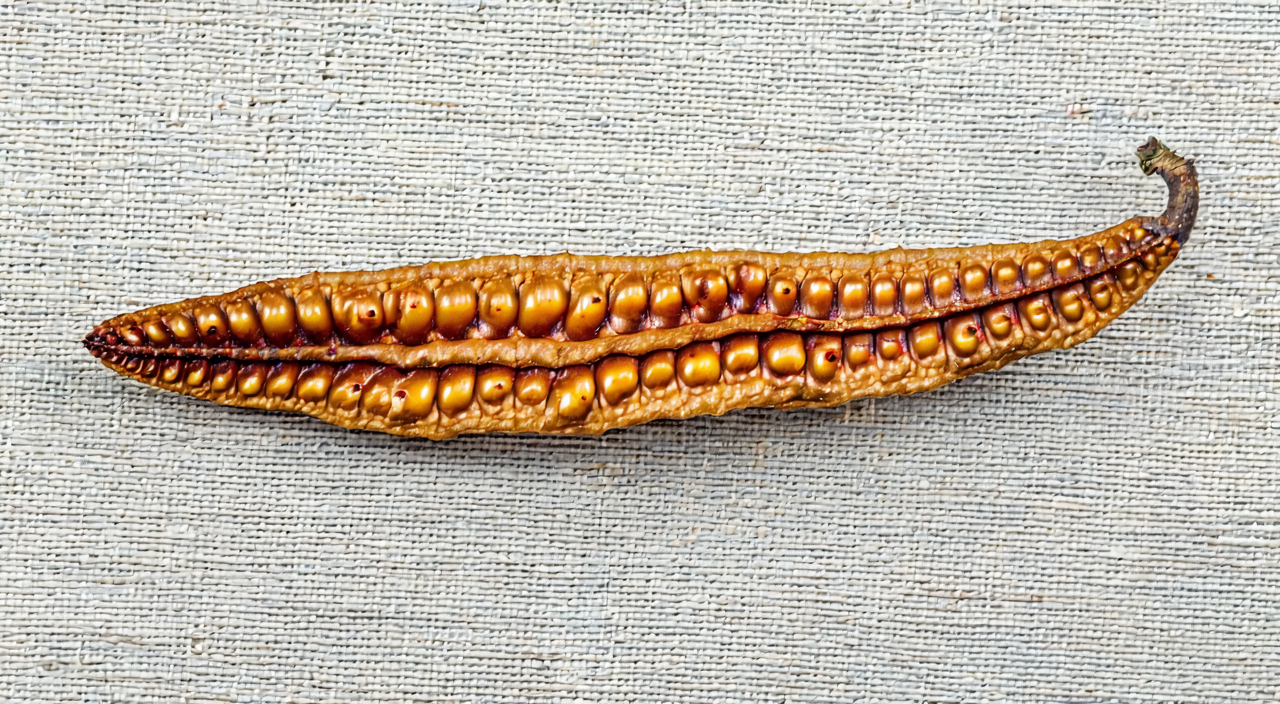
The part used as medicine or spice is not a single fruit but a complete fruiting spike. Dried long pepper spikes are cylindrical, slightly curved, generally 2 to 4.5 cm long and about 5 to 8 mm in diameter. The surface color ranges from yellowish-brown to dark brown, varying with harvest time and processing methods. On closer inspection, you can see that the whole spike is composed of many tiny berries tightly packed together, arranged in neat rings or spirals on the surface, and sometimes remnants of the stigma can still be seen at the tip.
In terms of texture, dried long pepper is hard but brittle, breaking with an uneven surface; you can see the granular tiny fruits and the thicker central axis of the spike. Its aroma is an important clue for identification: it has a distinctive pungent, spicy scent, somewhat similar to black pepper but deeper and more complex. Chewing delivers a noticeable pungent, hot sensation that stimulates the tongue and mouth, traditionally described as “acrid and hot.” Whole long pepper spikes can be distinguished from ordinary peppercorns by their spike shape, color, and this unique pungent aroma.
What is the medicinal part of long pepper?
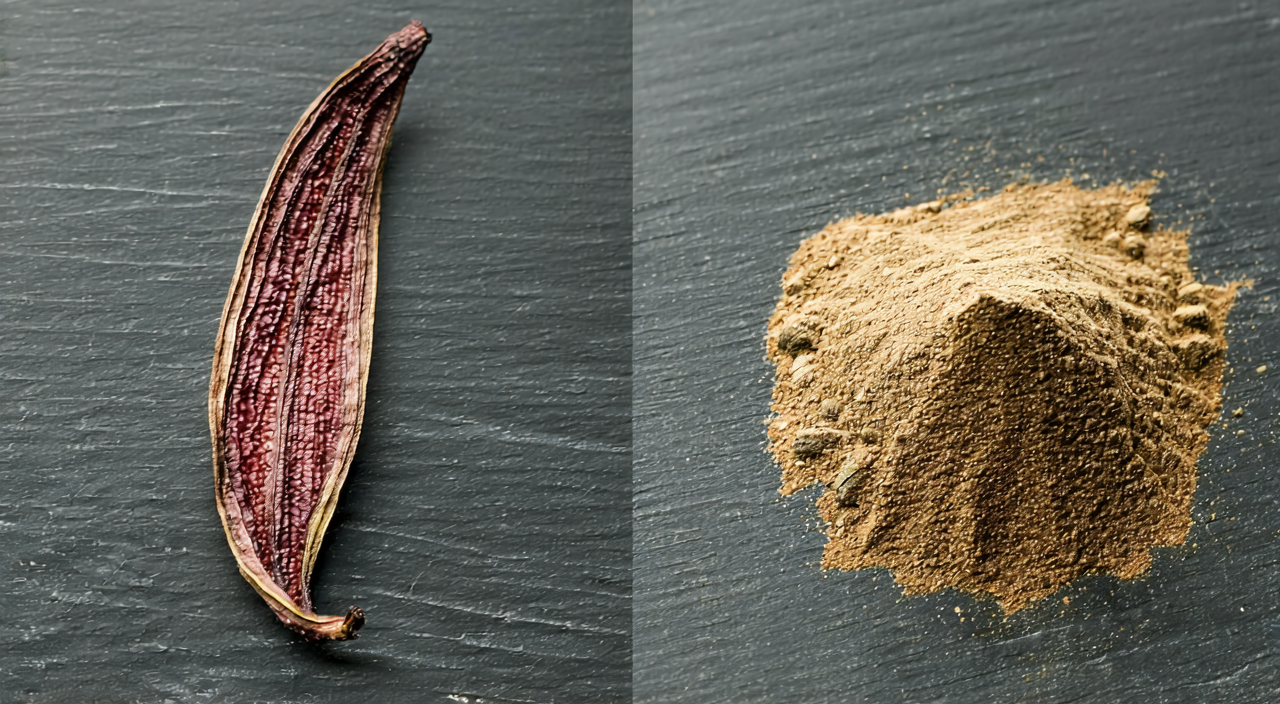
The medicinal part is the dried nearly ripe or ripe fruiting spike of Piper longum. It is usually harvested when the fruits turn from green to yellow but are not yet fully ripe, then cleaned and dried in the sun or at low temperature. It is mostly used as a whole dried spike, or ground into powder when required by a formula.
It is especially important to distinguish long pepper from black pepper: black pepper comes from nearly ripe fruits, typically found as spherical single fruits, whereas long pepper used in medicine is a whole fruiting spike. This fundamental difference determines their distinct form, aromatic intensity, and traditional TCM uses. On the international market, “long pepper” refers to the spike, setting it apart from round black or white peppercorns.
How does TCM understand long pepper?
In traditional Chinese medicine theory, long pepper is classified as an interior-warming herb. Its nature is acrid and hot, entering the Stomach and Large Intestine meridians. Traditionally, its actions are understood in terms of “warming the middle, dispelling cold, directing qi downward, and relieving pain.”
Practitioners observed that the warming and hot properties of long pepper may help with discomfort caused by internal cold invasion and deficient middle yang. For example, when there is cold pain in the epigastric region that improves with warmth, vomiting of clear fluids, or watery diarrhea, long pepper has been regarded as a choice for warming and regulating the middle. In terms of toothache, there are also ancient records of using long pepper powder topically for local pain relief, but such use is mostly based on folk experience and needs to be approached with caution.
It must be stressed that the above represents traditional thinking and is not a modern medical diagnosis. Whether long pepper is suitable depends on individual body constitution and specific manifestations, and it should be used under the guidance of an experienced TCM professional, not as a self-administered treatment.
What does modern research suggest?
Modern studies indicate that long pepper contains piperine, volatile oils, and various other constituents. Some in vitro and animal studies suggest that piperine may possess anti-inflammatory, antioxidant, and analgesic activities, providing some scientific space for exploring its traditional uses. However, current evidence is still mainly laboratory-based, and there is a considerable gap before it translates into clear clinical applications.
It is worth noting that such studies do not mean long pepper can be used directly as a drug, nor should they be interpreted as a promise of treatment for any specific disease. This information is shared only for broadening understanding, and readers are advised not to self-experiment based on these findings.
How does long pepper differ from black pepper and cubeb?
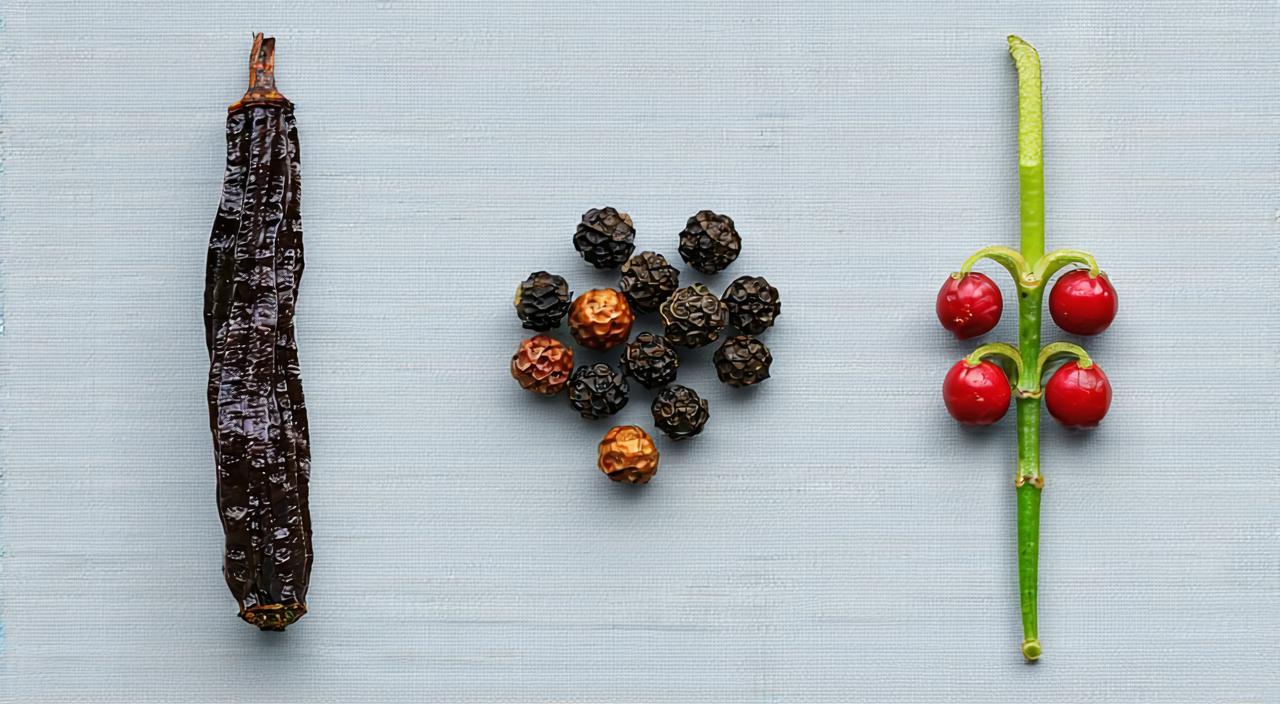
Readers outside China often encounter black pepper and may occasionally hear about cubeb, which can easily be confused with long pepper. The three can be distinguished by form, size, and aroma.
Black and white pepper are both spherical single fruits, about 4 to 6 mm in diameter. Black pepper is dried with the outer skin, which is wrinkled; white pepper is the seed with the skin removed. Long pepper, by contrast, is a cylindrical spike, noticeably longer than a peppercorn, and its surface is made up of many aggregated small fruits—the structural difference is visible at a glance.
Cubeb comes from different species in the Lauraceae or Piperaceae families and is usually spherical or ovoid, about 3 to 5 mm in diameter, with a grey-brown to dark brown outer skin, an aromatic but slightly bitter flavor, differing from the deeply pungent, complex aroma of long pepper. Moreover, cubeb has a different nature and meridian entry in TCM and should not be used as a substitute.
In short, if you see a long spike with a pronounced pungent aroma, it is very likely long pepper; small round granules require further judgment based on smell and appearance to distinguish pepper from cubeb.
Which formulas use long pepper?
Long pepper is used in traditional formulas mainly to warm the middle, dispel cold, and regulate qi movement. Here are a few representative directions, intended only as an understanding of traditional formula thinking and not as usage recommendations.
Long Pepper Pill (Biba Wan) is recorded in ancient texts such as the Sheng Ji Zong Lu and is commonly used for epigastric cold pain, poor appetite, and retching due to spleen-stomach deficiency-cold with impaired qi movement. Long Pepper Powder is often used for stomachache or abdominal pain caused by cold stagnation, frequently combined with dried ginger and magnolia bark. In modern clinical practice, some stomach-warming, cold-dispersing formulas may also include long pepper according to the specific pattern, to strengthen the warming and pain-relieving effect.
In addition, there are traditional records of using long pepper together with herbs like asarum and angelica root for topical toothache formulas. However, such external methods require proper preparation and should not be casually imitated.
Regardless of the formula, it must be based on thorough pattern differentiation and determined by a TCM practitioner according to individual constitution and actual conditions. Prepared Chinese medicines from different manufacturers vary in processing and dosage, so instructions should be read carefully and a professional consulted before use.
What precautions should be taken when using long pepper?
Long pepper is hot in nature, so it is generally unsuitable for people with yin deficiency and internal heat or those showing signs of excess heat. Yin deficiency with fire effulgence may present with hot palms and soles, dry mouth and throat, night sweats, a red tongue with scant coating; using the heating long pepper in such cases may worsen the discomfort.
Its pungent constituents may irritate the gastric mucosa, so those with gastric ulcers, active gastritis, or hyperacidity should be especially cautious. Pregnant women should only use it under medical guidance; traditionally, strong acrid-hot substances are generally avoided during pregnancy. Even when consumed in large amounts as a spice, attention should be paid to the potential for oral, throat, and digestive tract irritation due to its hot nature.
If symptoms such as epigastric cold pain, vomiting, or diarrhea persist without relief, or if they are accompanied by chest pain, severe abdominal pain, black stools, or progressive weight loss, seek medical attention promptly to rule out serious organic disease rather than solely relying on long pepper-type herbs for regulation.
Summary
Long pepper is a traditional interior-warming medicinal substance obtained from nearly ripe fruit spikes. It is cylindrical in shape with a unique pungent aroma, clearly distinguishable from the spherical single fruits of black pepper and from cubeb in both form and smell. TCM often understands its actions in terms of warming the middle, dispelling cold, directing qi downward, and relieving pain, and it appears in some stomach-warming, cold-dispersing formulas. Because of its acrid-hot nature, those with yin deficiency and fire effulgence or those at risk of gastric mucosal irritation should be cautious, and use should be guided by a professional based on individual circumstances. This article is for educational reference only and is not a substitute for professional diagnosis or treatment advice.