
What Is Gusuibu? Medicinal Parts, Identification Methods, and Common Formulas
In traditional Chinese medicine formulas for traumatology and for nourishing the liver and kidney, Gusuibu is a frequently used medicinal. When many people first hear the name, they may think it is simply a calcium-supplementing herb, but it is actually derived from the dried rhizome of Drynaria fortunei, processed specially before use. The Gusuibu decoction pieces seen on the market are usually sand-parched products with the hairs removed, already quite different from the fresh plant. This article will sort through the appearance identification, medicinal part, traditional application ideas, differences from Dipsacus and Cibotium, common formulas, and precautions for use, helping readers understand this medicinal more systematically.
What Does Gusuibu Look Like? How to Identify It?
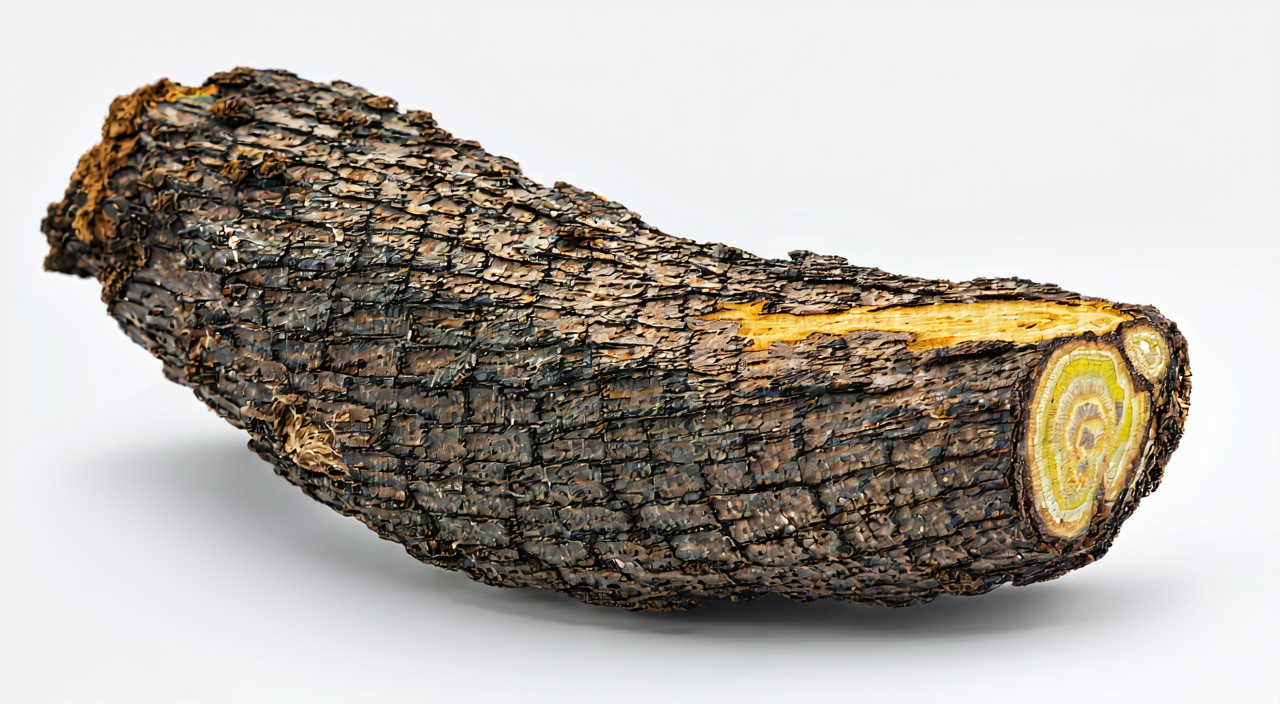
The original plant of Gusuibu is Drynaria fortunei, a plant in the family Polypodiaceae. The part used as medicine is its rhizome, which shows relatively typical appearance features after drying.
The unprocessed Gusuibu rhizome is flat, elongated, or cylindrical and slightly twisted, mostly 5–15 cm in length and about 0.5–1.5 cm in diameter. The surface is brown or dark brown and densely covered with small scales; these scales easily fall off and may feel rough to the touch. On close observation, remnants of petiole bases and a few fine roots can still be seen. When the rhizome is broken, the fracture surface is relatively flat and yellowish-brown or light brown; sometimes a ring of many small dots representing the ‘meristeles’ can be seen, a typical structure of fern rhizomes.
Using raw Gusuibu with hairs may irritate the throat, so sand-parching is commonly used in decoction piece processing. The cleaned rhizome is parched with hot sand until it puffs up, and the surface scales become scorched and fall off; residual hairs are then scraped away, and the rhizome is cut into thick slices. After sand-parching, the color of Gusuibu decoction pieces darkens, and the whole piece becomes puffed, looser, and more brittle. This is the form most commonly seen on the market.
Identifying ferns collected in the wild is difficult and easily confused with other fern species. Therefore, understanding the appearance of Gusuibu is mainly to help readers make a basic judgment when purchasing decoction pieces; casual self-collection and use is not recommended.
What Is the Medicinal Part of Gusuibu?
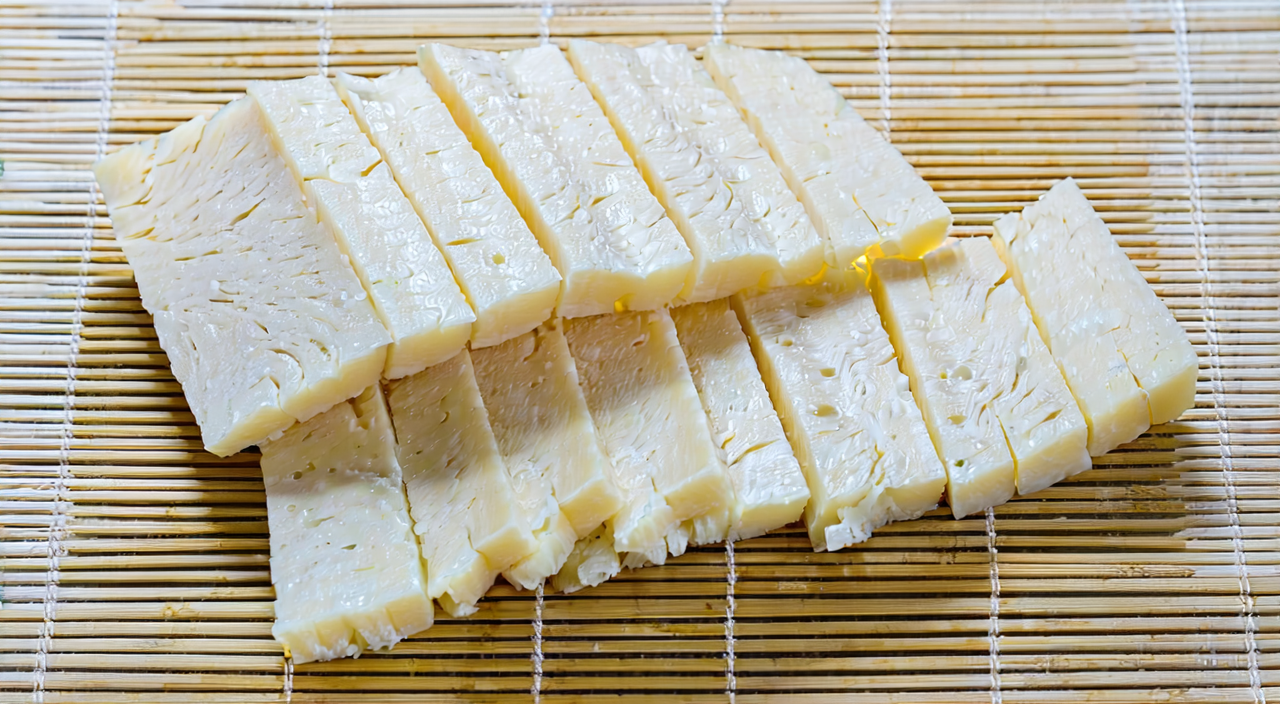
The medicinal part of Gusuibu is the dried rhizome of Drynaria fortunei. Harvesting is generally carried out mostly in winter and spring. After digging, the leaves and mud are removed, attached materials are removed, and the rhizome is either dried directly in the sun or steamed and then sun-dried. In some processing methods, part of the scales is first burned off before drying.
The raw Gusuibu surface is densely covered with scales and hairs. In traditional Chinese medicine use, it is believed that a rhizome with hairs is likely to irritate the throat when used in decoctions, so further processing is generally performed. The most common processing method is sand-parching: the rhizome is stir-fried with hot sand until the surface puffs up and the scales become scorched, then it is removed, brushed clean of hair ash, and cut into thick slices. Processed Gusuibu is not only easier to extract active substances during decocting, but also reduces discomfort when taken directly.
Understanding the medicinal part matters because it confirms that the medicinal properties of Gusuibu come from the rhizome rather than the whole herb, which also helps distinguish it from other medicinals derived from roots or rhizomes.
How Does Traditional Chinese Medicine Understand Gusuibu?
Traditional Chinese medicine often understands Gusuibu from the perspective of healing injuries, relieving pain, and tonifying the kidney and strengthening bones. It is warm in nature and bitter in flavor, and enters the kidney and liver meridians. It is considered a medicinal that can help reconnect tendons, set bones, invigorate blood, and resolve stasis.
In many traditional formula books, Gusuibu is commonly used for conditions related to traumatic injuries and pain due to blood stasis and swelling in the middle and late stages of fractures. It is also commonly combined in formulas for low back pain, tinnitus, deafness, and loosening of teeth caused by kidney deficiency. This approach derives from the TCM theories that ‘the kidney governs the bones’ and ‘the liver and kidney share the same source.’ Only when kidney qi is sufficient can the bones be strong, and Gusuibu is regarded as a medicinal that can ‘tonify the kidney and strengthen bones’ to support bone repair.
In addition, Gusuibu has a long history of external use. Traditionally it is used to dispel wind and eliminate spots, applied topically as a pounded paste or as an alcohol infusion for rubbing. It is sometimes included in external treatment approaches for skin issues such as alopecia areata and vitiligo.
It should be emphasized that these are summaries of traditional use experience and are not equivalent to efficacy verification in modern medicine. Whether Gusuibu can play a role in a particular condition still needs to be analyzed in light of the individual’s constitution, symptoms, and professional judgment.
What Clues Does Modern Research Provide?
In recent years, modern research on Gusuibu has mainly focused on chemical constituents and pharmacological activity. Studies have found that Drynaria fortunei contains flavonoids, triterpenoids, phenylpropanoids, and other components. Among them, flavonoids are often regarded as an important material basis for its potential role in promoting bone health.
Some in vitro experiments and animal studies have observed that Gusuibu extracts may have a certain promoting effect on the differentiation and proliferation of osteoblasts, and they also show some anti-inflammatory and microcirculation-improving trends. These findings provide some clues for the scientific interpretation of traditional uses, but current evidence is still mainly exploratory and cannot be directly extrapolated to specific effects in daily use.
For consumers, understanding these research developments can deepen their understanding of the medicinal, but it is not advisable to judge its medicinal value on this basis, nor should research results be taken as a guide for use.
What Are the Differences Between Gusuibu, Dipsacus, and Cibotium?
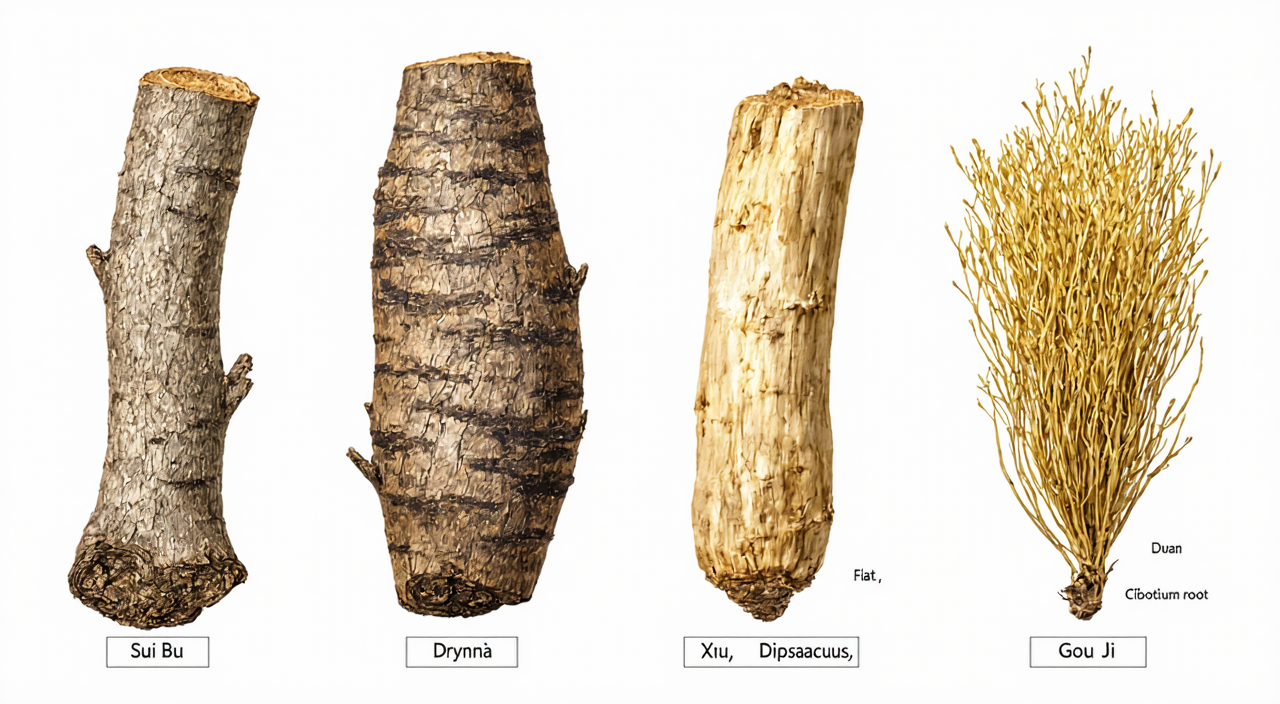
Gusuibu, Dipsacus, and Cibotium all involve, to varying degrees, the treatment of conditions related to the sinews and bones. They are also easily mentioned together because of similar medicinal functions, but the three have obvious differences in source and morphology.
Gusuibu is the dried rhizome of Drynaria fortunei. It is flat and elongated, with a surface densely covered in brown scales, and meristeles arranged in a ring can be seen on the cross-section. Dipsacus comes from the dried root of Dipsacus asper. It is long cylindrical in appearance, slightly tapering downward, with obvious longitudinal grooves and transverse elongated lenticel-like protrusions on the surface. Its fracture surface is uneven, the cortex is relatively thick, and the xylem is yellowish-brown. Cibotium is the dried rhizome of Cibotium barometz. Its surface is covered with golden-yellow hairs, and its texture is hard and not easily broken; its overall appearance is completely different from that of Gusuibu.
The three also have different emphases in traditional functions. Gusuibu excels at invigorating blood, repairing injury, tonifying the kidney, and strengthening bones. Dipsacus tends to tonify the liver and kidney, strengthen sinews and bones, and repair fractures, while also having a calming-the-fetus action. Cibotium warms and tonifies the liver and kidney and strengthens the waist and knees, with a focus on lower limb weakness and wind-cold-damp bi syndrome. Gusuibu and Dipsacus are often used together in traumatology formulas, but this does not mean the two can be substituted arbitrarily. Mistaken identification or substitution may affect the intended treatment approach. It is recommended to purchase from reliable sources and read the decoction piece name clearly to avoid confusion.
Which Formulas Use Gusuibu?
Patent Chinese medicine preparations are the main way many people encounter Gusuibu. Some traditional formulas and commonly seen modern patent medicines contain Gusuibu as an ingredient, often used in treatment approaches related to fracture recovery, sinew and bone pain, and foot weakness due to kidney deficiency. Several relatively common examples are listed below as references for understanding, not as recommended treatment plans.
- Gusuibu Wan: It uses Gusuibu as one of the main medicinals. Traditionally it is used for joint pain, soreness and weakness of the waist and knees, and sometimes to relieve discomfort after fractures. It is often regarded as an option when longer-term recuperation is needed.
- Jianbu Huqian Wan: Its main formula idea is to tonify the liver and kidney and strengthen sinews and bones. Gusuibu assists other kidney-tonifying medicinals in the formula. Traditionally it is used for conditions such as foot weakness due to kidney deficiency, lower limb weakness, and difficulty walking.
- Jiegu Qili Pian: This is a preparation developed on the basis of the traditional Qili San approach. Gusuibu is combined with frankincense, myrrh, and others, and it is commonly used for traumatic injuries and the stage of unresolved blood stasis, swelling, and pain in the middle and late stages of fractures.
- Shangke Jiegu Pian: This formula is built around reconnecting sinews, setting bones, invigorating blood, and resolving stasis. Gusuibu is often combined with Dipsacus, pyrite, and others, with a focus on the fracture recovery period and soft tissue contusions.
These formulas or patent medicines have different formula emphases. Whether they are suitable for a particular condition still needs to be comprehensively judged in light of the individual’s constitution, symptoms, specific product instructions, and professional advice. In particular, preparations containing this type of medicinal should not be purchased and used on one’s own based solely on symptoms.
What Precautions Should Be Taken When Using Gusuibu?
When using Gusuibu and its preparations, several aspects deserve special attention.
First, Gusuibu is traditionally considered warm in nature, so people with yin deficiency with effulgent fire or pronounced internal heat need to be cautious. If you are prone to dry mouth and throat, hot palms, night sweats, and similar manifestations, whether to use it should be based on the advice of a TCM professional, and corresponding adjustments in the formula may be needed.
Second, for traumatic injuries and fractures, standard medical emergency treatment such as fixation, reduction, and necessary surgery must be received first. Gusuibu or other Chinese herbal medicines must not be used on one’s own as a substitute. Medication during the fracture recovery period is also best carried out under the guidance of a doctor or pharmacist to avoid affecting healing through premature activity or improper force.
When using Gusuibu externally, also pay attention to skin reactions. When applying the fresh product or an alcohol infusion topically, some people may experience redness, itching, or other irritation. If irritation is obvious, stop use immediately and wash the area. In addition, Gusuibu comes from a fern, and there are many toxic ferns with similar morphology in the wild. Non-professionals must not dig or collect it themselves to avoid poisoning due to mistaken identification. Decoction pieces that have been properly processed should be purchased from reliable sources.
In addition, if pregnant women or those preparing for pregnancy need to use preparations containing Gusuibu, the decision must be made cautiously under the guidance of a doctor.
Summary
Gusuibu is a medicinal used relatively often in TCM traumatology and in tonifying the kidney and strengthening bones. Its key identification points are the flat elongated rhizome, brown scales, and puffed shape after sand-parching; its medicinal part is the rhizome of Drynaria fortunei. It differs clearly from Dipsacus and Cibotium in source and appearance, but is often mentioned together with them because of similar functions. Patent medicines containing Gusuibu, such as Gusuibu Wan and Jianbu Huqian Wan, are traditionally used for conditions related to the sinews and bones. However, before use, one should fully understand one’s own constitution and the product details. In particular, those with yin deficiency and effulgent fire need to be cautious, and traumatic injuries and fractures must first receive standard medical diagnosis and treatment. This article is for informational reference only and cannot replace professional diagnosis or treatment advice. If you have related health concerns, please consult a doctor promptly.