
What Is Xue Yu Tan? Medicinal Part, Identification, and Common Formulas
The name Xue Yu Tan may easily bring to mind plant charcoal or mineral charcoal, but its source is rather special: it is a processed product made from human hair after standardized cleaning and carbonization. Many overseas Chinese-speaking users checking formulas or materia medica information containing Xue Yu Tan want to know what it looks like, where its medicinal use comes from, and how it differs from common items such as Zonglu Tan and Pao Jiang. This article focuses on these points and is for informational education only; it does not provide home preparation methods or replace professional diagnosis.
What Does Xue Yu Tan Look Like? How Is It Identified?
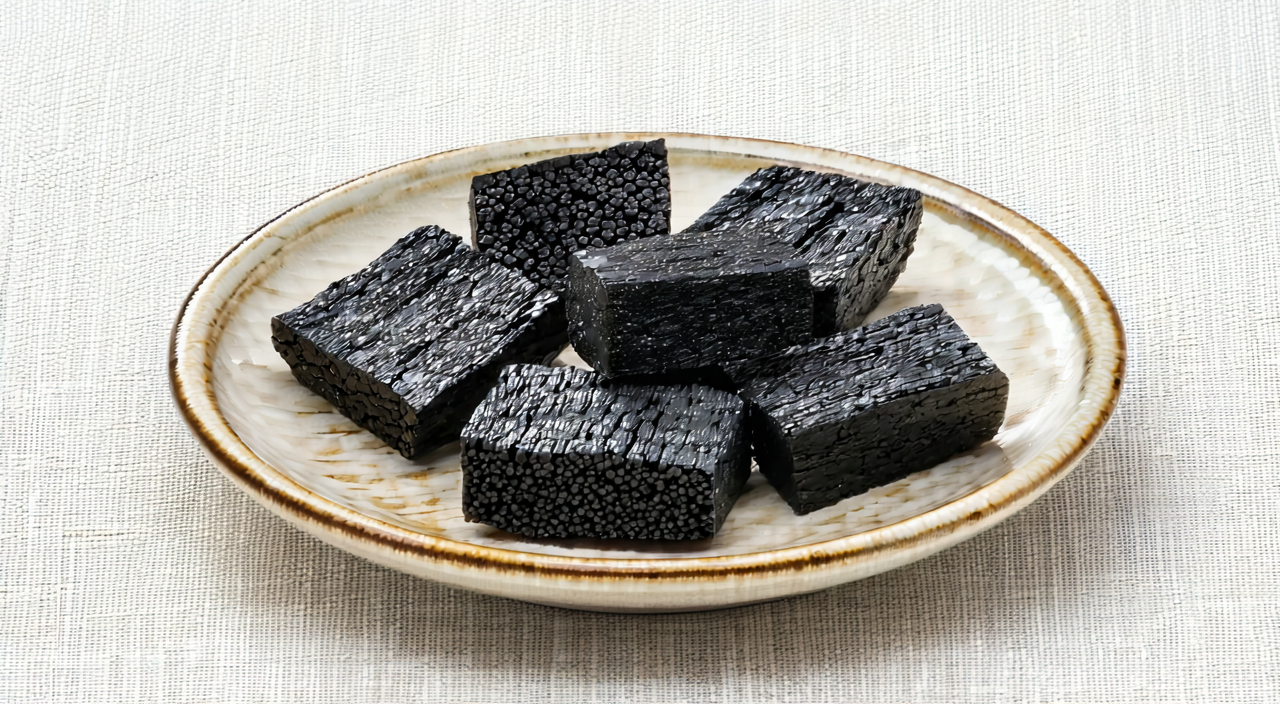
Xue Yu Tan usually appears as irregular lumps or masses, mainly charred black or jet black in color. Fine pores are visible on the surface, and the fractured surface is often porous as well. Its texture is light and brittle; it breaks easily when gently snapped by hand, with an uneven fracture surface and a blackish color. On careful smelling, it has a distinct carbonized odor, with a prominent burnt note, and it should not have an obvious rotten hair odor or a pungent chemical smell.
When identifying it, pay attention mainly to color, texture, pores, and odor. A properly carbonized product should be uniform overall and should not contain uncarbonized hair strands or obvious impurities. It should be noted that Xue Yu Tan is a processed product; users are not advised to burn human hair themselves to imitate or identify it, nor should the smell of home-burned hair be used as the sole criterion.
What Is the Medicinal Part of Xue Yu Tan?
The medicinal part of Xue Yu Tan is not the root, stem, leaf, or seed of a plant, but processed human hair. The traditional processing usually includes removing impurities, cleaning, and carbonization, ultimately forming a black carbonized material. Human hair needs to be cleaned and treated before use to reduce the introduction of impurities.
From the perspective of medicinal naming, the name Xue Yu has a traditional background. The ancients believed hair was related to blood, so human hair was called Xue Yu, and after carbonization it was called Xue Yu Tan. In modern use, hygiene, ethical, and quality standards are given more attention, and a regulated source with clear processing records is an important prerequisite.
How Does Traditional Chinese Medicine Understand Xue Yu Tan?
Traditional Chinese medicine often understands Xue Yu Tan from perspectives such as astringing and stopping bleeding, resolving stasis, and promoting urination. It is considered neutral or slightly warm in nature and bitter and astringent in flavor, and is commonly used in TCM treatment approaches for bleeding, especially in traditional patterns involving the lower burner, urination, or prolonged bleeding that does not resolve.
In clinical application, Xue Yu Tan is rarely used alone as a primary medicine; it is often combined with other hemostatic or stasis-resolving medicinals. Whether it is suitable depends on comprehensive assessment of the bleeding site, bleeding color, tongue and pulse presentation, and constitution. For example, bleeding due to blood heat, bleeding due to qi deficiency failing to contain blood, and bleeding due to stasis obstruction are treated in different directions, so one cannot simply assume that a carbonized product can stop bleeding.
Modern Research Focuses on Carbonized Materials and Quality Control
Modern research attention to Xue Yu Tan focuses more on the carbonization process, material morphology, and quality control. Carbonized human hair forms a porous structure, which may affect its ability to adsorb liquids. Therefore, studies often examine indicators such as degree of carbonization, pore characteristics, ash content, moisture content, and pH value.
In terms of quality, whether the raw material source is clear, whether cleaning is sufficient, whether carbonization is uniform, and whether there are uncarbonized fibers or foreign impurities all affect sample consistency. Good Xue Yu Tan should have uniform color, a light and brittle texture, and no obvious non-carbonized material. Related quality studies also pay attention to hygiene indicators such as heavy metals and microorganisms, which is directly relevant to the source reliability concerns of overseas users.
What Are the Differences Between Xue Yu Tan, Zonglu Tan, and Pao Jiang?
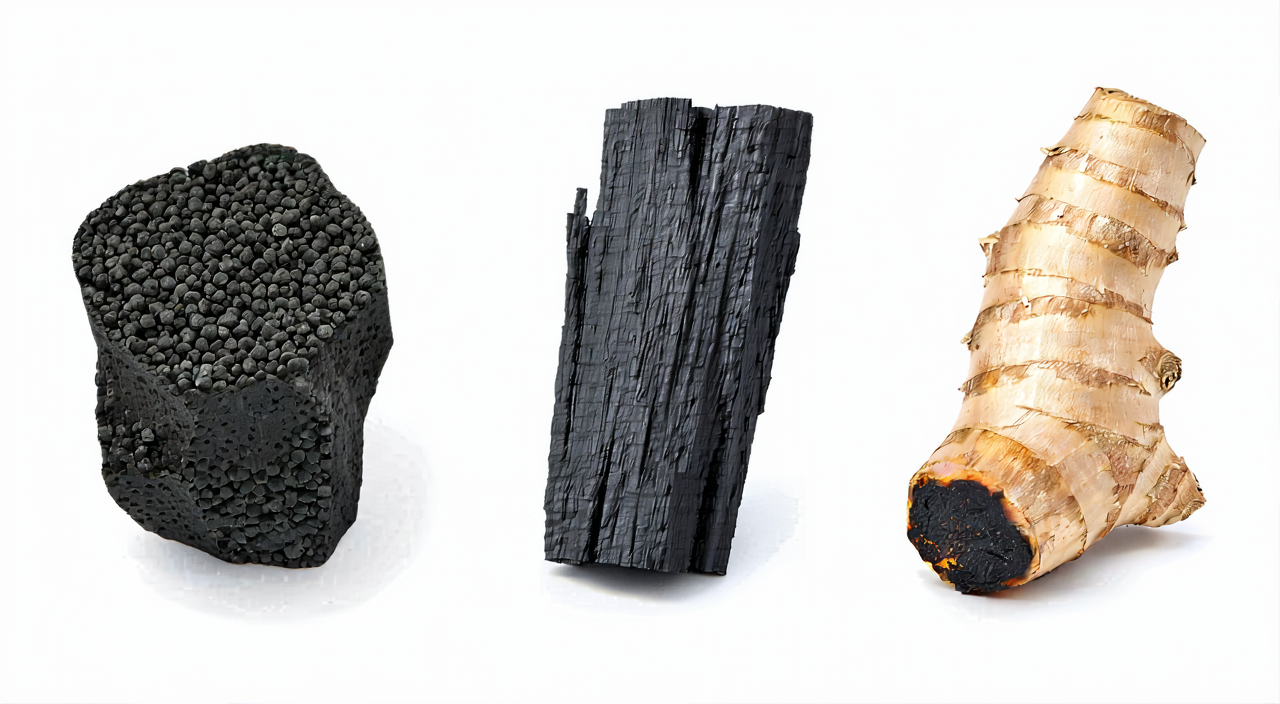
Xue Yu Tan, Zonglu Tan, and Pao Jiang all belong to carbonized or stir-fried carbonized products, but their sources and forms differ greatly. Xue Yu Tan comes from human hair and is irregular and porous, with a light, brittle texture and a jet-black color. Zonglu Tan comes from the leaf sheath fiber of palm family plants; after carbonization it may still retain a fibrous feel, mostly dark brown or charred black, light in weight but with more visible fiber orientation. Pao Jiang comes from the rhizome of ginger family plants; after stir-frying to carbon, the surface is charred black and the interior is darker, but it still retains the smell of ginger.
In terms of use, although all three are traditionally associated with stopping bleeding, their emphases differ. Xue Yu Tan often emphasizes resolving stasis and promoting urination; Zonglu Tan leans more toward astringing and stopping bleeding; Pao Jiang is often used for bleeding due to deficiency cold. Which one to choose should be based on TCM pattern differentiation, rather than simply substituting by name.
Which Formulas May Use Xue Yu Tan?
In traditional formulas, Xue Yu Tan often appears as an adjuvant or guiding medicinal in hemostatic formulas. Shi Hui San is one of the commonly mentioned formulas. It is composed of multiple herbs that clear heat, cool blood, or stop bleeding, and is traditionally used for bleeding patterns with obvious blood heat. The combination of carbonized medicinals in it is intended to strengthen astringing and containing actions, and Xue Yu Tan also plays a supporting role in this formula.
Formulas or preparations named after Xue Yu Tan, such as Xue Yu San and Xue Yu Tan Wan, are commonly found in classical literature. In modern application, attention should be paid to whether the preparation has undergone standardized processing and quality management. Xue Yu Tan may also be added to formulas that secure the thoroughfare vessel and stop bleeding based on pattern differentiation, and is often used in directions related to insecurity of the Chong vessel or failure of qi to contain blood in TCM theory.
It should be reminded that these formulas are not suitable for all bleeding conditions. The cause of bleeding, bleeding site, duration, and whether there is accompanying fever, infection, blood stasis, and so on all affect the choice. Whether it is suitable should be judged comprehensively by considering product information, individual circumstances, and advice from professionals.
What Should Be Noted When Using Xue Yu Tan?
When using Xue Yu Tan, the most important considerations are source hygiene and quality. Products from legitimate channels should have clear source records, processing information, and quality control. Carbonized human hair products of unknown origin or that cannot be confirmed to have undergone standardized treatment should not be used.
More importantly, it is not recommended to burn human hair at home to obtain Xue Yu Tan. The home environment makes it difficult to control temperature, oxygen, and time, which may produce irritating smoke or harmful substances, and cannot ensure the degree of carbonization or hygiene safety.
If bleeding of unknown cause, heavy bleeding, persistent bleeding, or accompanying symptoms such as marked dizziness, palpitations, chest pain, abdominal pain, black stools, or weight loss occurs, seek medical advice or go to the emergency department as soon as possible. Do not delay examination because of attention to carbonized hemostatic medicinals. Xue Yu Tan should only be understood as a subject of Chinese medicine knowledge and cannot replace emergency treatment or professional diagnosis.
Summary
Xue Yu Tan is a Chinese medicinal material formed from human hair after standardized cleaning and carbonization. When identifying it, attention should be paid to its charred black color, porous texture, light and brittle quality, and carbonized odor, but it should not be made by burning hair at home. Although it shares a similar traditional role in stopping bleeding with Zonglu Tan and Pao Jiang, their sources, forms, and applicable approaches are different. Formulas containing Xue Yu Tan, such as Shi Hui San, Xue Yu San, Xue Yu Tan Wan, and formulas that secure the thoroughfare vessel and stop bleeding, are mostly understood as traditional use directions; whether they are suitable should be judged by combining individual circumstances with professional advice. This article is for educational reference only and cannot replace professional diagnosis or treatment advice.