
What Is Palm Fiber Carbon? Medicinal Source, Identification, and Common Formulas
Palm fiber carbon is not a very common item among Chinese medicinal materials, but readers who follow traditional hemostatic herbs often encounter it. It is frequently mentioned together with charred human hair and charred Platycladus leaf. Although all of these names contain the word “charred,” their sources and traditional understanding are not the same. Many people, when they first hear “palm fiber carbon,” assume that it is simply charred fragments of some kind of bark. In fact, its source is closer to the fibrous leaf sheath remaining at the palm petiole. This article discusses what palm fiber carbon is, what it looks like, where it comes from, and how it is used in traditional formulas. The content is for informational reference only.
What Does Palm Fiber Carbon Look Like? How Is It Identified?
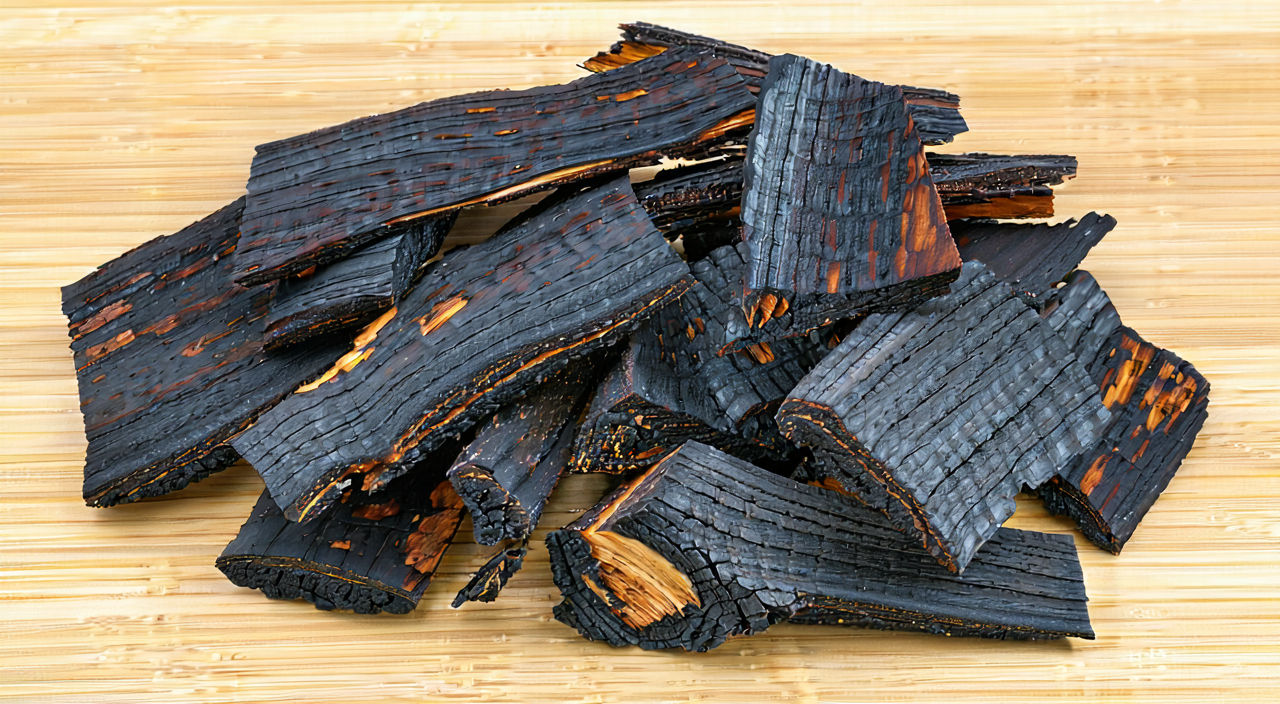
Palm fiber carbon is usually irregular lumps, strips, or fibrous masses, and its color is mainly dark brown to brownish black. Obvious fibrous striations are often visible on the surface, and some samples retain coarse longitudinal fiber bundles. Overall, it looks like clumps of carbonized plant fiber.
In terms of texture, palm fiber carbon is mostly light and brittle, and it breaks easily when snapped by hand. The fractured surface is not as dense as mineral-based medicinal materials; instead, a loose fibrous structure can be seen. When touched lightly, some samples leave a small amount of charcoal powder, and they generally have no obvious special odor. In traditional decoction piece experience, whether carbonization is uniform is usually observed: if there are still many uncarbonized yellowish-brown fibers on the surface, the degree of carbonization may be insufficient; if it has become very fine powder or has completely lost its fibrous form, it may not match the typical characteristics of common decoction pieces.
Different batches of palm fiber carbon may vary somewhat in color depth and fiber thickness, which is related to the source part of the raw material and the degree of carbonization. For everyday identification, the key features are “dark brown color, light and brittle texture, and obvious fibrous striations,” but quality should not be judged by color alone.
What Is the Medicinal Part of Palm Fiber Carbon?
Palm fiber carbon comes from the residual fibrous leaf sheath of the palm petiole of the palm plant (Trachycarpus fortunei). More specifically, it is a processed product obtained from fibers at the base of the palm petiole or the leaf sheath after standardized carbonization. Many people mistake it for “palm bark,” but its medicinal part is closer to leaf sheath fiber rather than trunk xylem, root bark, or fruit.
Before carbonization, these leaf sheath fibers are usually brown, tough, not easily broken, and strongly fibrous. After carbonization, the color and physical properties change: the appearance turns black and the texture becomes brittle, making it more convenient for traditional medicinal use. It should be noted that this article only introduces the source and traditional application directions of this medicinal material and does not provide home charring methods. Using burnt plant fiber as a substitute for standardized decoction pieces may bring unnecessary risks due to inconsistent temperature, degree of carbonization, and source part of the raw material.
How Is Palm Fiber Carbon Understood in Traditional Chinese Medicine?
In traditional Chinese medicine theory, palm fiber carbon is mostly classified among astringent and hemostatic medicinal materials. Its nature and flavor are usually recorded as bitter, astringent, and neutral, with slight variations in some classical texts depending on the specific usage. Traditionally, bitter is thought to drain and astringent is thought to restrain, so palm fiber carbon is often used for certain bleeding presentations, especially in treatment directions related to “astringing and restraining.”
The term “hemostatic” here does not simply correspond to a specific disease in modern medicine. Instead, it is judged from a pattern differentiation perspective, taking into account the color and location of bleeding, accompanying manifestations, and the patient’s constitutional state. Palm fiber carbon leans more toward astringing and securing, and may be more suitable for bleeding situations in traditional pattern differentiation where there is no substantial pathogen or where pathogenic heat is not obvious. If bleeding is caused by obvious blood stasis obstruction or relatively strong heat toxin, using astringent medicinal materials alone may be inappropriate and may even hinder pathogenic factors from being expelled.
Therefore, palm fiber carbon is usually not used alone in formulas; rather, it is combined with other medicinal materials to produce synergistic or balancing effects. Whether it is suitable for a particular person needs to be judged by considering that person’s constitution, symptoms, and professional advice.
What Are the Directions of Modern Research?
Modern research on palm fiber carbon is relatively limited, mainly focusing on changes in constituents before and after carbonization, fiber structure characteristics, and some in vitro activities. Some studies have examined its adsorption properties and hemostasis-related indicators, but the conclusions remain mainly at the basic research stage and cannot yet be directly equated with clinical efficacy.
For readers who want to understand palm fiber carbon, modern research can be regarded as a supplementary perspective: it helps explain why the carbonization process affects the appearance and some physical properties of the medicinal material, but it should not be used to conclude that palm fiber carbon alone can treat a specific type of disease. The effects of Chinese herbal formulas are usually based on the combined action of multiple medicinal materials and cannot be fully explained by a single component or a single mechanism.
How Does Palm Fiber Carbon Differ from Charred Human Hair and Charred Platycladus Leaf?
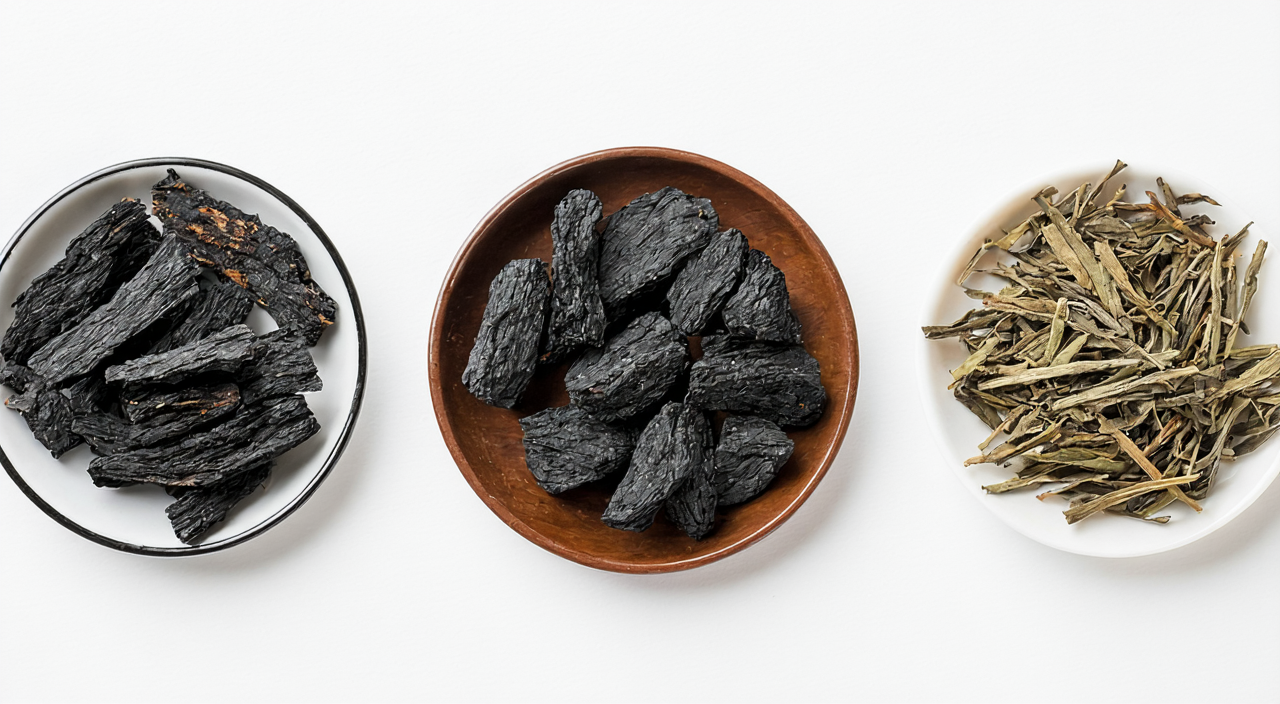
These three types of charred Chinese medicines all often appear in traditional hemostatic formulas, but their sources are clearly different.
Palm fiber carbon comes from palm leaf sheath fiber and belongs to the plant fiber category. Charred human hair is a processed product made from carbonized human hair; its source is completely different, and traditional understanding places more emphasis on directions such as “dispelling stasis and promoting diuresis,” which differs from palm fiber carbon’s astringent direction. Charred Platycladus leaf comes from the branches and leaves of Platycladus orientalis; the original plant is the young branch and leaf of Platycladus orientalis in the Cupressaceae family. It is used after stir-frying to char or carbonization and leans more toward the discussion of cooling blood and stopping bleeding.
In appearance, palm fiber carbon is mainly dark brown and fibrous, with an obvious fibrous feel. Charred human hair is often irregular lumps with a glossy appearance, light and brittle, and sometimes shows pore-like or hair trace features. Charred Platycladus leaf is mostly fragments or fine twig-like pieces, blackish brown in color, and often retains leaf remnants. When comparing the three, they can be initially distinguished by source, color, fiber morphology, and traditional emphasis of action.
Because their sources differ considerably, it is not recommended to substitute one for another simply because they are all “charred types.” The specific direction of use should be determined based on formula composition and individual circumstances.
Which Formulas Use Palm Fiber Carbon?
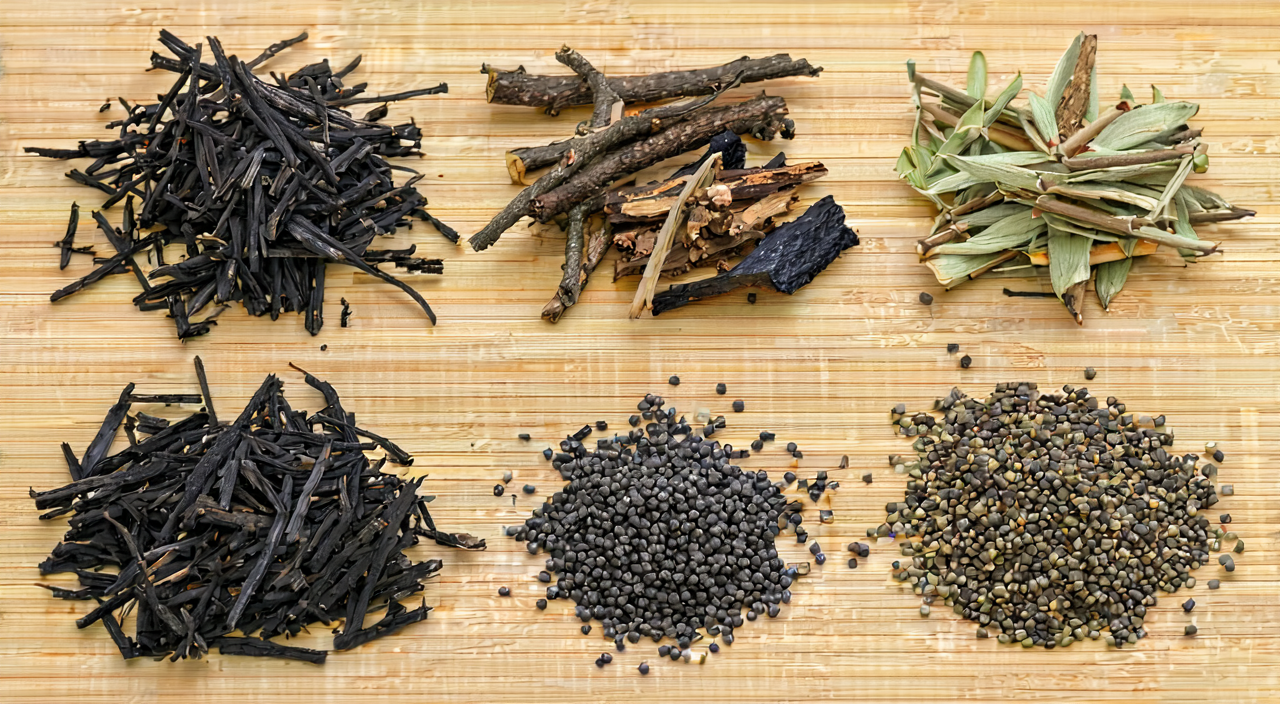
Palm fiber carbon appears as a supporting ingredient in some traditional hemostatic formulas. Common ones include Shihui San, Guchong Tang, and Zonglü San.
Shihui San is one of the traditional formulas used for bleeding due to blood heat, and it contains multiple medicinal materials that are charred while preserving their nature. Palm fiber carbon may be used together with charred Platycladus leaf, charred gardenia fruit, charred moutan bark, and others, reflecting the traditional concept that “blood stops when it sees black.” However, this concept is not suitable for all bleeding situations and must still be combined with pattern differentiation.
Guchong Tang is another formula commonly mentioned as containing palm fiber carbon. Traditionally, it is used for bleeding conditions related to insecurity of the Chong vessel and the spleen and kidney. In addition to astringent and hemostatic palm fiber carbon, the formula also includes qi-supplementing, securing, and blood-nourishing medicinal materials, reflecting a compound treatment approach.
Zonglü San is also recorded in some classical texts or modern formula references. It often combines palm fiber carbon with other hemostatic and astringent medicinal materials. Overall, palm fiber carbon is rarely used as the chief ingredient in formulas; it is more often used as an auxiliary astringent hemostatic, working together with other medicinal materials.
The names and compositions of these formulas may vary slightly in different sources. Readers are not advised to apply a formula by name on their own or to purchase raw materials and mix them by themselves. If further understanding is needed, comprehensive judgment should be made based on product descriptions, individual circumstances, and professional advice.
What Precautions Should Be Taken When Using Palm Fiber Carbon?
First, the cause of bleeding should be clarified. Palm fiber carbon leans toward astringing and is traditionally more suitable for bleeding without obvious substantial pathogen. If bleeding is accompanied by obvious blood stasis, fever, pain, local redness and swelling, or a dark purple tongue, it may be necessary to first address stasis-heat or substantial pathogen rather than simply restraining. Especially in cases of severe, prolonged, or recurrent bleeding, or when accompanied by obvious anemia, weight loss, black stool, hematemesis, hemoptysis, hematuria, or other symptoms, medical advice should be sought promptly rather than using charred Chinese medicines on one’s own.
Second, people with constipation or difficult bowel movements should be cautious. Palm fiber carbon is astringent in nature, and traditional understanding holds that it has a restraining tendency that may have some effect on intestinal motility. If a person already has habitual constipation, abdominal bloating, or difficulty passing stool, professional advice should be sought before use.
Third, attention should be paid to processing quality. Palm fiber carbon should come from standardized decoction pieces, with uniform color, fiber morphology, and degree of carbonization, and without mold, unusual odor, or impurities. It should not be replaced with palm leaf sheaths burned by oneself by the roadside, nor should other plant fibers be carbonized and passed off as palm fiber carbon. The temperature, time, and raw material control of homemade charring are unstable and may introduce tar-like substances or other impurities, so neither safety nor effectiveness can be guaranteed.
Fourth, long-term or high-dose use is not recommended. As an astringent medicinal material, palm fiber carbon is traditionally used for staged regulation and is not suitable for long-term daily use as a health supplement. If abdominal pain, nausea, abnormal bowel movements, skin discomfort, or other changes occur after taking it, stop use promptly and consult a professional.
Summary
Palm fiber carbon is a plant-fiber carbonized medicinal material with a clear source. Traditionally, it is understood mainly from the perspective of astringing and stopping bleeding. Its appearance is characterized by a dark brown color, obvious fibrous striations, and a light, brittle texture, and it differs from charred human hair, charred Platycladus leaf, and other charred medicines in source and emphasis of action. It often appears in traditional formulas such as Shihui San and Guchong Tang, but it is usually used as a supporting ingredient. Whether it is suitable for an individual still needs to be judged according to the cause of bleeding, constitution, and overall condition. This article is for informational reference only and cannot replace professional diagnosis or treatment advice.