
What Is Xuan Fu Hua? Medicinal Parts, Identification, and Common Formulas
When exploring Chinese herbal formulas or herbal health approaches, many people come across the name “Xuan Fu Hua” (Inula Flower). It is not as commonly seen in daily tea as chrysanthemum, nor as easily recognized as rose, yet it regularly appears in several classical formulas. This article provides a clear reference framework for overseas readers who want to understand Xuan Fu Hua, covering visual identification, the medicinal part, traditional Chinese medicine perspectives, how it differs from other flowers, and commonly used formulas.
What does Xuan Fu Hua look like? How to identify it?
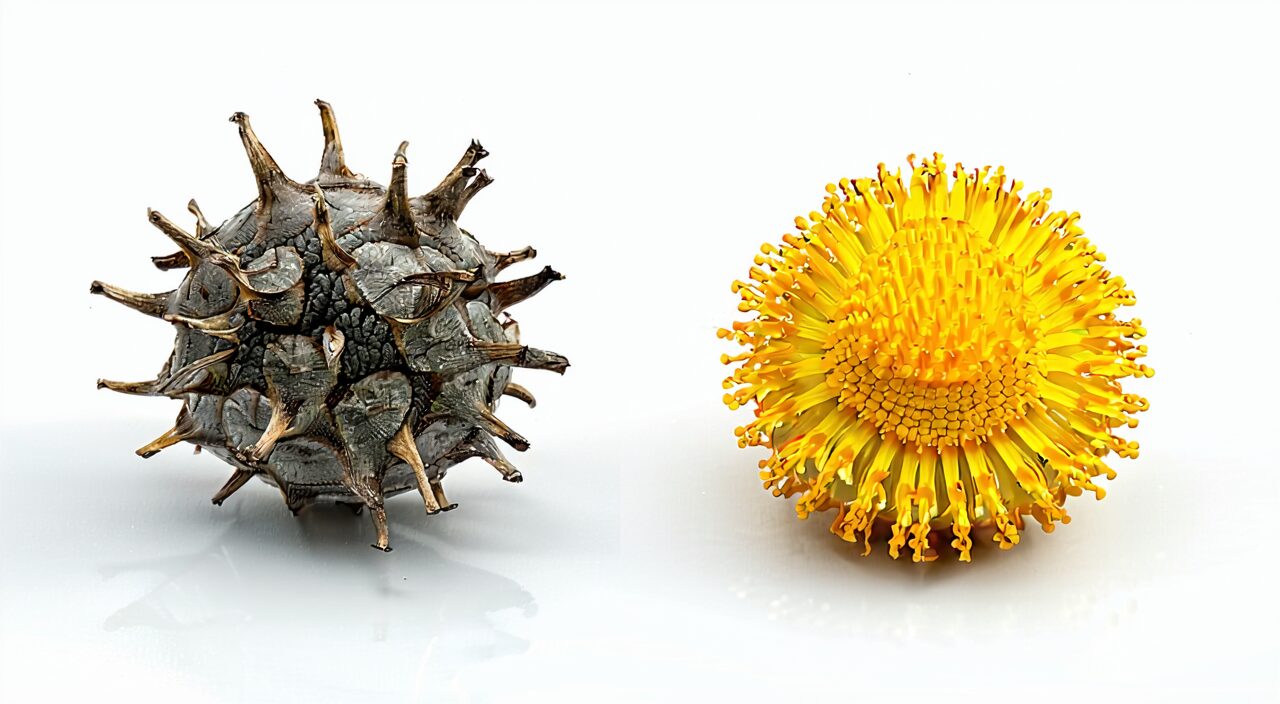
In terms of plant morphology, before it is processed as a medicinal, Xuan Fu Hua is actually the dried capitulum (flower head) of Inula japonica or Inula britannica, both from the Asteraceae family. If you see Xuan Fu Hua blooming in summer or early autumn, you will notice it looks somewhat like a small yellow “fuzzy ball.”
The dried medicinal material reveals its typical features more clearly. The whole Xuan Fu Hua herb is flat-spherical, sometimes slightly flattened or subglobose due to drying, with a diameter of about 1 to 2 cm. At the base is the involucre; the bracts are arranged in an overlapping, scale-like pattern, rather rigid, and often retain a hint of greyish green. Around the outer edge is a ring of ray florets, yellowish in color, with relatively long and narrow ligules that, when spread out, often show three small teeth at the tip. If you look closely, tiny glandular dots can be seen on the back of the ray florets. The centre contains many tubular florets, also with a yellow corolla that is five-lobed at the top.
A practical identification point is this: if you gently rub the dried Xuan Fu Hua in your palm, or use a magnifying glass to observe it, you will often see many fine white hairs. These hairs mainly attach to the achenes and styles and are one of the more obvious characteristics of Xuan Fu Hua. When purchasing or learning about this herb, check whether the flower heads are intact, whether the ray and tubular florets are clearly visible, and whether the natural fine hairs are present.
What is the medicinal part of Xuan Fu Hua?
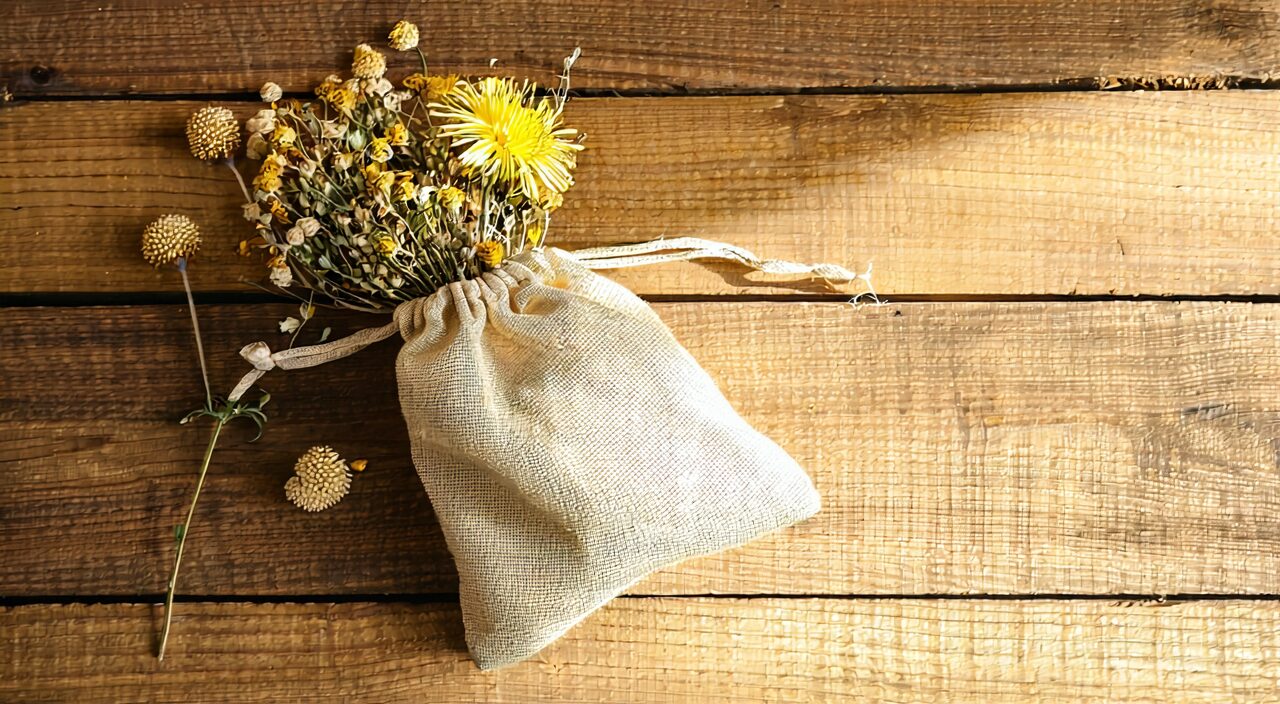
The medicinal part of Xuan Fu Hua is the dried capitulum described above. Harvesting usually takes place in summer and autumn, when the flower heads are just beginning to open or have opened recently. After picking, the stems, leaves and impurities are removed, and the flower heads are dried in the sun or in the shade for later use. Processing details may vary slightly between production regions, but the optimal material generally retains intact flower heads with a moist yellow sheen.
When decocting formulas that contain Xuan Fu Hua, there is a rather special traditional practice: “wrap-boiling” (bao jian). Because the flower heads carry numerous fine, downy hairs, if directly added to a decoction, the hairs can easily mix into the liquid and may irritate the throat and esophagus when consumed, causing discomfort. Therefore, many traditional Chinese medicine practitioners will specifically note “Xuan Fu Hua, wrap-boiled” when prescribing. This means placing the Xuan Fu Hua in a gauze bag before adding it to the decoction with the other herbs, so that direct irritation of the digestive tract by the hairs is reduced. This detail is quite important in practical use—whether you are boiling the herbs yourself or using related products, it is worth paying attention to.
How does traditional Chinese medicine understand Xuan Fu Hua?
From the perspective of traditional Chinese medicine, Xuan Fu Hua is often classified as a phlegm-resolving herb, but its emphasis is not merely on “resolving”; rather, it lies in the concept of “descending.”
Traditionally, the nature and taste of Xuan Fu Hua are described as bitter, acrid, and salty, slightly warm, mainly entering the Lung and Stomach meridians. Acridness can disperse and move, bitterness can descend and drain, and saltiness can soften hardness. Hence, it is considered particularly skillful in handling situations where “Qi is moving upward” inappropriately. For instance, when Lung Qi ascends counterflow and causes cough, panting, and profuse sticky phlegm, or when Stomach Qi counterflows and produces nausea, belching, or vomiting, Xuan Fu Hua is often considered as an herb to guide the treatment approach.
In summary, TCM often summarizes the actions of Xuan Fu Hua as downbearing Qi, resolving phlegm, promoting water movement, and stopping vomiting. It is neither like certain warming herbs that strongly tonify yang qi, nor like drastic purgatives that forcefully clear the bowels. Instead, it works in a relatively gentle way to help the body’s qi mechanism restore a normal downward direction, thereby reducing discomfort caused by qi counterflow and phlegm congealing. Of course, this is only a summary of traditional understanding. Everyone’s condition differs, and suitability must be judged by considering individual constitution and specific presentations.
What additional perspectives does modern research offer?
Modern research on Xuan Fu Hua also offers some supplementary understanding. Some experimental studies indicate that Xuan Fu Hua contains chemical constituents such as flavonoids and sesquiterpene lactones. In animal experiments, these constituents show certain antitussive, expectorant, and antiasthmatic activities, providing a degree of support for its traditional use in cough with profuse phlegm. In addition, some studies have observed potential anti-inflammatory and antioxidant effects.
It should be noted, however, that much of this research is still at the laboratory stage or based on animal models, and there remains a gap between these findings and actual effects in the human body. These data serve more as a reference side for understanding this medicinal material and cannot be directly equated with clinical efficacy or used as a basis for recommendation.
What are the differences between Xuan Fu Hua, Kuandong Hua, and Juhua?
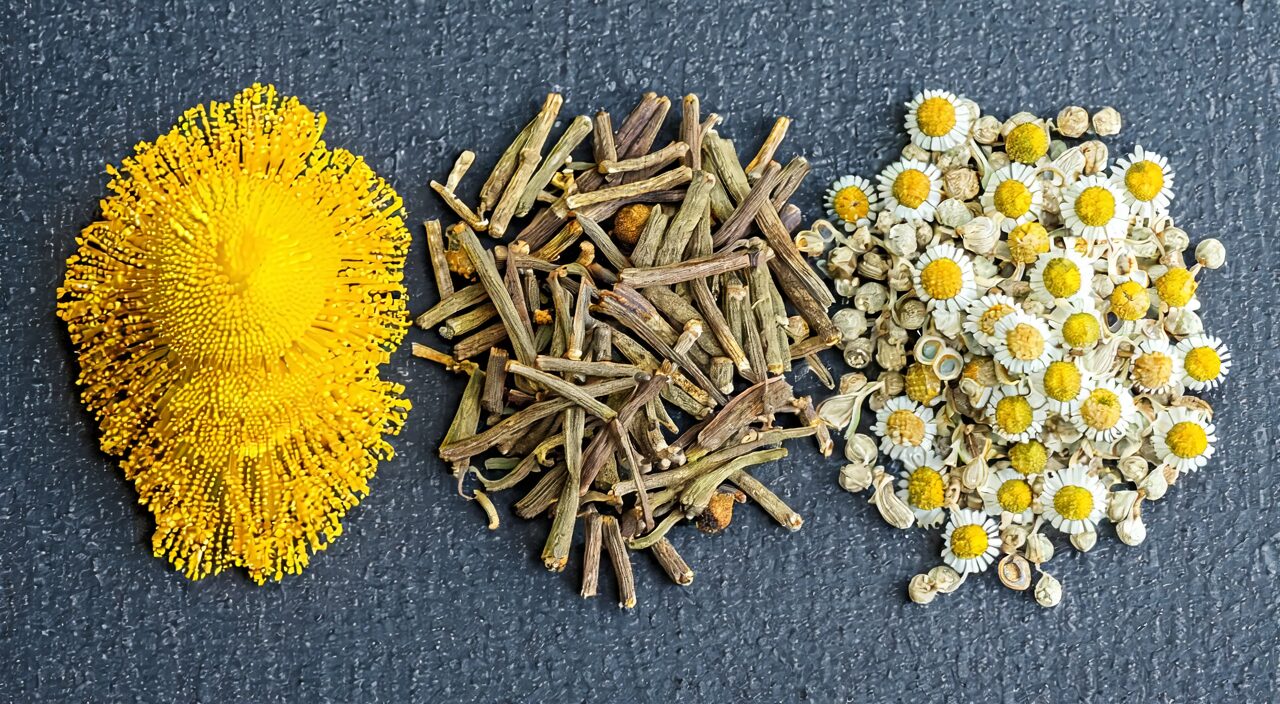
Many people initially confuse Xuan Fu Hua with other yellow flowers, most commonly Kuandong Hua (Coltsfoot Flower) and Juhua (Chrysanthemum).
Let’s first compare Xuan Fu Hua and Kuandong Hua. Both are frequently used cough-relieving and phlegm-transforming medicinal substances, but their sources and forms differ considerably. Xuan Fu Hua uses the opened capitulum, which looks flat-spherical with clearly visible ray and tubular florets. Kuandong Hua, on the other hand, uses the unopened flower bud. It is more rod-shaped or oblong-rod-shaped, purplish-red or brownish in color, and covered on the outside with multiple layers of bracts. Alone, Kuandong Hua looks more like a small bud, lacking the fully spread, yellow blossom form of Xuan Fu Hua. In traditional application, although both can be used for cough with profuse phlegm, Kuandong Hua leans more toward moistening the Lung, downbearing Qi, and relieving cough and transforming phlegm, while Xuan Fu Hua places more emphasis on descending Qi, resolving phlegm, and stopping vomiting. Therefore, when making a specific choice, it should still be differentiated according to the individual’s actual presentation and constitution.
Now compare Xuan Fu Hua and Juhua. The Chrysanthemum flowers commonly seen in daily life are mostly capitula, somewhat similar to Xuan Fu Hua in that regard, but the two differ greatly in size, degree of opening, and use. Chrysanthemum flowers are usually larger, with more layers of ray florets, and come in multiple colors including white and yellow; they are mainly used to disperse wind-heat, clear the liver, and brighten the eyes. Xuan Fu Hua tends to be smaller overall, concentrated in yellow tones, and its main focus is on descending Qi, transforming phlegm, and stopping vomiting. Furthermore, Chrysanthemum is generally not required to be wrap-boiled, whereas with Xuan Fu Hua, because of its fine hairs, wrap-boiling has become a very important traditional practice.
Which formulas use Xuan Fu Hua?
Xuan Fu Hua appears as an important ingredient in several classical formulas. Here we introduce three common directions for your understanding.
Xuan Fu Dai Zhe Tang is a formula from the Shang Han Lun, composed of Xuan Fu Hua, Dai Zhe Shi (Hematite), Ban Xia (Pinellia), Ren Shen (Ginseng), Sheng Jiang (fresh Ginger), Da Zao (Jujube), and Gan Cao (Licorice), among others. Traditionally, it is often used in situations with Stomach Qi counterflow, a stuffy and hard sensation in the epigastrium, and unrelenting belching. In it, Xuan Fu Hua mainly exerts its action of downbearing Qi and resolving phlegm, while Dai Zhe Shi heavily anchors and directs rebellious Qi downward; together, they aim to guide upwardly counterflowing Qi to descend. This type of formula has a rather clear direction, but before use, it still needs to be analyzed along with specific symptoms and constitution, and should not be copied directly.
Jin Fei Cao San is another formula that includes Xuan Fu Hua. “Jin Fei Cao” itself is sometimes used as an alternative name for Xuan Fu Hua. Besides Xuan Fu Hua, the formula often includes Ma Huang (Ephedra), Jing Jie (Schizonepeta), Qian Hu (Peucedanum), and Ban Xia, etc. Traditionally, it tends to dispel externally contracted wind-cold and transform phlegm to stop cough, and is more applied for presentations such as externally contracted wind-cold, cough with profuse phlegm, and aversion to cold with fever. In comparison, Jin Fei Cao San tends towards exterior patterns and failure of Lung Qi to descend, whereas Xuan Fu Dai Zhe Tang tends more towards central deficiency and Qi counterflow.
Xiang Fu Xuan Fu Hua Tang is a formula more commonly used within the warm disease school. It is composed of Xiang Fu (Cyperus), Xuan Fu Hua, Su Zi (Perilla Seed), Xing Ren (Apricot Kernel), Chen Pi (Tangerine Peel), and others. Traditionally, it is often used for conditions where phlegm and qi bind together, causing distension and pain in the chest and flanks, and cough with qi counterflow. In this formula, the combination of Xuan Fu Hua and Xiang Fu aims to rectify qi while simultaneously descending qi and resolving phlegm.
These formulas respectively represent the application of Xuan Fu Hua in different directions—regulating counterflow of Lung Qi, counterflow of Stomach Qi, and binding of phlegm and qi. Again, a reminder: formulas are merely a summary of traditional usage directions. Whether they are specifically applicable still requires a comprehensive judgment by an experienced TCM practitioner based on the four diagnostic methods, and it is not advisable to apply them on your own.
What should be noted when using Xuan Fu Hua?
Although Xuan Fu Hua is a medicinal with a long history of application, there are still some details worth noting in practical use.
First is the issue of irritation from the hairs. As already mentioned, wrap-boiling is recommended to prevent the hairs from irritating the throat and gastrointestinal tract. This is especially important for those with a sensitive constitution. It is not uncommon to experience pharyngeal itching, coughing, or slight nausea when drinking the decoction if the herb was boiled directly without a wrap.
Secondly, tradition holds that Xuan Fu Hua is warming and has a dispersing tendency. For people with yin deficiency with dry cough, dry cough with little sputum, hemoptysis, or pronounced qi deficiency, it may not be suitable for casual use. If the body already has insufficient fluids and upward-blazing deficiency fire, using acrid-disperse and warm-dry substances may aggravate the feeling of dryness. Individuals with allergic constitutions also need extra caution; initial contact is best conducted under professional guidance.
Furthermore, if cough or vomiting is accompanied by warning signs that require attention—such as persistent vomiting with inability to take food, abnormal breathing, chest tightness or chest pain, increasing amounts of coughed-up blood or black stools, or marked unintentional weight loss within a short time—these already go far beyond what a single medicinal herb can address. In such cases, one should seek prompt medical attention rather than relying on herbs or formulas to manage on one’s own.
Summary
Xuan Fu Hua is a traditional Chinese medicinal herb used for descending Qi, resolving phlegm, and stopping vomiting. Its unique capitulum, yellow ray florets, and fine hairs give it a certain degree of recognizability. It differs from Kuandong Hua and Juhua in terms of medicinal parts and applications. When using it, particular attention should be paid to wrap-boiling and whether it suits one’s individual constitution. For readers who wish to understand this herb more deeply, it is advisable to make a comprehensive judgment under the guidance of a professional TCM practitioner based on personal conditions. This article serves only as a basic science reference and cannot replace individualized diagnosis and advice.