
What Is Xiang Fu? Medicinal Parts, Identification, and Common Formulas
In Chinese herbal medicine, Xiang Fu (Cyperus Rhizome) is often mentioned alongside Mu Xiang (Aucklandiae Radix) and Wu Yao (Linderae Radix), but they come from different plants, with distinct appearances and traditional uses. For overseas readers just beginning to learn about qi-regulating herbs, understanding what Xiang Fu is—what it looks like, which part is used, and how it differs from Mu Xiang—can be a practical starting point. This article addresses these common questions to help you build a comprehensive understanding of Xiang Fu.
What Does Xiang Fu Look Like? How to Identify It?
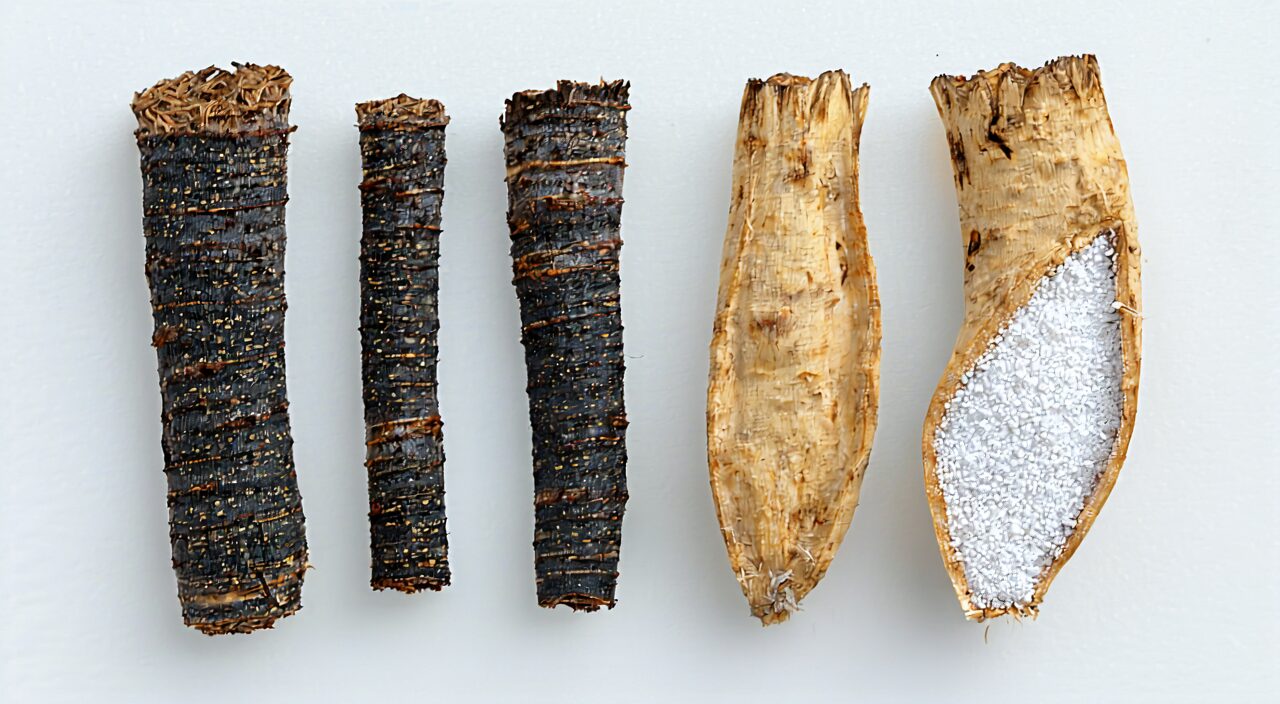
Xiang Fu has a distinctive appearance; once seen, it is generally not easily confused with other root and rhizome herbs.
Typical Xiang Fu rhizomes are mostly spindle-shaped, sometimes slightly curved, with both ends somewhat pointed, generally 1.5–3.5 cm long and 0.5–1 cm in diameter at the middle. The surface is blackish-brown or brown, with 6–10 prominent raised nodes; on the nodes, residual brown fibrous roots or broken rootlet scars may still be visible. The texture is hard and solid, not easily broken.
When broken, the cut surface is relatively flat, white or grayish-white, distinctly starchy, with the central part often slightly darker. It has a unique, faint aromatic smell and a slightly bitter taste. These features—especially the nodes, fibrous remnants, and white starchy cut surface—are reliable identification points.
What Is the Medicinal Part of Xiang Fu?
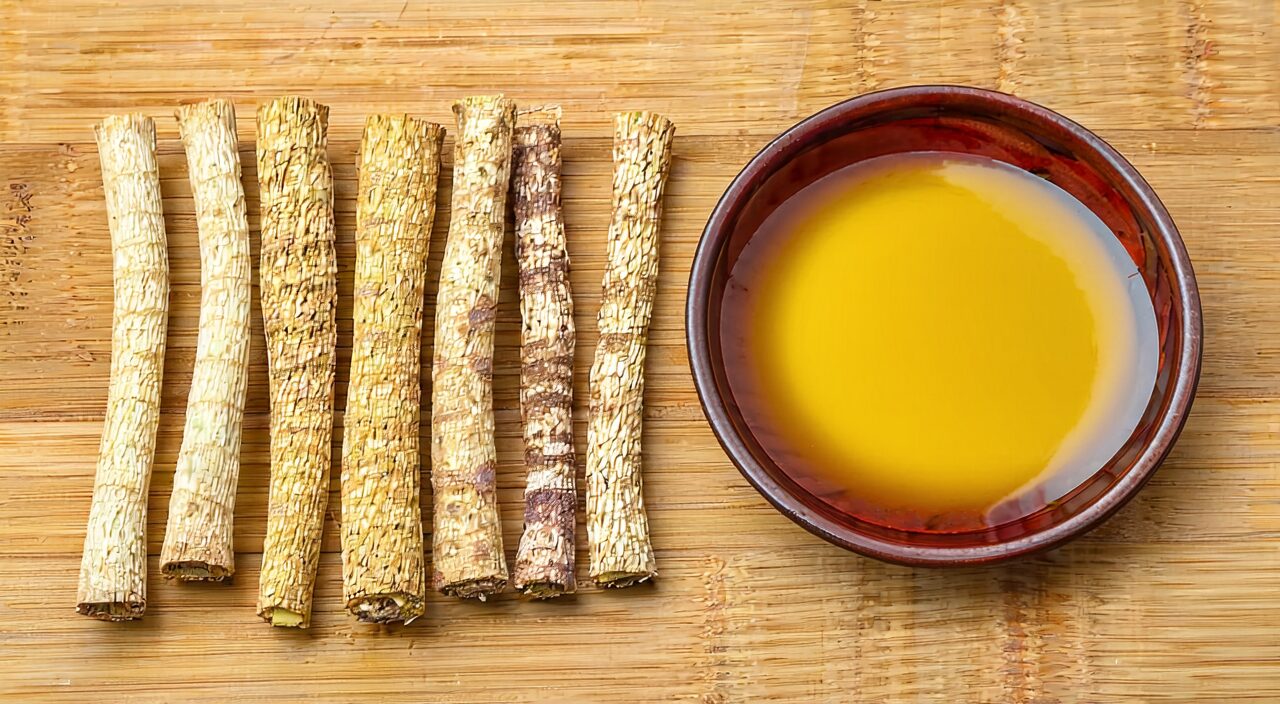
The medicinal part of Xiang Fu is the dried rhizome of the plant Cyperus rotundus (nutgrass), not the whole herb. Cyperus rotundus is a perennial sedge; only its underground rhizome is used medicinally.
It is usually harvested in autumn. After the fibrous roots on the surface are singed off, some are dried directly as unprocessed Xiang Fu (Sheng Xiang Fu); others are briefly boiled in water or steamed thoroughly and then dried. In traditional practice, a commonly used processed form is vinegar-fried Xiang Fu (Cu Xiang Fu), in which clean Xiang Fu slices are mixed with vinegar, moistened, and then dry-fried over low heat until slightly dry. Vinegar processing is believed to enhance its liver-soothing and pain-relieving effects.
Thus, when people ask about the medicinal part of Xiang Fu, the answer is clear: it is the dried rhizome of Cyperus rotundus, and depending on the therapeutic goal, it may be used in its unprocessed form or as vinegar-fried Xiang Fu.
How Does Traditional Chinese Medicine Understand Xiang Fu?
In traditional Chinese medicine theory, Xiang Fu is described as pungent, slightly bitter, and slightly sweet in flavor; neutral in nature; and it enters the Liver, Spleen, and San Jiao meridians. It has long been regarded as an important qi-regulating herb, with its core actions focused on moving qi.
Traditionally, it is understood through its ability to soothe the liver and relieve depression, regulate qi and relax the middle, and regulate menstruation and relieve pain. For emotional distress, chest and rib-side distension, and epigastric or abdominal fullness—if the pattern is identified as qi stagnation—Xiang Fu may be considered in the treatment approach. Especially for women’s menstrual irregularities, premenstrual breast distension, and dysmenorrhea due to liver qi constraint, Xiang Fu frequently appears in classical formulas.
It should be noted that these are based on traditional experience and are best understood as one approach within a broader framework. Whether it is suitable for a specific individual must be determined by considering the whole constitution, symptom presentation, and professional guidance.
How Does Modern Research View Xiang Fu?
Modern phytochemical studies show that Xiang Fu contains volatile oils such as cyperene and α-cyperone, as well as flavonoids and carbohydrates. Some in vitro and animal studies have observed that Xiang Fu may regulate gastrointestinal smooth muscle, exhibit mild anti-inflammatory effects, and possess analgesic and estrogen-like activities.
However, these findings currently remain largely at the level of basic research, and high-quality clinical evidence is still limited. They can serve as a reference for understanding this herb from a modern perspective but cannot be directly equated to confirmed effects in humans.
How Does Xiang Fu Differ from Mu Xiang and Wu Yao?
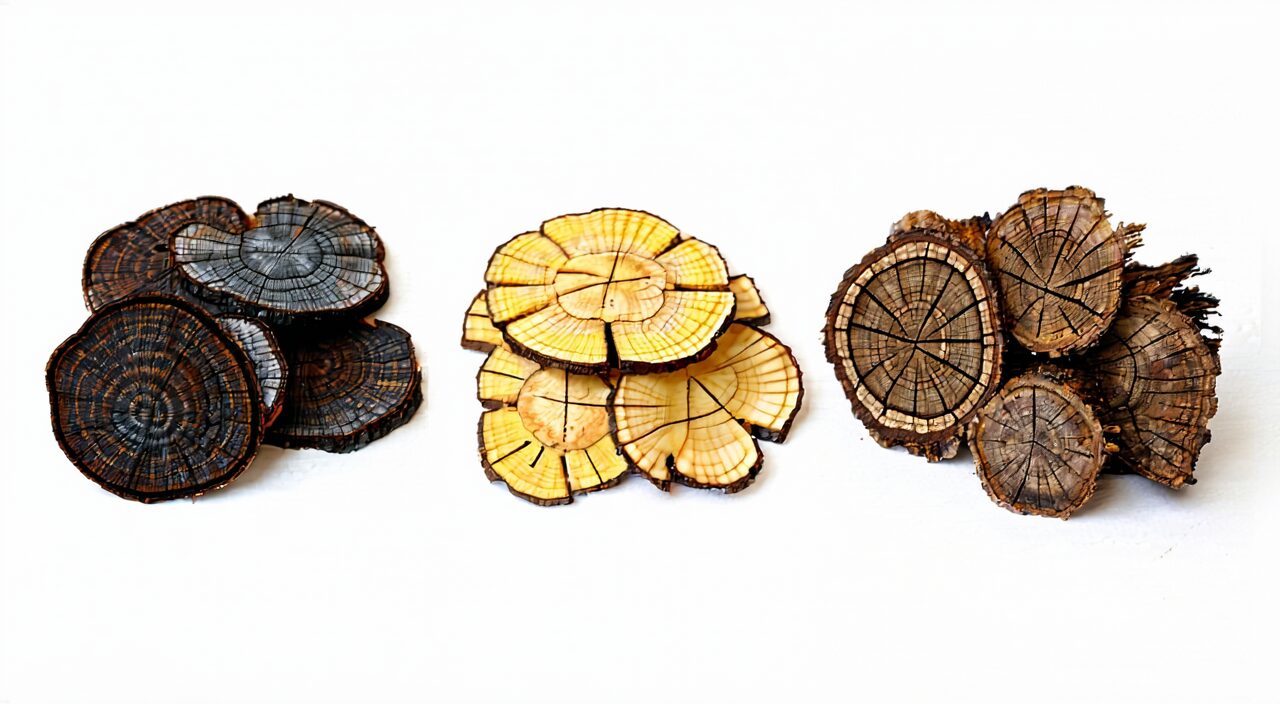
Xiang Fu, Mu Xiang, and Wu Yao are all classified as qi-regulating herbs in traditional categorization, but their origins, appearances, and emphasis in application differ considerably.
In terms of botanical origin, Xiang Fu is the dried rhizome of Cyperus rotundus (Cyperaceae); Mu Xiang is the dried root of Aucklandia lappa (Asteraceae); and Wu Yao is the dried tuberous root of Lindera aggregata (Lauraceae). The three have completely unrelated plant families.
In appearance, Xiang Fu is spindle-shaped, with a surface covered in closely spaced nodes and a white starchy cross-section; Mu Xiang is cylindrical or semi-cylindrical, with a yellowish-brown surface marked by longitudinal furrows and lateral root scars, a grayish-yellow cut surface with a radiating texture, and a strong, lasting aroma; Wu Yao is mostly spindle-shaped or cut into irregular slices, with a yellowish-brown or yellowish surface, a yellowish-white cut surface, a hard texture, and a milder, deeper fragrance.
Traditional applications also differ: Xiang Fu leans toward soothing the liver, regulating qi, and relieving menstrual pain, commonly used for rib-side pain and irregular menstruation caused by liver qi stagnation; Mu Xiang excels at moving qi, relieving pain, strengthening the spleen, and resolving food accumulation, often used for epigastric distension, pain, and reduced appetite due to spleen-stomach qi stagnation; Wu Yao is better at moving qi, dispelling cold, and warming the kidney to relieve pain, frequently used for cold pain in the epigastric region and hernia pain caused by cold-induced qi stagnation.
Therefore, although they all act on “qi,” the choice among them depends on factors such as liver, spleen, or cold-heat patterns.
Which Classical Formulas Use Xiang Fu?
Xiang Fu appears in many classical formulas, especially those designed to regulate qi. Below are some common examples, offered only as traditional knowledge for reference:
Yue Ju Wan: Xiang Fu is combined with Cang Zhu, Chuan Xiong, Shen Qu, and Zhi Zi. Traditionally, it addresses the six stagnations of qi, blood, phlegm, fire, dampness, and food, with Xiang Fu primarily targeting qi stagnation.
Chai Hu Shu Gan San: On the foundation of soothing the liver and regulating qi, Xiang Fu is added alongside Chai Hu, Chen Pi, and Chuan Xiong, often used for rib-side distension and chest oppression due to liver qi constraint.
Liang Fu Wan: This formula contains only Gao Liang Jiang and Xiang Fu—one warming and one dispersing—mainly addressing cold-epigastric pain and distension caused by cold-induced qi stagnation.
Xiang Su San: Xiang Fu is used together with Zi Su Ye, Chen Pi, and Gan Cao. Traditionally, it is used for external contraction of wind-cold with concurrent qi stagnation, with the approach leaning toward regulating qi and releasing the exterior.
Each of these formulas has its own focus. Whether any is appropriate for an individual depends on the actual pattern, constitutional differences, and should be sought through the guidance of a professional—self-prescribing is not recommended.
Precautions When Using Xiang Fu
Although Xiang Fu is a very commonly used qi-regulating herb, it is not suitable for every constitution.
Traditional experience holds that it should be used with caution in those with qi deficiency without stagnation. If there is already significant qi deficiency—manifesting as fatigue, lack of strength, and disinclination to speak—without obvious distension, using qi-moving herbs alone may further deplete qi. It is also unsuitable for those with yin deficiency and blood heat, as Xiang Fu’s pungent, dispersing nature may potentially consume yin and blood.
For menstrual irregularities, especially heavy bleeding, prolonged periods, or amenorrhea, it is essential to first determine the specific cause. If the condition stems from blood deficiency, blood heat, or organic disorders, relying solely on Xiang Fu may be inappropriate and could delay proper evaluation. Pregnant and breastfeeding women should seek professional advice before use.
Furthermore, unprocessed Xiang Fu (Sheng Xiang Fu) leans more toward regulating qi and releasing the exterior, while vinegar-fried Xiang Fu (Cu Xiang Fu) places greater emphasis on soothing the liver and relieving pain. The choice should be made based on the specific therapeutic direction and individual constitution. If there is recurring, persistent pain, emotional distress, or digestive issues that do not improve, it is advisable to seek medical attention rather than relying solely on a single herb for self-management.
Summary
Understanding Xiang Fu means more than just knowing its name—it involves recognizing its distinctive spindle-shaped rhizome, dark brown surface, and white starchy cross-section, identifying its medicinal part as the dried rhizome of Cyperus rotundus, and appreciating its traditional role in soothing the liver, regulating qi, and regulating menstruation. At the same time, although Xiang Fu, Mu Xiang, and Wu Yao all belong to the category of qi-regulating substances, their botanical origins, appearances, and the types of qi stagnation they address are all different—confusing them may lead treatment off course. Any herb should be used with careful consideration of one’s own condition. This article is for informational purposes only and cannot replace professional diagnosis or treatment advice.