
What Is Water Buffalo Horn? Medicinal Parts, Identification, and Common Formulas
Water buffalo horn is one of the commonly used animal horn materials in traditional Chinese medicine. When people first encounter the question “What is water buffalo horn?”, they may wonder where it comes from and how it differs from ordinary cattle horn or antelope horn. This article focuses on its appearance, medicinal parts, traditional Chinese medicine perspectives, common formulas, and precautions for use to help readers build a basic understanding. This article is for educational reference only and cannot replace professional diagnosis or treatment advice.
What Does Water Buffalo Horn Look Like? How Can It Be Identified?
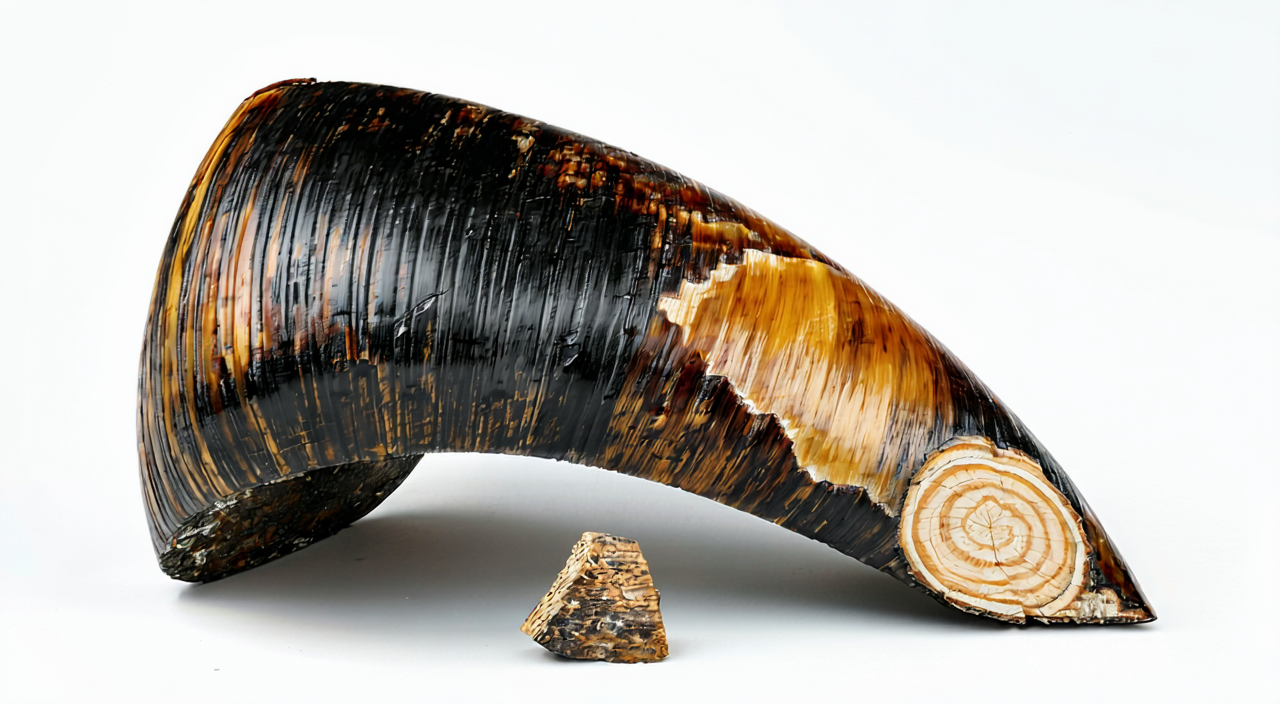
Water buffalo horn comes from the horns of water buffalo, which belong to the Bovidae family. It generally has a curved, conical shape. The base is relatively thick and gradually tapers toward the tip. Some horns curve backward and upward or toward both sides. The surface is usually blackish brown, brown-black, or dark brown, with visible longitudinal patterns and fine cracks. The base of the horn is often hollow, while the area closer to the tip is increasingly solid.
A cross-section may show layered or annular patterns in the keratin structure, with variations in color from the outside inward and sometimes a certain degree of luster. Medicinal slices are commonly irregularly shaped, powdered, or shaved into thin pieces, and are usually dark in color. For general reference, readers can focus on the overall shape, surface patterns, and layered structure of the cut surface. However, it is difficult to determine authenticity independently, so these features are mainly useful as a learning guide.
What Is the Medicinal Part of Water Buffalo Horn?
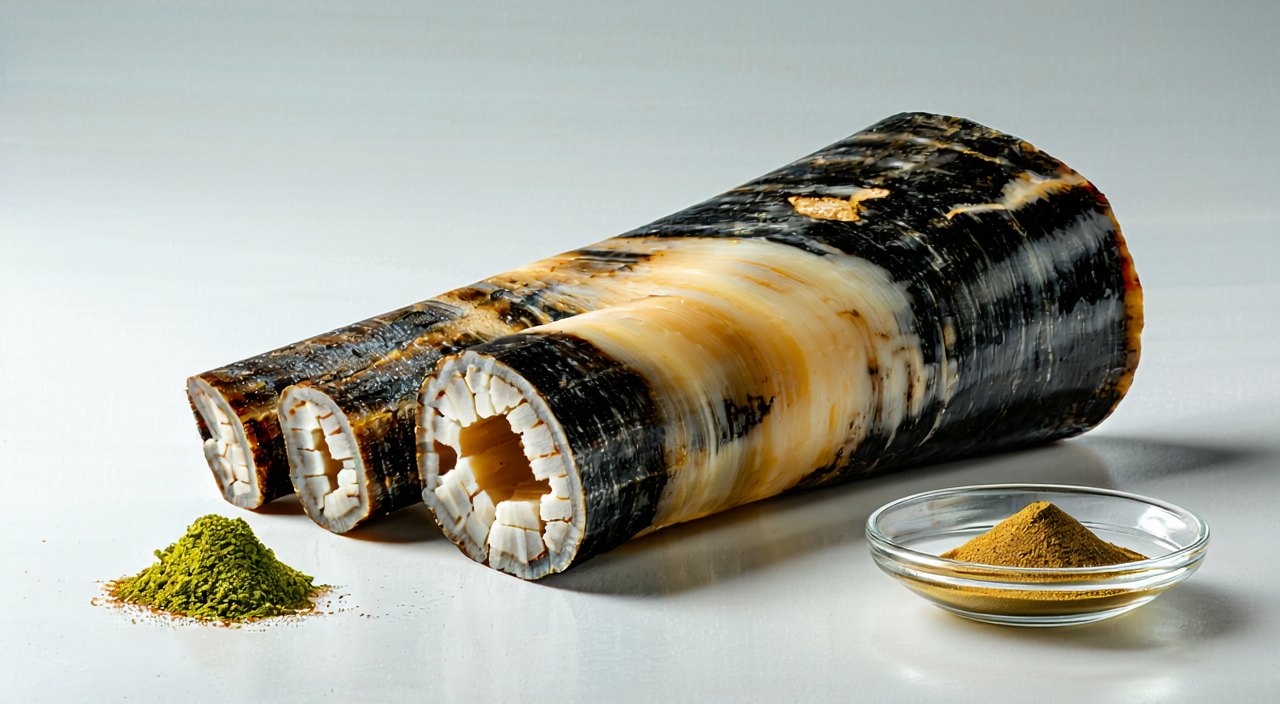
The traditional medicinal part of water buffalo horn is the horn itself. In modern Chinese patent medicines and formulas, products may include water buffalo horn slices, shavings, or powder, as well as “concentrated water buffalo horn powder,” which is a standardized preparation. Concentrated water buffalo horn powder is not simply ground horn; it is produced through extraction, concentration, drying, and other processes. Its dosage is therefore not exactly equivalent to that of ordinary horn powder.
Regardless of the form, the product should comply with the relevant pharmaceutical or food safety standards. Readers are not advised to grind an entire horn into powder for consumption, because home processing makes it difficult to ensure uniformity, hygiene, and dosage control. In formulas, water buffalo horn is generally used as one ingredient in a complete prescription rather than as a standalone daily health supplement.
How Is Water Buffalo Horn Viewed in Traditional Chinese Medicine?
In traditional Chinese medicine, water buffalo horn is generally understood from the perspectives of clearing heat, cooling the blood, resolving toxicity, and calming convulsions. It is generally considered cold in nature and is often combined with heat-clearing and blood-cooling herbs for patterns associated with heat entering the nutrient and blood levels. In traditional theory, “heat entering the nutrient and blood levels” may involve complex manifestations such as high fever, skin rashes, a tendency to bleed, restlessness, or disturbed consciousness rather than a single symptom.
Water buffalo horn has attracted increasing modern attention partly because it serves as a substitute source for rhinoceros horn in certain historical formulas after rhinoceros horn resources became restricted. Traditional theory holds that it enters the blood aspect and helps clear heat pathogens from the blood, thereby supporting effects such as clearing heat, cooling the blood, resolving toxicity, and calming convulsions. However, it is generally unsuitable for people with cold patterns, deficient-cold constitutions, or no clear signs of heat. Whether it is appropriate for an individual should be determined by considering their constitution, symptoms, and professional advice.
Focus of Modern Research: Substitution Background and Evidence Limitations
Modern interest in water buffalo horn is largely related to its legally regulated use as a substitute source for rhinoceros horn in certain historical formulas. Some classical formulas once used rhinoceros horn, but because of conservation policies, legal restrictions, and resource depletion, water buffalo horn has gradually been adopted as a substitute in modern practice. Some pharmaceutical standards also specify this substitution.
Modern pharmacological research has examined the potential antipyretic, sedative, and anti-inflammatory activities of water buffalo horn, while also analyzing components such as amino acids, peptides, and minerals. These studies provide some useful clues, but the overall strength of the evidence remains limited. Much of the research is still at the laboratory stage and is not sufficient to equate traditional effects directly with modern pharmacological conclusions. It is therefore better understood as a medicinal material with clearly established traditional applications while modern research continues to develop, rather than something to be taken casually in increased doses or for extended periods.
What Is the Difference Between Water Buffalo Horn, Antelope Horn, and Historical Rhinoceros Horn?
Water buffalo horn comes from water buffalo, antelope horn comes from specific antelope species, and rhinoceros horn is associated with protected rhinoceros species. The three differ in their sources, legal status, and traditional applications. Traditionally, antelope horn is associated more with calming the liver and extinguishing wind, as well as clearing the liver and improving vision, while water buffalo horn is associated more with clearing heat, cooling the blood, resolving toxicity, and calming convulsions. Rhinoceros horn was used for similar purposes in historical texts, but it is no longer legally traded or used in modern practice.
From a regulatory perspective, water buffalo horn comes from a relatively common source and is a commonly used Chinese medicinal material when legally sourced and properly processed. Because of differences in species protection status, the use of antelope horn is subject to strict restrictions. Rhinoceros horn is a protected wildlife product whose trade and use are strictly prohibited, and information related to such transactions should not be circulated. Ordinary consumers should not purchase rhinoceros horn or antelope horn products from unknown sources.
Which Formulas Contain Water Buffalo Horn?

Many traditional formulas aimed at clearing heat, cooling the blood, resolving toxicity, and calming convulsions use water buffalo horn as the source of the horn ingredient in modern practice. Qing Ying Tang is a classic formula from warm disease theory. In modern use, water buffalo horn often replaces rhinoceros horn and is combined with rehmannia root, scrophularia root, ophiopogon root, and other ingredients to clear heat from the nutrient level and vent it outward. Modern substitute versions of Xi Jiao Di Huang Tang are also common. These typically use water buffalo horn in place of rhinoceros horn for traditional patterns involving heat entering the blood level and bleeding due to blood heat.
Qing Wen Bai Du Yin is a more complex heat-clearing and blood-cooling formula containing ingredients such as gypsum, anemarrhena rhizome, and coptis rhizome. Modern preparations or decoctions often use water buffalo horn as a substitute. Preparations in the Zi Xue Dan category are traditional emergency formulas, and some modern products may contain water buffalo horn or concentrated water buffalo horn powder. These formulas involve complex pattern differentiation. Seeing “water buffalo horn” in a formula does not mean it is suitable for everyone. Readers should consider the product instructions, individual constitution, and professional advice together.
What Precautions Should Be Taken When Using Water Buffalo Horn?
Water buffalo horn is relatively cold in nature and is mainly used for heat-related patterns. People with a cold and deficient digestive system, a tendency toward diarrhea, poor appetite, cold hands and feet, or a generally cold constitution may not be suitable for long-term or high-dose use. If there are no clear signs of heat, water buffalo horn should not be used as a daily “fire-clearing” product.
If persistent high fever, impaired consciousness, convulsions, severe headache, chest tightness or chest pain, difficulty breathing, ongoing bleeding, severe abdominal pain, vomiting, black stools, or marked weight loss occurs, seek medical attention or emergency care promptly rather than relying on a single medicinal material. Regarding sourcing and hygiene, choose products with a clear origin, standardized processing, and complete labeling. Individuals should not independently seek out raw horns and grind them into powder for consumption.
Summary
Water buffalo horn is an animal horn medicinal material obtained from water buffalo. Its curved, conical shape, blackish-brown surface, longitudinal patterns, and hollow base can help with basic identification. In modern traditional Chinese medicine, it is commonly used for traditional purposes involving clearing heat, cooling the blood, resolving toxicity, and calming convulsions, and it is often used as one regulated substitute source for rhinoceros horn in certain historical formulas. It is not suitable for everyone, and whether it should be used depends on individual constitution, specific symptoms, and professional advice. This article is for educational reference only and cannot replace professional diagnosis or treatment advice.