
What Is Chebula? Medicinal Parts, Identification, and Common Formulas
In traditional Chinese medicine, Chebula (He Zi) is a frequently mentioned astringent herb, yet many people are unfamiliar with its physical appearance. When seeing those yellow-brown fruit slices with longitudinal ridges on the herbal shelf, one may wonder: what part of which plant is Chebula? How does it differ from the more familiar Mume (Wu Mei) and Schisandra (Wu Wei Zi)? This article systematically sorts out the source, appearance, medicinal parts, traditional uses, and common formulas of Chebula, helping readers build a relatively clear cognitive framework.
What does Chebula look like? How to identify it?
Chebula is the dried ripe fruit of Terminalia chebula or Terminalia chebula var. tomentella of the Combretaceae family. In its medicinal form, the whole Chebula fruit is generally oblong or ovoid, mostly 2 to 4 cm in length and about 1.5 to 2.5 cm in diameter. The surface color ranges from yellowish-brown to dark brown, sometimes with fine wrinkles formed during drying. Its most distinctive feature is the 5 to 6 prominent longitudinal ribs that usually run from the base to the apex of the fruit; occasionally irregular shallow longitudinal grooves can be seen between the ribs. The fruit is firm, with thick flesh, enclosing a hard stone that is similar in shape, oblong or ovoid, and can be cracked open to reveal the seeds inside.
When purchasing or identifying dried Chebula, one can look for these ribbed fruits with a thick pericarp and hard pit. Sometimes commercially available Chebula slices are pitted flesh, showing irregular chunks, darker in color, hard in texture, and retaining traces of the longitudinal ribs. There is also roasted Chebula (Wei He Zi), a processed product with a darker surface, slightly charred aroma; these are common forms of Chebula in the herbal market.
What is the medicinal part of Chebula?
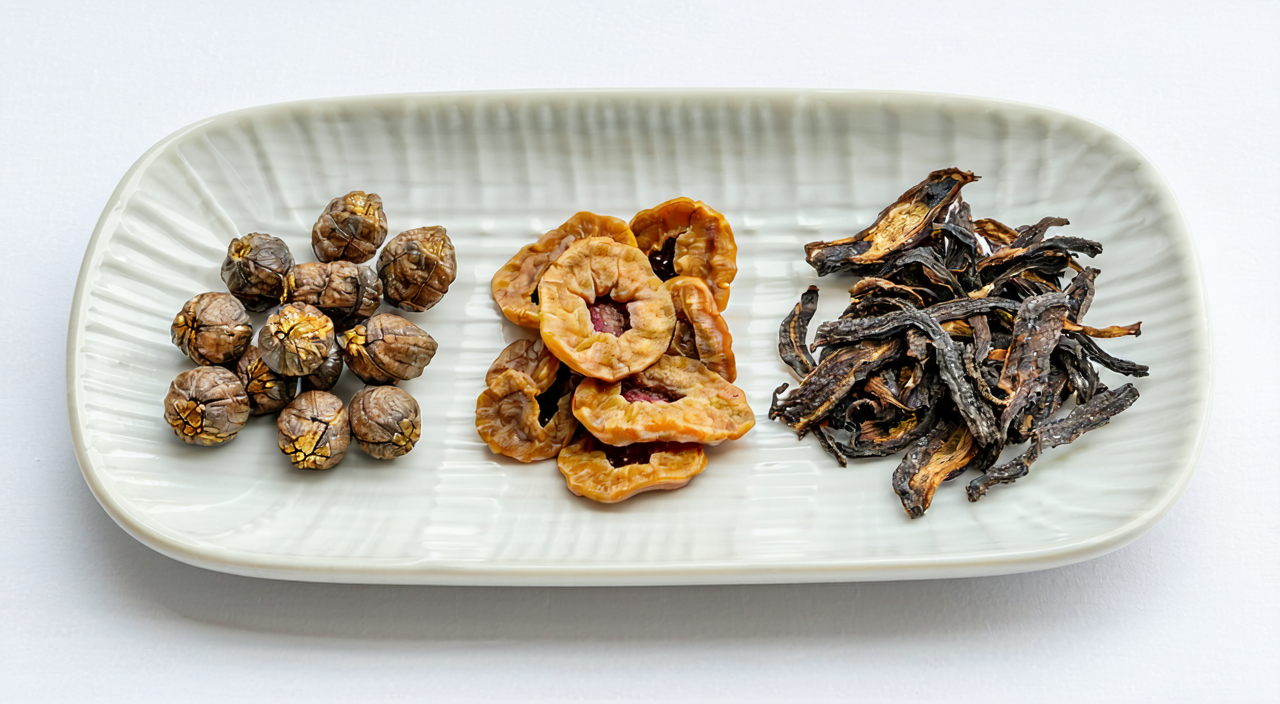
The medicinal part of Chebula is its ripe fruit. Depending on the requirements of different formulas, three main specifications are commonly used clinically: whole Chebula (with pit), pitted Chebula, and roasted Chebula. Whole Chebula uses the dried fruit directly; traditionally, the pit and flesh are believed to have slightly different emphasis, so some formulas specifically indicate “remove the pit” and use only the flesh. Pitted Chebula pieces often appear as irregular fragments or chunks, brown on the surface, brittle and easily recognized. Roasted Chebula is prepared by wrapping the flesh in flour or wet paper and roasting it; the processed herb has a milder astringent property and reduced irritation to the gastrointestinal tract, commonly used in situations requiring gentle astringency. In traditional preparations, Chebula is sometimes ground into powder for better mixing with other herbs.
How does TCM understand Chebula?
From the perspective of traditional Chinese medicine, Chebula is bitter, sour, and astringent in flavor, neutral in nature, and enters the Lung and Large Intestine meridians. Its core actions are generally summarized as astringing the intestines to stop diarrhea and astringing the lungs to relieve cough; it is also commonly used to benefit the throat and restore voice.
Astringing the intestines to stop diarrhea is the traditional application of Chebula for Large Intestine patterns. For chronic diarrhea, dysentery, and fecal incontinence due to prolonged conditions, if not astringed in time, qi and yin can be further damaged. In such cases, TCM practitioners may consider using astringents like Chebula in combination with spleen-fortifying, qi-supplementing, or yang-warming medicinals to help constrain the intestines. However, it should be noted that this usage is usually aimed at deficiency and prolapse patterns, not at stages where damp-heat and stagnant accumulations have not been cleared.
Astringing the lungs to relieve cough mainly addresses chronic cough and deficiency cough caused by dissipation of lung qi. When coughing persists and lung qi cannot properly contract, Chebula may be used together with lung-supplementing or phlegm-transforming herbs to help astringe lung qi and alleviate recurrent dry cough or shortness of breath. For throat discomfort and hoarseness, Chebula frequently appears in combinations that benefit the throat and restore voice, traditionally used with Platycodon root and Licorice to help protect the voice.
In general, Chebula leans toward “astringing” and “constraining,” suitable for patterns where qi mechanism is slipping and failing to hold. Whether it is appropriate needs to be comprehensively judged together with the whole-body presentation.
What does modern research focus on regarding Chebula?
Modern phytochemical studies have found that Chebula contains tannins such as chebulinic acid and chebulagic acid, as well as polyphenols, triterpenoids, and other substances. These components are related to the traditional astringent effect of Chebula; some in vitro experiments suggest that tannins may possess astringent, antioxidant, and certain antimicrobial activities. However, overall, research on Chebula remains mainly at the stage of component analysis and preliminary activity observation, and there is still some distance from clarifying its specific mechanism of action and scope of application in the human body. In other words, these modern research findings can provide a background for understanding the traditional uses of Chebula, but they cannot yet be directly equated with clinical recommendations.
How does Chebula differ from Mume and Schisandra?
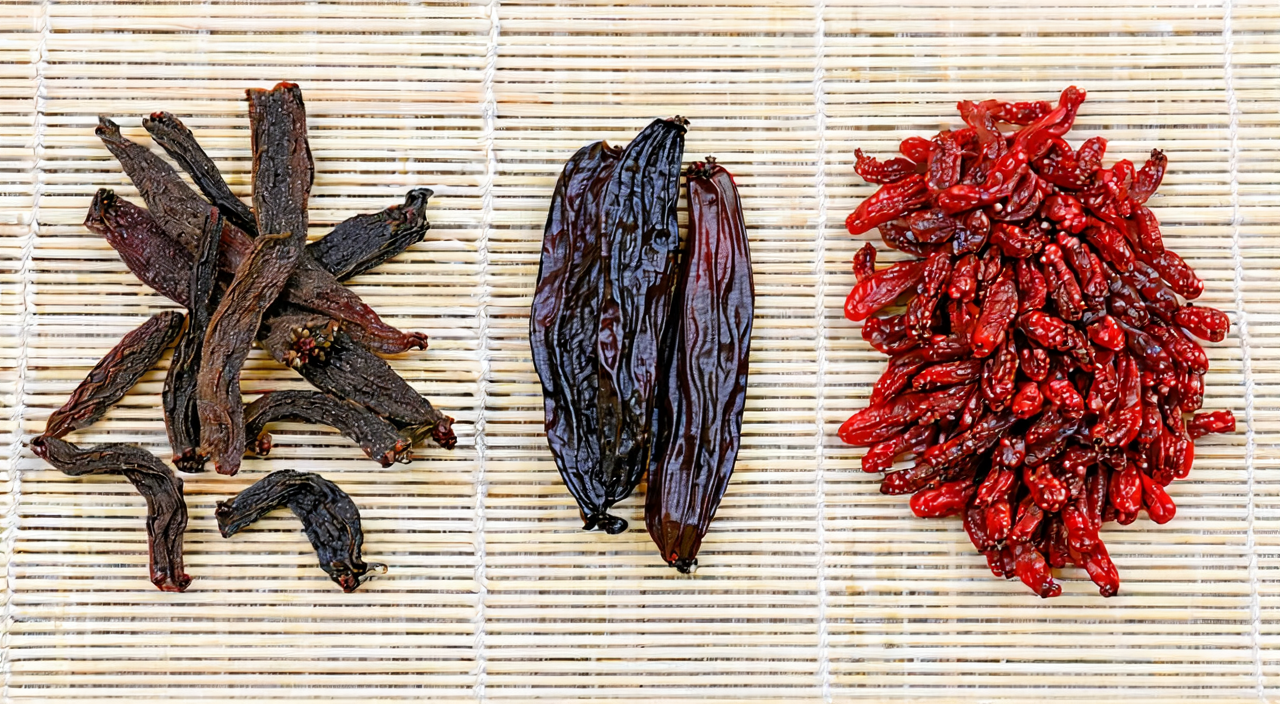
Chebula, Mume, and Schisandra all belong to commonly used astringent herbs and are easily confused in appearance and usage. In terms of fruit shape, Mume is the nearly ripe fruit of Prunus mume (Rosaceae) processed by smoking or drying; it is mostly subspherical or irregularly flattened, with a black or brownish-black surface and prominent wrinkles, lacking the distinct longitudinal ribs of Chebula. Schisandra is the dried ripe fruit of Schisandra chinensis or Schisandra sphenanthera (Magnoliaceae); its berries are small, mostly spherical or oblate, with red, purplish-red, or dark red surfaces, sometimes with a “white frost,” and also lack the longitudinal rib feature. In terms of taste, Mume is intensely sour, Chebula is sour with astringency and bitterness, while Schisandra is mainly sour with some sweetness and thin flesh.
In traditional applications, although all three herbs can astringe and secure, their emphasis differs. Mume leans toward generating fluids and calming roundworms, Schisandra leans toward astringing lung qi and securing essence, while Chebula focuses more on astringing the intestines to stop diarrhea and astringing the lungs to benefit the throat. Understanding these differences helps provide a better sense of direction when exploring the combination thinking of different formulas.
Which formulas use Chebula?
Chebula appears as an important astringent and lung-astringing herb in some classic formulas. Several common examples are listed below to help readers understand its general combination ideas in compound prescriptions.
Zhenren Yangzang Decoction (True Man’s Viscera-Nourishing Decoction) is a formula for spleen-stomach deficiency cold with chronic diarrhea and dysentery, often manifesting as fecal incontinence, abdominal pain relieved by warmth and pressure, fatigue, and poor appetite. In this formula, Ginseng, Atractylodes, and Nutmeg warm and supplement the spleen and stomach, while Chebula combined with Poppy Husk exerts an astringing and securing effect, embodying the combination approach of “supplementing the deficient” and “astringing the slipping.”
Chebula Powder (He Zi San) is a formula with Chebula as the main ingredient; the composition varies slightly in different medical records, commonly pairing Chebula with Coptis and Aucklandia, used when intestinal damp-heat has lessened but there is still slippery diarrhea, thereby firming the intestines to stop diarrhea while also clearing residual heat.
Chebula Drink (He Zi Yin), seen in the “Formulas to Aid the Living” (Ji Sheng Fang), is composed of Chebula, Apricot Seed, and Platycodon, traditionally used for chronic cough and loss of voice caused by lung qi failing to astringe. Here, Chebula astringes the lungs, Apricot Seed directs qi downward, and Platycodon lifts and opens lung qi – a classic combination of astringing, descending, and diffusing.
Jiu Xian San (Nine Immortals Powder) is used for lung deficiency chronic cough, adding multiple astringents like Poppy Husk, Schisandra, and Mume, together with Ginseng, Coltsfoot, and other qi-supplementing and phlegm-transforming ingredients. Chebula’s role here remains to astringe lung qi and prevent further dissipation of qi and yin.
It should be noted that the applicable conditions, contraindicated populations, dosage, and duration of treatment for the above formulas all have relatively strict requirements and should not be self-prescribed. Whether they are suitable needs to be determined based on individual constitution, symptom presentation, and professional judgment, rather than deciding to use them based on a single symptom alone.
What precautions should be taken when using Chebula?
Although Chebula is a relatively gentle astringent, several aspects still need attention during use.
First, it is not suitable in the early stage of externally-contracted cough. When a cough has just appeared and is accompanied by exterior symptoms such as chills, fever, and nasal congestion, the body needs to vent pathogens outward; premature use of astringents may hinder the outward dispersal of evil qi and instead prolong the cough.
Second, Chebula should not be used alone in the initial stage of damp-heat dysentery or diarrhea, when the stool is foul-smelling, with urgent abdominal pain and tenesmus. Such situations usually involve damp-heat accumulation in the intestines, which requires clearing and draining damp-heat and discharging stagnated accumulations, rather than simply astringing.
Furthermore, for people with obvious constipation, using Chebula may further affect intestinal conduction. Additionally, long-term or large-dose use of astringent herbs may potentially mask certain internal underlying causes. For example, chronic diarrhea may hide problems such as chronic intestinal inflammation or malabsorption; if the root cause is not sought and addressed, merely relying on astringency may briefly show changes but does not eliminate the hidden danger. Therefore, for symptoms that recur or have a long course, or are accompanied by significant abdominal pain, black stools, weight loss, chest tightness, or palpitations, a doctor should be consulted promptly rather than self-medicating with Chebula or related formulas over a long period.
Summary
The core features of Chebula lie in its obvious longitudinal rib appearance, the use of the ripe fruit as the medicinal part, and its traditional application in astringing the intestines to stop diarrhea and astringing the lungs to benefit the throat. It is often mentioned together with Mume and Schisandra, but each has distinguishable differences in morphology, flavor, and emphasis of application. Formulas containing Chebula are mostly astringing prescriptions, and special attention should be paid to differentiating deficiency patterns from excess patterns when using them. This article is for popular science reference only and cannot replace professional diagnosis or treatment advice. If you have related health concerns, it is recommended to seek help through formal channels.