
What Is Safflower? Medicinal Parts, Identification, and Common Formulas
Many people hearing “safflower” easily confuse it with saffron (Crocus sativus). In fact, safflower is the dried flower of the Asteraceae plant Carthamus tinctorius, composed of many reddish-yellow or red tubular corollas; whereas saffron is the dried stigma of the Iridaceae plant Crocus sativus, consisting only of slender red thread-like parts. Understanding exactly what safflower is, how to identify it, and how it is used in traditional Chinese medicine can help you be more careful and clear when choosing and using it.
What Does Safflower Look Like? How Is It Identified?
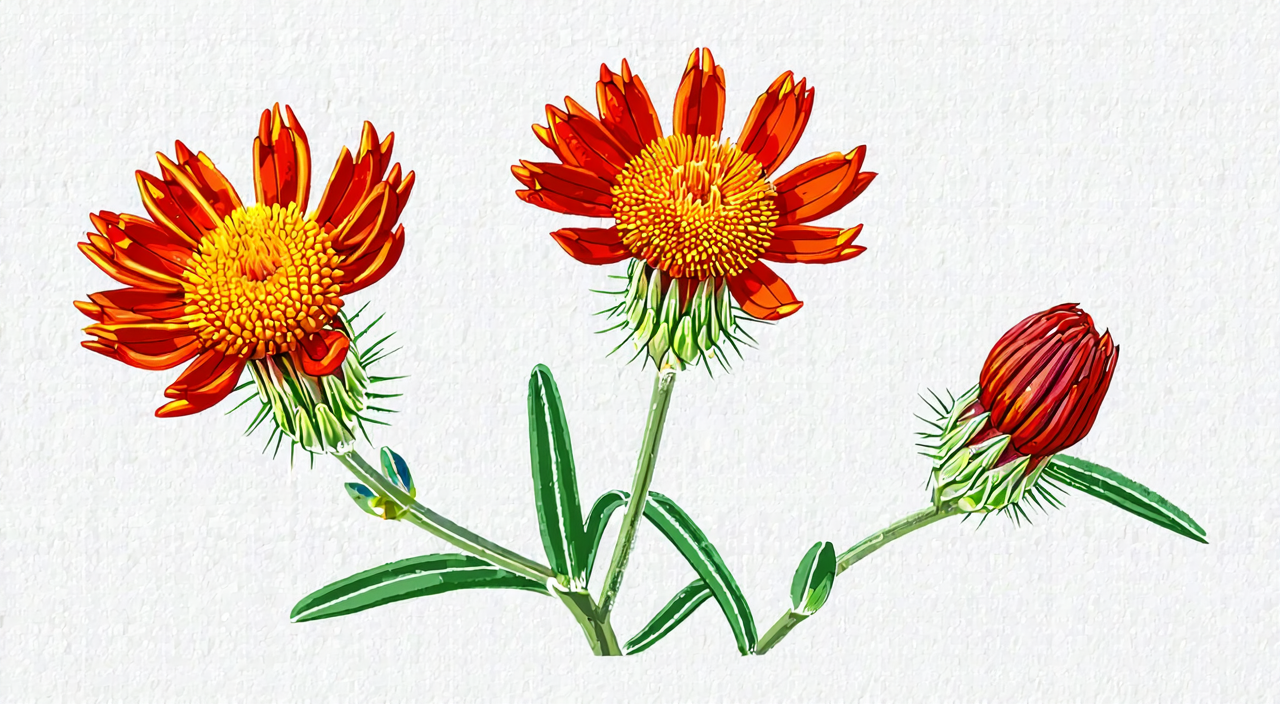
Dried safflower appears as a mass of soft reddish-yellow or red broken flowers. A complete individual flower is slender and tubular, with a corolla about 1.5–2 cm long, splitting into five narrowly linear lobes at the tip that look like thin fringe; the corolla tube is slender and long, and the base often retains a small ovary remnant. On close inspection, a yellow pistil stigma extends from the center of the corolla, with a slightly enlarged tip. The medicinal material as a whole feels soft and light, yet brittle, and has a faint, distinctive aroma. If a small pinch of safflower is rubbed onto white paper, the paper will be stained golden yellow or orange-yellow, which is one of its characteristics as a natural dye.
Occasionally, other flowers are dyed and passed off as safflower on the market, so when identifying it, in addition to checking the color and tubular corolla, pay attention to whether the lobes are natural, whether the slender corolla tube is retained, and whether the color after rubbing is even and natural.
What Is the Medicinal Part of Safflower?
The medicinal part of safflower is the dried flower. It is usually harvested in summer when the flowers turn from yellow to red, at which point the petals are fully open and the color is rich. After harvest, it is generally dried in the shade or at low temperature, avoiding direct strong sunlight that may darken the color and cause loss of active components. Dried safflower can be used directly, and traditionally it may also be used raw or stir-fried; different processing methods may influence its therapeutic tendency.
As a medicinal material, the dried corolla of safflower is often used directly, or it is crushed and combined with other medicinal substances. The texture, color, and odor of the corolla are important references for judging quality. Good safflower is bright in color, with intact tubular flowers, without excessive fragments and impurities, and has a fresh, non-pungent fragrance.
How Does Traditional Chinese Medicine Understand Safflower?
From the perspective of traditional Chinese medicine, safflower is generally classified within the category of activating blood and transforming stasis. Its nature and flavor are acrid and warm, and it usually enters the Heart and Liver meridians. In traditional understanding, safflower “enters the blood aspect” and is skilled at invigorating blood, unblocking menstruation, dispersing stasis, and relieving pain. When there is poor menstrual flow caused by blood stasis obstruction, postpartum lochia that is not expelled smoothly, or localized bruising, swelling, and pain after traumatic injury, safflower is commonly considered as a possible direction.
However, this “activating blood” action is not suitable for all situations. Chinese medicine emphasizes pattern differentiation. If a person has qi and blood deficiency, or a clear tendency to bleed, using safflower alone may be inappropriate. Therefore, safflower is often used together with peach kernel, Chinese angelica root, and Sichuan lovage root to promote blood movement within a formula, and it is rarely used alone in large doses.
What Does Modern Research Find About Safflower?
Modern research mainly focuses on components in safflower such as safflower yellow and safflower glycosides. Some in vitro studies and animal experiments suggest that safflower extracts may have certain effects on platelet aggregation, vasodilation, and microcirculation. In addition, some studies have observed a protective effect of safflower yellow in myocardial ischemia models.
However, these studies are mostly laboratory explorations or small-scale observations at present, and there is still a distance from establishing them as standard evidence-based medical interventions. These findings can serve as one aspect of understanding safflower, but they should not be directly equated with “eating it can prevent or treat cardiovascular and cerebrovascular problems.” This point requires particular clarity.
What Are the Differences Between Safflower, Saffron, and Campsis Flower?
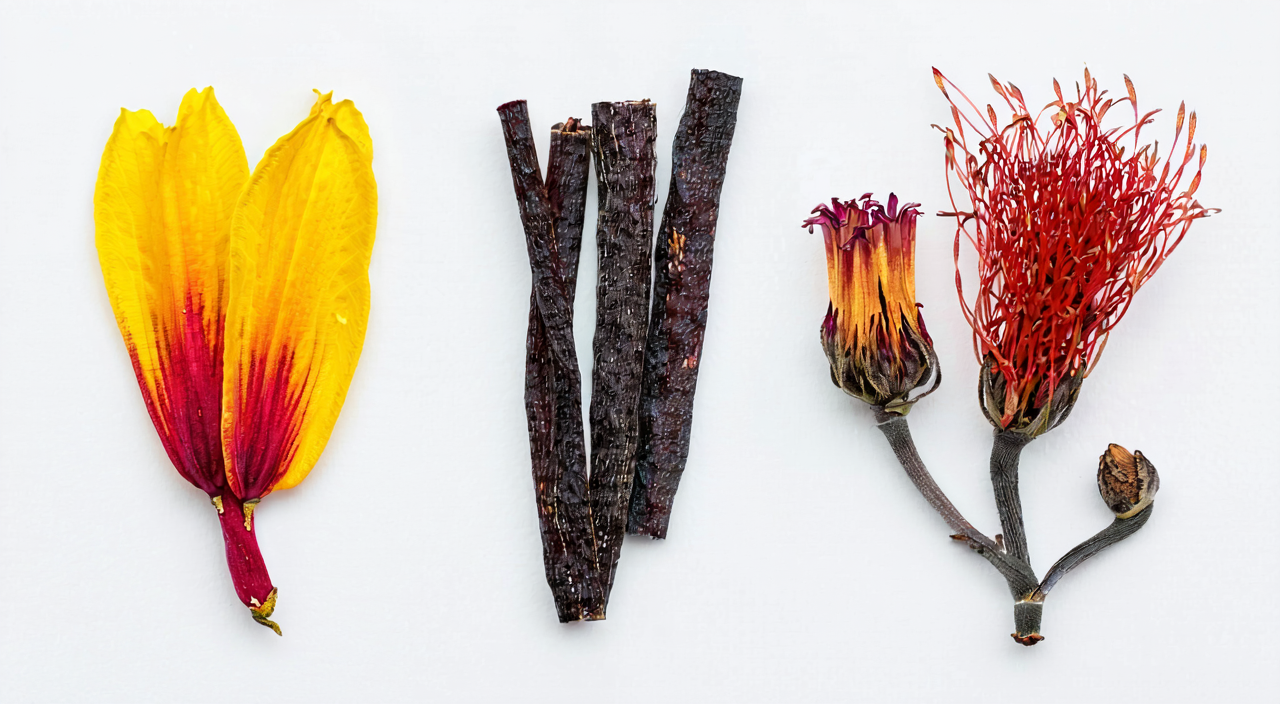
Safflower, saffron, and campsis flower are three medicinal substances that are easily confused in name or appearance. They come from different plants, and their medicinal parts and morphological differences are obvious.
Saffron is not a “red flower” at all; it is the dried stigma of Crocus sativus. It appears as dark red, thread-like pieces, each very slender, without any petal structure. When a small amount of saffron is placed in water, it releases a golden-yellow color and slowly sinks in a thread-like manner, and the water does not immediately turn cloudy red. This makes it clearly different from the color released when safflower tubular corollas are added to water. In traditional use, saffron also has a blood-activating action, but its nature tends to be cool and moistening, whereas safflower tends to be acrid and warm, so their directions differ.
Campsis flower is the flower of Campsis grandiflora or Campsis radicans in the Bignoniaceae family. It is usually quite broken, and the intact corolla is funnel-shaped, brownish-red or dark red in color, with a texture very different from the tubular corolla of safflower. Traditionally, campsis flower is used more for cooling the blood and dispelling wind, which differs from safflower’s emphasis on activating blood and unblocking menstruation. Therefore, recognizing the tubular corolla of safflower, the slender stigma of saffron, and the funnel-shaped corolla of campsis flower is a basic method for quickly distinguishing them.
Which Formulas Use Safflower?
When studying traditional formulas, safflower often appears as a blood-activating herb in various combinations. The following formulas are common examples. They have different therapeutic directions, but all contain safflower.
Taohong Siwu Tang is based on Siwu Tang with the addition of peach kernel and safflower. Traditionally, it is commonly used for menstrual irregularities, dysmenorrhea, or dark purple menstrual flow with clots caused by blood stasis combined with blood deficiency.
Xuefu Zhuyu Tang combines peach kernel, safflower, Chinese angelica root, rehmannia root, and achyranthes root, among others. It focuses on blood stasis in the chest, and common reference directions include chest pain, chronic headache, insomnia, and vivid dreaming associated with blood stasis.
Tongqiao Huoxue Tang highlights a combination of musk, peach kernel, safflower, red peony root, and Sichuan lovage root. Its traditional focus is on stasis obstruction in the head and face, such as chronic headache, hair loss, deafness, and a dull complexion.
Fuyuan Huoxue Tang contains bupleurum root, trichosanthes root, Chinese angelica root, safflower, and peach kernel, among others. It emphasizes blood stasis retained after traumatic injury and stabbing pain in the chest and hypochondrium. Traditionally, it is used to activate blood, dispel stasis, soothe the liver, and unblock the collaterals.
These formulas each have their own emphasis: some lean toward nourishing blood, some toward moving qi, and some toward unblocking collaterals. However, they all need to be used based on accurate pattern differentiation, and mechanically applying a formula is often unsafe.
What Precautions Should Be Taken When Using Safflower?
Although safflower is common, it is not suitable for everyone. Pregnancy is a situation that requires particular avoidance, because its blood-activating action may stimulate uterine contractions. People with heavy menstrual bleeding, uterine bleeding, or other clear bleeding tendencies also need to be very cautious and should preferably consult a doctor before considering its use.
People taking anticoagulant or antiplatelet medications should fully assess the risks before using safflower, because safflower may enhance the effects of these drugs and increase the risk of bleeding.
In addition, adulteration occurs in the market, where other petals or other plants are dyed to imitate safflower. These fake products may simply be dyed plant fragments, without safflower components, and may even bring unnecessary health risks. When purchasing, it is advisable to buy from reliable sources and observe whether the appearance has the characteristic intact tubular corolla.
When using safflower for health maintenance or daily regulation, it is not recommended to steep it in water or boil it in soup in large amounts over a long period. Suitability should still be judged based on individual constitution, specific symptoms, and advice from relevant professionals.
Summary
Safflower is the dried corolla of Carthamus tinctorius in the Asteraceae family, and it is a completely different medicinal substance from saffron. Its tubular corolla, reddish-yellow or red appearance, and traditional use for activating blood and unblocking menstruation are key to identification and understanding. Whether using safflower as a single herb or in formulas containing it, it is essential to understand its blood-activating characteristics and contraindications, especially for those who are pregnant, have bleeding tendencies, or are taking anticoagulants. This article is for general educational reference only and cannot replace professional diagnosis or individualized advice. For medication safety, always consult a qualified professional.