
What Is Pepper? Medicinal Parts, Identification, and Common Formulas
When people mention pepper, many first think of black pepper in Western cooking or white pepper used in Chinese cooking to remove unpleasant odors and enhance flavor. In fact, pepper is not only a seasoning; in traditional Chinese medicine, it is also a long-used medicinal substance. Pepper comes from the nearly mature or mature fruit of the pepper plant, Piper nigrum, and is mainly divided into black pepper and white pepper according to harvest timing and processing methods. Although both come from the same source, they differ somewhat in appearance, aroma, and traditional usage emphasis. This article will discuss pepper’s appearance and identification, medicinal parts, traditional Chinese medicine understanding, formula applications, and precautions, helping readers understand this common aromatic medicinal more comprehensively.
What Does Pepper Look Like? How Is It Identified?
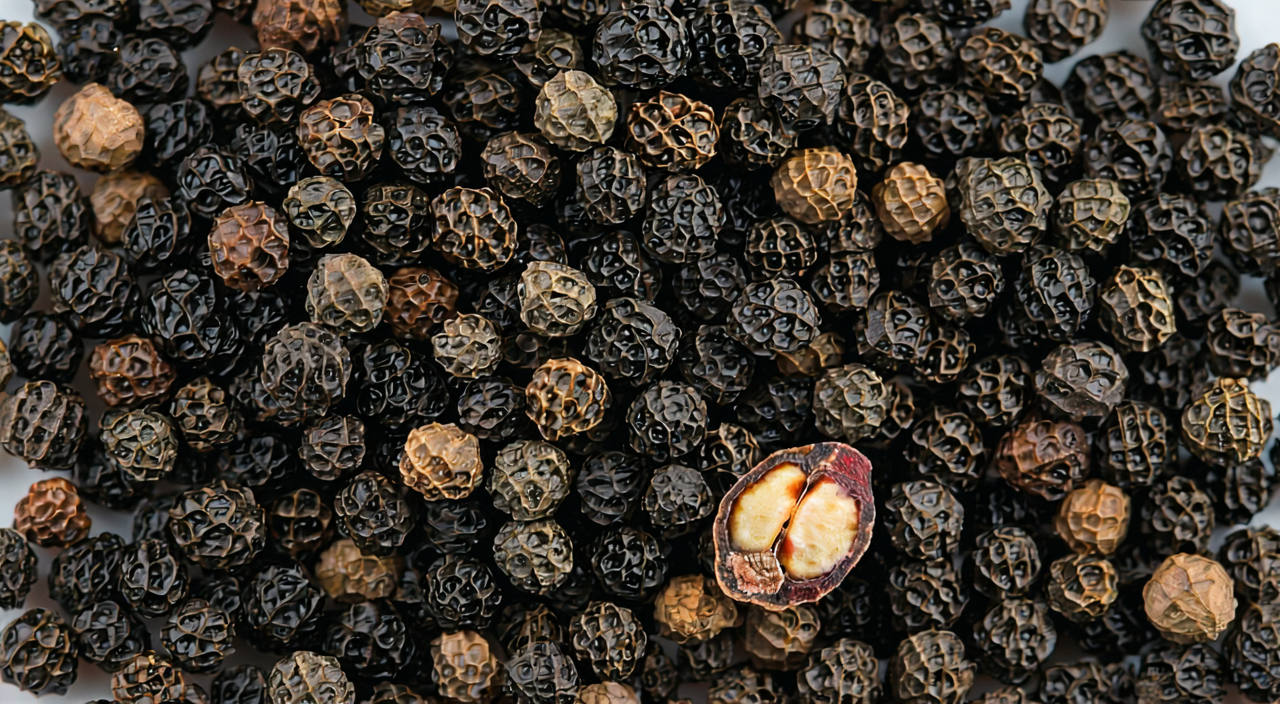
Pepper fruit is a berry that grows in spike-like clusters on the original plant, but the pepper we commonly see is mostly dried granules. Identification can be approached from three aspects: shape, surface features, and aroma.
Dried pepper fruits are mostly spherical, about 3–6 mm in diameter. Black pepper is made from nearly mature fruits that are directly sun-dried or oven-dried; its surface is blackish brown with prominent net-like wrinkles, the texture is relatively hard, and a small remnant of the stigma base often remains at the top. White pepper is made from fully mature fruits that are first soaked to remove the pericarp and flesh, and the seed kernels are then dried; therefore its surface is grayish white or pale yellowish white, very smooth, with almost no visible wrinkles, and sometimes light longitudinal ridges can be seen. Both are considered best when the grains are large, plump, and strongly aromatic.
In terms of aroma, pepper has a distinctive pungent fragrance, and a clear spicy-numbing sensation is felt when chewing. Black pepper retains its volatile components more completely, giving a sharper pungent aroma, while white pepper has a relatively more subdued aroma but still has a strong warming sensation.
What Is the Medicinal Part of Pepper?
The medicinal part of pepper is its dried nearly mature or mature fruit. In other words, what is actually used as a medicinal substance is not the root, leaves, or branches of the plant, but the fruit itself; it simply appears as black pepper or white pepper depending on the processing method.
At harvest, black pepper uses slightly greenish-yellow fruits that are not yet fully mature; at this stage the pericarp tightly wraps the seed kernel. White pepper, by contrast, is harvested when the fruit is fully mature and turning red, then the outer skin is removed by soaking or fermentation, and finally the grayish-white seed kernel is obtained. Removing the pericarp not only changes the appearance but also adjusts its acrid dispersing nature to a certain degree. Traditionally, white pepper is considered more focused in warming the middle and dispelling cold, while black pepper, because it retains the pericarp, seems to have stronger acrid dispersing power. It should be clear that regardless of the processing method, the part used as medicine is always the fruit and its inner seed kernel, not any other organ.
How Does Traditional Chinese Medicine Understand Pepper?
In traditional Chinese medicine theory, pepper is classified as an interior-warming medicinal. Traditional materia medica generally summarizes its nature and flavor as acrid and hot, entering the stomach and large intestine meridians. Understanding of its actions focuses mainly on two aspects: warming the middle and dispelling cold, and directing qi downward to resolve phlegm.
“Warming the middle and dispelling cold” means that pepper can warm the spleen and stomach and dispel cold pathogens lingering in the middle burner. When cold pathogens directly invade or the spleen and stomach are deficient-cold, causing cold pain in the gastric region, vomiting of clear fluid, poor appetite, and loose stools, pepper is often used as a medicinal in this type of regulating approach. Traditionally, pepper is often combined with warming substances such as dried ginger, long pepper, and galangal to strengthen the effect of warming the middle burner.
Directing qi downward and resolving phlegm reflects pepper’s use in regulating qi movement and addressing phlegm-dampness. Traditional Chinese medicine holds that congealing cold pathogens can easily affect qi movement, leading to qi counterflow and the binding of phlegm and qi. Pepper’s acrid-hot nature helps drive qi downward and has a certain resolving effect on cold-type phlegm-dampness. In some regulating approaches for chest oppression, cough and wheezing, or profuse clear phlegm caused by cold-phlegm, pepper has also been included in formulas. Of course, these understandings remain within the scope of traditional theory, and whether they suit an individual must be judged comprehensively in light of specific constitution and symptoms.
What Does Modern Research Reveal?
Modern research mainly focuses on active components such as piperine contained in pepper. Some basic experiments show that piperine has certain effects in promoting digestive fluid secretion and influencing gastrointestinal motility, which may correspond to part of the traditional experience of “warming the middle.” In addition, in studies on component extraction, pepper has been observed to have antioxidant potential and the potential to influence certain inflammatory pathways, but most of these findings come from in vitro experiments or animal studies, and there is still distance from forming broadly applicable health recommendations.
Therefore, this content is more suitable as background information rather than as a definite basis for guiding personal daily regulation. Any idea of using pepper extracts for specific health goals should be viewed cautiously with the support of professional scientific research and clinical evidence.
What Are the Differences Among Black Pepper, White Pepper, and Sichuan Pepper?
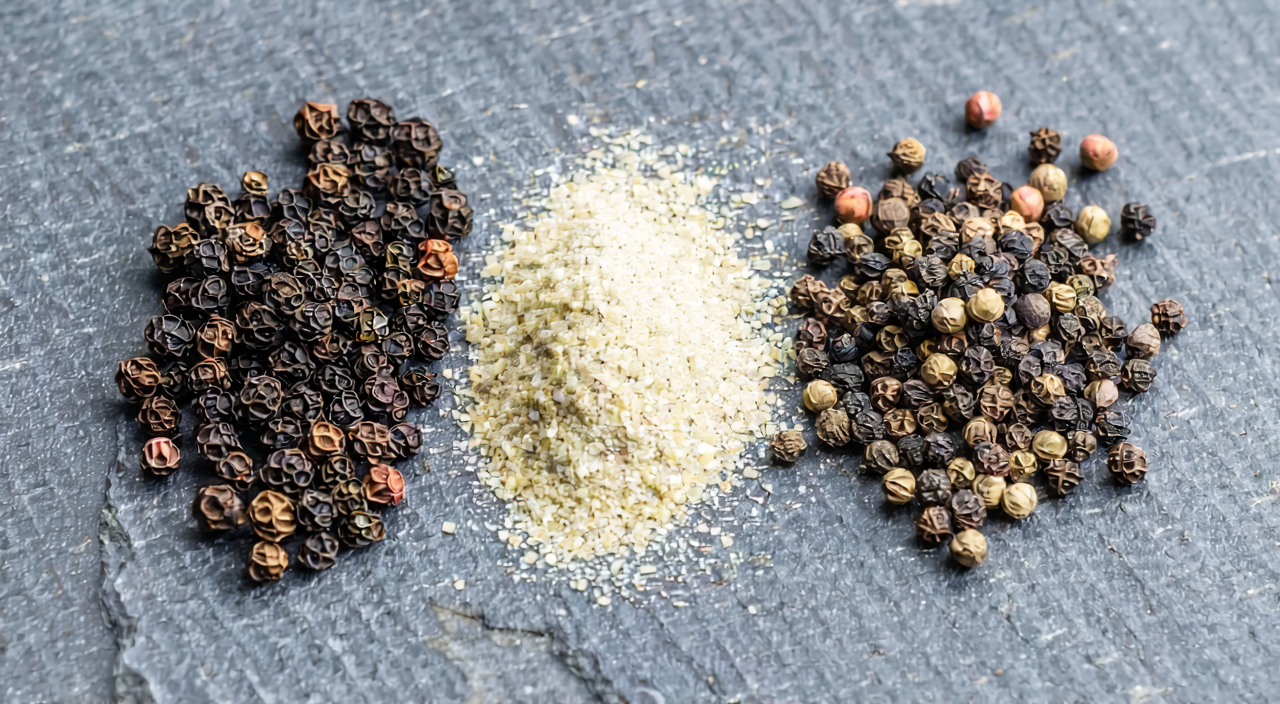
The difference between black pepper and white pepper lies mainly in the processing method and the presence or absence of the pericarp, as mentioned earlier. Here is a clearer summary: black pepper has the pericarp, is blackish brown, has a wrinkled surface, and has a more rising pungent aroma; white pepper has the pericarp removed, is grayish white, has a smooth surface, has a more focused warming sensation, and a deeper pungency. In traditional use, black pepper is often used for exterior cold or situations requiring dispersal, while white pepper is more oriented toward warming the interior and is suitable for chronic patterns of spleen-stomach deficiency-cold. Essentially both are pepper, just with different emphases.
Many people easily confuse pepper with Sichuan pepper. Sichuan pepper belongs to the Rutaceae family, completely different from the Piperaceae family to which pepper belongs, so their appearance, nature, and flavor are fundamentally different. Sichuan pepper fruits often split open like small sacks, with wart-like glandular dots on the surface and a distinct numbing taste, while pepper is mainly pungent and does not have Sichuan pepper’s special tongue-numbing sensation. From the perspective of traditional Chinese medicine, although both are warm in nature, Sichuan pepper is also good at expelling parasites and relieving itching, and it enters the spleen, stomach, and kidney meridians; in addition to warming the middle and relieving pain, it can dry dampness, so its application directions are quite different. Comparing the two helps clarify pepper’s characteristics.
Which Formulas Use Pepper?
In traditional formulas, pepper is mostly used in combinations that warm the middle, dispel cold, and direct qi downward to stop vomiting. The following lists several relatively common application directions for informational reference only and should not be directly taken as medication advice.
Pepper Center-Regulating Pill appears in some ancient formula books. It is derived from Center-Regulating Pill by adding pepper and other medicinals, and is traditionally used for relatively severe deficiency-cold in the middle burner, vomiting, abdominal pain, watery diarrhea, and cold hands and feet. In this formula, pepper is combined with dried ginger, ginseng, and white atractylodes rhizome to strengthen the power of warming and supplementing the middle burner and dispelling cold to relieve pain. The selection of this type of formula depends heavily on accurately identifying cold signs, and it is clearly unsuitable for those with heat patterns or yin deficiency.
Pepper Decoction is another type of formula named after pepper. Different medical texts record slight variations, but most use pepper as the chief medicinal, combined with substances that warm the middle and move qi, and are used for stomach pain, vomiting, and hiccups caused by cold pathogens invading the stomach. Traditional experience holds that Pepper Decoction is specifically effective at warming the middle and stopping vomiting, making it suitable for cold-type vomiting and hiccups.
In addition, some formulas in the category of warming the middle and dispelling cold, although not directly named after pepper, may include pepper according to symptomatic needs. For example, in dietary therapies or pill formulas for spleen-stomach deficiency-cold, a small amount of pepper is often added as an ingredient to provide a warming and unblocking effect. However, pepper is an acrid-hot substance, so these formulas generally use a small dose and are often combined with other medicinals to restrain its effects. If individuals want to know whether a specific formula is suitable for them, they must consider their constitution, symptoms, and professional judgment, and should not choose it merely based on its name or a rough impression.
What Precautions Should Be Taken When Using Pepper?
Although pepper is common, it is not suitable for everyone to use casually in large amounts. The following situations require special attention.
First, people with gastritis, gastric ulcers, or duodenal ulcers should be very cautious. Pepper is acrid and hot in nature and can easily irritate the gastric mucosa, possibly causing a burning sensation, stomach pain, or worsening of the ulcer surface. Such people should avoid large amounts of pepper or high-concentration pepper products as much as possible in their daily diet and in any regulation. Second, people with yin deficiency with effulgent fire constitution should not use it in large amounts. If one usually has dry mouth and throat, hot palms, night sweats, a red tongue with little coating, this indicates that yin fluids are relatively insufficient, and using acrid-hot substances may further aggravate deficiency fire and cause discomfort. Third, during bleeding from hemorrhoids or an obvious blood-heat state, traditional understanding holds that pepper’s warm nature that stirs the blood may not be conducive to recovery, so it is advisable to stop using it temporarily. Fourth, even as a daily seasoning, long-term excessive consumption is not recommended. Excessive pungent stimulation may adversely affect the entire digestive tract, especially in children, the elderly, and people with weak gastrointestinal function.
When obvious stomach pain, repeated vomiting, black stools, unexplained weight loss, or similar signs occur, it is not recommended to self-treat with pepper or pepper-containing formulas; seek medical help promptly to clarify the nature of the problem.
Summary
As a material used both as food and medicine, pepper is understood in traditional Chinese medicine mainly from the perspectives of warming the middle and dispelling cold and directing qi downward to resolve phlegm. Because of different harvest times and processing methods, black pepper and white pepper differ in appearance and in their emphasis on acrid dispersal versus warming the interior, and should be distinguished according to the actual situation. Traditional formulas such as Pepper Center-Regulating Pill and Pepper Decoction should be treated cautiously based on a full understanding of one’s own constitution and symptoms and in combination with professional advice; they should never be used on impulse. This article is for informational reference only and cannot replace professional diagnosis or individualized health guidance.