
What Is Laifuzi? Medicinal Part, Identification Methods, and Common Formulas
Many people are not familiar with Laifuzi, but when mentioning “radish seeds,” some households have an impression. Laifuzi is the mature seed of the cruciferous plant radish, harvested and dried for medicinal use. Although it seems similar to the raw radish seeds we casually discard, there are specific requirements for harvest time and processing. Raw radish seeds from the kitchen, without selection and treatment, should not be directly used as Laifuzi. Medicinal Laifuzi is often divided into raw and dry-fried forms, and their traditional uses differ. This article provides a relatively complete reference framework covering visual identification, medicinal part, TCM perspectives, differences from Zisuzi and Baijiezi, common formulas, and precautions, for readers who want to understand Laifuzi.
What Does Laifuzi Look Like? How to Identify It?
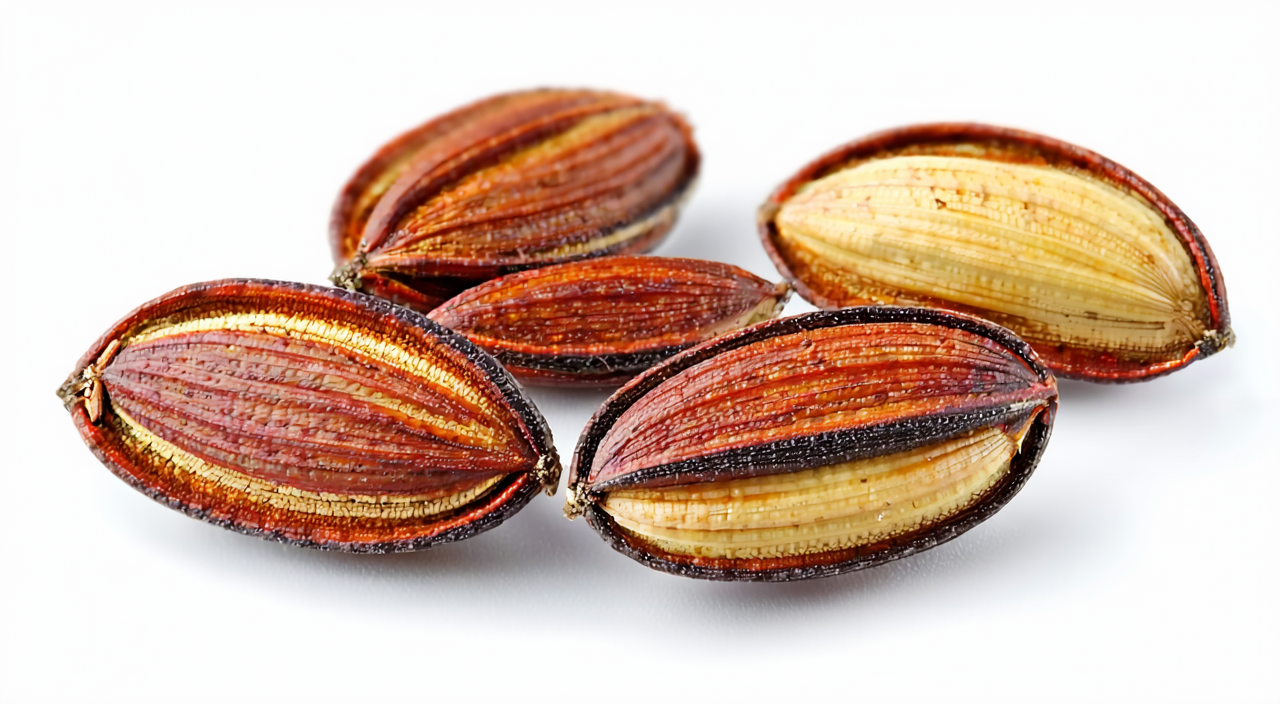
Laifuzi has distinctive appearance characteristics that can be identified through careful observation from several aspects.
Overall, Laifuzi is subovoid or elliptical, slightly flattened, and not large—generally about 2.5–4 mm long and 2–3 mm wide. The surface color is mostly yellowish-brown, reddish-brown, or grayish-brown, with a few darker shades. Under a magnifying glass, the seed surface has densely arranged fine reticulate patterns, which is one of the key features that distinguish Laifuzi from other similar seeds. One end of the seed has a round hilum with a slightly darker color.
If you cut the seed with a fingernail or blade, you will see two thick cotyledons inside, whitish or yellowish-white in color, rich in oil. When rubbed between fingers, it feels noticeably greasy. Laifuzi has a faint odor; when chewed, there is a slight oily fishy taste and a mild pungent sensation, but not a spicy heat.
Sometimes, Laifuzi with overly pale color or a distinct moldy smell can be encountered on the market; this is often related to improper storage or adulteration. When identifying, combine features such as color, reticulation, and oily cotyledons for a more reliable overall impression.
What Is the Medicinal Part of Laifuzi?
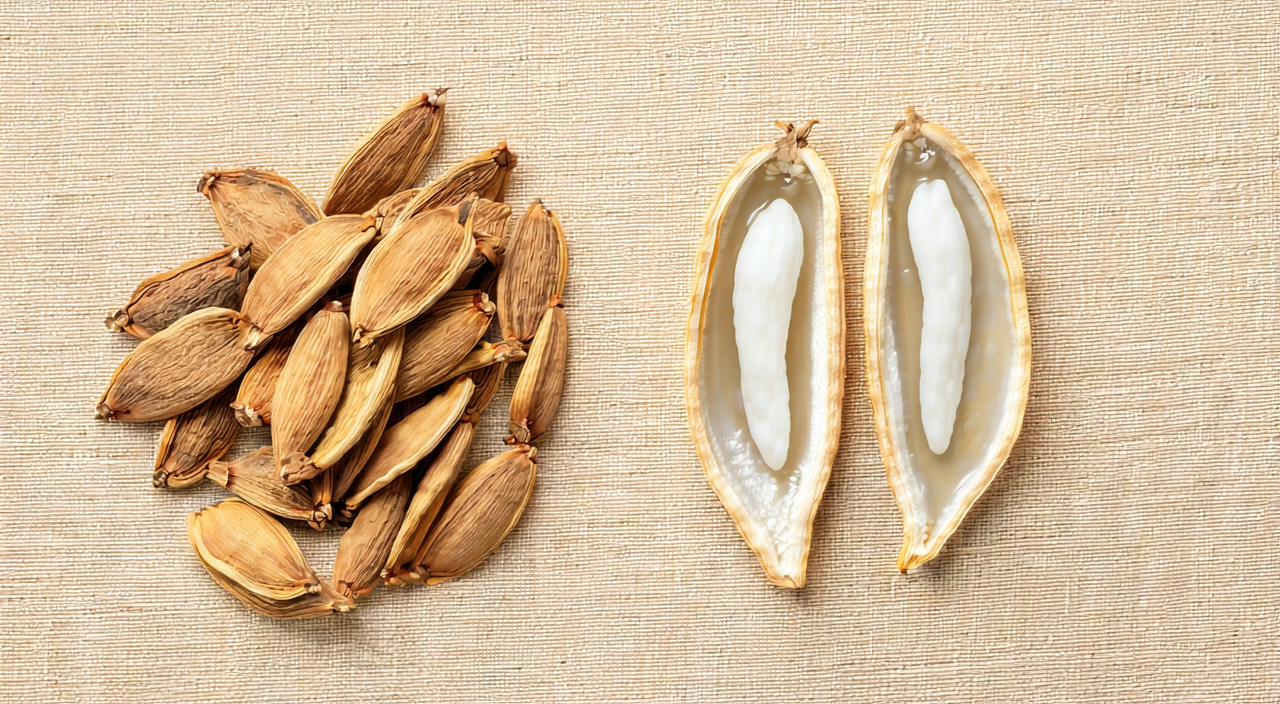
The medicinal part of Laifuzi is clearly the dried mature seed of radish. Generally, in summer or autumn, when the above-ground parts of the radish begin to turn yellow and the siliques are mature but not yet dehiscent, the whole plant is cut down and sun-dried. The seeds are then beaten out, impurities removed, and dried thoroughly—this becomes medicinal Laifuzi.
Traditionally, Laifuzi can be used raw or dry-fried. Raw Laifuzi retains the oily moist nature of the seed, has a more pungent odor, and is traditionally considered to have a relatively stronger effect in expelling phlegm and saliva. Dry-fried Laifuzi is stir-fried over low heat until it slightly bulges, the surface color deepens, and an aroma emerges; it is then removed and cooled. The oily nature is moderated after frying, and its medicinal action tends to target the middle and lower jiao, making it commonly used for eliminating food stagnation and relieving distension, and for directing qi downward and resolving phlegm. Therefore, when dispensing formulas containing Laifuzi, practitioners often specifically note the use of dry-fried Laifuzi, which differs from the focus of the raw product in traditional thinking.
In simple terms, whether raw or dry-fried, the basic medicinal part is the same; the differences in traditional usage arise from the processing method.
How Does TCM View Laifuzi?
In traditional Chinese medicine theory, Laifuzi’s meridians entered are mostly related to the spleen, stomach, and lung, and its nature and flavor are pungent, sweet, and neutral. In terms of functions, it is most often mentioned for eliminating food stagnation and relieving distension, and for directing qi downward and resolving phlegm.
Eliminating food stagnation and relieving distension addresses conditions such as abdominal distension, belching, acid regurgitation, and poor appetite caused by food stagnating in the middle jiao and qi movement impairment. Laifuzi is especially known for addressing food accumulation from overeating starchy or greasy foods. Traditionally, it is often combined with Shenqu (medicated leaven), Shanzha (hawthorn), Maiya (malt) and other herbs for pronounced food stagnation and abdominal distension.
Directing qi downward and resolving phlegm is mainly used for cough, wheezing, and profuse phlegm conditions that tend to be excessive in nature. It is traditionally believed that Laifuzi can direct lung qi downward and transform turbid phlegm. It is often paired with other seed-based medicinals such as Zisuzi (perilla seed) and Baijiezi (white mustard seed) to assist in patterns of phlegm and qi obstruction with wheezing, cough, and chest fullness.
Some ancient texts also mention that Laifuzi can promote qi circulation and relax the bowels, offering auxiliary support for constipation due to qi stagnation. However, this is generally considered under clear pattern differentiation and in combination with other herbs.
It should be noted that these views are based on traditional TCM pattern differentiation and treatment. Whether Laifuzi is suitable, and whether raw or dry-fried, depends on individual constitution and accompanying symptoms.
What Does Modern Research Say?
Modern research on Laifuzi focuses primarily on its chemical composition and pharmacological activities. Laifuzi contains fatty oils, volatile oils, sinapine, sulforaphane, and various enzymes. The high content of fatty oils accounts for the oily feel of the seeds.
Some in vitro studies and animal experiments suggest that Laifuzi extract can influence gastrointestinal smooth muscle activity, potentially promoting gastrointestinal motility. Additionally, some studies have observed expectorant and antitussive activities in respiratory tract experiments. However, most of these studies are still at a preliminary exploratory stage, and there is a gap before uniform clinical consensus is reached. For the general readership, this content can serve as extended background information about the herb and should not be directly equated with specific human effects of Laifuzi.
What Are the Differences Between Laifuzi, Zisuzi, and Baijiezi?
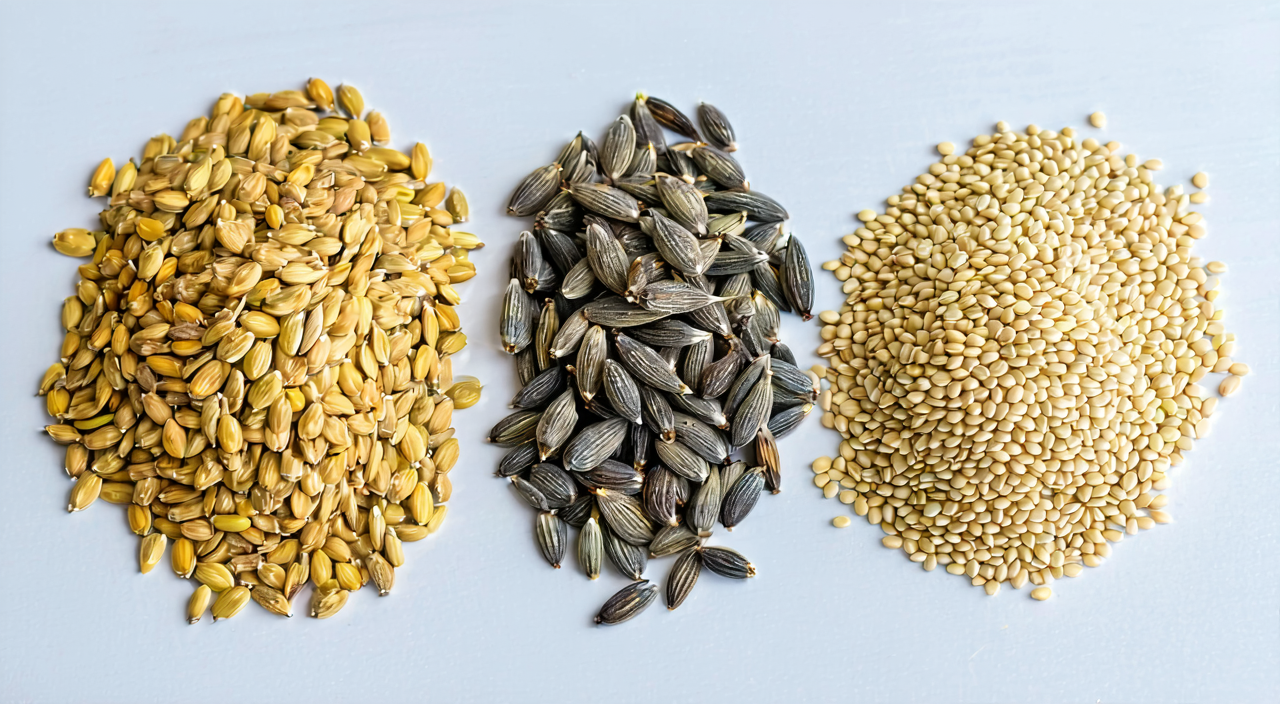
Laifuzi, Zisuzi, and Baijiezi are all commonly used seed-based medicinals. They can be easily confused in appearance and partially overlap in traditional uses, but their differences are actually quite distinct.
In terms of size, Zisuzi is the smallest, usually ovoid or spherical, with a diameter of less than 2 mm; Baijiezi is slightly larger, spherical, about 2–2.5 mm in diameter; Laifuzi is the largest, subovoid or elliptical, with a length usually over 2.5 mm. Among the three, Laifuzi is the largest in size, making it easy to distinguish in a side-by-side comparison.
In terms of color, Zisuzi is mostly grayish-brown or grayish-tan, with slightly raised dark reticulation on the surface; Baijiezi is mostly yellowish-white or pale yellow, with a relatively smooth surface and no obvious reticulation; Laifuzi is yellowish-brown, reddish-brown, or grayish-brown, with visible fine reticulate patterns—this is one of the very intuitive features for identifying Laifuzi.
In terms of odor and taste, Zisuzi has a faint aromatic scent and an oily taste when chewed, but is not strongly pungent; Baijiezi has a stronger odor and, after grinding, a strong pungency similar to mustard’s heat; Laifuzi has a relatively bland odor, with pronounced oiliness when broken open and a mild pungent taste.
In traditional usage, all three can be used for cough and wheezing with abundant phlegm, but with different emphases. Zisuzi leans toward directing qi downward and calming wheezing, along with moistening the intestines; Baijiezi tends to warm the lung and transform phlegm, promote qi circulation, and dissipate masses; Laifuzi excels at eliminating food stagnation and relieving distension, directing qi downward and resolving phlegm, making it more suitable for cases of food accumulation and phlegm congestion accompanied by abdominal distension. The formula Sanzi Yangqin Decoction (Three-Seed Filial Devotion Decoction) uses all three precisely to take advantage of their respective strengths in dealing with the complex situation of phlegm congestion and qi counterflow with chest and abdominal fullness.
Which Formulas Include Laifuzi?
Laifuzi appears in many classic formulas, especially those for eliminating food stagnation and guiding out accumulation, and for directing qi downward and resolving phlegm.
Baohe Wan (Harmony-Preserving Pill) is a well-known formula that uses dry-fried Laifuzi, together with Shanzha (hawthorn), Shenqu (medicated leaven), Banxia (pinellia), Fuling (poria), Chenpi (tangerine peel), and others. Traditionally it is used for overeating, epigastric and abdominal distension, foul belching, and acid regurgitation due to undigested food. The concept of Baohe Wan focuses on digesting food and harmonizing the stomach, and Laifuzi plays a key role in eliminating food stagnation, relieving distension, moving qi, and guiding out accumulation.
Sanzi Yangqin Decoction (Three-Seed Filial Devotion Decoction) is another frequently mentioned formula. It consists of Zisuzi, Baijiezi, and Laifuzi, originally used for conditions of phlegm congestion and qi counterflow with cough, wheezing, fullness in the chest and abdomen. Among the three seeds, Laifuzi tends to direct qi downward and relieve distension, complementing Zisuzi’s qi-descending action and Baijiezi’s phlegm-transforming effect, and the overall prescription targets patterns where phlegm and qi obstruct each other, leaning toward excess.
Laifuzi Powder is another type of formula where Laifuzi takes the lead. Versions recorded in ancient texts vary: some use Laifuzi alone ground into powder, while others combine it with other qi-regulating and stagnation-resolving herbs, mainly for food accumulation with abdominal distension and qi stagnation.
Additionally, in some formulas for digesting food and resolving phlegm, Laifuzi often appears in dry-fried form, frequently combined with Juhong (red tangerine peel), Zhishi (immature bitter orange), Fuling (poria), Muxiang (costus root), and others, for patterns of food stagnation with cough, profuse phlegm, and a thick greasy tongue coating.
These formulas are traditional combinations repeatedly used within the TCM pattern differentiation framework. Whether they suit an individual’s specific situation requires comprehensive assessment based on constitution and actual presentation, with reference to professional advice.
What Precautions Should Be Taken When Using Laifuzi?
Although Laifuzi comes from the seeds of the common vegetable radish, there are still some traditional precautions worth knowing when it is used as a medicinal.
First, those with pronounced qi deficiency should be cautious when using Laifuzi. Traditionally, Laifuzi is thought to move qi and guide out stagnation. For people with genuine qi deficiency, shortness of breath, fatigue, and abdominal distension that feels empty on palpation, taking it alone or in large amounts may further deplete spleen and stomach qi. Similarly, individuals with long-term loose stools and obvious spleen-stomach yang deficiency are also not suitable for large amounts of raw Laifuzi. Although dry-fried Laifuzi is milder, it should still be considered within the context of pattern differentiation.
Second, many health-conscious people ask whether Laifuzi and Renshen (ginseng) can be used together. Traditionally it is widely believed that Laifuzi can weaken Renshen’s qi-tonifying effect, so it is generally not recommended to take large amounts of Laifuzi together with ginseng-type tonics. However, this view is more based on traditional compatibility prohibitions and is not an absolute contraindication. In special circumstances, some practitioners may combine them to achieve “tonifying without causing stagnation,” but this must be based on clear pattern differentiation and precise dosage ratios; ordinary people should not attempt this on their own.
Another detail easily overlooked is that the fatty oils in Laifuzi can go rancid. If stored improperly, especially in hot and humid conditions for too long, Laifuzi may develop oil oozing, darker color, and a rancid smell; such Laifuzi should no longer be used. Therefore, after purchase, it should be sealed and stored in a cool, dry place, and it is not advisable to stockpile too much at once.
If symptoms such as abdominal distension, cough, or indigestion recur, or are accompanied by marked anxiety, palpitations, chest distress, or significant weight loss, one should not rely solely on Laifuzi or related formulas, but should promptly consult a local physician or professional to identify the underlying cause.
Summary
Laifuzi is the mature seed of radish, characterized by its subovoid shape, yellowish-brown to reddish-brown color, and fine reticulation as key identification features. Its medicinal part is clear, and raw and dry-fried forms differ in traditional thinking. Within the TCM framework, it is most often discussed in relation to eliminating food stagnation and relieving distension, and directing qi downward and resolving phlegm, and it forms a trio with Zisuzi and Baijiezi with distinct emphases. This article only provides an objective compilation of herbal information; specific use should always consider individual circumstances and professional advice to avoid blind application.