
What Is Lingxiao Flower? Medicinal Parts, Identification, and Common Formulas
Many people have seen clusters of orange-red trumpet-shaped flowers on garden fences or old courtyard walls, blooming vividly in midsummer—that is Lingxiao flower. In traditional Chinese medicine, Lingxiao flower is not merely an ornamental plant; after harvesting and processing, its flowers are also a long-used Chinese medicinal material. This article provides a relatively clear framework by covering what Lingxiao flower looks like, where its medicinal part lies, how Chinese medicine understands it, how it differs from safflower and Chinese rose flower, which formulas use it, and what precautions should be taken.
What Does Lingxiao Flower Look Like? How to Identify It?
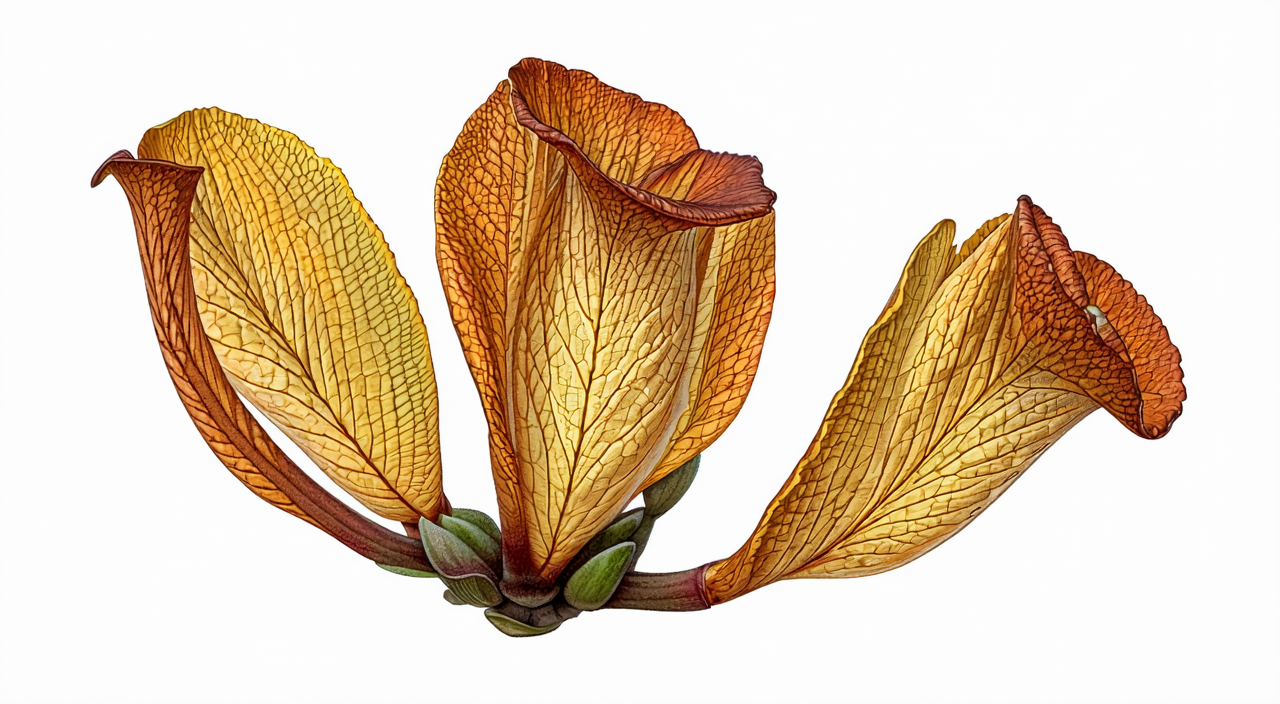
The original plants of Lingxiao flower are Campsis grandiflora or Campsis radicans of the Bignoniaceae family, and the medicinal part is mainly its flower. In appearance, the corolla is funnel-shaped, with a relatively wide corolla tube. The apex divides into five lobes, and the edges curl slightly outward, giving the whole flower a substantial appearance. After drying, Lingxiao flower is generally reddish-brown or orange-brown, with fine wrinkles on the surface and a thin, slightly brittle texture.
One key part for identification is the calyx. The calyx of Lingxiao flower is bell-shaped, usually brownish-yellow or grayish-green, with several obvious longitudinal ribs visible on the surface. This is an important feature that distinguishes it from certain tubular flowers of similar shape. Overall, dried Lingxiao flower is rarely complete and flat; most pieces are wrinkled or broken. However, by noting the funnel-shaped corolla, five-lobed apex, and longitudinal veins on the calyx, you can generally make a judgment.
What Is the Medicinal Part of Lingxiao Flower?
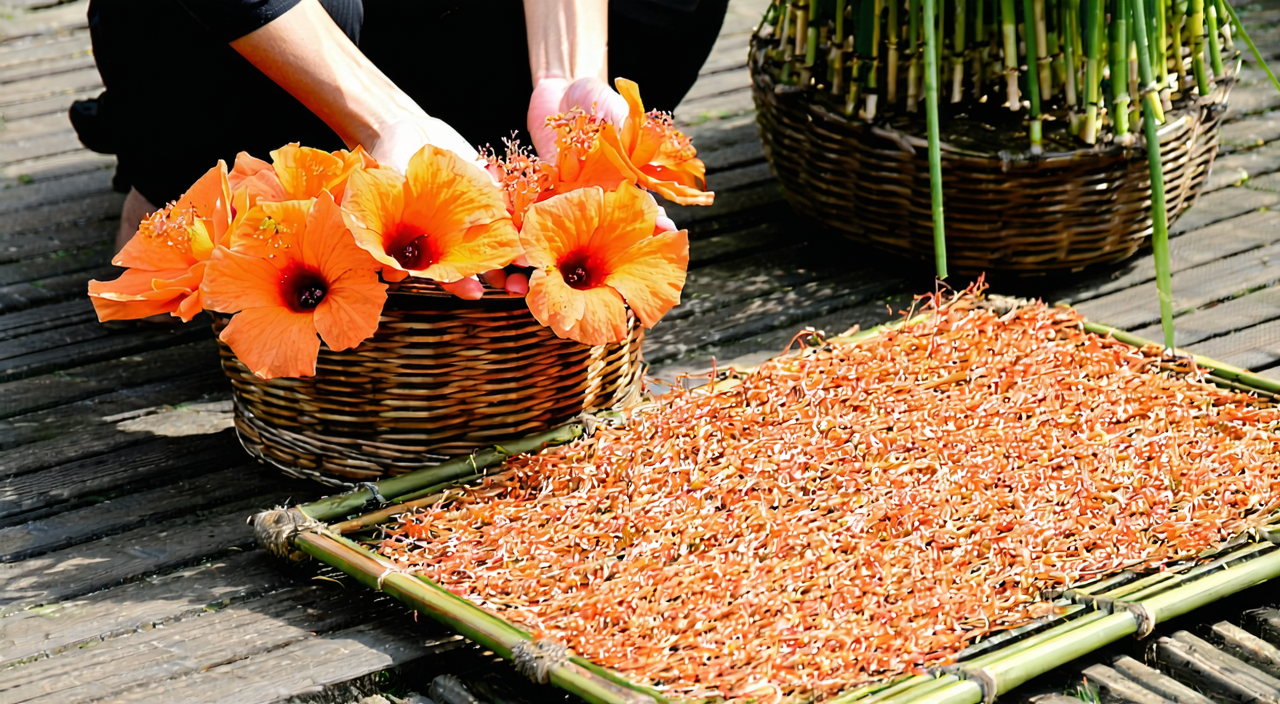
The medicinal part of Lingxiao flower is clearly its dried flower. It is usually harvested in summer and autumn when the flowers are in full bloom. After picking, twigs, leaves, and other impurities are removed, and then the flowers are made into medicinal material by sun-drying or low-temperature drying. In some regions, the flowers of Campsis radicans are also used. Although the plant morphology is slightly different, their functions are traditionally considered similar.
The harvesting and drying process has a significant impact on quality. If harvested too early, the flowers have not fully opened and the active constituents may be insufficient; if harvested too late, the petals are prone to falling off, affecting the appearance of the medicinal material. If the drying temperature is too high, the flowers may scorch and darken in color. Generally, those with a natural reddish-brown color, a faint pleasant fragrance, and no mold are considered best.
How Does Chinese Medicine Understand Lingxiao Flower?
In traditional Chinese medicine theory, Lingxiao flower is usually classified as a blood-activating and menstruation-regulating medicinal. In earlier classical texts, it is often called “Ziwei.” Traditionally, it is considered cold in nature and pungent in flavor; some texts record it as sour in flavor. It enters the liver and pericardium meridians. Its main actions can be summarized in two aspects: invigorating blood and unblocking menstruation, and cooling blood and dispelling wind.
From the perspective of invigorating blood and unblocking menstruation, Lingxiao flower is often used for blood-stasis-related menstrual irregularities, amenorrhea, masses and accumulations, and insufficient postpartum lactation. Because its nature is cool, it may be more suitable for patterns of stasis and heat binding or blood heat with stasis, while cold congealing and blood stasis require combination with warming and unblocking medicinals. Another aspect is cooling blood and dispelling wind. Ancient physicians also commonly used Lingxiao flower for skin issues related to blood heat generating wind, such as wind rash, pruritus, acne, and rosacea. These understandings come from long-term accumulated experience. Whether they apply to a specific individual must be carefully judged according to constitution and symptom presentation.
Brief Overview of Modern Research
Modern phytochemical studies show that Lingxiao flower contains flavonoids, phenylpropanoids, triterpenoids, and other constituents. Some of these compounds have shown certain anti-inflammatory, antioxidant, and microcirculation-improving activities under experimental conditions. These findings provide a modern perspective for traditional uses, but experimental data do not equal effects in the human body, and they remain mainly a direction for understanding.
How Does Lingxiao Flower Differ from Safflower and Chinese Rose Flower?
Many people easily confuse Lingxiao flower, safflower, and Chinese rose flower, especially when looking at their dried forms. In fact, the three differ clearly in source, medicinal part, and emphasis in traditional functions.
As described above, Lingxiao flower is a complete dried flower with an obvious funnel-shaped corolla, reddish-brown or brownish-red in color, and a calyx with longitudinal veins. Safflower is the dried tubular flower of Carthamus tinctorius of the Asteraceae family, without the ovary. Its corolla is red or dark red, slender and tubular, five-lobed at the apex, and relatively soft in texture. When placed in water, it releases an orange-yellow pigment. Chinese rose flower is the dried bud or newly opened flower of Rosa chinensis of the Rosaceae family. It often retains the receptacle and sepals, and its petals range from pink to purplish-red, arranged in multiple layers, with a rich, fragrant aroma.
In terms of traditional functions, safflower emphasizes invigorating blood, dispelling stasis, unblocking menstruation, and relieving pain, making it a commonly used medicinal for blood-stasis presentations. While Chinese rose flower invigorates blood and regulates menstruation, it is particularly good at soothing the liver and regulating qi, and is often used for menstrual irregularities caused by constrained liver qi. Lingxiao flower invigorates blood while also cooling blood and dispelling wind, so it is used more in cases of blood heat with stasis and certain skin problems. Although all three can be involved in regulating menstruation, their pathways and applicable directions are not exactly the same.
Which Formulas Use Lingxiao Flower?
Lingxiao flower is used as one ingredient in some traditional formulas. Here are two relatively common examples, provided only to illustrate traditional formulation thinking.
Lingxiao Hua San comes from Taiping Shenghui Fang. The original formula consists of Lingxiao flower, Chinese angelica root, red peony root, raw rehmannia root, and other ingredients. Traditionally, it is used for blood heat with stasis and inhibited menstruation. In this formula, Lingxiao flower is combined with other blood-cooling and blood-activating medicinals, giving the whole formula a cool and dispersing tendency.
Ziwei San comes from Yangshi Jiacang Fang. It uses Lingxiao flower (Ziwei) as the main ingredient, combined with Chinese angelica root, zedoary rhizome, and others. Traditionally, it is mostly used for amenorrhea or abdominal masses caused by internal obstruction of blood stasis in women. Its approach still centers on invigorating blood and dispelling stasis.
In addition, in some modern and contemporary empirical formulas for invigorating blood and dispelling stasis, Lingxiao flower is sometimes added according to the specific situation, especially when a tendency toward stasis and heat is considered. However, whether such formulas are suitable for an individual needs to be judged through a comprehensive assessment of constitution, symptom presentation, and professional advice, and should not be applied mechanically on one’s own.
What Precautions Should Be Taken When Using Lingxiao Flower?
Several aspects require special attention when using Lingxiao flower. First, it should not be used during pregnancy, because its blood-activating action is relatively strong, and it is traditionally believed to possibly affect pregnancy. Second, people with heavy menstrual bleeding or no signs of stasis should avoid using it, so as not to worsen bleeding. Third, those with a bleeding tendency, such as frequent gum bleeding, subcutaneous bruising, or poor coagulation, should also be cautious. Fourth, it is particularly important to note that ornamental Lingxiao flowers planted along green belts or in gardens may contain pesticide residues or insecticide components, and must not be picked and used as medicine on one’s own. Medicinal Lingxiao flower should be purchased from reputable channels and meet relevant quality standards.
In addition, if menstrual irregularities or skin problems persist or recur over a long period, or if they are accompanied by significant pain, abnormal bleeding, or low mood, it is advisable to seek medical evaluation first and identify the cause before discussing a management approach. The information in this article does not constitute medical advice.
Summary
As a traditional Chinese medicinal, the key medicinal features of Lingxiao flower are its funnel-shaped dried flower and the longitudinal veins on the calyx, which can be used to distinguish it from safflower and Chinese rose flower. Chinese medicine generally applies it to invigorate blood, unblock menstruation, cool blood, and dispel wind. Related ancient formulas such as Lingxiao Hua San and Ziwei San reflect this approach. However, before actual use, individual circumstances should be considered and assessed by a professional, especially for those who are pregnant, have heavy menstrual bleeding, or have a bleeding tendency, for whom it should be avoided. The above content is for general educational reference only and cannot replace professional diagnosis or treatment advice.