
What Is Lingzhi? Medicinal Parts, Identification and Common Formulas
Lingzhi (Ganoderma) is a widely recognised medicinal substance in traditional Chinese medicine. Much of the public’s interest comes from wellness culture, classical records and everyday discussions about health maintenance. Yet basic questions are often overlooked—what exactly does “Lingzhi” refer to, how do the different sources differ in appearance, which parts are used as medicine, and what should be noted about common preparations? This article addresses these points by sorting out Lingzhi’s identification features, medicinal parts, traditional understanding and some key information for use, offering a reference for overseas Chinese readers.
What does Lingzhi look like and how to identify it?
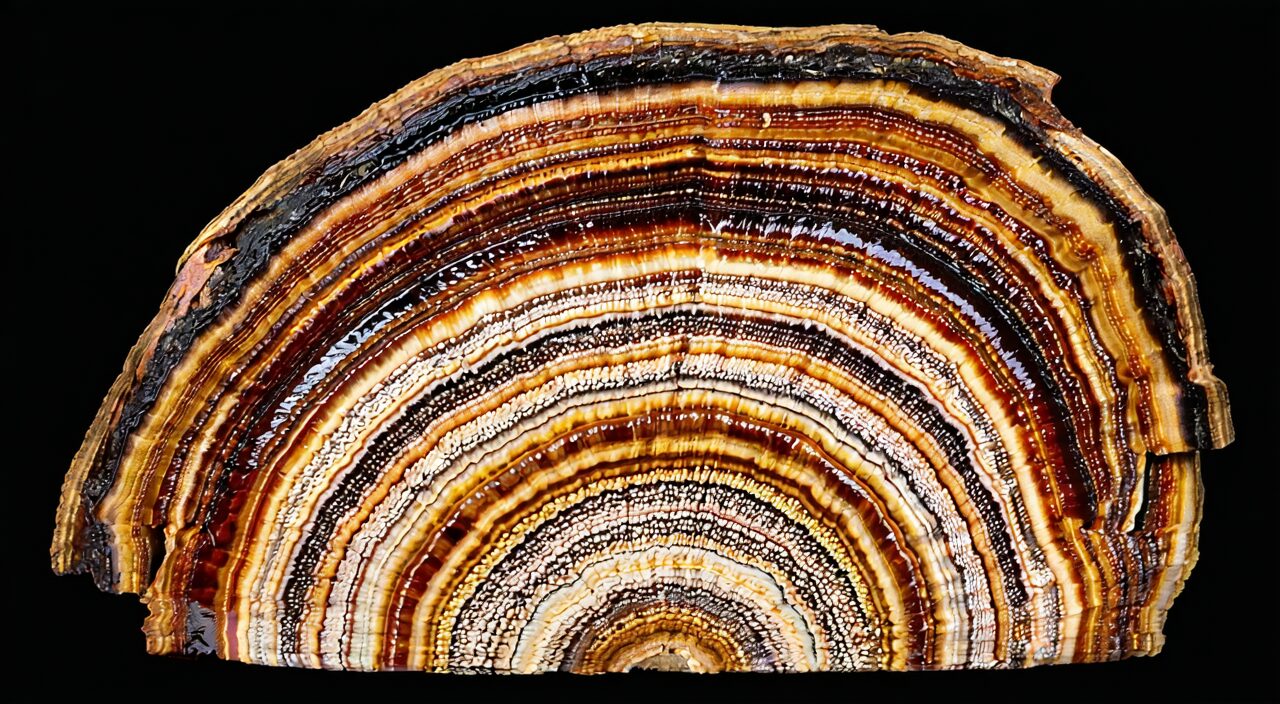
In its natural state, the most striking part of Lingzhi is its pileus (cap). The cap is usually semicircular, kidney-shaped or nearly round, with a lacquer-like gloss on the surface—a fairly typical identification feature. The gloss weakens after drying but still resembles a thin coat of varnish. The cap surface often shows concentric rings and radial furrows, and the colour overall tends towards reddish-brown, purplish-brown or dark brown, with the margin often slightly paler than the centre and sometimes a lighter growing edge.
The pore surface on the underside of the cap is white to pale brown, with densely packed tiny pore openings that look like a compact layer of fine pores. The stipe (stem) is mostly lateral, sometimes nearly central, hard and tough in texture, with the same lacquer-like gloss on the surface, and the colour is similar to or slightly darker than the cap.
The species accepted in the Chinese Pharmacopoeia include Ganoderma lucidum (Chizhi) and Ganoderma sinense (Zizhi). They can be roughly distinguished by cap colour and gloss. The cap of Chizhi is mostly reddish-brown with relatively more obvious gloss, and the stipe is shorter or nearly absent. The cap of Zizhi is often purplish-black to dark blackish-brown; both cap and stipe still show a lacquer-like gloss, but the overall colour is darker, the stipe is longer and more prominent, and the texture tends to be harder. These features help form a preliminary direction when comparing with similar fungi.
What are the medicinal parts of Lingzhi?
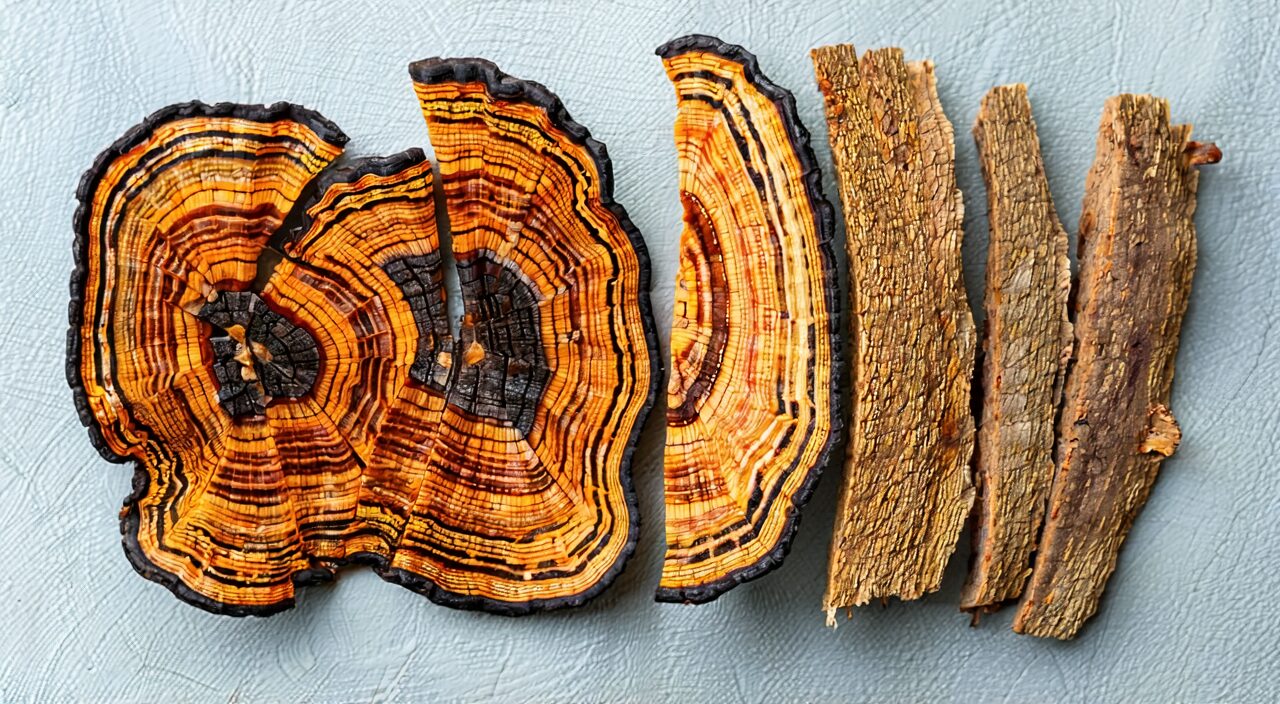
The medicinal part of Lingzhi is the dried fruiting body, which is the whole umbrella-like structure we commonly see, including the cap and the stipe. During harvesting and processing, it is usually picked when the fruiting body has reached a certain maturity but before the spores begin to be released. After removing sediment and impurities, it is sun-dried or dried at low temperature.
Common commercial forms of Lingzhi include the whole dried fruiting body, thick oblique or transverse slices, and coarse powder. Slices are convenient for decocting, while coarse powder is mostly used for making capsules or extracts. In addition, Lingzhi spore powder is collected from the spores ejected from the gills; it is not the fruiting body itself. It has a different origin, and the processing methods and compositional characteristics also differ, so it cannot simply be equated with the actions of the Lingzhi fruiting body.
How does TCM understand Lingzhi?
Within the traditional Chinese medicine framework of nature, flavour and channel entry, Lingzhi is generally described as sweet and neutral, entering the Heart, Lung, Liver and Kidney channels. From this perspective, it is mainly used for regulating patterns related to supplementing qi and calming the spirit, and relieving cough and wheezing. In traditional use, Lingzhi can be taken alone as a decoction, or it is often combined with herbs such as Renshen (Ginseng), Huangqi (Astragalus), Danggui (Angelica sinensis) and Fuling (Poria) to carry out holistic regulation according to different pattern presentations.
For example, in cases of insufficient heart qi that easily leads to palpitations and shallow sleep, it is often used from the angle of supplementing qi and calming the spirit; for chronic cough due to lung deficiency and shortness of breath with dyspnea, it is frequently combined with herbs that supplement lung qi and resolve phlegm to stop coughing. These approaches reflect traditional medicine’s view of Lingzhi as a “supplementing” and “moderating” medicinal substance, rather than a direct intervention aimed at a specific disease.
What components and actions of Lingzhi attract modern research attention?
Modern research mainly focuses on polysaccharides, triterpenoids and other compounds in the Lingzhi fruiting body and spore powder. Related experiments largely concentrate on immune regulation, antioxidant and neuroprotective activities. Some in vitro and animal studies have observed noteworthy bioactivities, but there remains a considerable gap between these and real effects in the human body. At present, high-quality human studies are still insufficient to form consistent conclusions.
Therefore, when looking at these studies, it is appropriate to understand them as preliminary explorations of the active components of Lingzhi, and they should not be directly equated with clinical treatment conclusions. In everyday use, a safer approach is to understand Lingzhi within the framework of traditional health preservation diets or TCM pattern regulation, rather than relying on a single research finding to guide its use.
How do Lingzhi and similar medicinal substances differ?
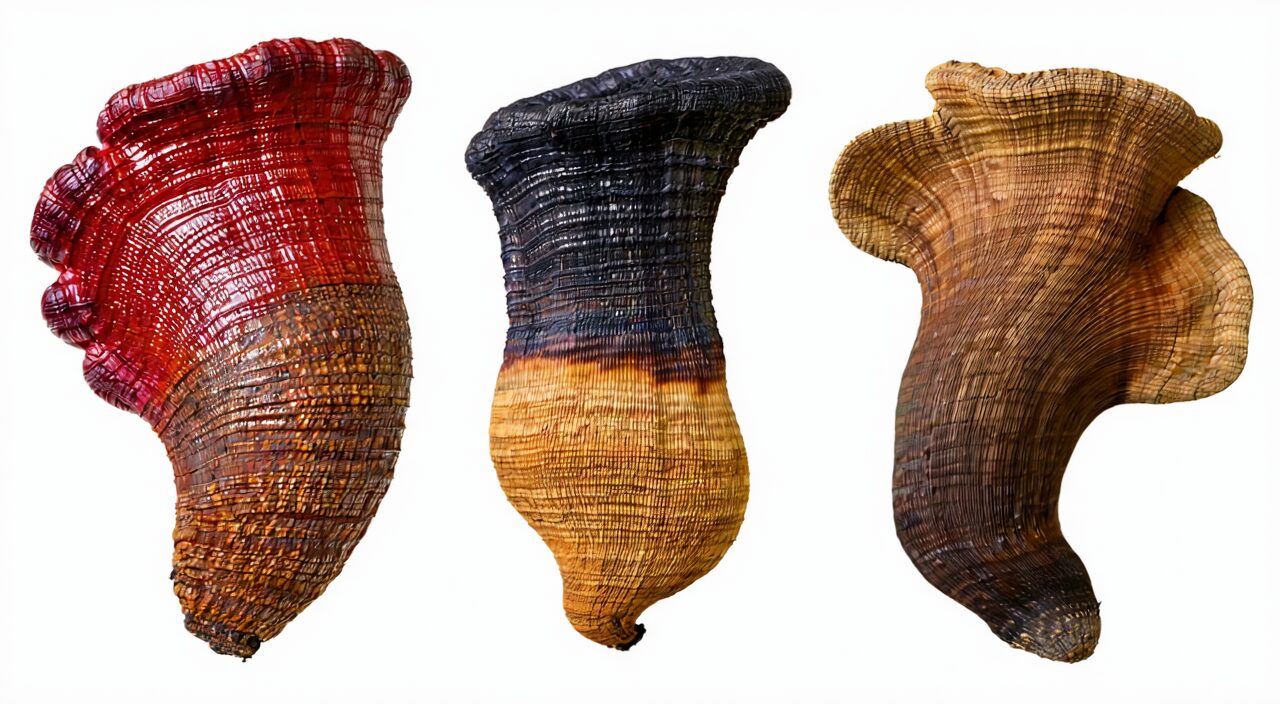
Substances that closely resemble Lingzhi and are easily confused with it include Zizhi (Ganoderma sinense) and Shushe Lingzhi (Ganoderma applanatum). Zizhi itself is one of the pharmacopoeial source species for Lingzhi, belonging to the same Ganoderma genus as Chizhi. Its cap is more purplish-black and its stipe is longer; traditional applications differ slightly in emphasis, and it is often considered more able to nourish yin and calm the spirit. Both Chizhi and Zizhi can be regarded as genuine Lingzhi; the difference lies only in colour and certain traditional preferences in use.
Shushe Lingzhi (Ganoderma applanatum) also belongs to the Ganoderma genus, but it clearly differs from Lingzhi in appearance and medicinal part. It usually lacks a stipe or has only a very short one; the cap surface has no lacquer-like gloss or the gloss is very faint; the texture is corky, harder and thicker. Traditionally, Shushe is not used as the Lingzhi recognised by the pharmacopoeia; it has different directions of use in folk applications and cannot simply be treated as Lingzhi. In addition, large polypore fungi that look somewhat like Lingzhi sometimes appear on the market, and attention needs to be paid to features such as the pore surface, gloss and texture to avoid confusion.
What formulas use Lingzhi?
In traditional Chinese medicine formulas, Lingzhi mostly appears as part of compound prescriptions and is rarely used as a single-ingredient formula. In modern times, for convenience, fixed-dosage products such as Lingzhi capsules, Lingzhi tablets and Lingzhi spore powder have been developed. Lingzhi capsules usually use Lingzhi fruiting body extract or coarse powder as the raw material; Lingzhi tablets are mostly made from Lingzhi fruiting body extract with appropriate excipients compressed into tablet form; Lingzhi spore powder is collected from the spores and processed with or without sporoderm-breaking, serving as a separate category of health-use product.
In traditional combinations, Lingzhi is often added to assist in supplementing qi, calming the spirit, or relieving cough and dyspnea. For instance, it is combined with Suanzaoren (Ziziphi spinosae semen), Yuanzhi (Polygalae radix) and Longyanrou (Longan aril) for restless heart-mind; with Renshen (Ginseng) and Baizhu (Atractylodis macrocephalae rhizoma) for qi deficiency and general weakness; and with Chuanbeimu (Fritillariae cirrhosae bulbus) and Baibu (Stemonae radix) for chronic cough and deficiency-type dyspnea. These kinds of combination strategies need to be judged according to an individual’s constitution and specific circumstances and cannot be simply copied. For commercially available Lingzhi-related products, it is more advisable to carefully read the product description, understand the raw materials, processing technology and scope of application, and then consider together with professional advice.
What should be noted when using Lingzhi?
Overall, Lingzhi is relatively mild, but several points still require special attention. First, some people may be allergic to components of the Lingzhi fruiting body or spore powder, experiencing rashes, itching or gastrointestinal discomfort; for first-time use, it is recommended to start with a small amount and observe. Second, because some components of Lingzhi have shown effects on platelet aggregation in studies, those with bleeding tendencies, those using anticoagulant medications, or those about to undergo surgery need to be especially cautious, and it is advisable to decide whether to use it under a doctor’s guidance.
Furthermore, it needs to be clear that Lingzhi spore powder and the Lingzhi fruiting body cannot simply be considered equivalent. Spore powder comes from spores, and its main component profile differs from that of the fruiting body; it cannot directly replace the role of the fruiting body in formulas. Extraction methods, dosage forms and active content can also vary greatly between different products. Therefore, before using any Lingzhi preparation, it is best to first understand the specific source and ingredient information of the product, so as to avoid blindly following trends.
Summary
As a highly regarded medicinal substance in traditional Chinese medicine, Lingzhi’s identification relies on features such as the lacquer-like gloss, concentric rings and pore surface. The medicinal part is primarily the dried fruiting body. Although Zizhi belongs to the same source species, it shows slight differences in appearance and traditional application. TCM uses Lingzhi mainly from the perspectives of supplementing qi, calming the spirit, and relieving cough and wheezing. While modern research suggests directions involving certain active components, there is still a distance from clinical application. When using it, attention should be paid to allergy risk, bleeding risk, and the distinction between spore powder and the fruiting body. This article provides popular science reference only and cannot replace professional diagnosis or treatment advice. If there are long-term symptoms or if you are currently using other medications, please consult a professional first.