
What Is Dandelion? Medicinal Parts, Identification, and Common Formulas
Dandelion is probably one of the first wild plants many people recognize in spring. The yellow flower and the drifting white puffball have almost become icons of fields and roadsides. However, many don’t know that dandelion is a heat-clearing and detoxifying herb with a long history of use in Chinese herbal medicine, and the whole plant can be used. This article organizes foundational knowledge about dandelion from the perspectives of visual identification, medicinal parts, TCM understanding, and common formulas.
What Does Dandelion Look Like? How to Identify It?
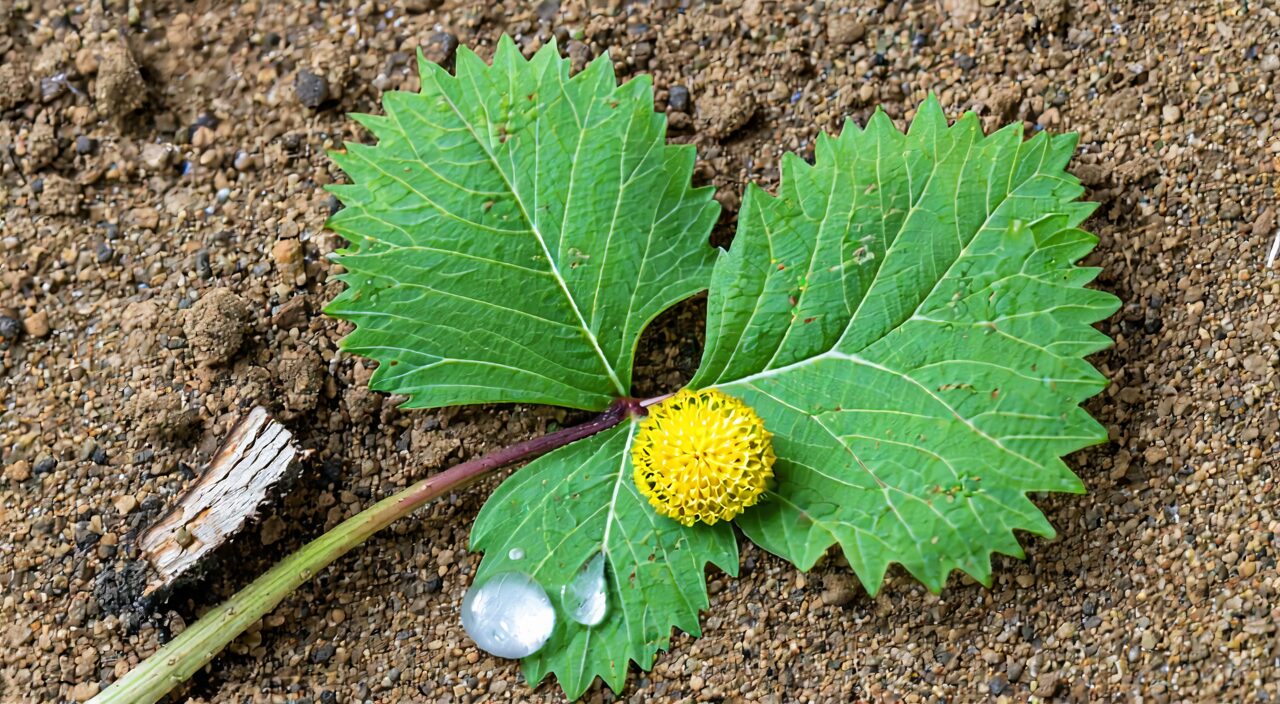
Dandelion is a perennial herbaceous plant in the Asteraceae family. Identification can start from the leaves, flowers, latex, and roots.
Its leaves emerge from the root; there is no above-ground stem. The leaves are generally oblanceolate with distinct pinnatifid margins. The lobes usually point downward. The leaves are soft, green on the surface, and sometimes purplish on the underside. The degree of lobing varies greatly depending on the growing environment, but typically you can see triangular-tipped lobes, a relatively stable identification feature.
The flower is a typical head (capitulum) solitary at the tip of the scape. The scape arises from the leaf rosette, is long and hollow, and exudes white latex when broken. The inflorescence is about 2 to 4 cm in diameter, with green involucral bracts on the outside. When open, multiple layers of yellow ligulate florets appear, looking like a single complete yellow flower but actually composed of many tiny flowers. Flowering mostly occurs in spring and summer, opening on sunny days and closing on cloudy days or in the evening.
After flowering, it produces achenes with pappus that gather into a white puffball, which disperses with the wind—this is also one of the origins of its common name.
The underground root is relatively long, cylindrical, with brownish-yellow outer skin, obvious longitudinal wrinkles on the root body, and white latex visible when broken. Dandelion is usually harvested together with the root for medicinal use, so the root is just as important as the aerial parts.
What Are the Medicinal Parts of Dandelion?
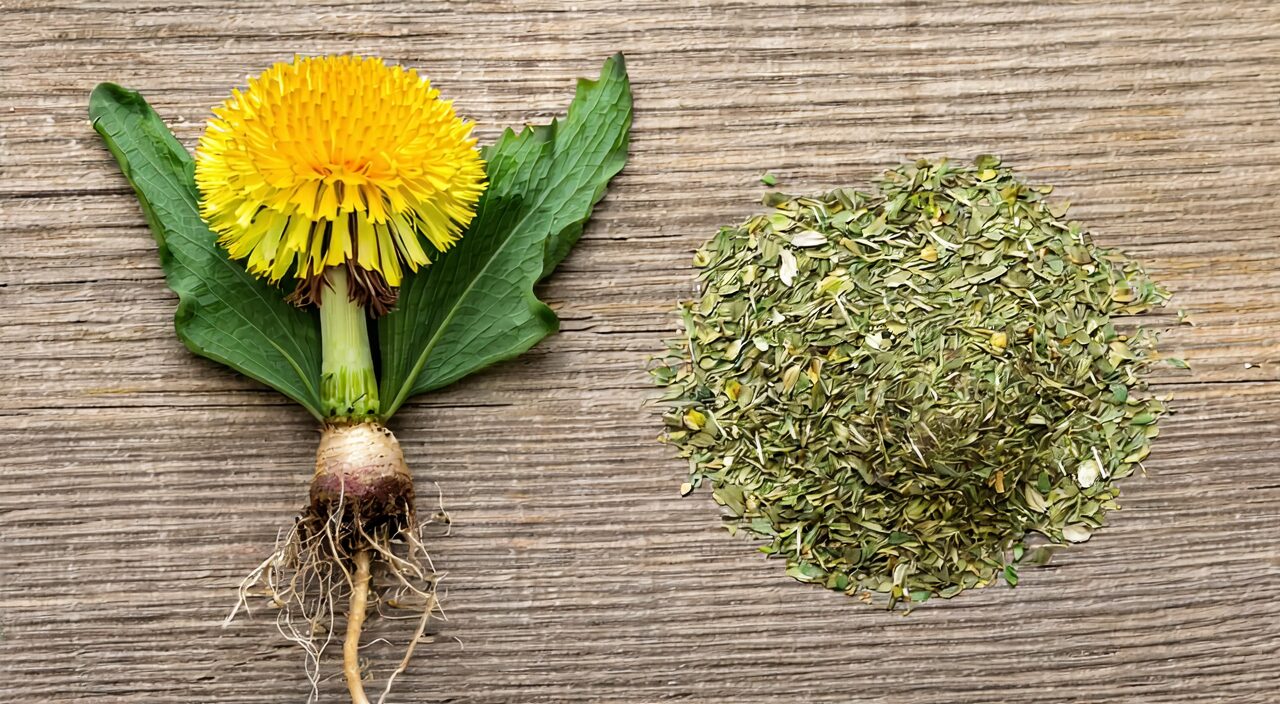
The medicinal part of dandelion is the whole plant with root, meaning the aerial parts and the root are used together. It is usually harvested in spring and summer when the flowers first bloom, with impurities removed and washed; it can be used fresh or dried for storage.
Fresh dandelion is often used mashed for external application or boiled in water for drinking. The dried product is more convenient for storage and use in formulas. In traditional formulas or daily conditioning, both fresh and dried forms have their applications: the fresh herb has a colder property, while the dried herb has a slightly milder action. Choose according to your needs and availability.
How Does TCM Understand Dandelion?
Traditional Chinese medicine considers dandelion bitter and sweet in taste, cold in nature, and mainly enters the Liver and Stomach meridians. It is recorded in ancient texts such as the Tang Bencao and Bencao Yanyi. Its core actions are often summarized as clearing heat and detoxifying, reducing swelling and dissipating nodules, and promoting diuresis and relieving strangury.
“Clearing heat and detoxifying” means that from a TCM perspective, it is often used to address conditions caused by heat toxins, such as skin redness and swelling, sores, ulcers, sore throat, etc. Among these, breast abscess (similar to mastitis) is a typical indication. Many texts regard dandelion as a commonly used herb in the early stages of breast abscess. “Reducing swelling and dissipating nodules” means it may help disperse hard lumps or masses caused by heat congestion, so it frequently appears in formulas for breast issues. “Promoting diuresis and relieving strangury” refers to its use as an auxiliary herb for damp-heat conditions leading to dribbling or heat-type strangury.
Note that these concepts are based on the traditional theoretical framework and are not direct “treatments” for specific modern disease names. Whether it is suitable for an individual should be determined based on constitution, specific conditions, and professional judgment.
What Does Modern Research Say About Dandelion?
Modern research has found that dandelion contains taraxasterol, choline, inulin, organic acids, flavonoids, and other constituents. Some experiments and literature indicate that these components show certain anti-inflammatory, antioxidant, or hepatoprotective tendencies in laboratory studies, and there are also explorations of digestive and immune aspects. However, most research is still in preliminary stages and has a long way to go before being translated into clear clinical applications, so laboratory results cannot simply be equated with effects in the human body.
Those interested in modern dandelion research can treat this information as an extension of interest, but it should not replace empirical use and professional guidance.
How Does Dandelion Differ from Sow Thistle and Chinese Violet?
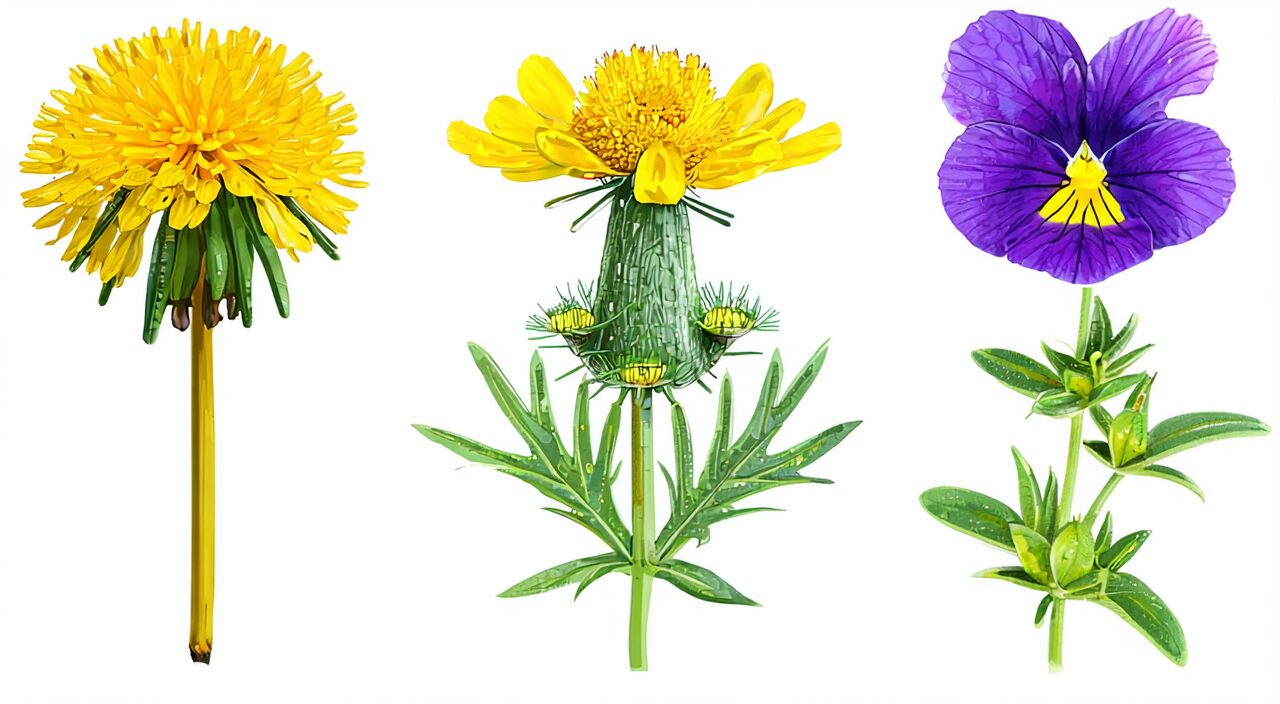
Many people confuse dandelion with other similar plants, especially sow thistle and Chinese violet.
Sow thistle (Sonchus oleraceus) is also in the Asteraceae family, with pinnatifid leaves, but its leaf margins often have sharp spines that feel prickly, and it does not produce white latex when broken—this is a key difference. Sow thistle also has yellow flowers, but the heads are smaller than dandelion, with fewer ligulate florets, and multiple heads are arranged in corymbs, unlike dandelion’s solitary head on the scape. The main medicinal part of sow thistle is the whole plant, and its traditional uses tend toward clearing heat, drying dampness, removing toxins, and stopping dysentery; it cannot be directly substituted for dandelion.
Chinese violet (Viola yedoensis) belongs to the Violaceae family. Its root-leaves grow in clusters, with ovate or narrowly ovate leaf blades and shallow, blunt teeth on the margins, completely different from the deeply pinnatifid dandelion leaves. Its flowers are violet-purple or pale purple, and the flower shape is entirely different from the clustered ligulate florets of dandelion. Chinese violet is also a heat-clearing and detoxifying herb in TCM, but it is mainly used for furuncles, carbuncles, and swellings, with a stronger emphasis on cooling blood and reducing swelling, differing from dandelion in meridian tropism and range of use.
When identifying plants in the wild, it is recommended to focus on leaf shape, flower color, and the presence of latex to avoid miscollection. Never consume plants you are unsure about.
Which Formulas Use Dandelion?
Dandelion is used in many traditional formulas. Several common ones are listed below for reference only.
Wuwei Xiaodu Yin (Five-Ingredient Detoxification Drink): Composed of honeysuckle flower, wild chrysanthemum flower, dandelion, Chinese violet, and Semiaquilegia root. This formula is traditionally used for sores, boils, and swellings caused by exuberant heat toxin, especially in the early stages of furuncles and carbuncles, aiming to clear heat toxins. Dandelion plays the role of clearing heat, detoxifying, reducing swelling, and dissipating nodules. Its use requires assessment based on specific patterns and constitution.
Dandelion Decoction: From Yixue Zhong Zhong Can Xi Lu (Records of Chinese Medicine with Reference to Western Medicine), it uses fresh dandelion alone to make a decoction, traditionally used for eye conditions such as red, swollen, and painful eyes, drawing on dandelion’s properties of clearing heat and improving vision. This usage leans more toward folk experience and the practice of certain physicians.
Ruyong Tang (Breast Abscess Decoction): This is an empirical formula, often featuring dandelion as the principal herb, combined with trichosanthes fruit, burdock fruit, forsythia fruit, green tangerine peel, and others, used in the early stages of breast abscess with the purpose of clearing heat, dissipating masses, unblocking collaterals, and reducing swelling. Different practitioners may have slight variations, sometimes adding bupleurum root or trichosanthes root, but dandelion is usually the key herb. Such formulas have traditionally been used for early-stage breast abscess in postpartum lactating women, but should not be applied mechanically without proper evaluation.
The specific use of any formula must be based on individual constitution, symptom presentation, and product instructions or professional medical judgment; do not copy formulas directly.
What Precautions Should Be Taken When Using Dandelion?
Although dandelion is common, there are some points to note when using it.
First, it is cold in nature. People with spleen-stomach deficiency-cold, such as those prone to bloating, loose stools, feeling cold, or poor appetite, may experience worsened discomfort, diarrhea, or stomach cold if they use it in large amounts or over a long period. Second, in cases of complete biliary obstruction, dandelion or related preparations are generally not recommended, as it may stimulate bile secretion and is unsuitable for such patients.
People with a history of allergies, especially those sensitive to Asteraceae plants (such as mugwort, daisy, etc.), may experience skin rashes or respiratory allergic reactions after using dandelion. Start with a very small amount for observation during initial contact. Additionally, when harvesting dandelion in the wild, pay special attention to whether the collection site is near farmland or roads, as these places may have pesticide or heavy metal residues. Also avoid mistakenly collecting similar-looking plants like sow thistle or wild lettuce. If you are not fully confident in plant identification, do not consume it or use it as a medicinal herb on your own.
Pregnant and breastfeeding women should consult a professional before using dandelion and should not decide on the method and dosage by themselves.
Summary
As a Chinese medicinal herb used as the whole plant with root, dandelion has relatively clear lines in terms of appearance identification, medicinal parts, and traditional usage directions. TCM generally understands it from the angles of clearing heat and detoxifying, reducing swelling and dissipating nodules, and promoting diuresis and relieving strangury. It has significant distinctions from plants like sow thistle and Chinese violet, and daily identification is not complicated. However, precautions such as constitution with cold tendency, biliary issues, and allergy risks still need to be considered when using it. This article is only for TCM knowledge education and reference; it cannot replace professional diagnosis or treatment advice.