
What Is Euryale Ferox (Fox Nut)? Introduction to Medicinal Parts, Identification, and Common Formulas
When people hear about Qianshi (Euryale ferox seed), many only think of it as something “similar to lotus seeds” or “a grain used in congee.” Indeed, Qianshi often appears in daily cuisine, but it is also a traditional Chinese medicinal herb with a long history. On the market, you can find fresh Qianshi with its shell, dried medicinal Qianshi, and easily cooked edible Qianshi kernels — their forms and uses are not identical. This article provides a relatively complete framework for understanding this herb from the perspectives of identification, medicinal parts, traditional understanding, common formulas, and precautions, helping readers to better know this material when needed.
What Does Qianshi Look Like? How to Identify It
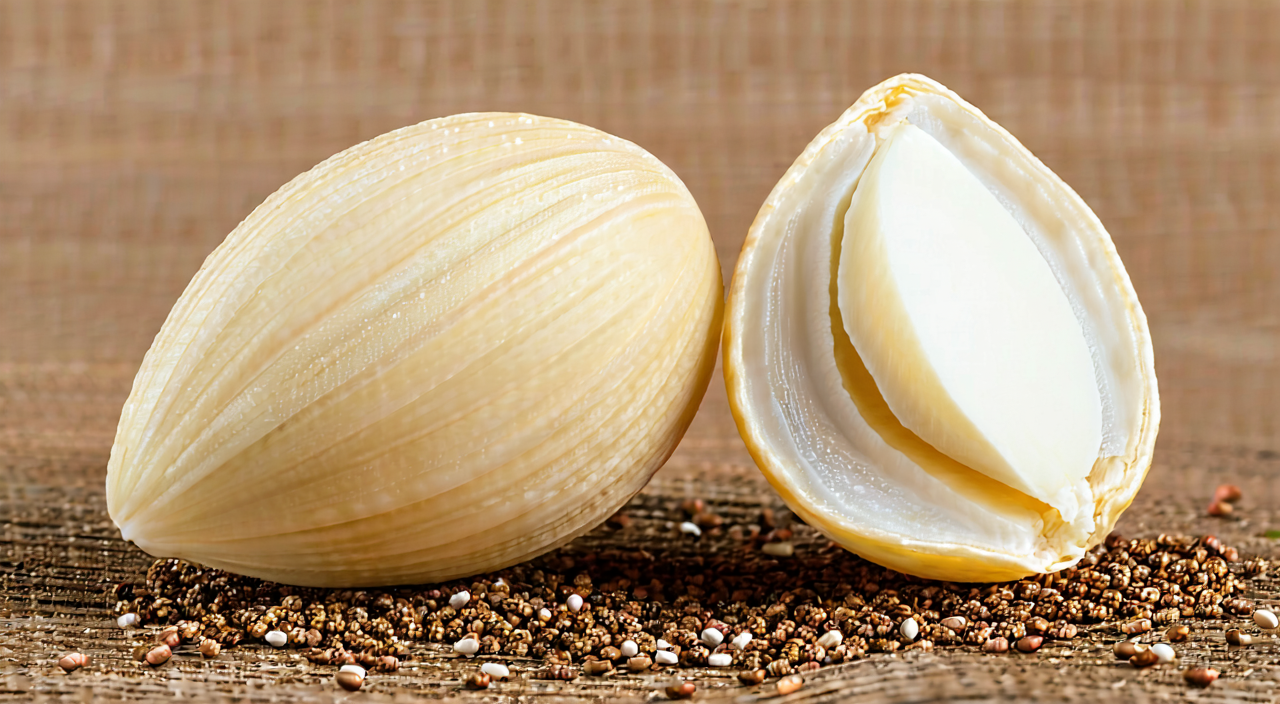
The medicinal part of Qianshi is mainly the seed kernel. When dried, the whole kernel is roughly spherical, with most measuring about half a centimeter in diameter, though some are slightly smaller or larger. On an intact dried Qianshi, a distinct protuberance can be seen at one end, while a remnant of the seed stalk remains at the other end. Sometimes a small amount of reddish-brown or dark purple inner seed coat still adheres to the surface. After shelling, the kernel is usually white or pale yellowish-white, extremely hard, and not easily crushed between the fingers.
If a dried Qianshi kernel is cut open, the cross-section displays a fine, starchy texture with a pure white color; faint light-colored striations may sometimes be visible near the edges. The odor is very faint, and touching the cross-section lightly with the tip of the tongue produces a slightly viscous, slippery sensation — a rather distinctive characteristic. If the color appears dull, there is a rancid oil smell, or the texture has become brittle and less starchy, it usually indicates prolonged storage or moisture damage, and it is no longer suitable for medicinal use.
What Is the Medicinal Part of Qianshi?
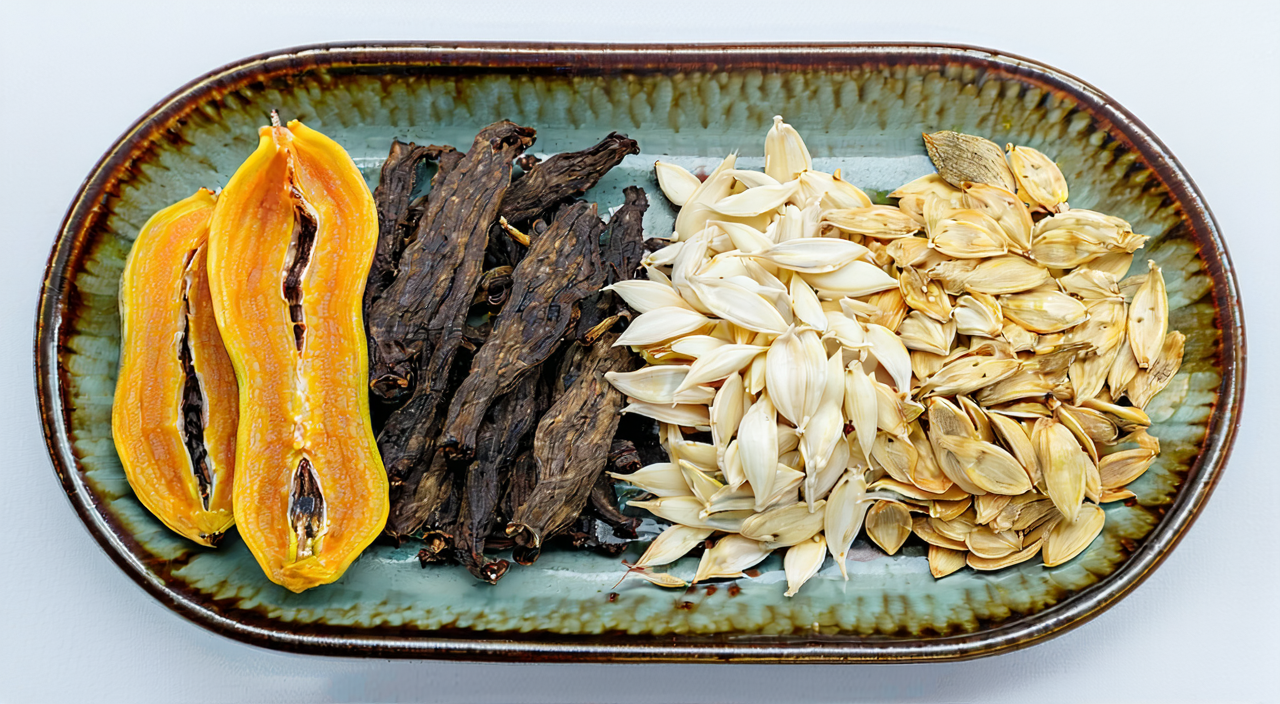
The medicinal part of Qianshi is the mature seed kernel of Euryale ferox, a plant in the water lily family (Nymphaeaceae). The seeds are typically harvested in autumn when the fruit is ripe. The fruit coat is removed, the seeds are extracted, the hard outer shell is discarded, and the kernels are dried in the sun, yielding the commonly seen Chinese medicinal herb Qianshi.
Within the pharmacy, a distinction is made between raw (sheng) Qianshi and stir-fried (chao) Qianshi. Raw Qianshi is the cleaned, directly dried seed kernel, whitish in color with abundant starchiness. Stir-fried Qianshi is prepared by dry-frying the cleaned kernels over gentle heat until they turn slightly yellow and sometimes puff up a little; tiny scorch spots may appear on the surface. The odor changes slightly after stir-frying, and the rate at which the kernels absorb water and release their constituents during decoction also differs. The edible Qianshi kernels used in home cooking are also shelled kernels, but they are often frozen when fresh or specially processed into an easily cooked form. They differ from the dried medicinal product in moisture content, texture, and processing methods, and cannot be regarded as equivalent.
How Does Traditional Chinese Medicine Understand Qianshi?
In traditional Chinese medicine theory, Qianshi is generally categorized as an astringent and tonic herb, primarily characterized by its ability to stabilize, bind, and strengthen the spleen. Its therapeutic actions mainly involve three aspects.
The first is tonifying the kidney and securing essence. Throughout history, physicians have often used Qianshi to address patterns related to kidney qi insecurity, such as seminal emission and spermatorrhea, frequently combining it with herbs like Jinyingzi (Rosae laevigatae fructus) and Shayuanzi (Astragali complanati semen). This line of thinking commonly appears in traditional astringent formulas.
The second action is tonifying the spleen and stopping diarrhea. For chronic loose stools or diarrhea caused by spleen deficiency with impaired transportation and transformation, Qianshi can be combined with Baizhu (Atractylodis macrocephalae rhizoma), Fuling (Poria), and Lianzi (Nelumbinis semen) to help improve the condition of spleen deficiency with dampness by tonifying the spleen and astringing. It must be noted that this application is specific to spleen deficiency without significant food stagnation or excess pathogens; it is not suitable for all types of diarrhea.
The third use is dispelling dampness and stopping leukorrhea. When there is profuse, thin, clear vaginal discharge attributed to spleen deficiency with dampness pouring downward, traditional practice considers combining Qianshi with Shanyao (Dioscoreae rhizoma) and Baiguo (Ginkgonis semen). If the discharge is yellowish, sticky, and foul-smelling, that pattern does not usually fall within the scope of using Qianshi alone and requires further pattern differentiation.
Preliminary Observations from Modern Research on Qianshi
Modern research has conducted some preliminary analyses on the constituents of Qianshi, revealing that it contains starch, proteins, various amino acids, as well as certain amounts of polyphenols and polysaccharides. Some experiments suggest that the polysaccharide fractions in Qianshi may possess antioxidant activity and demonstrate a certain ability to scavenge free radicals under in vitro conditions. Animal studies have also observed that Qianshi extracts show some regulatory trends on blood glucose and blood lipid levels, but most of this evidence remains at an early stage.
These observations provide a modern perspective for understanding Qianshi, but they cannot yet be directly extrapolated to definitive clinical effects. Qianshi should still be understood as a traditional medicinal herb, and one should not substitute routine medical treatments with it based on current research findings alone.
What Are the Differences Between Qianshi, Lotus Seed, and Coix Seed?
Qianshi (Euryale ferox seed), Lianzi (lotus seed), and Yiyiren (coix seed) are all common seed-type medicinal materials derived from aquatic or moisture-loving plants, and their appearances can be easily confused.
In terms of seed kernel morphology: lotus seed is mostly elliptical, with a protruding seed pore at the center of one end. After shelling, it can be easily split into two cotyledons, with a green lotus plumule in between, and it tastes slightly sweet. Qianshi is roughly spherical, with a small protuberance at one end, a white and highly starchy cross-section, and a viscous, slippery mouthfeel when chewed, lacking the split cotyledon structure of the lotus seed. Coix seed is broadly ovate or oblong, with a longitudinal groove on the ventral side, a lighter texture than the other two, and a whitish or slightly yellowish tint.
In traditional applications, lotus seed tends to tonify the spleen to stop diarrhea, nourish the kidney, and calm the heart, often associated with heart-spleen dual deficiency patterns. Coix seed tends to promote urination, drain dampness, strengthen the spleen, and relieve impediment, and is used more frequently when dampness is prominent and water-dampness is retained. Qianshi, on the other hand, focuses on tonifying the kidney and securing essence, tonifying the spleen to stop diarrhea, and dispelling dampness to stop leukorrhea, with a more pronounced astringent power. In terms of astringent and binding characteristics, Qianshi is stronger than coix seed, and compared to lotus seed, it acts more on the lower burner. Whether to choose Qianshi must be judged based on the individual constitution and symptomatic presentation.
Which Formulas Use Qianshi?
Qianshi appears as a key astringent and spleen-tonifying herb in several traditional formulas. The following are some of the more representative ones.
Jin Suo Gu Jing Wan (Metal Lock Essence Pill): This is a classic formula for securing the kidney and astringing essence, commonly composed of Shayuanzi (Astragali complanati semen), Qianshi, Lianxu (Nelumbinis stamen), Longgu (fossilized bone), and others. Traditionally, it is considered for patterns of kidney deficiency with insecurity, leading to seminal emission, spermatorrhea, sore back, and tinnitus. In this formula, Qianshi and Shayuanzi work together to reinforce the astringent effect.
Shui Lu Er Xian Dan (Water and Earth Two Immortals Pill): This formula contains only two ingredients — Jinyingzi (Rosae laevigatae fructus) and Qianshi — one from the land and one from the water, hence the name. It has traditionally been used in the regulative approach for kidney qi insecurity and an unconsolidated essence gate, offering astringent action without creating stickiness.
Qianshi Wan (Euryale Pill): This formula usually takes Qianshi as the principal herb, combined with Lianzi (Nelumbinis semen), Fuling (Poria), Shanyao (Dioscoreae rhizoma), and others, with an overall emphasis on strengthening the spleen and astringing. It has traditionally been used for spleen deficiency with reduced appetite, unformed stools, seminal emission, and spermatorrhea. The herbal proportions vary in different versions, but the core remains Qianshi as the astringent foundation.
Spleen-Fortifying and Astringent Formulas: In spleen-tonifying and qi-boosting formulas such as Si Jun Zi Tang (Four Gentlemen Decoction) and Shen Ling Bai Zhu San (Ginseng, Poria, and Atractylodes Powder), Qianshi is sometimes added to enhance the intestine-binding and antidiarrheal effect. This is suitable for patterns of spleen deficiency with exuberant dampness and chronic diarrhea without obvious excess pathogens.
These formulas represent traditional directions of use. Specific situations require comprehensive assessment based on individual constitution, symptomatic characteristics, and the judgment of a professional Chinese medicine practitioner or pharmacist. They should not be used directly as a basis for self-prescribing.
What Precautions Should Be Observed When Using Qianshi?
Although Qianshi has traditionally been classified as a medicinal and edible material, that does not mean it is suitable for everyone. The following situations require particular attention.
When there is constipation, abdominal distension and fullness, or retained food stagnation, it is generally not advisable to use Qianshi alone. Its astringent and binding nature may aggravate defecation difficulties or abdominal discomfort. If there is obvious dampness stagnation and distention, using the astringent Qianshi could instead cause the excess pathogens to linger.
Additionally, individuals with glucose metabolism issues who intend to use Qianshi as a daily food ingredient or dietetic remedy should note its relatively high starch content, which may impact postprandial blood glucose. It is best to consult a doctor or nutritionist first and reasonably control the dosage within an overall dietary plan.
Individuals who are taking other medications or have serious underlying medical conditions should also first confirm with a healthcare professional whether incorporating Qianshi into any regulation approach is appropriate.
Summary
Qianshi is the mature, dried seed kernel of Euryale ferox. Its key identification features are a roughly globular shape, a white starchy cross-section, and a slightly viscous, slippery mouthfeel. Traditional Chinese medicine primarily understands it from the perspectives of tonifying the kidney and securing essence, tonifying the spleen to stop diarrhea, and dispelling dampness to stop leukorrhea. Compared with lotus seed and coix seed, Qianshi is more astringent and often serves as an astringent cornerstone in specific formulas. When using Qianshi, attention should be paid to contraindicated patterns such as constipation, abdominal bloating, and food accumulation, and a comprehensive judgment should be made based on individual conditions. Do not use it to replace standard medical treatment on your own. The information provided in this article is for educational reference only and cannot replace professional diagnosis and medical advice.