
What Is Dragon’s Blood? Medicinal Source, Identification, and Common Formulas
In the traumatology and external medicine fields of traditional Chinese medicine, there is a medicinal substance with an intense color that often appears in resin form—dragon’s blood. Many overseas readers may associate the name with blood or animal-derived ingredients when they first hear it, but it is actually a red resin obtained from specific plants. Red resins from different plant sources are found in various regions, but the dragon’s blood traditionally used in Chinese medicine is mainly related to the fruit and trunk of Daemonorops draco. So, what does dragon’s blood look like? Which part of the plant does it come from? How does it differ from myrrh and frankincense, which are often confused with it? This article will address these common questions one by one.
What Does Dragon’s Blood Look Like? How Is It Identified?
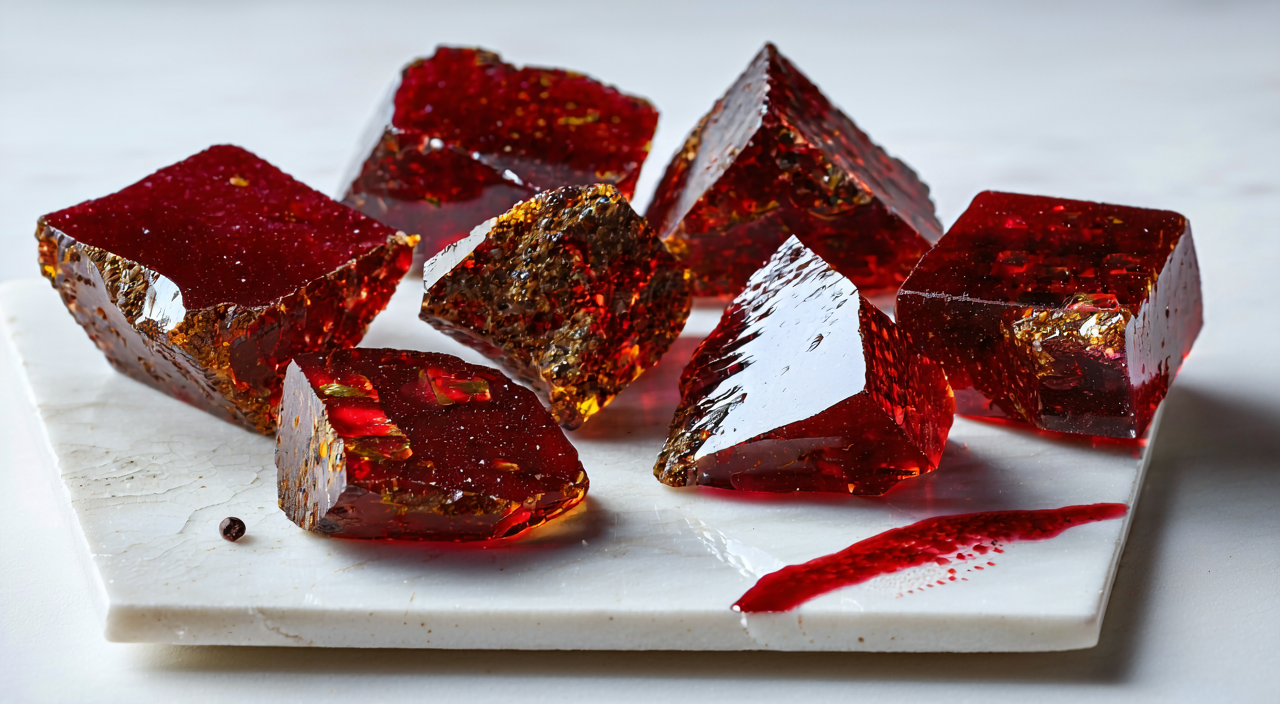
Identifying dragon’s blood by its appearance is an important first step in understanding this medicinal substance. Commercially available dragon’s blood is commonly found as irregular lumps or loose powder, with particles of varying sizes adhering to one another.
In terms of color, genuine dragon’s blood is generally dark red to reddish brown, sometimes with dark patches on the surface. It is relatively brittle in the hand; when struck forcefully or broken open, the fractured surface reveals a glass-like luster, which is an important identification point. Scraping the surface with a fingernail, or gently rubbing a small amount of powder on white paper, leaves a distinct red streak that is bright and does not fade easily. When dragon’s blood powder is placed in water, it generally does not dissolve readily, and the water is not dyed red, which clearly distinguishes it from certain artificially colored products.
It is also worth noting that dragon’s blood softens or melts when heated, a property sometimes used in traditional preparation processing. During daily handling, if the color appears overly uniform and bright, the fractured surface lacks luster, or the streak color is yellowish or dull, extra caution is needed, as the product may be adulterated with other resins or colorants.
What Is the Medicinal Source of Dragon’s Blood?

Strictly speaking, dragon’s blood is not obtained from the roots, stems, leaves, or flowers of a plant; it is a processed resin product. Its source plant is Daemonorops draco, a member of the palm family Arecaceae. Reddish-brown resin is secreted from the surface of its fruit and between its scales, and similar resin can also flow when the trunk is damaged.
Traditionally, when collecting dragon’s blood, the fruit is shaken thoroughly or other methods are used to encourage the resin to exude, and the thick red secretion is collected. After preliminary removal of impurities and drying, it is further refined into irregular lumps or ground into powder. In other words, the dragon’s blood we usually see is already a processed resin product rather than a complete organ of the original plant.
Because it is a processed resin product, different production areas and processing methods may have some influence on the texture and color of dragon’s blood. However, within the range of genuine products, its core characteristics—dark red, translucent color, a glass-like fractured surface, and a distinct red streak—are fairly consistent.
How Does Traditional Chinese Medicine Understand Dragon’s Blood?
Traditional Chinese medicine understands dragon’s blood mainly through the actions of “invigorating blood and relieving pain,” “resolving stasis and stopping bleeding,” and “closing sores and promoting tissue regeneration.” In terms of nature, flavor, and channel tropism, dragon’s blood is generally considered neutral in nature, sweet and salty in flavor, and it mainly enters the Heart and Liver channels.
In both external and internal use for traumatic injuries, blood stasis, swelling, and pain, dragon’s blood is often used as a medicinal substance that addresses both “dispersing stasis” and “stopping bleeding.” For example, after a sprain with local bruising, swelling, and fixed pain on pressure, traditional thinking would consider combining dragon’s blood to help disperse stagnation and relieve pain. For traumatic bleeding, especially when bleeding is accompanied by obvious stasis, dragon’s blood is also believed to stop bleeding while preventing blood stasis from lingering.
In addition, for sores that rupture and are slow to close, Chinese medicine may consider dragon’s blood from the perspective of “closing sores and promoting tissue regeneration,” often using it externally with other blood-nourishing and tissue-regenerating medicinal substances. Of course, the above is based only on traditional experience; whether it is suitable for a specific individual still needs to be evaluated by a professional in light of their constitution, symptoms, and presentation, and should not be simply equated with modern medical drug efficacy.
A Brief Overview of Modern Research on Dragon’s Blood
Modern research on dragon’s blood focuses mainly on its chemical constituents and some exploratory in vitro and animal studies. Dragon’s blood contains dracorhodin, dracorubin, and flavonoids. Some studies have attempted to observe its anti-inflammatory, analgesic, and wound-healing-promoting effects.
For example, some animal experiments have found that dragon’s blood extracts show certain effects on some inflammation models, and in vitro cell studies also suggest that related constituents may be involved in regulating certain signaling pathways associated with tissue repair. However, these findings are still a considerable distance from definitive clinical conclusions. They mainly serve as a supplementary perspective for understanding the traditional uses of dragon’s blood, and cannot be directly used to infer therapeutic outcomes or guide drug selection.
What Are the Differences Between Dragon’s Blood, Myrrh, and Frankincense?
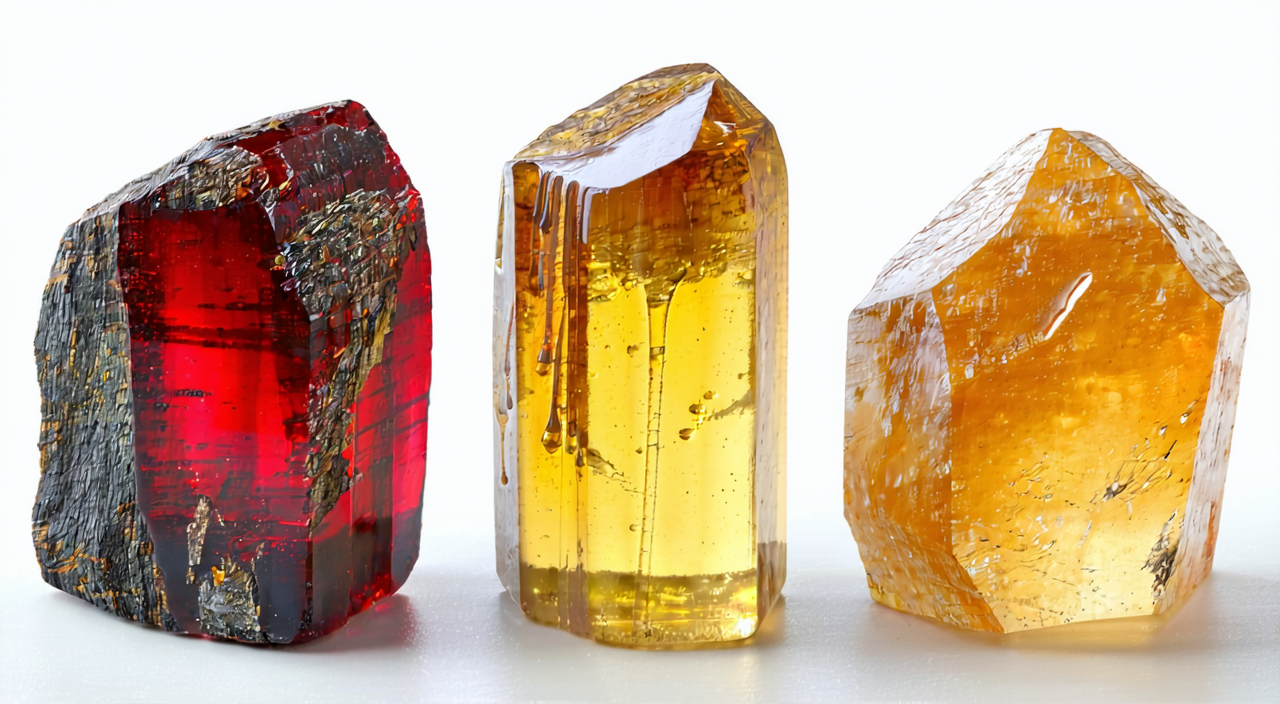
Among resinous medicinal substances, dragon’s blood, myrrh, and frankincense are often compared because they are all commonly used in traumatology and pain-related regulation, but the three differ significantly in appearance, odor, and texture.
Myrrh comes from the myrrh tree of the Burseraceae family and is also a resin. Its color is usually yellowish-brown to reddish-brown, often with an oily sheen on the surface, and the fractured surface is mostly waxy or granular. Its odor is rather distinctive, with a resinous aroma resembling a burnt fragrance. Frankincense also comes from the Burseraceae family, from the frankincense tree, and is mostly yellowish-white to pale green translucent droplet-shaped granules. It is relatively brittle and light, with an aromatic odor and a slight turpentine-like note.
In comparison, dragon’s blood is the darkest in color, ranging from dark red to reddish-brown, with a prominent glass-like luster on the fractured surface. When ground into powder, it is bright red, and its odor is very faint or almost without a distinctive smell. Another practical difference is that dragon’s blood has a very distinct red streak, whereas myrrh and frankincense usually do not have a similar dark red streak feature. When identifying them in practice, comparing the color, luster, odor, and streak color of the three together allows for a better preliminary distinction.
Which Formulas Commonly Use Dragon’s Blood?
Dragon’s blood appears in many traditional ready-made formulas, most commonly in traumatology and pain-related formulas. The following are examples frequently seen in the literature or in products, but it should be noted that they are provided only as references for usage directions, not as recommendations for any specific symptoms.
Qili San: This is a classic traumatology formula, commonly used for traumatic injuries, blood stasis with swelling and pain, and external bleeding. The formula generally contains dragon’s blood, frankincense, myrrh, safflower, borneol, and other medicinal substances. Traditionally, it is considered to both invigorate blood and disperse stasis while relieving pain and stopping bleeding, with an action that tends to move and penetrate.
Huoxue Zhitong San (Blood-Moving Pain-Relieving Powder): This formula focuses more on invigorating blood and moving qi, reducing swelling, and relieving pain. It often includes dragon’s blood alongside Chinese angelica root, notoginseng, frankincense, and other medicinal substances, and is commonly used for soft tissue contusions and the later stages of sprains when stasis is obvious. Before use, it is advisable to determine whether there is local heat, marked redness and swelling, or other signs of acute inflammation, because the treatment direction is not exactly the same.
Dragon’s Blood Capsules: Dragon’s blood is made into capsules as a single ingredient or in combination for convenient internal use. Traditionally, it is often used for stabbing stomach pain, dysmenorrhea, or post-traumatic stasis caused by internal blood stasis. In practice, whether and how to use it still depends on one’s constitution and specific presentation.
Dieda Wan (Trauma Pill): This is a very common category of formulas for both external and internal use, often composed of rhubarb, notoginseng, dragon’s blood, frankincense, myrrh, and other substances. Traditionally, it is considered to invigorate blood and disperse stasis, reduce swelling, and relieve pain, and may be understood as a regulating direction for soft and hard tissue swelling after traumatic injury.
It should be emphasized again that the above formulas or Chinese patent medicines should be used under professional guidance, based on individual constitution, symptoms, and product instructions. One should not decide to use them solely on the basis of general educational information.
What Precautions Should Be Taken When Using Dragon’s Blood?
Although dragon’s blood is a traditionally used resinous medicinal substance, there are some points that require special attention.
First, dragon’s blood is contraindicated during pregnancy, which is a relatively consistent understanding in traditional use. Because dragon’s blood has a strong blood-invigorating action, it may have adverse effects during pregnancy. Second, people with bleeding tendencies or those using anticoagulant medications should be very cautious. Dragon’s blood has dual properties of invigorating blood and stopping bleeding, but its relationship with anticoagulants is not clearly established, so it should not be combined with them without authorization, as this may interfere with blood coagulation or mask the underlying condition.
Furthermore, if there is deep tissue injury, or if the wound shows obvious infection, suppuration, redness, swelling, heat, and pain, or if it is accompanied by fever, severe abdominal pain, persistent vomiting, black stools, weight loss, or similar signs, it is not advisable to rely on dragon’s blood or formulas containing dragon’s blood on one’s own; prompt medical attention should be sought instead.
In addition, dragon’s blood on the market may be dyed or adulterated with other plant resins. When purchasing, try to choose products with clear origins and from proper channels, to avoid uncertain effects or unnecessary bodily reactions caused by adulteration.
Summary
As a red resin obtained from Daemonorops draco, dragon’s blood has long been used in traditional Chinese medicine for traumatic injuries, pain due to blood stasis, and the closure of sores. Understanding its dark red appearance with a glass-like luster, its clear origin as a processed resin, and its differences from myrrh and frankincense helps to recognize this medicinal substance more accurately. At the same time, the use of dragon’s blood requires special attention to pregnancy, bleeding tendencies, and drug interactions. Any choice of treatment should be made under professional judgment. This article is for informational reference only and cannot replace individualized medical advice.