
What Is Pyrite (Zirantong)? Medicinal Part, Identification, and Common Formulas
In Chinese medicine, the substance called Zirantong is not the metallic copper we are familiar with. Many people new to Chinese medicine see the name “Zirantong” and assume it is a naturally formed pure copper, but it is actually a mineral medicine composed mainly of pyrite. Traditionally, Zirantong received its name because of its copper-like metallic luster, but mineralogically it is closer to iron sulfide. For those living overseas who want to understand how Chinese medicine approaches bone injuries, Zirantong is impossible to ignore, but it is even more important to understand what it actually is, how to identify it, and why it cannot be used directly.
What Does Pyrite Look Like? How Is It Identified?
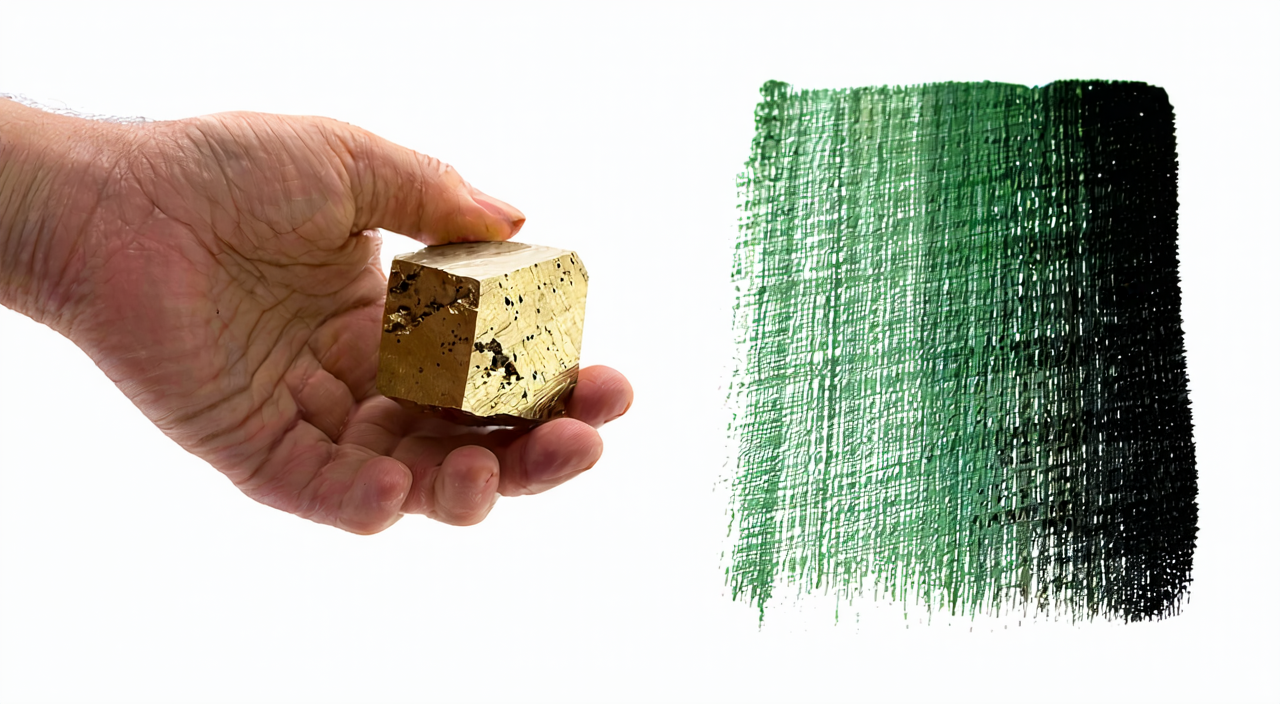
Pyrite typically appears as cubes of varying sizes or irregular lumps. Its surface is often pale brass-yellow with a strong metallic luster, looking somewhat like a metal block. However, its streak is in sharp contrast to its appearance: when scratched on an unglazed white porcelain plate, it usually leaves a dark green streak.
When held in the hand, it feels heavy; it is hard and brittle, and when broken the fractured surface is uneven but still has a metallic luster. Because it often occurs in pyrite-bearing deposits, its surface may sometimes show raindrop-like or striped oxidation marks, with a slightly darker color. The cubic crystal form of pyrite is one of the important identification features, but some pyrite occurs as irregular dense masses, so the streak color and weight also need to be considered. If you see a mineral that is golden and bright but relatively light, it is likely not the genuine product and should be judged with caution.
What Is the Medicinal Part of Pyrite?
The medicinal part of pyrite is the mineral itself, not the roots, stems, or leaves of a plant. As a mineral medicine, it cannot be used directly after being dug up; it must be cleaned and processed. The traditional processing method is usually calcination and quenching: the pyrite is first broken into appropriate pieces, heated with strong fire until red-hot, and then immediately quenched in vinegar to cool it. This is repeated several times until the texture becomes brittle, making it easier to crush and to extract the active components during decoction.
This calcination and quenching process must be carried out under professional conditions. It changes the physical and chemical properties of the mineral, reduces some impurities, and strengthens its effect of dispersing stasis and relieving pain. Because the process involves high temperatures and acidic liquids, it must never be attempted at home, otherwise there is a risk of burns, explosive splattering, or the release of harmful gases. Properly prepared decoction pieces are already calcined, quenched, and tested, so they only need to be taken according to a practitioner’s instructions.
How Does Traditional Chinese Medicine View Pyrite?
In traditional Chinese medical theory, pyrite is acrid and neutral in nature, enters the Liver channel, and its core actions are to disperse blood stasis, relieve pain, and reconnect bones and sinews. Classical texts record that it “can enter the sinews and bones and move stagnant blood.” It is often used for traumatic injuries, sinew rupture, bone fractures, blood stasis, swelling, and pain, especially in stages where promoting callus formation and soft tissue repair is needed.
In formula combinations, pyrite is often used with Dang Gui, Chuan Xiong, Ru Xiang, Mo Yao, Gu Sui Bu, and other herbs that invigorate blood, resolve stasis, and strengthen sinews and bones, to enhance recovery from bone injuries. However, pyrite tends to be moving and dispersing, so patients with qi and blood deficiency are not suitable for using it alone or for long periods. Chinese medicine strongly emphasizes individualized treatment. If a bone injury is accompanied by obvious deficiency of the internal organs, qi and blood should be regulated first before adding stasis-resolving and bone-connecting medicines. This requires an experienced Chinese medicine practitioner to judge based on the overall condition.
What Does Modern Research Focus On?
From a modern analytical perspective, pyrite is mainly composed of iron disulfide, with small amounts of copper, zinc, manganese, lead, arsenic, and other elements. One focus of research is precisely heavy metal impurities and quality control, because pyrite from some sources may contain relatively high levels of lead and arsenic. Without standardized processing and strict testing, long-term or excessive use may pose safety risks.
In addition, changes in composition before and after processing are another focus of modern research. After calcination and quenching, sulfur content decreases, and the dissolution forms of some metal elements may change. It has been regarded as one of the sources of iron supplementation, but there is still no consensus on its actual absorption and utilization. Therefore, current quality management of pyrite focuses more on limiting heavy metal limits and standardizing processing technology to ensure its relative safety in traditional applications, rather than unilaterally emphasizing any particular special effect.
How Is Pyrite Different from Metallic Copper and Magnetite?
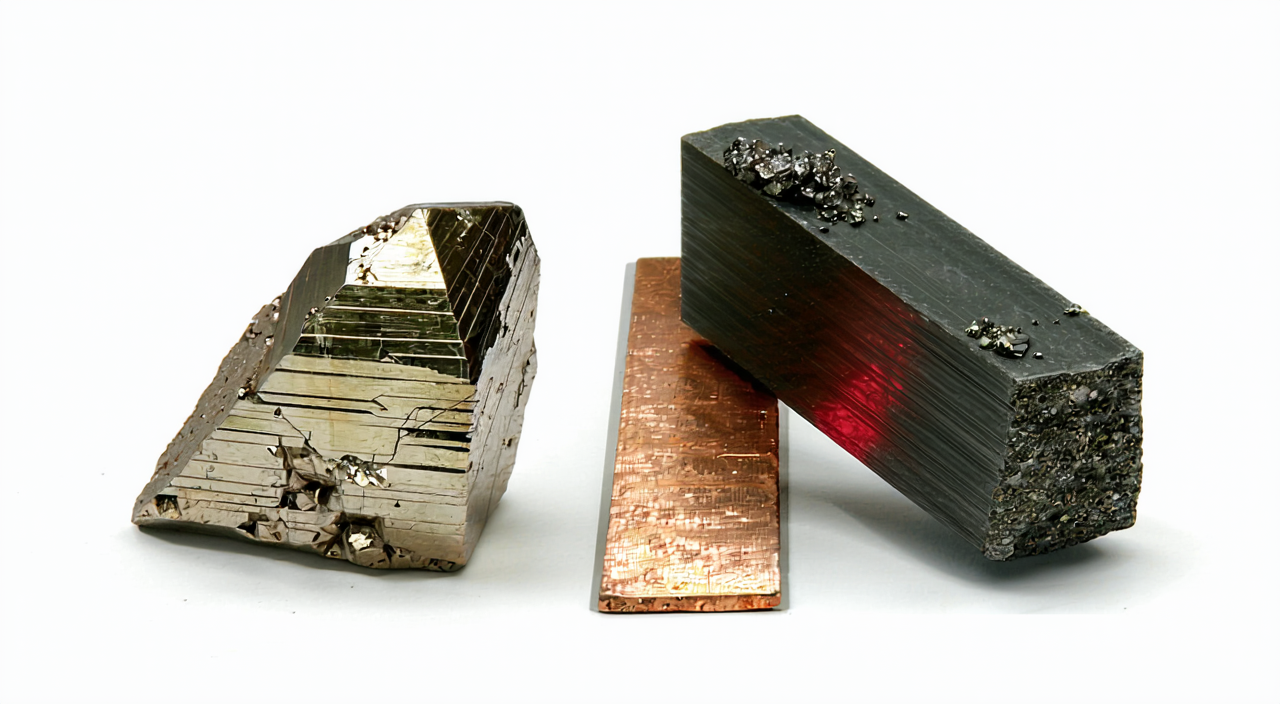
Many people mistake pyrite for metallic copper or magnetite. Metallic copper usually occurs as highly malleable red or reddish-purple flakes or granules and has excellent electrical and thermal conductivity, completely different from the brass-yellow color, cubic crystals, and hard, brittle texture of pyrite. Magnetite is mainly composed of iron tetroxide and is black or brownish black. Its most distinctive feature is that it can be attracted by a magnet, whereas pyrite generally has no magnetism or only very weak magnetism.
In addition, magnetite is also relatively heavy in texture, but its color and form are quite different. The surface of magnetite is dull or slightly metallic, and it does not show the bright brass-yellow color seen in pyrite. Using the three simple methods of streak, magnetism, and color, they can basically be distinguished quickly. When purchasing mineral specimens or Chinese medicine decoction pieces overseas, understanding these differences can help avoid confusion.
Which Formulas Use Pyrite?
Pyrite often appears in traumatology formulas to enhance the effects of invigorating blood and reconnecting bones. A common example is Zirantong San, in which calcined pyrite is usually combined with Dang Gui, Chuan Xiong, Ru Xiang, Mo Yao, and others, used for middle and late stages of fractures when stasis has not completely resolved and swelling and pain have not subsided. In addition, modern preparations such as Jiegu Qili Pian and Shangke Jiegu Pian often contain calcined pyrite. Traditionally, such preparations are considered helpful for promoting bone healing and reducing local stasis and swelling.
There are also other traditional bone-setting formulas, such as Jiegu Dan and Xugu Huoxue Tang, in which pyrite is often an important component. It is important to note that these formulas and patent medicines must be selected according to the stage after injury, body constitution, and whether proper reduction and fixation have been completed. They are not suitable for all fractures. Especially in cases of open fractures, infection, or severe internal diseases, patients must be treated in a medical facility. These formulas are mainly an auxiliary direction during the recovery period and cannot replace surgical reduction and fixation.
What Precautions Should Be Taken When Using Pyrite?
As a mineral medicine, the most prominent safety concerns with pyrite are mineral contamination and excessive heavy metals. Therefore, only decoction pieces that have been properly processed and tested should be used. Never collect natural ore and grind it for direct consumption, and never try to calcine and quench it yourself. Patients with liver or kidney insufficiency need to be especially cautious when using pyrite, because mineral medicines place a relatively heavy metabolic burden on the body, and if excretion is impaired there may be a risk of accumulation.
After a fracture occurs, the first step is proper reduction and fixation. One should not rely on pyrite or pyrite-containing products alone to make the bone heal on its own. If the fracture is poorly aligned or does not heal over time, a follow-up examination should be performed promptly; simply prolonging the course of medication will not solve the problem. At the same time, long-term or excessive use of pyrite or related formulas is not recommended. If nausea, loss of appetite, abdominal discomfort, or black stools occur during use, stop taking it promptly and consult a qualified healthcare professional. Remember that pyrite is a medicinal substance for short-term use under guidance, not a daily health supplement.
Summary
Pyrite is a traditional mineral medicine derived mainly from pyrite. It can be identified by its cubic crystal form, brass-yellow metallic luster, and dark green streak. In Chinese medicine, it is usually classified under the approaches of reconnecting bones and sinews and dispersing stasis and relieving pain, provided that reduction and fixation have been completed and it is used under professional guidance. Modern quality control focuses on its heavy metal content and processing methods. Pyrite is not suitable for self-processing or long-term use, and patients with liver or kidney insufficiency need to be especially cautious. This article is for educational reference only and is not a substitute for professional diagnosis or treatment.