
What Is Zi Wan? Medicinal Parts, Identification, and Common Formulas
If you are just starting to learn about Chinese medicinal herbs, the name Zi Wan might evoke a refined herbal impression. It often appears in formulas for relieving cough and resolving phlegm. But what exactly does Zi Wan look like? What part is used medicinally? How does it differ from Kuan Dong Hua, another herb commonly used for cough? This article will address these questions, outlining fundamental knowledge about Zi Wan to give you a clear starting point for understanding this traditional remedy.
What Does Zi Wan Look Like? How to Identify It
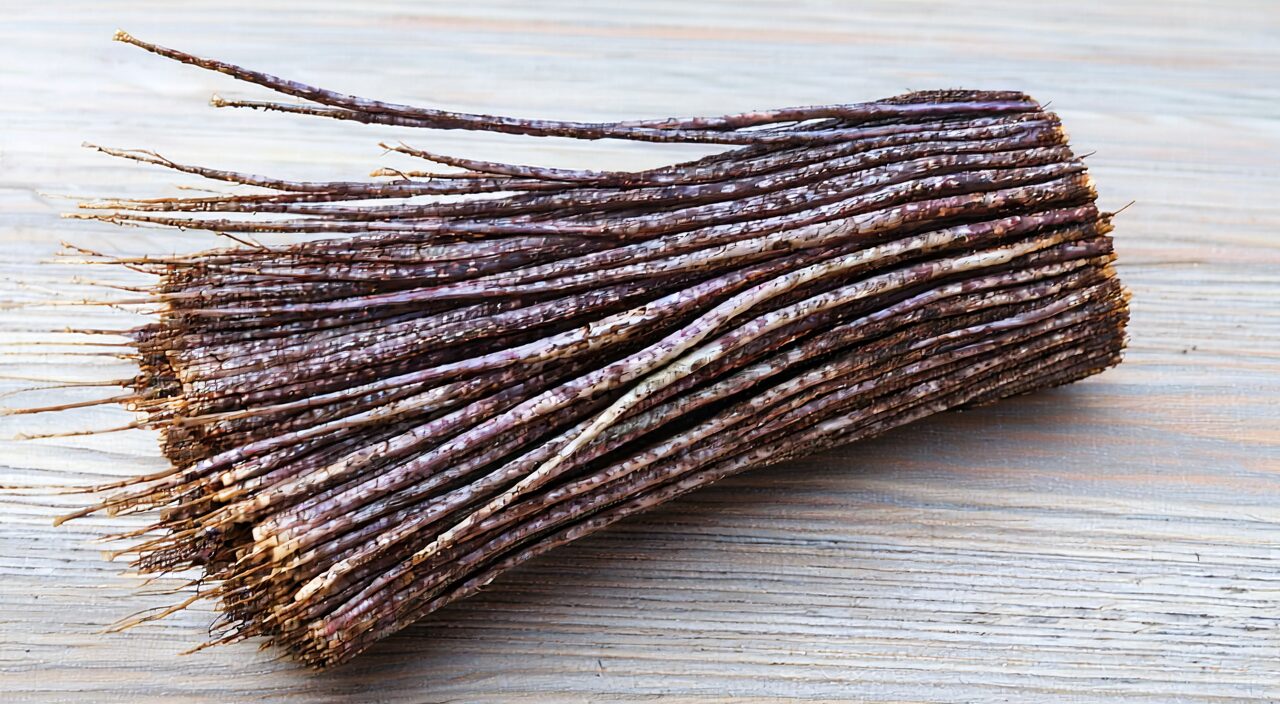
Zi Wan is the dried root and rhizome of Aster tataricus, a plant in the Asteraceae family. The whole medicinal material appears as irregular clumps or clustered masses. A notable feature is the short rhizome, sometimes with remnants of stem bases; many slender roots grow from the rhizome, often braided or spreading. The root surface is purplish-red or grayish-red with longitudinal wrinkles. The texture is pliable and tough, not easily broken, and the fractured surface is slightly fibrous with a pale-colored wood core visible. The odor is faint, and the taste is slightly sweet initially, becoming mildly bitter. If the color is dark black, the texture brittle and hard, or the odor unusual, the material may have been stored too long or might be an adulterant. Herbalists historically summarized that “Zi Wan should display purplish red, slender roots in clusters, pliable yet unbroken,” which can serve as a quick visual reference for identification.
What Is the Medicinal Part of Zi Wan?
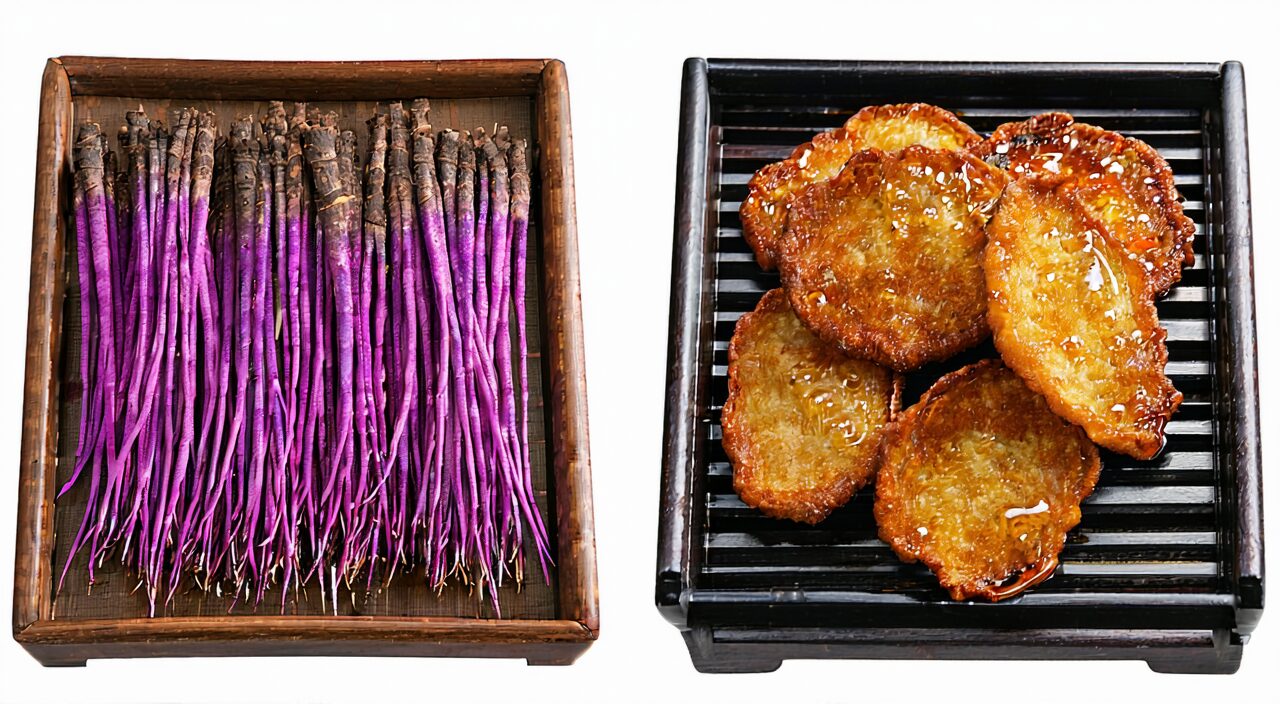
The medicinal part of Zi Wan is its dried root and rhizome. Harvesting and processing usually occur in autumn after the aerial parts wither or in spring before sprouting. The roots and rhizomes are dug up, cleaned of soil and residual stems, and then dried in the sun or by heat. The raw herb is often used directly, but some is processed by stir-frying with honey to produce honey-fried Zi Wan (Mi Zi Wan). After honey-frying, the surface becomes brownish, with increased moistness, and the action leans more toward moistening the lung. In traditional usage, for cough with difficult expectoration or qi rising abnormally, raw Zi Wan and honey-fried Zi Wan are chosen based on different experiences, which should be evaluated according to individual conditions and formula composition.
How Does TCM Understand Zi Wan?
Traditional Chinese medicine typically understands Zi Wan through its nature, taste, channel tropism, and actions. Zi Wan is warm in nature, acrid and bitter in taste, and enters the Lung channel. Its core actions are moistening the lung, directing qi downward, resolving phlegm, and stopping cough. It is commonly used for cough caused by external contraction or internal damage, especially when there is much phlegm, qi counterflow, or difficulty expectorating phlegm. Many traditional cough formulas include Zi Wan to help diffuse and descend lung qi. Because Zi Wan can both guide qi downward and provide moistening, it can be part of a treatment strategy for patterns such as wind-cold fettering the lung or phlegm-dampness obstructing the lung, depending on the herbal combinations. However, suitability must be determined by comprehensive assessment of tongue and pulse signs, constitution, and other factors.
Focus Points of Modern Research on Zi Wan
Modern research on Zi Wan mainly focuses on its chemical constituents and pharmacological activities. It contains compounds such as shionone, luteolin, and quercetin. Some preliminary studies explore its relaxant effects on airway smooth muscle and its influence on mucus secretion, but most of this research remains at the laboratory stage, and much work is still needed before translation into specific clinical applications. This information can only serve as a reference for understanding the background of the herb and cannot be directly equated with clinical effects.
What Are the Differences Between Zi Wan, Kuan Dong Hua, and Bai Qian?
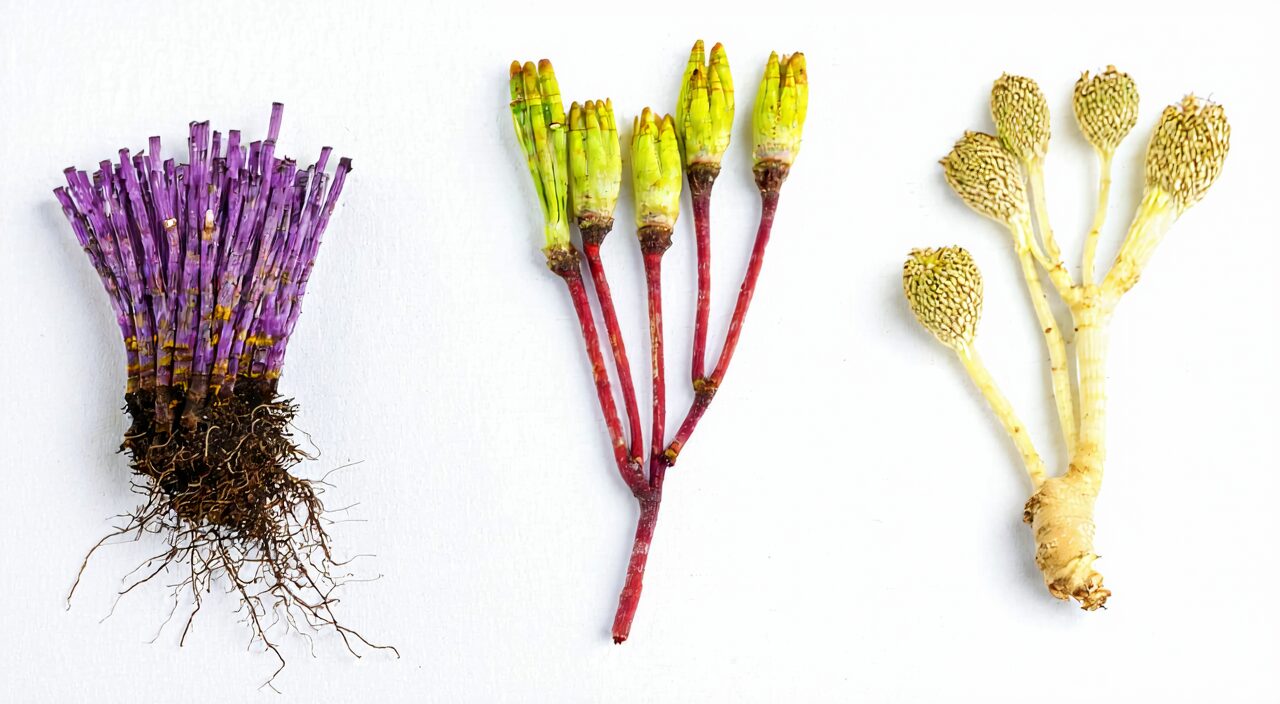
These herbs often appear together in cough-relieving formulas, but their origins and morphological features are distinctly different. Kuan Dong Hua is the dried flower bud of Tussilago farfara, an Asteraceae plant. It is long, rod-shaped, with purplish-red bracts on the outside and a brittle texture, completely unlike the slender root clusters of Zi Wan. Bai Qian is the dried rhizome and root of Cynanchum stauntonii or Cynanchum glaucescens (Asclepiadaceae). Its rhizome is slender, cylindrical, with obvious nodes, a yellowish-white or yellowish-brown surface, hollow pith, and a relatively hard texture. Zi Wan, in contrast, features fibrous root clusters, a pliable texture, and a purplish-red or grayish-red color. In terms of actions, Kuan Dong Hua excels at stopping cough and resolving phlegm, and may be suitable for both new and persistent coughs; Bai Qian tends to direct qi downward and resolve phlegm; Zi Wan moistens the lung, directs qi downward, and simultaneously resolves phlegm. In practice, the choice often depends on the nature of the phlegm, the cough presentation, and the patient’s constitution.
Which Formulas Contain Zi Wan?
Zi Wan appears in many traditional cough-relieving and phlegm-resolving formulas. Several classic examples are introduced below to illustrate traditional application approaches.
Zhi Sou San, from Yi Xue Xin Wu (Medical Insights), is often used for cough, throat itch, and difficult expectoration caused by wind invading the lung. The formula combines Zi Wan with Bai Bu, Bai Qian, and others to diffuse the lung and stop cough. Traditionally, it is used when external pathogenic factors from a common cold have resolved but the cough persists.
There are several formulas named Zi Wan Tang with Zi Wan as the principal herb. For instance, Zi Wan Tang from Tai Ping Hui Min He Ji Ju Fang (Formulary of the Bureau of People’s Welfare Pharmacies) mainly targets failure of lung qi to descend, cough with rapid breathing, and a sensation of phlegm in the throat. It often pairs Zi Wan with Sang Bai Pi (mulberry root bark) and Xing Ren (apricot kernel), emphasizing simultaneous descending of qi and resolving of phlegm.
She Gan Ma Huang Tang, from Jin Gui Yao Lue (Essentials from the Golden Cabinet), is traditionally used for cough and qi counterflow with a “water-chicken sound” in the throat caused by cold rheum congesting the lung. The formula includes She Gan (blackberry lily rhizome), Ma Huang (ephedra), Zi Wan, and Kuan Dong Hua, among others. Zi Wan helps warm the lung, transform retained fluids, and direct qi downward to stop cough.
The above formulas are traditional application examples. Whether they are suitable for an individual should be determined comprehensively based on constitution, symptoms, product instructions, and advice from professionals. The directions of different formula combinations vary greatly and cannot be simply copied.
What Precautions Should Be Taken When Using Zi Wan?
Although Zi Wan is a commonly used herb, several points should be kept in mind during use. First, for excess-heat cough characterized by high fever, thick yellow phlegm, and marked thirst, using Zi Wan alone is generally not appropriate; traditionally it is combined with heat-clearing herbs. Second, for yin-deficiency dry cough with scanty phlegm, hoarseness, and a red tongue with little coating, raw Zi Wan, with its tendency toward warmth and dryness, may not be suitable; in such cases, honey-fried Zi Wan combined with yin-nourishing substances is preferred. Additionally, some individuals may experience stomach discomfort or nausea after taking it, possibly related to the herb’s warm nature and personal sensitivity. Starting with a small dose and observing the response or consulting a professional is advisable. Honey-fried Zi Wan is slightly less drying, but syndrome differentiation is still required. Furthermore, for cases accompanied by pronounced chest tightness, palpitations, or persistent unresolved cough, it is recommended to consult a physician promptly, obtain a clear diagnosis, and then consider adjunctive support.
Summary
Zi Wan is a traditional herb used to stop cough and resolve phlegm, with the root and rhizome serving as the medicinal part. Its distinguishing appearance is clusters of purplish-red slender roots. Compared with Kuan Dong Hua and Bai Qian, its form and application emphasis differ. In formulas such as Zhi Sou San, Zi Wan Tang, and She Gan Ma Huang Tang, Zi Wan functions to moisten the lung, direct qi downward, resolve phlegm, and stop cough. When using it, one should consider differences in constitution, such as excess heat or yin deficiency, carefully choose between raw and honey-fried products, and follow professional guidance. This article is for informational reference only and cannot replace professional diagnosis or treatment advice.