
Chinese Medicine Websites at Home and Abroad: How to Evaluate Information Reliability and Purchase Safety

When searching for Chinese medicine information or planning to buy Chinese medicine products overseas, it is easy to come across a wide variety of websites. Some appear rich in content, yet it is hard to determine their accuracy; others offer convenient purchasing processes but fail to clarify product origins. This is particularly confusing for overseas Chinese or non-Chinese speakers unfamiliar with the domestic internet environment—how to find relatively reliable information and safe purchasing channels among so many websites is a very real challenge.
This article aims to provide a framework for comparison. The focus is not to recommend any specific platform but to offer a set of actionable observation dimensions, helping you make a more rational judgment about whether an unfamiliar website is trustworthy.
Why Compare Chinese Medicine Websites at Home and Abroad

Chinese medicine websites are highly mature in China, but for overseas users, language barriers, payment methods, shipping restrictions, and varying regulations on herbal products across countries can turn a seemingly simple search into a much more complicated process.
If decisions are made solely based on search engine rankings or page appearance, key safety signals may be overlooked. Some websites look professional but lack basic product liability information; others offer a good reading experience but clearly exaggerate the effects of use.
By comparing the features of different types of websites, it becomes easier to establish your own criteria for judgment, rather than passively accepting one-sided claims made by the websites.
Main Characteristics of Domestic Chinese Medicine Websites
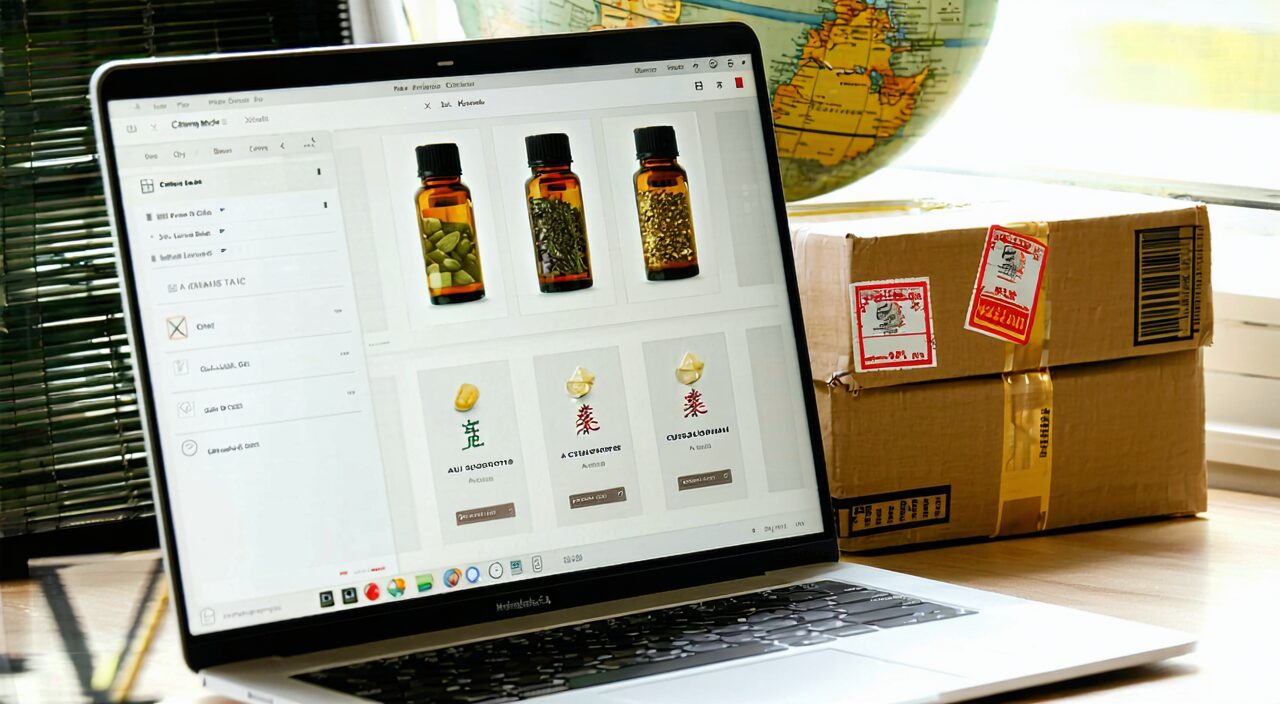
Domestic Chinese medicine websites are generally operated by large health portals, TCM clinics, pharmaceutical companies, or content platforms. They are characterized by a large volume of information and a strong Chinese-language context.
Rich in Content but Varying in Depth
Many domestic websites bring together TCM theories, formula introductions, medication experiences, and wellness articles, serving as a great resource for those who want to learn Chinese medicine in depth. At the same time, however, the content sources and review standards vary greatly. It is often difficult for ordinary readers to distinguish which content has been reviewed by professionals and which is simply personal experiences uploaded by users.
Wide Product Selection but Inconvenient for Overseas Purchases
In terms of products, domestic platforms often cover a wide range of proprietary Chinese medicines, decoction pieces, and health products, with relatively transparent pricing. However, most of these websites primarily serve domestic users.
Consumers often need to verify payment methods, cross-border logistics, and whether the products comply with the regulations of the destination country on their own. If ordering directly from a domestic platform for overseas delivery, the following issues may arise:
- Customs clearance risks
- Shipping delays
- Product non-compliance locally
Language and Services Mainly in Chinese
For overseas Chinese readers, a Chinese-language interface may not be a significant barrier. But for non-Chinese users, obtaining accurate information is much more difficult. Some websites rely on machine translation, and key usage precautions may be misunderstood, which in turn increases risk.
Main Characteristics of Overseas Chinese Medicine Websites

Overseas Chinese medicine websites primarily target the local Chinese population or non-Chinese speakers interested in TCM. They have different emphases on language adaptation, payment and logistics, and compliant expression.
More User-Friendly Language and Localization
Many overseas sites offer multilingual versions or high-quality English content, making them more user-friendly for non-Chinese speakers. Some websites also explain TCM concepts in the context of local cultural habits, lowering the barrier to understanding.
However, this also introduces a problem: the accuracy of terminology in the translation process varies greatly. Sometimes TCM terms are oversimplified or misinterpreted. Complex concepts like constitution types and pattern types can easily lose crucial information in translation.
Payment and Logistics Better Suited for Overseas Users
Such websites usually support local mainstream payment methods, and logistics are designed around overseas warehouses or local shipping, resulting in relatively clear delivery times and return processes.
However, the product range is often not as comprehensive as that of domestic platforms; some classic formulas and rare medicinal materials may not be covered. Some websites focus their selection on herbal extracts in the form of health supplements, offering a limited choice of traditional decoction pieces or formula granules.
Significant Differences in Product Information and Compliant Expression
It is worth noting that overseas Chinese medicine websites vary considerably in their product descriptions.
Some platforms provide relatively complete product ingredients, suggested usage, contraindications, and safety reminders, with restrained language. Others may engage in exaggerated claims or vague function assertions.
How to introduce Chinese medicine products in a compliant manner within different regulatory frameworks is a complex issue. Consumers can get an initial sense of a website’s professionalism by paying attention to the following details:
- Whether a clear disclaimer is prominently displayed
- Whether absolute terms are used frequently
Key Dimensions for Evaluating Website Reliability

Whether it’s a domestic or an overseas platform, the following dimensions can help you quickly establish a basic evaluation framework.
Content Sources and Professional Background
Reliable Chinese medicine websites usually indicate the professional background of the content writer or reviewer, or specify the references for the information.
When browsing, you can pay attention to:
- Whether the article has a clear author byline and professional background
- Whether it cites the sources of referenced information
- Whether the headline over-emphasizes “healing effects” but lacks specific pattern differentiation reasoning
If a large number of articles have no author bylines, or the headline style leans toward a narrative of “healing” without explaining the TCM pattern differentiation logic, extra caution is needed. Traditional Chinese medicine places great importance on individualized assessment; a responsible website would not use a one-size-fits-all approach.
Product Information Transparency
On product-related pages, you can check whether the following basic information is provided:
- Clear product name
- Complete ingredient list
- Specifications, origin, and storage conditions
- Any usage precautions and contraindications for specific populations
If this information is incomplete, or if it focuses solely on efficacy without mentioning unsuitable populations, caution is warranted. Additionally, whether the product images are clear and the label information is readable are also important observation points.
Translation Quality and Terminology Accuracy
For websites targeting non-Chinese speakers, you can check whether the translation of TCM terms retains their original meaning.
For example, translating “清热” as “clear heat” is a relatively common practice. However, if the constitutional context is entirely omitted and the product is directly implied to solve all “inflammation” problems, it could be misleading. Good translation preserves the traditional expression while adding necessary explanations to prevent readers from forming an absolute understanding.
Compliant Expression and Safety Reminders
Different countries and regions have strict restrictions on claims made for herbal products, especially when it comes to disease-related statements, which require extra attention.
A website willing to take responsibility for its information will often prominently display reminders such as:
- The content is for reference only and cannot replace professional diagnosis or treatment advice.
- Consult a qualified professional before using the product.
- If serious or persistent discomfort occurs, seek medical attention promptly.
Such disclaimers are not just a formality; they reflect how seriously the platform takes the baseline of safety.
Payment, Logistics, and After-Sales Contact
Safety also extends to the transaction process. You can check whether the website provides verifiable:
- Company information and privacy policy
- Return and exchange policies and customer service contact channels
- Security seals or protection indicators on the payment page
If the entire website only has an online form, with no physical contact information to be found, or the payment page lacks security indicators, then no matter how well-written the content is, it is not advisable to place an order rashly.
Contact Information and Traceability
A trustworthy website usually does not hide its operating entity. You can check whether the website footer contains:
- Company name and registered address
- Contact email or phone number
- Any relevant industry registration information in the country of operation (applicable to overseas sites)
This does not mean that all websites must disclose all internal information, but sites that completely conceal their identity are hard to trust.
Website Types Suitable for Different Users

Depending on individual circumstances, different types of Chinese medicine websites can play different roles.
Primarily for Learning TCM Knowledge
If your main goal is to understand TCM theories and health preservation ideas, the depth of content and narrative logic become more important.
You may prioritize websites with the following characteristics:
- Article structure is clear and adept at distinguishing “traditional understanding” from “modern research”
- Frequently mentions pattern differentiation premises rather than directly offering universal solutions
- Even without purchasing any product, can provide structured TCM knowledge
Primarily for Looking Up Formula or Proprietary Chinese Medicine Information
For such needs, you can turn to platforms with formula databases or proprietary Chinese medicine product pages. Focus on the following:
- Whether traditional usage directions are introduced
- Whether cautious wording such as “commonly used for” or “traditionally used for” is used
- Whether it reminds users to consider their own constitution and symptoms and to use under professional guidance
A website that provides such reminders is a relatively positive signal.
Primarily for Purchasing Chinese Medicine Products
If you plan to buy online, it is advisable to regard product transparency, logistics assurance, and after-sales feedback as hard requirements.
Take some time to browse:
- The website’s safety reminders and FAQ page
- The completeness of product page information
Rather than making a decision based solely on promotions or user reviews. For a platform you are using for the first time, a safer approach is to start with a small batch of low-risk products, and then make further judgments after experiencing the full process.
Common Misconceptions and Tips to Avoid Pitfalls

When browsing Chinese medicine websites, there are several common misconceptions to be aware of in advance.
Misconception 1: More Content Means More Professionalism
A large number of articles does not equal reliable information. Some websites increase page count by mass collecting or piecing together content, with little professional review.
What matters is not the length but whether the article provides evidence-based statements. The value of TCM popular science lies in helping people understand the thinking, not in offering a cure-all promise.
Misconception 2: Only Looking at Positive Reviews and Sales Volume
User reviews and sales volume can serve as references, but they cannot replace independent judgment.
Some product pages only display filtered positive reviews, or the review content is vague and lacks specific usage descriptions. Genuine feedback usually mentions:
- Individual constitutional differences
- Details like adjustments in diet and daily routine
Instead of simply stating “slept well” or “feels energetic.”
Misconception 3: Ignoring Safety and Compliance Signals
Some people may think safety reminders are just a formality and do not affect actual effectiveness. But in fact, a website that proactively emphasizes “consult a professional before use,” “not suitable for severe or prolonged symptoms,” and “should be considered in light of individual circumstances” often has a clearer understanding of the complexity of Chinese medicine.
Such a website is also more likely to take product quality and user safety seriously. Conversely, expressions that avoid mentioning unsuitable populations or fail to mention any potential risks at all should raise concern.
Tips to Avoid Pitfalls
When unsure about a website’s reliability, you can ask yourself a few questions:
- Has the website clearly explained the boundary between information and products?
- Does it remind users that severe symptoms should prompt timely medical attention?
- Can you find a real, reachable responsible party?
If these most basic questions cannot be answered affirmatively, then no amount of attractive advertising is reason enough to place an order or rely on the information.
Summary

Chinese medicine websites at home and abroad each have their own features, but when it comes to information reliability and purchase safety, the key is not whether the site is domestic or overseas, but whether it possesses:
- Content professionalism
- Product transparency
- Clear safety reminders
Regardless of which platform you choose for information or product purchases, it is worth spending some time examining details such as content sources, translation accuracy, compliant expression, payment and logistics guarantees, and contact information. These dimensions cannot guarantee finding a perfect website, but they can at least help filter out clearly unreliable options.
When making decisions about using and purchasing Chinese medicine, it is always safer to make a comprehensive judgment based on personal health conditions, local regulations, and advice from professionals. This article serves only as a popular science reference for organizing a judgment framework and cannot replace professional diagnosis or treatment advice.