
What Is Red Peony Root? Medicinal Parts, Identification, and Common Formulas
Red peony root (Chi Shao) comes from the dried root of the buttercup family plants Paeonia lactiflora or Paeonia veitchii. It is a commonly used heat-clearing and blood-cooling medicinal material in clinical Chinese medicine. Because its root bark is brownish-red or reddish-brown, it is traditionally used under the name “red peony root” to distinguish it from white peony root, which is processed by removing the bark.
For readers who are learning about Chinese medicine or coming into contact with herbal formulas, learning to visually identify red peony root, understanding its medicinal part, and recognizing its role in formulas helps build a more complete picture of this herb.
What Does Red Peony Root Look Like? How to Identify It
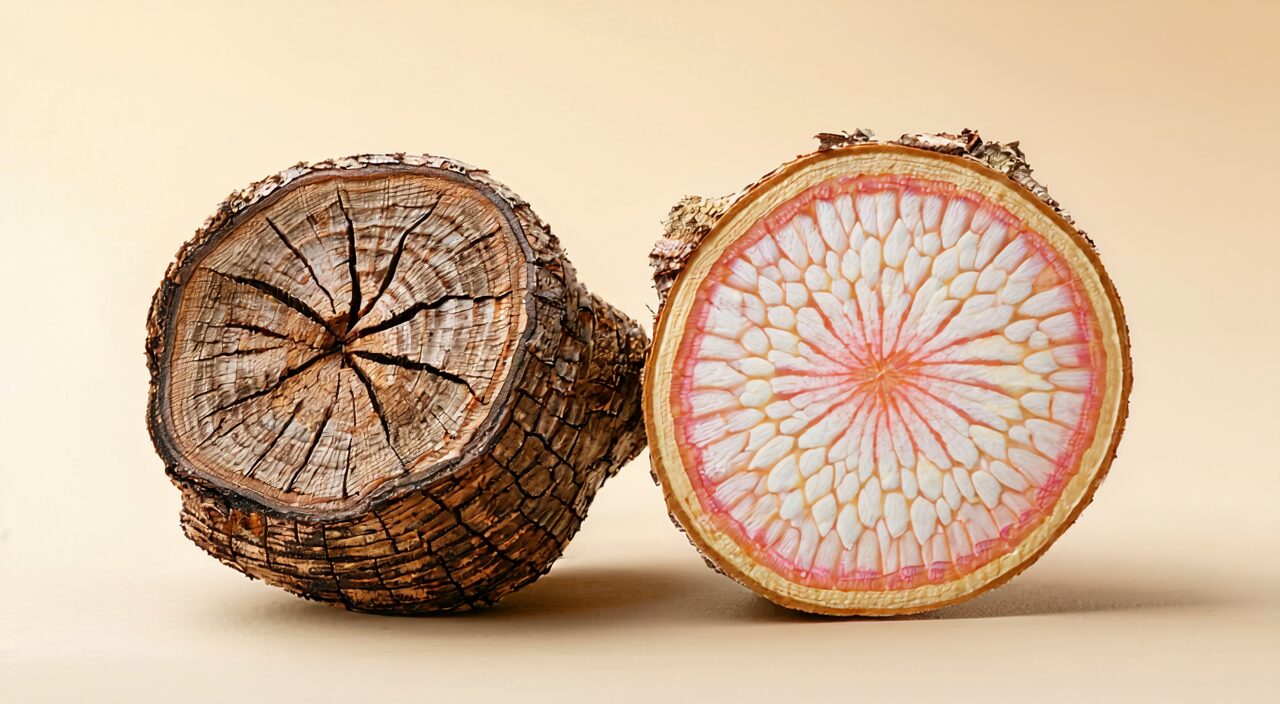
Red peony root has several very stable morphological features that can be quickly assessed by looking at its shape, surface, and cross-section.
The dried root is mostly cylindrical or nearly cylindrical, slightly curved, of varying lengths, and usually around one to two centimeters in diameter. The outer surface is brownish-brown or dark brown and relatively rough. Longitudinal wrinkles, fine root scars, and slightly raised transverse lenticel-like marks are often visible, making the surface look uneven rather than smooth.
The broken cross-section is a crucial identification feature. Although red peony root is relatively hard, it is quite brittle, so the fractured surface is relatively flat. The cross-section is mostly pinkish-white or slightly pink, with a thin bark and a relatively broad wood portion showing distinct radial patterns. Experienced practitioners call this pattern the “chrysanthemum heart.”
If you examine a slice of red peony root under light, you will also notice that the color transition between the inner bark and the wood is natural, without a sharp boundary.
In terms of odor, red peony root has a faint, distinctive fragrance, and its taste is slightly bitter with a hint of sourness and astringency. Together, these sensory characteristics help distinguish it from other similar-appearing root herbs.
What Is the Medicinal Part of Red Peony Root?
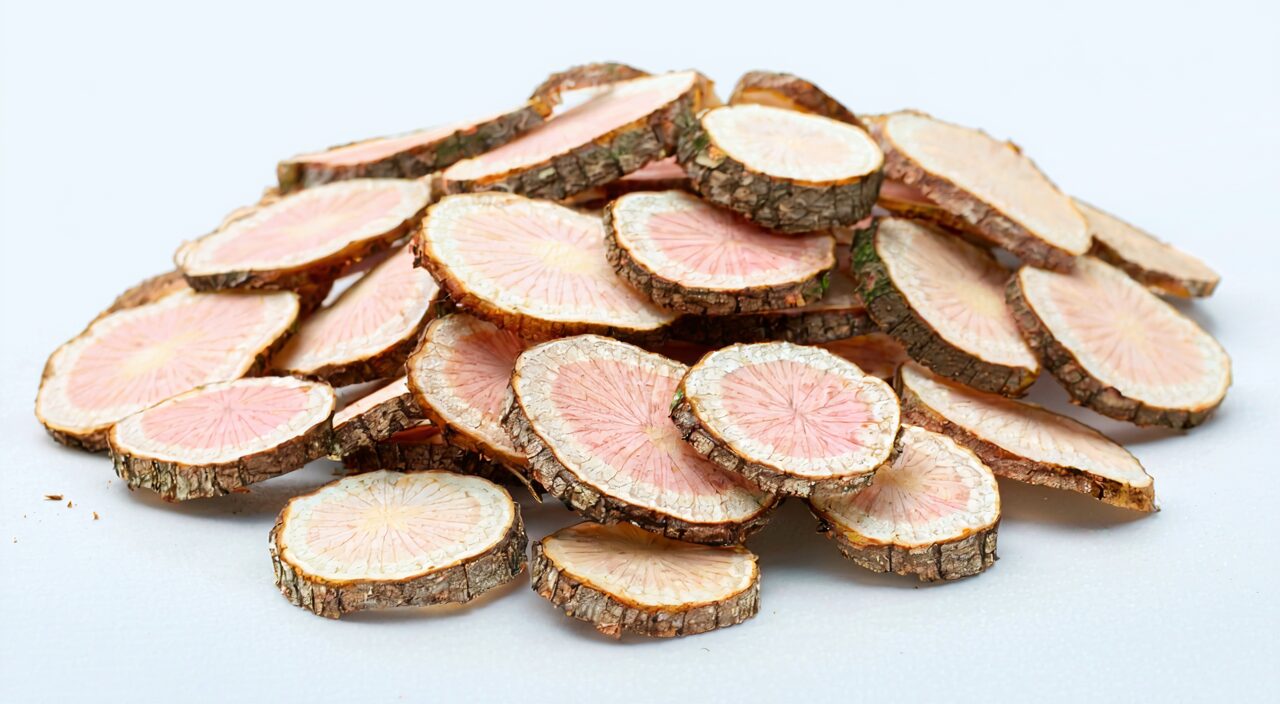
The medicinal part of red peony root is its root. It is typically harvested in spring and autumn, with autumn harvesting being more common. After harvest, the aerial parts, rhizomes, attached fibrous roots, and soil are removed, and the roots are then dried directly in the sun. This is the crude form of red peony root. Precisely because the bark is largely retained during processing, the brownish-brown outer skin is preserved, which is one of the significant visual differences between red peony root and white peony root.
On the market, besides whole dried roots, red peony root is more commonly seen in sliced form. The slices are typically irregular, roundish or oval thin pieces cut transversely or obliquely. The cut surface clearly shows a pinkish-white to slightly red cross-section with evenly distributed radial wood patterns. In some thicker slices, you can even see remnants of the brownish-brown outer bark at the edges. These details can all assist in identifying red peony root at the slice level.
How Does Chinese Medicine Understand Red Peony Root?
In traditional Chinese medicine theory, red peony root is characterized as bitter and slightly cold, and it mainly enters the Liver meridian. The concept of “entering the Liver meridian” does not mean the herb acts only on the anatomical liver; rather, it indicates a tendency to regulate the qi and blood conditions associated with the Liver meridian pathway.
In traditional applications, red peony root is often used along two main lines: “clearing heat and cooling the blood” and “dispersing blood stasis and relieving pain.” When the body develops epidemic macules due to blood heat, or symptoms such as hematemesis or epistaxis caused by reckless movement of hot blood, many empirical approaches consider red peony root’s heat-clearing and blood-cooling action.
At the same time, red peony root has the property of invigorating blood and dispersing stasis, which distinguishes it from herbs that only clear heat and cool the blood. It is traditionally described as capable of “cooling the blood without leaving stasis behind.” For amenorrhea or dysmenorrhea caused by poor qi and blood circulation, or for local swelling and pain from trauma and contusions, red peony root is often included in corresponding formulas as a way to help unblock blood vessels and relieve pain.
It should be noted that these are all understandings based on traditional experience. They reflect a summary of red peony root’s action direction from the perspective of nature, flavor, and meridian tropism in Chinese medicine, rather than direct pharmacological conclusions in the modern medical sense.
What Components and Effects of Red Peony Root Are Studied in Modern Research?
Modern phytochemical research has gained considerable knowledge of red peony root’s components. It contains a series of monoterpene glycosides such as paeoniflorin, oxypaeoniflorin, and benzoylpaeoniflorin, as well as certain amounts of gallotannins and other phenolic acids.
In vitro and animal studies suggest that components like paeoniflorin in red peony root may have a certain anti-inflammatory potential, affecting the release of certain inflammatory mediators. Additionally, some basic research has observed trends in aspects such as antioxidation, improvement of microcirculation, and regulation of immune-related indicators.
However, most of these studies are conducted under laboratory conditions, using extracts or purified compounds of red peony root. There are significant differences in experimental dosage and administration route compared to traditional decoction and oral use. Therefore, these results are currently mainly used to help understand the possible active substance basis of red peony root. They should not be directly interpreted as meaning that the same effects will occur in the human body after use, nor should specific therapeutic conclusions be derived from them.
How Does Red Peony Root Differ from Similar Herbs?
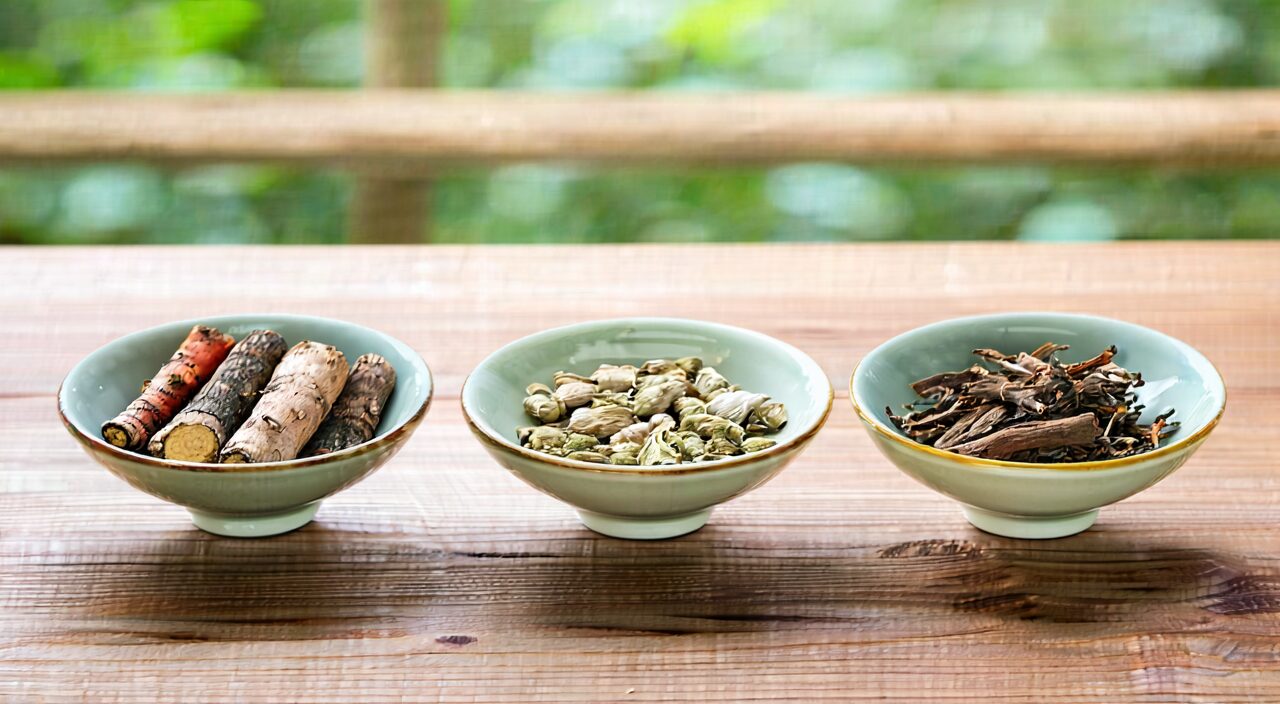
In practical identification and use, the two herbs most easily confused with red peony root are white peony root and moutan bark. Their differences can be understood from aspects of plant source, processing method, appearance, and traditional application emphasis.
Differences Between Red Peony Root and White Peony Root
Although both red peony root and white peony root come from peony roots, their processing methods are entirely different, resulting in distinct differences in several aspects:
| Comparison Item | Red Peony Root (Chi Shao) | White Peony Root (Bai Shao) |
|---|---|---|
| Processing Method | Harvested and sun-dried directly, usually without removing the bark | Outer bark removed, then boiled or steamed, and dried |
| Outer Bark Color | Brownish-brown | Whitish or slightly reddish-brown |
| Cross-Section Features | Pinkish-white or slightly red, hard and brittle | Whiter, more starchy, firmer texture |
| Taste | Slightly bitter, with a sour and astringent sensation | Predominantly sour |
| Traditional Application Emphasis | Clears heat, cools blood, invigorates blood, and disperses stasis; leans toward regulating blood heat and stasis | Nourishes blood, regulates menstruation, softens the liver, and relieves pain; mostly used for blood deficiency and liver qi disharmony |
Although they share the same origin, once the processing method changes, the tendencies of nature, flavor, and action also change, so they should not be substituted casually.
Differences Between Red Peony Root and Moutan Bark
Moutan bark is the root bark of tree peony, so the medicinal part is already different, and there are differences in appearance and traditional function emphasis:
| Comparison Item | Red Peony Root (Chi Shao) | Moutan Bark (Mu Dan Pi) |
|---|---|---|
| Medicinal Part | Root | Root bark |
| Appearance Features | Cylindrical, brownish-brown outer bark, cross-section pinkish-white to slightly red with obvious radial patterns | Often tubular or semi-tubular; outer surface grayish-brown or purplish-brown; inner surface light grayish-yellow; distinct fragrance |
| Odor and Taste | Slight odor, slightly bitter and astringent taste | Fragrant odor, slightly bitter and astringent taste |
| Traditional Application Emphasis | Relatively stronger in invigorating blood and dispersing stasis; more prominent tendency to move blood stasis | Clears heat and cools blood while tending to reduce deficiency heat and vent latent fire from the yin level; often used for bone-steaming without sweating, night fever, etc. |
In formula composition, their application concepts are also different and should be distinguished based on specific conditions.
Which Formulas Use Red Peony Root?
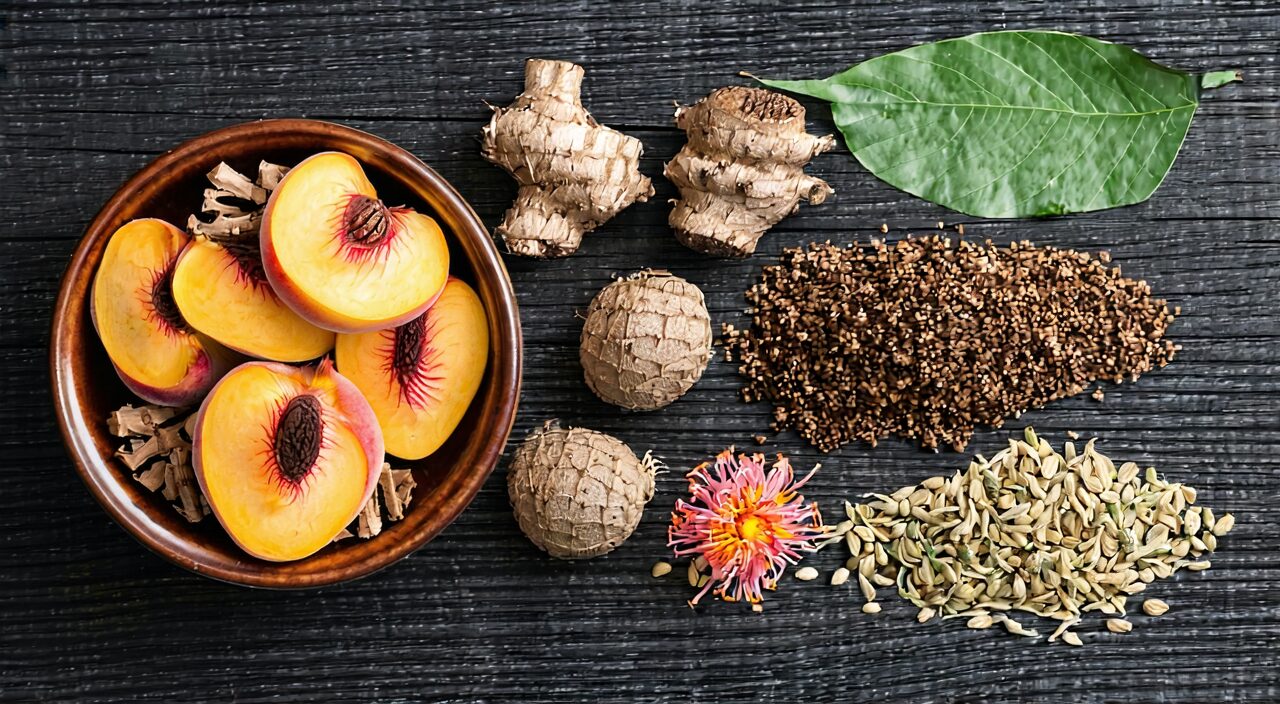
Red peony root is used in many classic Chinese medicine formulas, primarily exerting its invigorating blood, dispersing stasis, clearing heat, and cooling blood actions in combination. The following are several representative formulas that use red peony root in different directions to illustrate its role in combinations. This does not constitute a recommendation for specific symptoms.
Xuefu Zhuyu Tang (Blood Mansion Stasis-Expelling Decoction) Xuefu Zhuyu Tang is one of the representative formulas for the method of invigorating blood and resolving stasis. In this formula, red peony root is combined with peach kernel, safflower, achyranthes, etc., focusing on resolving stasis in the blood mansion of the chest. It is traditionally used for chest tightness, stabbing pain, and other issues related to qi and blood stasis. Here, red peony root tends to strengthen the blood-invigorating and stasis-resolving effect, helping improve blood stasis stagnation.
Tao Hong Si Wu Tang (Peach Kernel and Safflower Four Substances Decoction) Tao Hong Si Wu Tang is derived from Si Wu Tang by adding peach kernel and safflower. In this formula, red peony root is often used together with blood-nourishing and blood-invigorating herbs such as angelica and ligusticum. The overall tendency is to strengthen blood-invigorating and menstruation-regulating actions on a blood-nourishing foundation. It is often used for menstrual irregularities, unsmooth menstruation, and other conditions characterized by blood deficiency accompanied by stasis.
Xijiao Dihuang Tang (Rhinoceros Horn and Rehmannia Decoction) In the ancient formula Xijiao Dihuang Tang, rhinoceros horn was used as the chief herb, but now water buffalo horn is commonly used as a substitute in clinical practice. In this formula, red peony root is combined with rehmannia and moutan bark to jointly clear heat, cool the blood, disperse stasis, and resolve toxins. It is traditionally used for relatively acute and severe blood heat manifestations caused by heat pathogens deeply entering the blood level, such as body fever, prominent maculopapular eruptions, and a deep-red, dry tongue.
Dahuang Mudan Tang (Rhubarb and Moutan Decoction) Dahuang Mudan Tang is often used for the regulation of early-stage intestinal abscess (appendicitis). In this formula, red peony root is combined with rhubarb, moutan bark, peach kernel, and other herbs, with the main purpose of draining heat, breaking stasis, dissipating masses, and reducing swelling. Here, red peony root assists rhubarb in cooling the blood and invigorating blood while also participating in resolving local stagnation, swelling, and pain, helping restore the normal flow of qi and blood.
These four formulas are merely listed as examples of traditional usage directions; they do not represent that they are suitable for everyone. Whether they are appropriate, as well as specific dosages and formula adjustments, should be considered under the guidance of an experienced practitioner and based on individual current conditions.
What Precautions Should Be Taken When Using Red Peony Root?
Although red peony root has the property of invigorating blood and dispersing stasis, this very characteristic also brings some points that require special attention.
- Heavy menstrual bleeding: The blood-invigorating effect of red peony root may further increase menstrual flow, so caution is needed.
- Bleeding tendency or related medical history: For individuals with a history of gastric ulcer bleeding, platelet dysfunction, etc., use should be undertaken with great caution, as the blood-invigorating property may increase bleeding risk or prolong clotting time.
- Concurrent use of anticoagulant or antiplatelet medications: If taking medications such as warfarin, aspirin, or clopidogrel, red peony root may potentiate their effects. Risks should be assessed under a physician’s guidance; self-combined use is not recommended.
- Pregnancy: Traditionally, the stasis-dispersing and blood-invigorating nature of red peony root is considered unfavorable for pregnancy stability; pregnant women should avoid its use.
- Persistent or unexplained symptoms: When various discomfort symptoms persist over a long period, recur, or are severe and unexplained, one should not rely solely on a single herb. Seeking timely medical attention and systematic investigation is always the safer choice.
The above reminders are based on red peony root’s traditional actions and modern pharmacological concerns. They do not cover all individual situations, and professional guidance should still be followed when using it.
Summary
Red peony root is a commonly used Chinese medicinal herb known for its blood-invigorating and heat-clearing properties. Its brownish-brown outer bark, pinkish-white to slightly red cross-section, and distinct radial patterns are key points for visual identification. It has clear differences from the same-source white peony root and the somewhat similar-looking moutan bark in terms of processing and functional tendencies, so they cannot be used interchangeably. In formulas such as Xuefu Zhuyu Tang, Tao Hong Si Wu Tang, Xijiao Dihuang Tang, and Dahuang Mudan Tang, red peony root often plays the role of invigorating blood and dispersing stasis or cooling blood and draining heat. Given its blood-invigorating nature, extra caution is required for those at risk of bleeding, during pregnancy, and for those using anticoagulant medications. This article is for scientific knowledge reference in Chinese medicine only and cannot replace professional diagnosis or treatment advice. If you have specific health concerns, please consult a licensed local practitioner.