
What Is Shi Di? Medicinal Part, Identification, and Common Formulas
Shi Di may sound unfamiliar to those first exploring Chinese medicine, but persimmons, the autumn fruit, are well known. Shi Di actually comes from the familiar persimmon tree—it is the dried persistent calyx of the ripe fruit. In traditional Chinese medicine, Shi Di is not simply a part of the fruit; it is regarded as a clearly defined medicinal substance, especially when dealing with hiccups and related belching issues. This article discusses the morphological identification, medicinal part, traditional understanding, differences from other herbs, and common formulas containing Shi Di, to help overseas readers better understand this Chinese medicinal.
How to Identify Shi Di
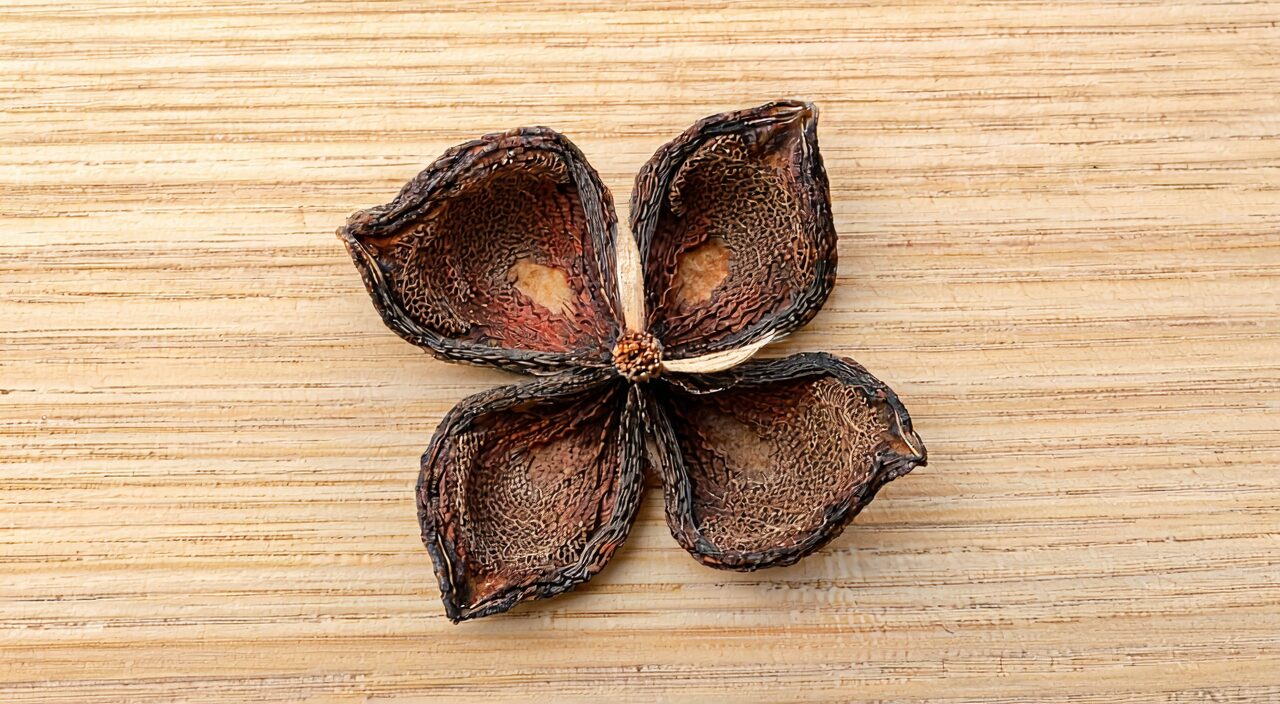
Shi Di typically appears as a flat, disc-shaped structure, about 1.5 to 3 cm in diameter. The margin is four-lobed, with lobes that are broadly triangular or nearly round, slightly recurved outward. Overall it looks like a pale brown little flower that has already opened. The back is mostly yellowish-brown or reddish-brown, densely covered with fine hairs; the inner surface is slightly lighter, yellowish-brown or with a dull reddish hue, and the hairs are sparser. In the center of Shi Di, a round scar from the fallen fruit stalk can be clearly seen, often surrounded by radial cracks or several raised rings. Dried Shi Di is brittle and hard, easy to break, with a faint odor and an astringent taste. If moistened slightly with water, it regains some flexibility, which is a small identification trick.
What Is the Medicinal Part of Shi Di?
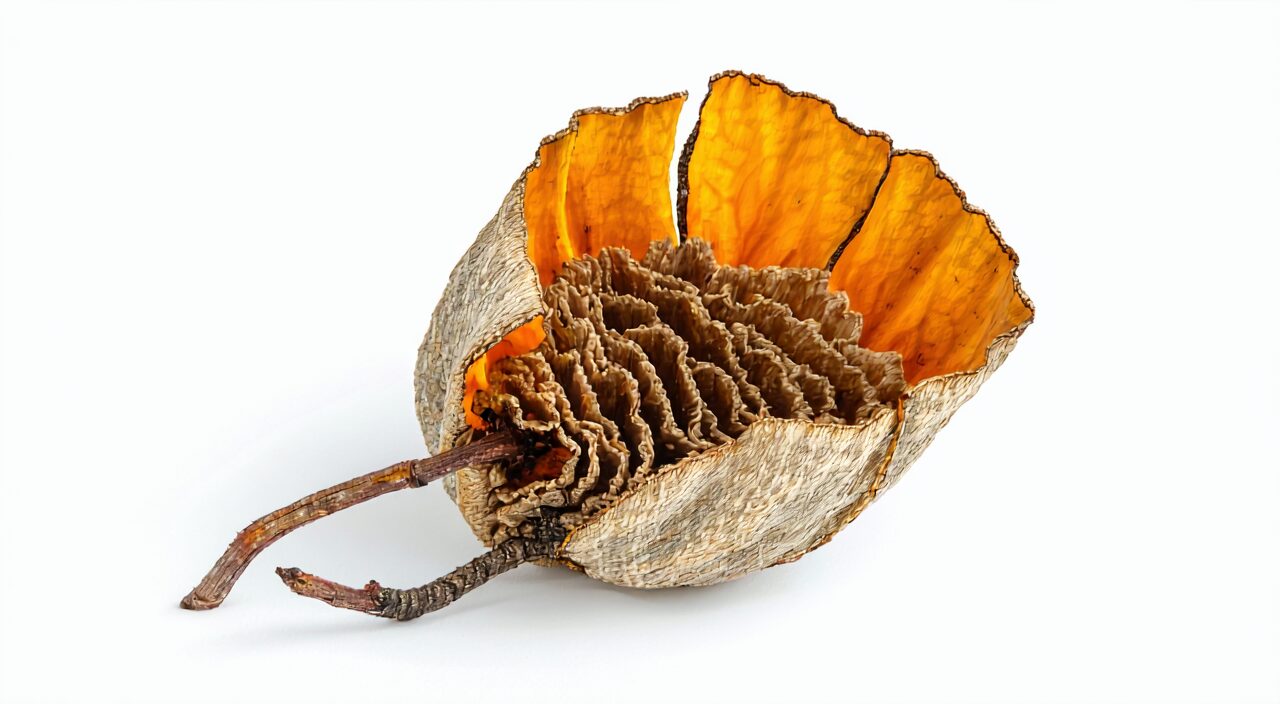
The medicinal part of Shi Di is clearly defined: it is the dried persistent calyx attached to the ripe fruit of Diospyros kaki Thunb. (Ebenaceae). In other words, what we use is not the entire fruit stalk or stem, but the four-lobed sepal part that remains at the base of the fruit after the persimmon is picked. Usually, after the fruit matures and is harvested in winter, the naturally fallen calyces are collected or removed from the persimmons, residual fruit stalks are eliminated, sand and dirt are washed away, and they are dried directly in the sun or at low temperature. The commercial Shi Di crude drug mostly retains a flat disc shape, is brittle, and is considered of good quality when the pieces are large, fleshy, yellowish-brown, and free from impurities.
How Does Chinese Medicine Understand Shi Di?
Traditional Chinese medicine focuses on Shi Di’s action of descending qi and stopping hiccups. Shi Di is neutral in nature, bitter and astringent in taste, and enters the Stomach meridian. According to TCM theory, hiccups or stubborn belching are often related to rebellious stomach qi, and Shi Di’s directional effect is to descend stomach qi, thereby stopping hiccups. Because its nature is mild—neither warm nor cold—it is especially suitable for hiccups caused by stomach cold and qi reflux. However, with appropriate combinations, it can also be used in some cases with a tendency toward heat patterns. Nevertheless, when treating hiccups, TCM never looks only at the “hiccup” symptom; a comprehensive differentiation of cold, heat, deficiency, and excess is necessary. For example, stomach-heat hiccups often come with dry mouth, bad breath, a red tongue with yellow coating; using Shi Di with a large amount of warming herbs alone could even worsen the discomfort. Thus, whether Shi Di is suitable still depends on one’s constitution, specific symptoms, and a professional’s pattern diagnosis.
What Preliminary Findings Does Modern Research Present on Shi Di?
Modern phytochemical studies have found that Shi Di contains tannins, triterpenoids, flavonoids, and some organic acids. The astringent effect of tannins has been speculated to possibly be related to the anti-hiccup mechanism, but this conjecture has not been adequately verified. Some in vitro experiments and animal studies have observed the effects of Shi Di extracts on gastrointestinal smooth muscle, suggesting some regulatory influence on abnormal spasms, but the relevant research is still at an exploratory stage with limited evidence levels. Overall, modern pharmacological research on Shi Di cannot yet be directly translated into a basis for safe self-use by the public; it mainly serves as supplementary reference to traditional experience.
How Does Shi Di Differ from Clove and Inula Flowers?
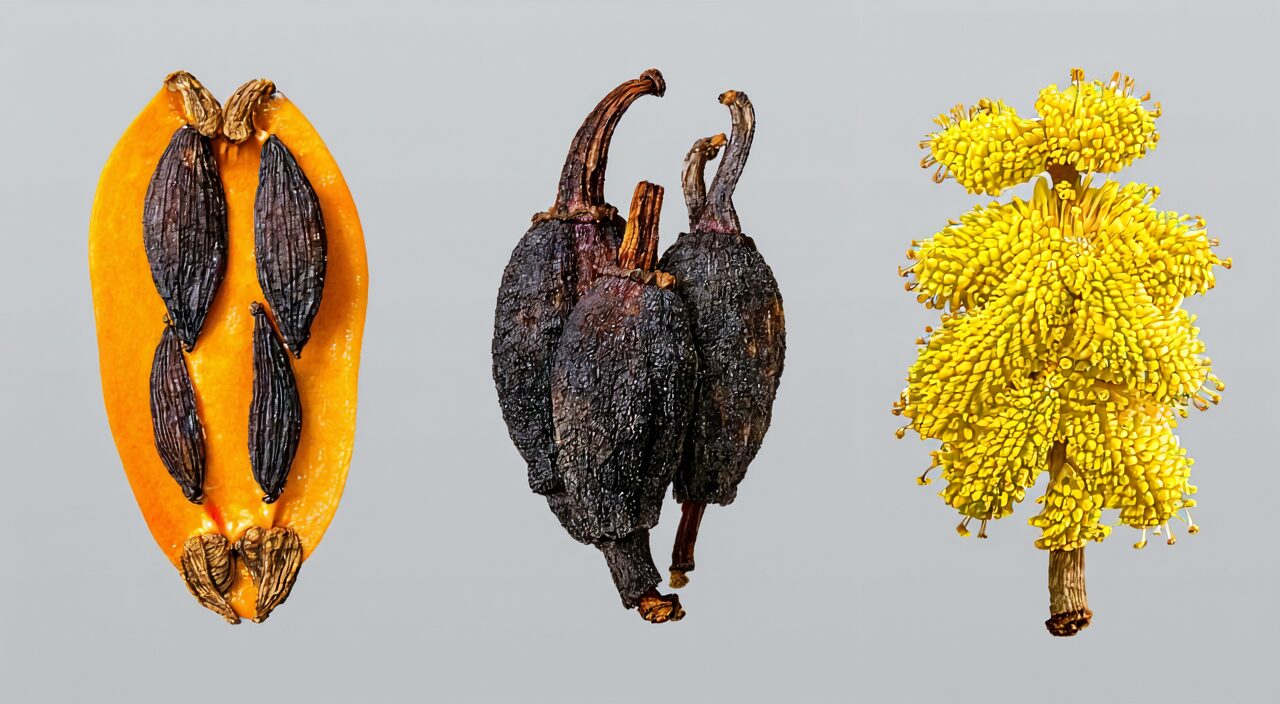
Shi Di, clove (Ding Xiang), and Inula flower (Xuan Fu Hua) are all used in Chinese medicine to address hiccups or rebellious qi, but their origins and forms are entirely different. Shi Di is the persistent calyx of the persimmon, shaped like a flat four-lobed disc, with no flower bud or inflorescence structures; clove is the flower bud of Syzygium aromaticum (Myrtaceae), resembling a small dark brown nail, with a strong and pungent aroma; Inula flower is the capitulum inflorescence of Inula japonica (Asteraceae), composed of many small yellow tubular florets and covered with downy hairs. In traditional usage, Shi Di specializes in descending stomach qi and stopping hiccups and is often paired with clove, one descending and one warming; clove tends to warm the middle burner and direct rebellious qi downward, more suitable for stomach-cold vomiting and hiccups; Inula flower is known for descending qi and resolving phlegm, often applied for nausea and belching caused by phlegm-fluids retention, and is usually decocted wrapped in cloth to prevent the hairs from irritating the throat. Although the three have overlapping actions, the underlying pathogenesis and formula preferences are markedly different, so they cannot be substituted for one another casually.
Which Formulas Use Shi Di?
Shi Di often appears as the primary herb for stopping hiccups in classical formulas. The following three formulas are the most representative. Clove and Diospyros Calyx Decoction (Ding Xiang Shi Di Tang) consists of clove, Shi Di, ginseng, and fresh ginger. It is traditionally used for persistent hiccups due to stomach qi deficiency and cold with upward qi reflux—common presentations include a weak hiccup sound that worsens with cold and improves with warmth. Diospyros Calyx Decoction (Shi Di Tang) has different origins, but one common version simply pairs clove and Shi Di, focusing more intently on quickly descending rebellious qi and stopping hiccups. Clove and Diospyros Calyx Powder (Ding Xiang Shi Di San) is a modification based on Clove and Diospyros Calyx Decoction, strengthening the actions of warming the middle, moving qi, and descending rebellion, still centered around the core pairing of clove and Shi Di. The common idea behind these formulas is to address patterns of stomach cold with qi reflux. If hiccups are accompanied by obvious signs of stomach heat, phlegm-fire, or food accumulation—such as a strong foul taste in the mouth, a thick yellow tongue coating, and abdominal distension that refuses pressure—these formulas may not be suitable. Therefore, when learning about these formulas, more attention should be paid to the diagnostic direction behind them, rather than treating them as a universal combination for any hiccup.
What Precautions Should Be Taken When Using Shi Di?
First of all, it is important to be alert: if hiccups persist for more than one or two days without relief, or are accompanied by chest tightness, upper abdominal pain, vomiting, difficulty swallowing, or noticeable weight loss, you must seek medical attention promptly to rule out organic problems involving the stomach, esophagus, or nervous system. Simply self-treating with Shi Di is not advisable. Furthermore, in TCM use, although Shi Di is mild, differentiation between stomach cold and stomach heat is still necessary. Those with stomach cold often feel chilly, have a deep and slow hiccup sound, and prefer warm drinks; those with stomach heat commonly present with dry mouth, bitter taste, red tongue with yellow coating, and a loud hiccup sound. Overuse of warm and drying combinations may also damage fluids in people with stomach yin deficiency and symptoms like dry mouth and throat. Therefore, it is not recommended to use Shi Di in large amounts or for long periods without clear pattern differentiation. Pregnant women, breastfeeding women, and individuals with special constitutions should consult a professional before using any Chinese herbal medicine.
Summary
Shi Di is the dried persistent calyx of the persimmon fruit. In traditional Chinese medicine, it is mainly regarded as a herb that descends qi and stops hiccups. It has distinct identifying features and is often combined with clove to address hiccups caused by stomach cold and qi reflux. However, Chinese medicine emphasizes pattern differentiation and treatment; the same hiccup manifestation may involve completely different underlying mechanisms. When using Shi Di and related formulas, one should make a comprehensive judgment based on individual constitution, specific symptoms, and professional advice. If hiccups recur or are accompanied by other discomfort, medical evaluation should be prioritized without delay. This article serves as a popular science reference only and cannot replace professional diagnosis or treatment advice.