
What Is Polygala Root? Medicinal Parts, Identification, and Common Formulas
When exploring traditional Chinese formulas for calming the mind, many overseas readers repeatedly come across the herb “Polygala” (Yuan Zhi). It often appears in combinations designed for restless sleep, palpitations with anxiety, forgetfulness, and emotional unease. Knowing how Polygala looks, which part is used, and where it fits into classical formulas helps build a fuller understanding of this category of botanicals and related traditional prescriptions.
What does Polygala look like? How to identify it
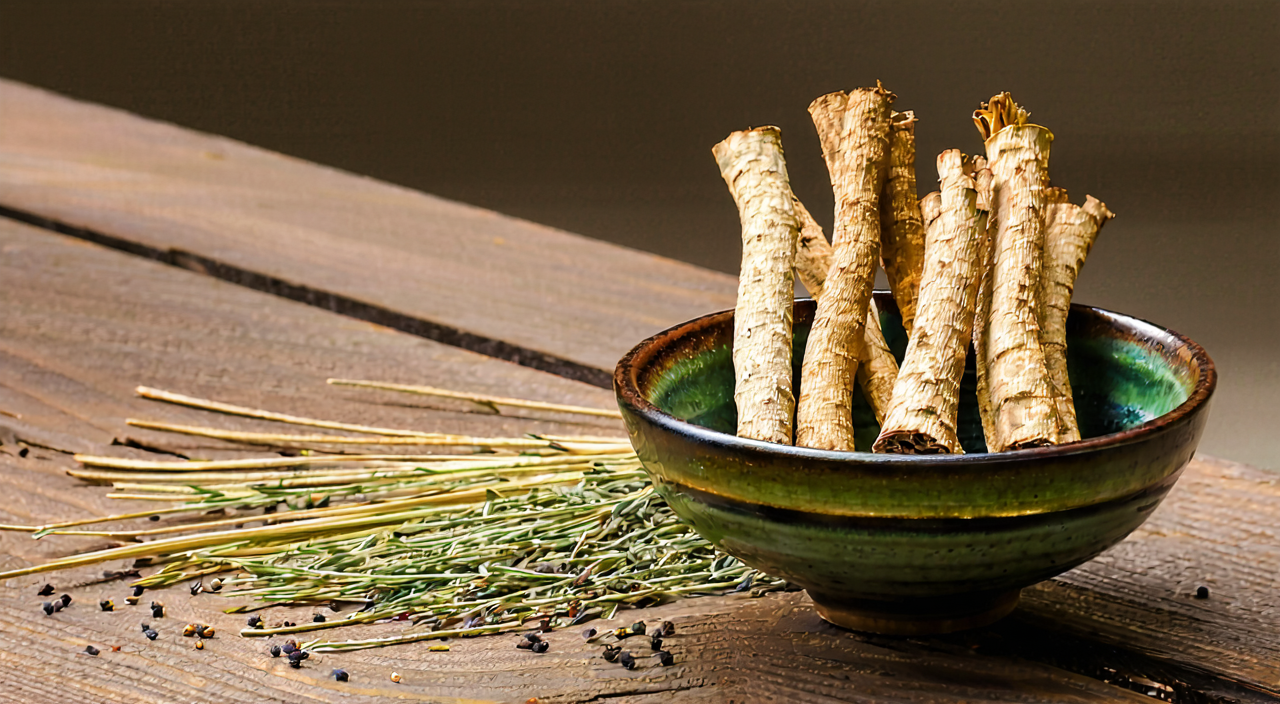
The medicinal part of Polygala usually appears as slender, curved, cylindrical pieces; some are slightly swollen in the middle, resembling thin, twisted rootlets or shriveled twigs. The outer skin is mostly greyish-yellow to greyish-brown, with dense, prominent horizontal wrinkles of varying depth—an important identifying feature.
If you examine a cross-section, you will see a thin outer cortex and a central wood core. In well-processed slices the wood core has usually been removed, leaving a hollow or semi-hollow tube, traditionally called “Polygala tube” (Yuan Zhi Tong). Pieces that are not fully de-cored have a thicker bark portion and a yellowish-white wood core that can be easily peeled away. You may also come across thin roots and rootlets, or segments cut into small sections—these are all common forms of Polygala in decoction pieces. The overall odor is mild; chewing produces a peppery, numbing sensation with a slight bitterness.
What is the medicinal part of Polygala?
The medicinal part is the dried root of Polygala tenuifolia or Polygala sibirica, harvested in spring or autumn, cleaned of soil and dried. One key processing step is removing the wood core. Traditionally, the wood core was thought to contribute to stomach discomfort, so it is often discarded, keeping only the outer bark and phloem to produce “Polygala tube” or “Polygala flesh” (Yuan Zhi Rou).
The Polygala used today is usually prepared by boiling with licorice water or stir-baking with honey and then drying. Such processing may moderate its potential irritant effect on the digestive tract and also yields pieces with different properties, suited for different formulation directions. Whether in its raw or processed form, Polygala is understood in traditional practice mainly through the properties of the root.
How does Chinese medicine understand Polygala?
In traditional Chinese medical theory, Polygala is commonly understood from several angles: calming the mind and boosting cognition, connecting the heart and kidneys, dispelling phlegm to open the orifices, and reducing abscesses and swellings.
Calming the mind and connecting the heart and kidneys form the core usage of Polygala. It is traditionally believed to help settle the spirit while guiding heart fire downward to interact with kidney water. Therefore, many formulas for restlessness, poor memory, and shallow sleep arising from heart-kidney disharmony include Polygala.
In terms of dispelling phlegm to open the orifices, Polygala is often used when phlegm blocks the heart orifices, leading to mental confusion, dulled expression, or sudden loss of consciousness. When combined with herbs such as Shi Chang Pu (Acorus gramineus rhizome), the traditional understanding is that the combination strengthens the ability to open the heart orifices and transform dampness and phlegm.
In addition, Polygala has a traditional record of external use for reducing abscesses and swellings. For red, swollen, firm lumps that have not yet formed pus, ancient methods describe grinding Polygala into a powder and applying it as a paste. Though less common today, this use preserves another facet of Polygala’s traditional profile. All these insights are based on traditional experience and classical texts; whether they suit an individual still needs to be assessed in the context of their constitution and current condition.
What does modern research generally focus on?
Modern phytochemical studies show that Polygala contains polygala saponins, polygala sugar esters, oligosaccharide esters, and other constituents. Some animal experiments and in vitro studies have observed that Polygala extracts exert inhibitory effects on the central nervous system, possibly suggesting sedative tendencies and improvement of learning and memory. In addition, promotion of respiratory mucus secretion and certain anti-inflammatory activities have been reported. However, most of these studies remain at the basic research stage and are still a long way from clinical relevance; they can serve as directions for further understanding but should not be directly equated with therapeutic indications.
What are the differences between Polygala, Shi Chang Pu, and Shou Wu Teng?
Polygala (Yuan Zhi), Shi Chang Pu (Acorus gramineus rhizome), and Shou Wu Teng (Polygoni Multiflori Caulis) all appear frequently in spirit-calming formulas, but they come from different medicinal parts and have distinct traditional profiles.
Polygala is the root, prized for calming the mind, boosting cognition, connecting heart and kidneys, and dispelling phlegm to open the orifices. Shi Chang Pu is the rhizome; it leans towards transforming dampness, opening the orifices, and rousing the spirit and clearing phlegm, and is often applied when the clear orifices are obscured by damp turbidity. Shou Wu Teng is the dried stem of Polygonum multiflorum; traditionally it is mainly used to nourish blood, calm the mind, dispel wind, and unblock collaterals, often for deficient restlessness and insomnia associated with yin-blood insufficiency.
Morphologically, Polygala pieces are slender, curved root shapes with horizontal wrinkles and are hollow after de-coring. Shi Chang Pu appears as a flattened cylindrical rhizome with a rough surface, distinct nodes, and rootlet scars. Shou Wu Teng is a thin, cylindrical stem with a reddish-brown or purplish-brown outer skin and a prominent wood portion on cross-section. Recognizing these differences helps you understand ingredient selections and formula strategies when reading different prescriptions.
Which formulas use Polygala?
In classical formulas Polygala is rarely the leading herb, but it often serves as an important assistant that adds a layer of regulation. Several common directions include:
In Gui Pi Tang (Spleen-Restoring Decoction), Polygala pairs with Ren Shen (ginseng), Huang Qi (astragalus), and Dang Gui (angelica sinensis) mainly for patterns of heart-spleen qi and blood deficiency that lead to palpitations, forgetfulness, insomnia and dream-disturbed sleep; here Polygala helps to calm the mind and settle the spirit.
In An Shen Ding Zhi Wan (Calming the Spirit and Settling the Mind Pill), Polygala is used alongside Fu Shen (poria with wood), Shi Chang Pu, and Long Chi (dragon’s tooth), traditionally for panic, mental restlessness, and inability to settle down; Polygala focuses on connecting heart and kidneys.
Kai Xin San (Joy Powder) is a small classic formula composed of Polygala, Ren Shen, Fu Ling (poria), and Shi Chang Pu; it is often used for forgetfulness, mental fogginess, and slowed thinking. Polygala works together with Shi Chang Pu to open the orifices, dispel phlegm, calm the mind, and boost cognition.
Yuan Zhi Wan (Polygala Pill) has several versions, typically built around Polygala combined with Fu Shen, Suan Zao Ren (ziziphus seed) or Zhu Sha (cinnabar), and is used for heart-kidney disharmony with mental unrest, fretful insomnia, and easily interrupted sleep.
Each of these formulas and patent medicines has a different emphasis and needs to be evaluated based on constitution and symptom presentation; no one-size-fits-all conclusion can be drawn. At the same time, patent remedies from different brands or regions may have variations in formulation, so always study the product information carefully before use.
What precautions should be taken when using Polygala?
Although Polygala is commonly used, there are several points to keep in mind.
Polygala can be somewhat irritating to the stomach lining, especially in its raw form. Some people may experience stomach discomfort or nausea after taking it, which is why processed (Zhi Yuan Zhi) Polygala is typically preferred. Those with active gastric or duodenal ulcers should generally take caution.
Pregnancy is a special stage; formulas containing Polygala should not be used on one’s own without full professional guidance. In addition, Polygala has a mild central inhibitory effect. If you are already using sedatives or sleep aids, consult a qualified healthcare professional beforehand to avoid potential additive effects.
Different processed products have different tendencies: raw Polygala leans more towards dispelling phlegm and opening the orifices but is more irritating; Zhi (licorice-prepared) Polygala is gentler and mainly used for calming the mind; honey-prepared Polygala is more moistening and is often emphasized for patterns involving qi deficiency and dry cough from lung dryness. These choices need to be matched to the individual’s situation with professional input, rather than relying on a single piece of information to decide on a formula by oneself.
Finally, if severe insomnia persists or recurs, or is accompanied by notable chest tightness, palpitations, anxiety, agitation, or significantly low mood, one should not rely solely on herbal regulation and should seek timely medical evaluation to identify the underlying cause.
Summary
Polygala is a traditional spirit-calming medicinal. Its key identification points are slender, curved pieces with dense horizontal wrinkles and a hollow center after removal of the wood core; the medicinal part is the root. In classical Chinese medicine it is used from the perspectives of stabilizing the mind, connecting the heart and kidneys, and dispelling phlegm to open the orifices, playing a supporting role in formulas such as Gui Pi Tang, An Shen Ding Zhi Wan, and Kai Xin San. This article is provided for informational reference only and does not replace professional diagnosis or treatment advice. Any specific use should take into account individual constitution and be guided by a qualified professional.