
What Is Qianniuzi? Medicinal Parts, Identification, and Common Formulas
When consulting traditional Chinese herbal materials, many people come across the name “Qianniuzi” (also known as Morning Glory Seeds) and often see the terms “Hei Chou” (Black Chou) and “Bai Chou” (White Chou). Qianniuzi is not a gentle tonic, but a rather potent purgative and water-expelling drug; understanding its origin, morphology, usage directions and potential risks is essential for safely grasping Chinese medicine formulas.
What Does Qianniuzi Look Like? How to Identify It?
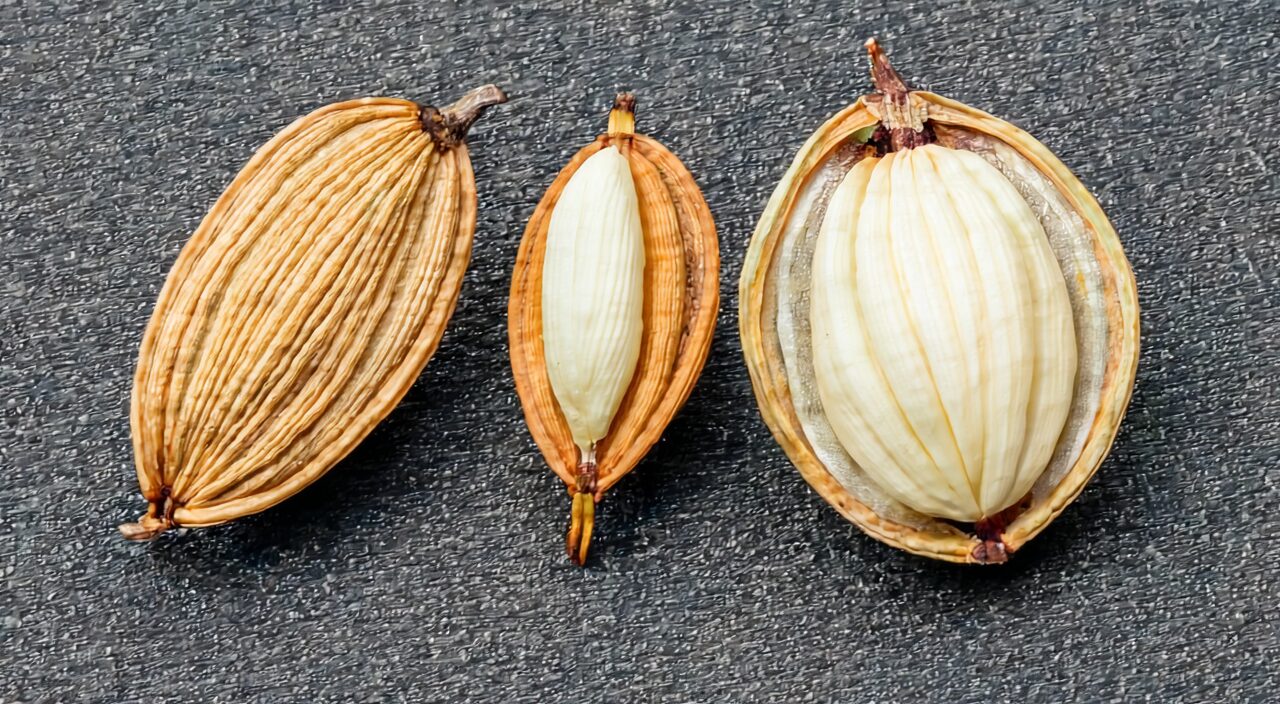
Qianniuzi is actually the seed of morning glory plants; the mature seeds are used medicinally. The whole seed is trigonous-ovate in shape, resembling a small orange segment but more triangular. The dorsal side is convex, while the two lateral sides are relatively flat; on the ventral side a distinct ridge line is visible.
The seed coat color varies by variety, commonly grayish-black or pale yellowish-white. The dark brown ones are commonly called “Hei Chou” (Black Chou), and the pale yellowish-white ones are called “Bai Chou” (White Chou). The seed surface has fine longitudinal wrinkles; one end is slightly pointed, and the other end has a slightly depressed hilum. The hilum appears dot-like or short linear and is slightly darker—an important feature for identifying Qianniuzi.
After removing the seed coat, the kernel inside is yellowish-white and rich in oil. Overall, the seeds are hard, not easily broken, with a faint smell and a spicy, bitter taste accompanied by an oily sensation. If you rub them in your hands, you will feel a slight greasy feel. These external features can help preliminarily distinguish Qianniuzi from other seeds that look somewhat similar, though professional experience is still needed for accurate identification.
What Are the Medicinal Parts of Qianniuzi?
The medicinal part of Qianniuzi is well-defined: it is the dried mature seed of Pharbitis nil (lobed-leaf morning glory) or Pharbitis purpurea (round-leaf morning glory), both in the Convolvulaceae family. Harvesting occurs in late autumn when the fruits are mature but the husks are not yet open; the aerial parts are cut, dried in the sun, and the seeds are beaten out and cleaned to obtain the raw herb.
Traditionally, Qianniuzi is used raw or dry-fried. Raw Qianniuzi has a stronger purgative effect and relatively pronounced toxicity; fried Qianniuzi is prepared by heating the cleaned seeds over a gentle fire until they slightly swell, the color deepens, and a crackling sound and fragrance emerge. After frying, the medicinal nature becomes more moderate and toxicity decreases, making it more suitable for cases requiring a gentler action. This processing is an important traditional method for reducing toxicity and enhancing efficacy, which also indicates that Qianniuzi is not an ordinary herb that can be used casually.
How Does Traditional Chinese Medicine Understand Qianniuzi?
In TCM theory, Qianniuzi is bitter and acrid in taste, cold in nature, and toxic; it enters the Lung, Kidney, and Large Intestine meridians. It is not regarded as a conventional regulating remedy, but as an “attacking” drug, mainly oriented toward purging water and unblocking the bowels, expelling phlegm and clearing retained fluids, and destroying parasites and removing accumulations.
The term “purging water and unblocking the bowels” means that Qianniuzi can promote urination and defecation, helping to eliminate stagnant water-dampness in the body. For conditions such as edema with distention, ascites, and urinary and fecal retention, ancient formulas sometimes considered using Qianniuzi, relying on its strong water-expelling power to guide water-dampness out through the urine and stool. “Expelling phlegm and clearing retained fluids” targets phlegm-fluid lodged in the lungs or chest and diaphragm, manifesting as wheezing, fullness, and profuse cough with sputum; Qianniuzi can drive out phlegm and drain water. In addition, Qianniuzi has the action of destroying parasites and removing food accumulation; historically it was also used to expel intestinal parasites such as roundworms and tapeworms, especially when food stagnation and constipation were present, serving both laxative and anthelmintic purposes.
Nevertheless, these are all understandings based on traditional thinking. Whether Qianniuzi is suitable for a specific individual depends on their constitution, symptoms, and overall condition, and it should not be applied simply based on one or two symptoms. In particular, Qianniuzi is a strong-acting substance; ancient practitioners emphasized “stop as soon as the disease is relieved” and advised against prolonged use.
What Does Modern Research Say About the Toxicity of Qianniuzi?
In modern research, considerable attention is given exactly to the toxicity of Qianniuzi. It contains constituents such as pharbitin (pharbitic acid glycosides), which can produce a strong purgative effect after being broken down in the body, stimulating the intestines and causing diarrhea, abdominal pain, nausea, and vomiting. Excessive use may lead to severe water and electrolyte imbalances, and even bloody stools and neurological symptoms.
Studies also indicate that Qianniuzi has certain effects on the kidneys; those with pre-existing kidney impairment need to be particularly cautious. At the same time, combining Qianniuzi with certain other drugs may increase toxicity risks. For instance, tradition holds that combining Qianniuzi with Croton (Ba Dou) greatly enhances toxicity; modern observations also suggest that such combinations markedly aggravate intestinal irritation and systemic reactions.
Precisely because of these clear toxicity characteristics, Qianniuzi is not recommended for self-directed use. Whether used alone or in a formula, it should be evaluated and controlled by experienced practitioners under a full understanding of the individual’s situation. When symptoms such as swelling, ascites, or constipation recur or persist for a long time, serious organic diseases should first be ruled out rather than attempting to use Qianniuzi for “detox” or “laxative” purposes on one’s own.
What Is the Difference Between Hei Chou and Bai Chou?
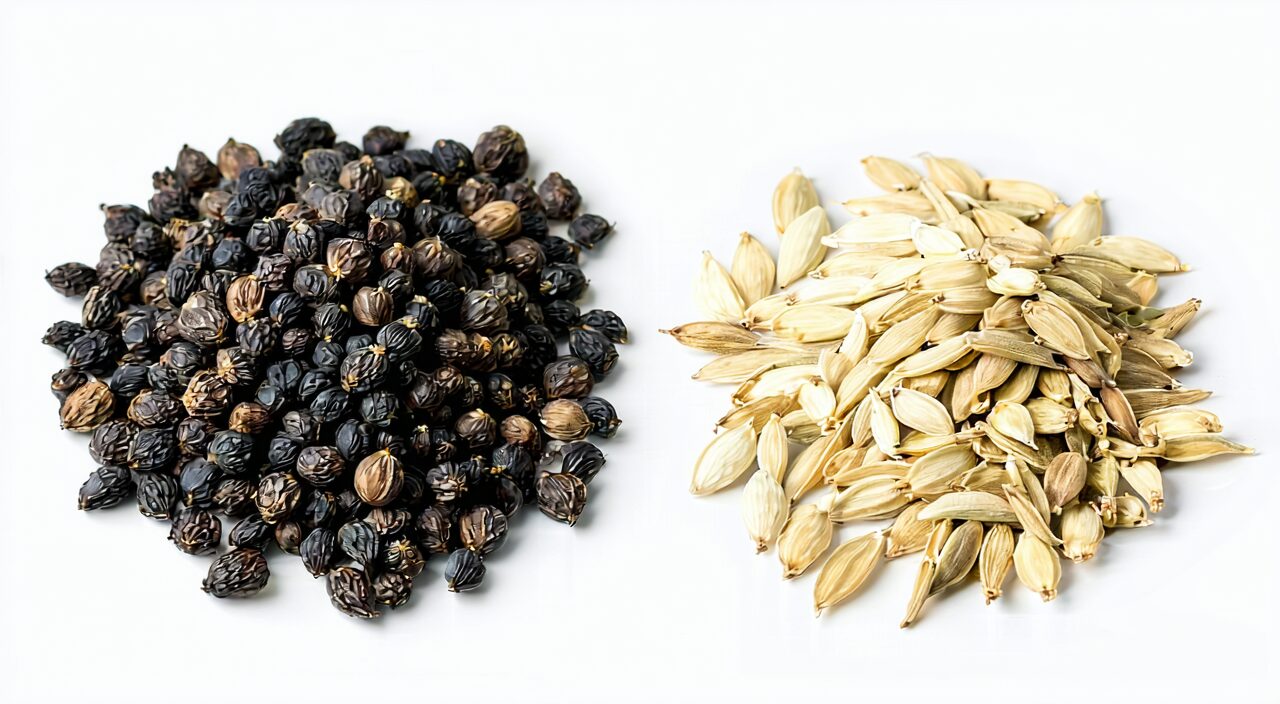
Hei Chou and Bai Chou are not two different species; they both come from the same type of plant, differing only in seed coat color. Generally, the grayish-black or dark brown seeds are called Hei Chou, and the pale yellowish-white or light brown ones are called Bai Chou. In traditional commerce, Hei Chou and Bai Chou are often mixed together, and there is no absolute superiority of one over the other.
Some classical texts mention that “the black one acts more swiftly, the white one acts more gently,” suggesting a possible link between color and the speed and intensity of action. However, this statement has not been fully verified by modern research, nor does it imply that Bai Chou is any safer than Hei Chou. Whether Hei Chou or Bai Chou, the main constituents and toxicity characteristics are essentially the same, and they must be used with equal caution. When purchasing or learning about this herb, the color difference can serve as a commercial trait reference, but it should not be simplistically equated with stronger or weaker efficacy or higher or lower toxicity.
Which Formulas Use Qianniuzi?
Although Qianniuzi is not among the most widely used herbs in classical formulas, several representative formulas can help us understand its traditional application principles.
Zhou Che Wan (Pill for Driving the Water) is a formula with strong water-expelling power, traditionally used for severe water-dampness congestion and qi stagnation resulting in generalized edema, abdominal distention, panting, and urinary and fecal retention. The formula combines Qianniuzi with Gan Sui (Euphorbia kansui), Yuan Hua (Genkwa flower), Da Ji (Euphorbia pekinensis), and qi-moving medicinals. The goal is to synergistically expel water, but the irritant effect is also markedly increased; this formula must never be used casually.
Yu Gong San (Yu’s Merit Powder) is relatively simple, mainly composed of Qianniuzi combined with Xiao Hui Xiang (fennel). It is traditionally used for cold-dampness water hernia, scrotal edema, or testicular hydrocele-like presentations. Qianniuzi expels water, while fennel regulates qi and disperses cold, fitting the traditional understanding of cold-dampness water disorders.
Qianniuzi Wan (Qianniuzi Pill) is a category of pills with Qianniuzi as the main ingredient; different medical records give varying compositions, commonly including Da Huang (rhubarb) and Bing Lang (areca nut). They are mainly used for accumulation and stagnation with便秘, abdominal distention, or parasitic accumulation. In application, the form, dosage, and duration of such formulas must be strictly controlled, and they are mostly used in relatively acute and excess conditions.
The above formulas are introduced only as traditional knowledge and should not be regarded as treatment plans for any specific disease. Whether they are suitable depends on individual constitution, symptom presentation, and professional judgment.
What Precautions Should Be Taken When Using Qianniuzi?
Qianniuzi should not be used on one’s own—this is the foremost reminder when learning about this herb. The following types of situations especially call for avoidance.
Pregnancy is a contraindication for Qianniuzi, because its strong purgative and water-expelling actions may trigger uterine contractions and pose a risk to pregnancy safety. People who are weak in constitution, with shortness of breath, lack of strength, prone to diarrhea, or already in a dehydrated state should also avoid it, as it may further deplete vital qi and disrupt body integrity.
For those with pre-existing liver or kidney diseases, the risk of using Qianniuzi increases significantly, and it should be fully evaluated by a specialist physician in the relevant department. Children and the elderly, whose constitutions are comparatively more fragile, are likewise unsuitable for casual use.
Particular attention must be paid to incompatibility: traditionally, Qianniuzi should not be combined with Croton (Ba Dou), as this is believed to enhance toxicity and may cause violent diarrhea, abdominal pain, or even more severe poisoning. If you are taking other medications, you should be especially careful not to add Qianniuzi on your own, to avoid unpredictable interactions.
If you experience severe, persistent, or recurring constipation, edema, abdominal distention, or accompanying symptoms such as marked weight loss, black stools, severe vomiting, palpitations, chest tightness, or abnormal breathing, you should seek medical attention promptly to identify the cause rather than relying on Qianniuzi to relieve superficial symptoms.
Summary
Qianniuzi is a relatively drastic traditional Chinese medicine. Its medicinal part is the mature seed, which has a trigonous-ovate shape. There are two commercial types—Hei Chou and Bai Chou—but both share similar toxic properties. Traditionally, Qianniuzi has been used for purging water and unblocking the bowels, expelling phlegm and clearing retained fluids, and destroying parasites and removing accumulations. However, modern research clearly indicates it has significant toxicity, and self-directed use poses considerable risk. Pregnant women, people with weak constitutions, and those with liver or kidney diseases should particularly avoid it. Understanding Qianniuzi is more about correctly recognizing traditional formulas rather than implying it can be self-selected; any use must be conducted under professional judgment.