
What Is Cornelian Cherry (Shan Zhu Yu)? Medicinal Parts, Identification, and Common Formulas Explained
When it comes to herbs that tonify the liver and kidney, many people immediately think of goji berry or rehmannia root. However, cornelian cherry (Shan Zhu Yu), which frequently appears in classical formulas, remains unfamiliar to quite a few. For overseas users who are accustomed to seeking health maintenance ideas from traditional Chinese medicine, clearly understanding what cornelian cherry actually is, how to identify it, and how it differs from easily confused herbs is a prerequisite for safe and rational use. Starting from basic information about cornelian cherry, this article will cover visual identification, medicinal parts, TCM understanding, modern research, comparison with similar herbs, common formulas, and usage precautions, helping readers build a relatively complete cognitive framework.
What Does Cornelian Cherry Look Like? How to Identify It?

What you see in the herbal market or in a packet of prepared slices is generally not the intact fresh fruit, but processed dried fruit pulp. It often appears as irregular pieces or pouch-like fragments with slightly curled edges, a wrinkled surface, and a texture that is soft yet slightly tenacious. The color is mostly purplish-red to purplish-black; some older stock may be darker, but overall, it keeps the deep-colored characteristic.
Through simple observation, several key identification points can be grasped: the appearance is wrinkled and uneven, not plump and round like goji berry; the smell is faint, but on tasting, there is a distinct and lasting sour and astringent flavor. This sour-astringent sensation is a highly recognizable feature of cornelian cherry. If you encounter material that looks smooth, plump, bright red, and distinctly sweet, it is most likely another fruit, not processed cornelian cherry slices.
Additionally, after removing the fruit pit, the space left in the cornelian cherry pulp often appears concave, and it feels somewhat sticky when rubbed between the fingers, which is partly related to its polysaccharide components. Traditionally, thick flesh, purplish-red color, and intense sour-astringent taste are considered signs of good quality. When you need to identify it yourself, the sour-astringent mouthfeel can serve as an important reference, but it is still recommended to purchase properly processed slices from trustworthy channels to reduce the risk of misuse.
What Is the Medicinal Part of Cornelian Cherry?
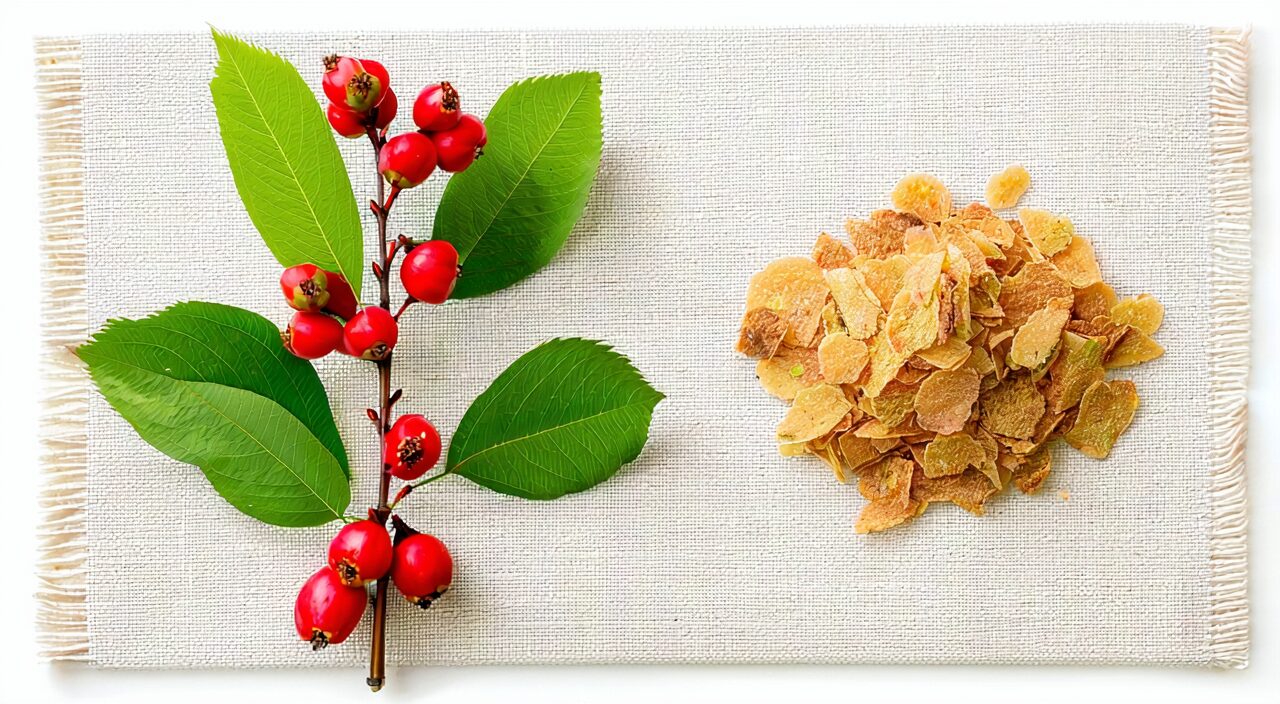
The medicinal part of cornelian cherry is clearly defined as the dried ripe fruit pulp of Cornus officinalis (Cornaceae). It is harvested in late autumn or early winter when the fruit skin turns red, the pit is removed, and the pulp is dried. Traditionally, “removing the pit and taking the pulp” is emphasized because the pit and the pulp have different applications; the “Shan Yu Rou” (cornelian cherry pulp) or “wine-processed cornelian cherry pulp” mentioned in formulas all refer to the pulp part.
In retail prepared slices or raw materials for Chinese patent medicines, common forms include: raw cornelian cherry pulp, which is directly dried pulp; and wine-processed cornelian cherry pulp, which is steamed or stewed with yellow rice wine and then dried, resulting in a darker color and a somewhat modified sour-astringent sensation. Some believe wine-processing makes it more warming and nourishing. Understanding these different processed forms helps make clearer judgments when purchasing or reading product labels.
It should be noted that not everything bearing the name “Zhu Yu” shares the same origin. The description in this section applies only to the fruit pulp of cornelian cherry. Other herbs like evodia fruit (Wu Zhu Yu) have entirely different medicinal parts, which will be specifically distinguished later.
How Does Traditional Chinese Medicine Understand Cornelian Cherry?
Traditional Chinese medicine has a long-standing understanding of cornelian cherry. Its nature and flavor are generally described as sour and astringent, slightly warm, and it enters the liver and kidney meridians. Its core actions center on two aspects: tonifying the liver and kidney, and astringing to secure and arrest.
“Tonifying the liver and kidney” means that in traditional thinking, cornelian cherry is often used for patterns of liver and kidney insufficiency manifesting as soreness and weakness of the lower back and knees, dizziness, tinnitus, impotence, and seminal emission. It is frequently combined with prepared rehmannia root, Chinese yam, goji berry, and other herbs in an effort to supplement both yin and yang. It must be stressed that “tonifying” here is a descriptive term for adjusting the body’s state within the TCM theoretical framework and should not be equated with treating specific diseases.
“Astringing to secure and arrest” is mainly reflected in the direction of regulating the excessive loss of essence, qi, sweat, urine, and other body substances. For example, in cases of profuse sweating with collapse, flooding and spotting or vaginal discharge, and frequent urination, cornelian cherry has traditionally been regarded as a medicinal herb capable of astringing and securing, often combined with dragon bone, oyster shell, and schisandra fruit to achieve “stopping” and “astringing” effects. However, such applications are generally within specific deficiency pattern contexts and are mostly determined by TCM practitioners based on an overall assessment of whether it is appropriate. One should not judge or apply it on one’s own.
What Components and Effects Does Modern Research Focus On for Cornelian Cherry?
Modern research is mainly interested in the active components contained in cornelian cherry, such as polysaccharides, organic acids, and iridoid glycosides. Compounds like loganin and morroniside are thought to possibly relate to its traditional effects of tonifying the liver and kidney and astringing to secure and arrest. Some in vitro and animal studies suggest that cornelian cherry extracts exhibit certain activities in immune regulation, liver protection, antioxidation, and inhibition of inflammatory responses.
However, these studies need to be viewed rationally. At present, most findings remain at the experimental research stage, and there is still a considerable gap between these and actual effects in the human body. Some exploratory studies have observed the potential of cornelian cherry-containing formulas in assisting blood sugar regulation and improving diabetic complications, but these data are not yet sufficient to be directly equated with clinical therapeutic conclusions. Therefore, readers are not advised to use modern research results as the sole basis for self-medicating with cornelian cherry. This knowledge is more suitable as a supplementary perspective for understanding its traditional application direction.
How Does Cornelian Cherry Differ from Similar Medicinal Herbs?
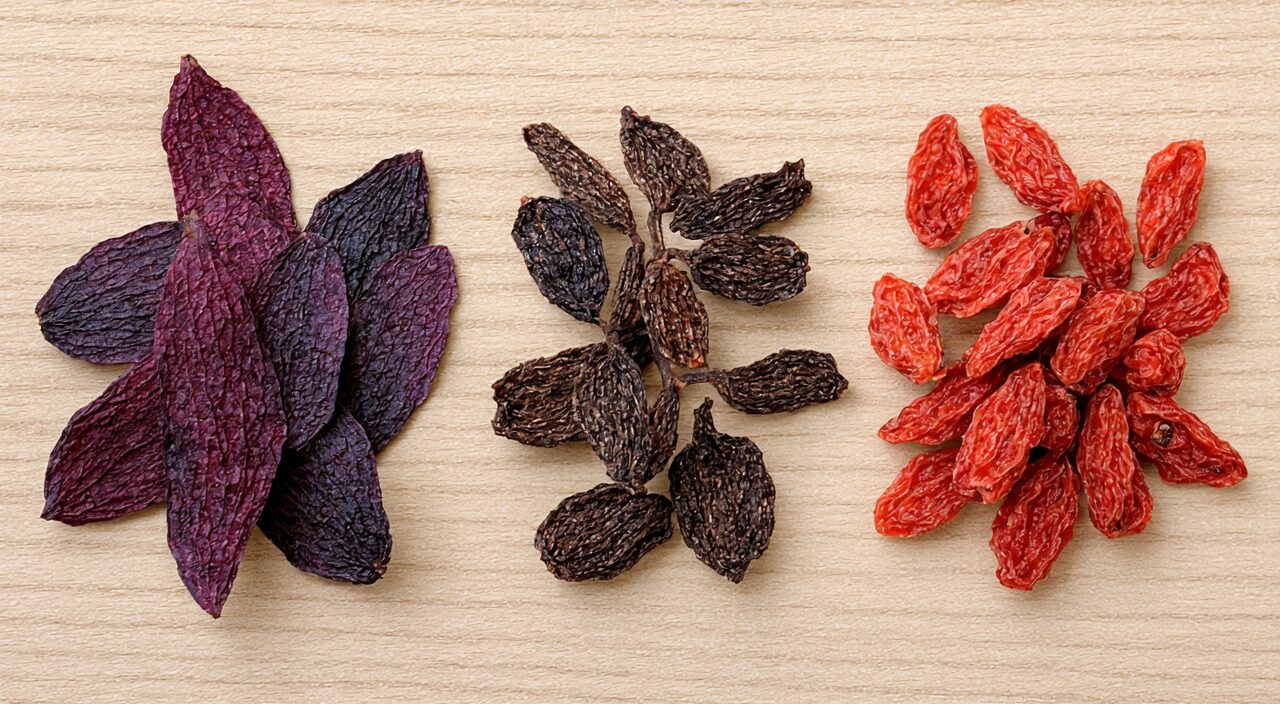
Among common tonifying and fruit-type medicinal herbs, cornelian cherry is most easily confused with evodia fruit and goji berry.
Cornelian Cherry vs. Evodia Fruit
Their names sound similar, but their origins are completely different. Cornelian cherry comes from the Cornaceae family and uses the ripe fruit pulp; it is sour-astringent and slightly warm, traditionally targeting the liver and kidney, mainly with tonifying and astringing properties. Evodia fruit comes from the Rutaceae family; its medicinal part is the nearly ripe fruit; its nature and flavor are pungent, bitter, and hot, with slight toxicity, entering the liver, spleen, and stomach meridians. It excels at dispersing cold and relieving pain, and directing qi downward to stop vomiting, commonly used for headache due to cold stagnation in the liver meridian, cold pain in the epigastric region, and vomiting with acid regurgitation. The two differ greatly in their effect directions and must never be mixed. When purchasing and storing, pay special attention to the scientific name and species on the label.
Cornelian Cherry vs. Goji Berry
Goji berry is also commonly used to tonify the liver and kidney, and to benefit the essence and brighten the eyes. Its red appearance can easily confuse beginners. The differences between the two are relatively distinct: goji berry is spindle-shaped or oval, with a bright or dark red surface, wrinkled yet plump, and tastes sweet with slight sourness; cornelian cherry is in irregular pieces or pouch-like fragments, purplish-red to purplish-black, and tastes sour-astringent without sweetness. Regarding the medicinal part, goji berry generally uses the ripe fruit, including flesh and seeds; cornelian cherry requires removal of the pit and use of only the pulp. In traditional application, goji berry leans neutral and gentle, while cornelian cherry leans astringent and restraining, each having its own focus.
In summary, as long as you grasp the color, shape, taste, and medicinal part, you can distinguish them in most common situations.
Which Formulas Contain Cornelian Cherry?
Cornelian cherry appears in many classical formulas. Especially in traditional formulations related to kidney, liver, essence, and blood, it often plays the dual role of astringing and tonifying. The following formulas may be of greater interest to overseas users who pay attention to Chinese medicine.
Six-Ingredient Rehmannia Pill (Liu Wei Di Huang Wan)
This is a widely recognized formula, consisting of six ingredients: prepared rehmannia root, cornelian cherry, Chinese yam, water plantain rhizome, tree peony bark, and poria. Among them, cornelian cherry, together with prepared rehmannia root and Chinese yam, forms the “three tonics” in traditional understanding, with cornelian cherry mainly responsible for tonifying the liver and kidney and astringing essence. Such combinations are commonly indicated for regulating kidney yin insufficiency with upward flaming of deficient fire, but actual suitability needs to be determined based on a comprehensive assessment of symptoms and constitution.
Left-Restoring Pill (Zuo Gui Wan)
Left-Restoring Pill has prepared rehmannia root as its principal ingredient, combined with cornelian cherry, Chinese yam, goji berry, deer horn glue, turtle shell glue, cyathula root, and dodder seed. It tends to nourish kidney yin and replenish the essence and marrow. In this formula, cornelian cherry, working together with other yin-nourishing and essence-replenishing substances, is intended to add a restraining effect alongside tonification and reduce the dissipation of essence and qi. It has traditionally been used for patterns of true yin insufficiency and essence and marrow depletion manifesting as dizziness, lower back soreness, and weak legs.
Right-Restoring Pill (You Gui Wan)
In contrast to Left-Restoring Pill, Right-Restoring Pill leans toward warming and tonifying kidney yang. Its composition includes prepared rehmannia root, Chinese yam, cornelian cherry, goji berry, deer horn glue, dodder seed, eucommia bark, Chinese angelica, cinnamon bark, and processed aconite. Here, cornelian cherry likewise plays the role of tonifying the liver and kidney and astringing essence, but when combined with yang-warming medicinals, the overall direction shifts to warming and invigorating the primal yang and replenishing essence and blood. It needs to be pointed out that yang-warming formulas are more suitable for deficiency-cold types and are not appropriate for those with internal heat or damp-heat to try on their own.
Golden Cabinet Kidney Qi Pill (Jin Kui Shen Qi Wan)
Golden Cabinet Kidney Qi Pill is composed of rehmannia root, Chinese yam, cornelian cherry, water plantain rhizome, poria, tree peony bark, cinnamon twig, and aconite. In this formula, cornelian cherry, combined with rehmannia root and Chinese yam, is intended to supplement while astringing, complemented by poria, water plantain rhizome, and other diuretics that leach out dampness. Traditionally, it is used for kidney yang insufficiency and impaired qi transformation manifesting as heavy sensations in the lower back, leg swelling, and difficult urination. Such formulas emphasize assisting yang and promoting urination, so before use, it is usually necessary to clarify whether there is a tendency of yang deficiency with water retention; it is not advisable to select it on one’s own based on just one or two symptoms.
In all the above formulas, cornelian cherry appears as part of the traditional formulation logic and does not act alone. Whether it suits an individual’s condition requires consideration of overall constitution, current symptoms, and professional advice. It is not recommended to directly use it as an ordinary supplement for “tonifying liver and kidney.”
What Precautions Should Be Taken When Using Cornelian Cherry?
After seeing cornelian cherry appear in so many tonifying formulas, some may consider decocting it alone or increasing the dosage for daily use, but this is not safe.
Traditional experience holds that cornelian cherry, with its sour-astringent flavor and restraining properties, should not be applied arbitrarily when there is damp-heat accumulation, difficult urination, or unresolved excess pathogens in the body; otherwise, it may hinder the expulsion of pathogenic factors and aggravate discomfort. For example, if someone is in the acute stage of a urinary tract infection, or has obvious damp-heat or excess-heat signs such as a thick, yellow, greasy tongue coating, abdominal bloating, constipation, or fever, it is not suitable to use astringing and securing herbs.
Moreover, even if a case belongs to a deficiency pattern, a comprehensive assessment is still needed to determine whether it tends toward yin deficiency or yang deficiency, whether dampness is combined, and whether astringing is necessary. Self-administration of large doses or long-term use may interfere with the body’s own regulation. Therefore, if you are uncertain about your condition, or if you have long-term, recurring physical discomfort, especially accompanied by significant fatigue, pain, weight loss, or emotional abnormalities, it is recommended to consult a physician or professional first, and not to use cornelian cherry or related patent medicines as a complete substitute for standard medical treatment.
Summary
Cornelian cherry is a medicinal herb whose primary traditional application directions are tonifying the liver and kidney and astringing to secure and arrest. Its medicinal part is the dried ripe fruit pulp with the pit removed. Key identification features are its purplish-red to purplish-black color, wrinkled flaky pieces, and distinctly sour-astringent taste. It differs fundamentally from evodia fruit in origin, nature, flavor, and effect, and is also clearly different from goji berry, so the species should be clarified before use. Cornelian cherry is used in classical formulas such as Six-Ingredient Rehmannia Pill, Left-Restoring Pill, Right-Restoring Pill, and Golden Cabinet Kidney Qi Pill, but whether it is suitable still needs to be assessed based on personal constitution and professional advice. In particular, it should not be used independently when damp-heat or unresolved excess pathogens are present. This article is for general informational reference only and cannot replace professional diagnosis or treatment advice.