
What Is Cinnabar? Identification, Medicinal Parts, and Common Formulas
When it comes to cinnabar, many overseas Chinese may first think of traditional Chinese patent medicines like An Gong Niu Huang Wan (Peaceful Palace Bovine Bezoar Pill) and Zhu Sha An Shen Wan (Cinnabar Spirit-Calming Pill), or the deep, steady red used in calligraphy and painting. Cinnabar has a long history of use in Chinese medicine, but it is also a mercury-containing mineral drug; improper use can lead to serious risks. Precisely because of this “common yet high-risk” nature, questions like what exactly cinnabar is, how to identify it, and which formulas contain it naturally arise for those concerned about the safety of Chinese medicine.
What Does Cinnabar Look Like? How to Identify It?
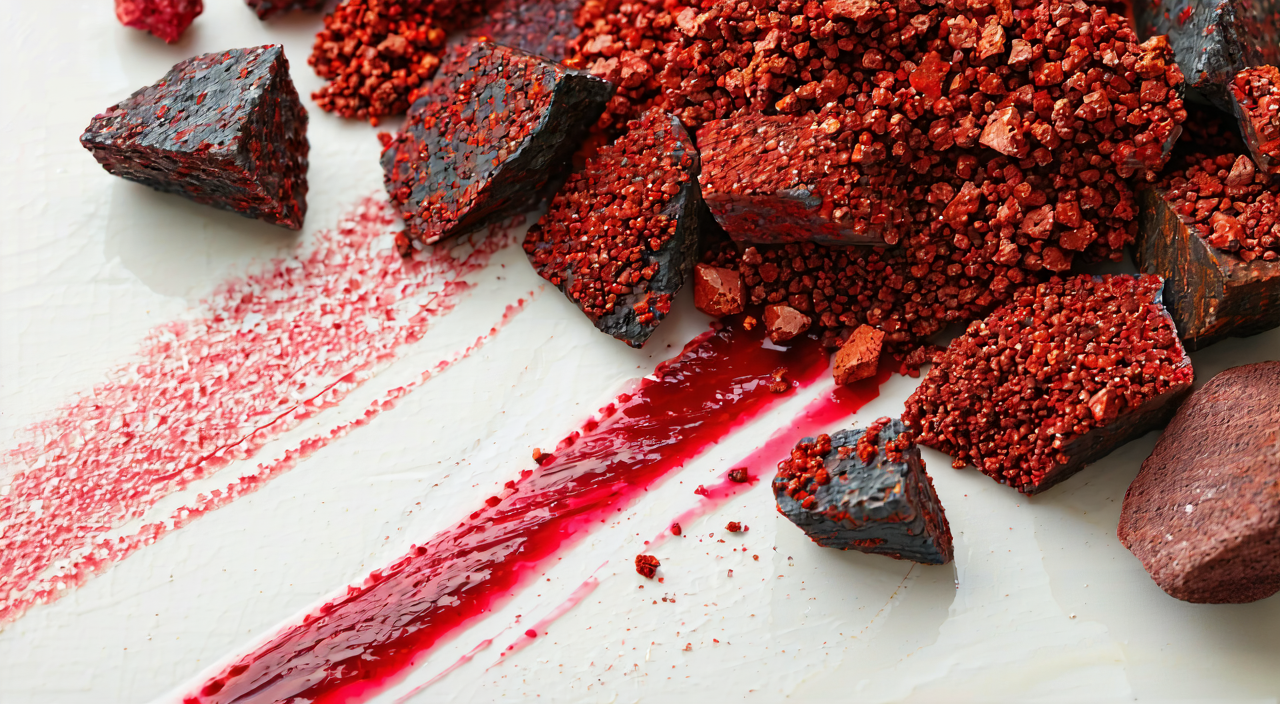
In nature, cinnabar is known mineralogically as cinnabarite (or simply cinnabar), and its raw ore often appears as granular, dense massive, or irregular aggregates; complete crystals are rarely seen. Traditionally, high-quality medicinal cinnabar is valued for its large size, vivid red color, and luster.
The most outstanding visual characteristic of cinnabar is its color—ranging from bright red to dark red. Fine-grained massive cinnabar typically displays a luster similar to that of diamond, often called an “adamantine luster” in the field. If you streak cinnabar across a white unglazed porcelain plate, it leaves a red streak, which is a key identification feature. Moreover, cinnabar’s density is distinctly higher than that of ordinary stones, so it feels noticeably heavy in the hand—this “heavy and brittle” quality can serve as a supplementary judgement during observation.
For general users, these characteristics help form a preliminary impression, but self-identification of mineral drugs remains risky; authentication and quality evaluation should be carried out by professional institutions.
What Is the Medicinal Part of Cinnabar?
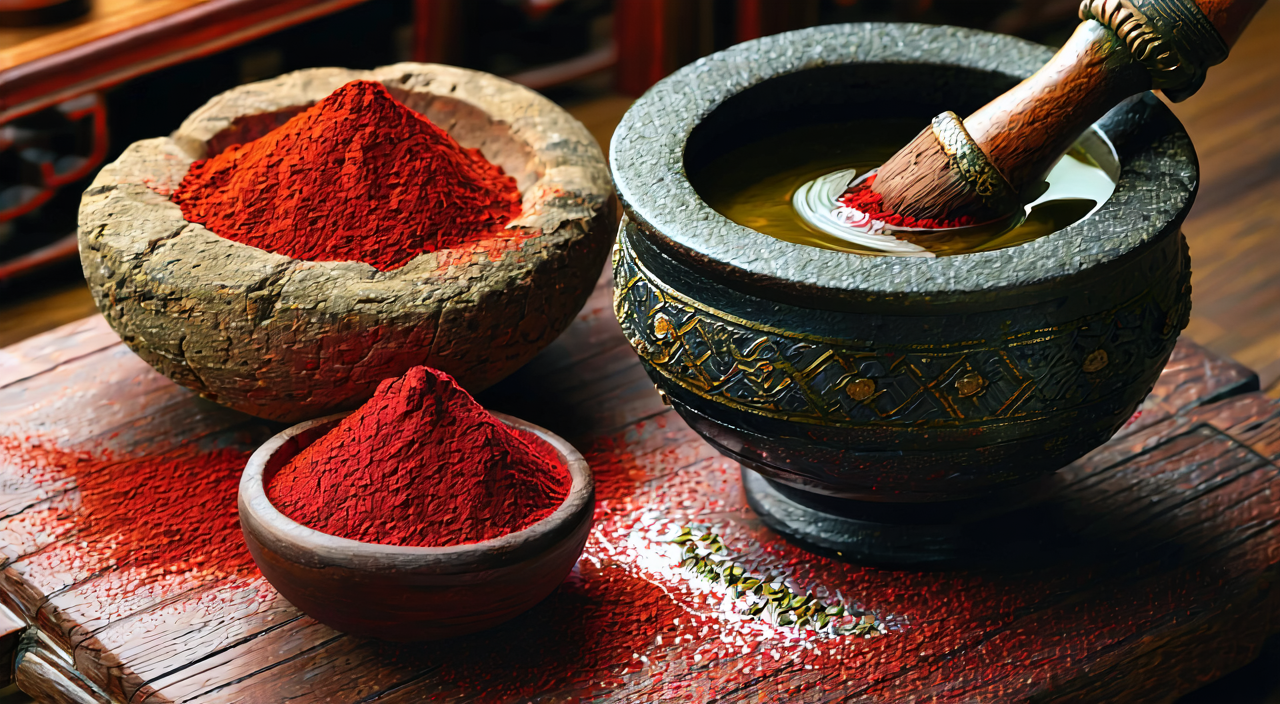
Unlike botanical drugs that use roots, leaves, or flowers, cinnabar’s medicinal part is not derived from living organisms but from a natural sulfide mineral. More precisely, its major component is mercury sulfide (HgS), typically formed in low-temperature hydrothermal deposits. After mining, impurities such as gangue and sediment are removed, and the purified portion is selected for medicinal use.
Throughout history, Chinese materia medica texts have been meticulous about cinnabar processing. One classic preparation method is shuifei (water-grinding), which involves repeatedly grinding, washing, suspending, and settling to remove soluble impurities and coarse particles, yielding an extremely fine cinnabar powder that reduces irritancy and risk during clinical use. Modern processing standards also impose strict technical requirements, but these are all professional preparation steps unsuitable for individuals to perform on their own. Understanding that cinnabar’s medicinal part is a mineral, not a plant, helps us recognize its fundamentally different risk profile compared with ordinary herbal medicines.
How Does Traditional Chinese Medicine View Cinnabar?
In traditional Chinese medicine, the understanding of cinnabar centers on the concept of ‘suppressing fright with heavy mineral to calm the spirit.’ Many ancient texts record that cinnabar, being heavy and entering the Heart channel, can clear heart fire, quell palpitations, and stabilize the mind. As a result, it was historically often combined in formulas for emotional and sleep disorders characterized by palpitations, anxiety, insomnia, excessive dreaming, and susceptibility to fright. Additionally, cinnabar was traditionally believed to brighten the eyes and clear heat-toxins; it sometimes appears in topical preparations for red eyes, mouth sores, or boils and sores.
However, these applications are primarily based on traditional clinical practice and experience; they do not mean that cinnabar can be casually taken internally or used long-term. When professionally applying cinnabar, TCM practitioners strictly control the dosage and duration and generally use it as one ingredient in a compound formula rather than as a single agent.
What Does Modern Research Say About the Mercury Risk of Cinnabar?
From the perspective of modern pharmacology and toxicology, one cannot discuss cinnabar without addressing its mercury content. Although cinnabar’s main component, mercury sulfide, has low solubility in water and gastric acid—leading some earlier views to assume low absorption and low toxicity—this does not mean it is risk‑free. Studies have found that under the action of gut microbiota or certain conditions, a portion of mercury sulfide may convert into the more toxic methylmercury or free mercury ions. Long-term or excessive use can still lead to liver and kidney damage as well as nervous system injury.
Therefore, international regulatory oversight of cinnabar-containing preparations is generally very strict; many countries either ban or restrict cinnabar in medicines and health products. For ordinary users, ‘low solubility’ should not be simplistically equated with high safety, and one should never self-administer cinnabar-containing products in an attempt to improve sleep or calm emotions.
How Does Cinnabar Differ from Realgar and Hematite?
Among common reddish mineral drugs, cinnabar, realgar, and hematite are sometimes easily confused, but they differ greatly in composition and use.
Cinnabar is mercury sulfide, appearing bright to dark red with a red streak and an adamantine luster; traditionally, it is primarily used to calm the spirit, settle fright, and clear heart heat. Realgar is an arsenic disulfide mineral, typically orange-red to deep red with a light orange-red streak and a garlicky odor; it is traditionally used for detoxification, killing parasites, drying dampness, and expelling phlegm, but its arsenic content also strictly precludes internal use except under professional guidance. Hematite, a type of red iron ore, is mainly ferric oxide (Fe₂O₃), usually dark brownish red or iron-red, with a cherry-red streak and without cinnabar’s adamantine luster; it is relatively hard and heavy, and in Chinese medicine it is mostly used to pacify the liver, subdue yang, redirect rebellious qi, and stop bleeding.
Simply grasping the differences from the perspectives of color, luster, and composition can help establish a basic concept and prevent mistaken purchase or misuse.
Which Formulas Use Cinnabar?
Historically in Chinese medicine, there are indeed some classic formulas that contain cinnabar. The following are provided only as a reference for understanding formula composition and are by no means an invitation to try them on your own.
Zhu Sha An Shen Wan (Cinnabar Spirit‑Calming Pill) uses cinnabar as one of its heavy‑sedating spirit‑calming ingredients, combined with huang lian (Coptis), dang gui (Angelica sinensis), and sheng di (Rehmannia); traditionally it targets heart‑fire hyperactivity with damage to yin blood causing mental restlessness. Ci Zhu Wan (Magnetite & Cinnabar Pill) pairs magnetite with cinnabar, plus shen qu (fermented mass), and is often used for heart‑kidney disharmony manifesting as tinnitus, hearing loss, or blurred vision. Tian Wang Bu Xin Dan (Celestial Emperor Heart‑Supplementing Elixir) also contains a trace amount of cinnabar; this formula emphasizes enriching yin, nourishing blood, supplementing the heart, and calming the spirit, historically used for yin‑blood deficiency with palpitations, forgetfulness, and deficient vexation insomnia. In An Gong Niu Huang Wan (Peaceful Palace Bovine Bezoar Pill), cinnabar combines with niu huang (bezoar), rhinoceros horn (substituted in modern versions), and she xiang (musk) for severe conditions like high fever with unconsciousness from febrile disease or stroke with block pattern.
A common characteristic of these formulas is that they are only used after a physician has accurately diagnosed the patient’s pattern based on TCM differentiation, and they are taken only for a short duration; they are absolutely not suitable for long-term regulation or as everyday calming supplements.
What Precautions Should Be Taken When Using Cinnabar?
Regarding the use of cinnabar, the most important point is: individuals must never self-administer cinnabar or cinnabar-containing preparations internally, nor treat them as ordinary calming or sleep-aid products for long-term use.
Cinnabar poses clear risks of liver and kidney toxicity. Pregnant and breastfeeding women, children, and those with impaired liver or kidney function must strictly avoid contact. During use, cinnabar should never be heated or calcined, because high temperatures generate free mercury vapor, which is extremely harmful if inhaled. Moreover, any claim that ‘natural cinnabar is nontoxic’ or ‘can detoxify the body’ lacks scientific evidence and should be treated with vigilance.
If a large dose of cinnabar is inadvertently ingested, or if symptoms such as nausea, vomiting, a metallic taste in the mouth, abdominal pain, or reduced urine output occur, discontinue all use immediately and seek medical attention without delay—do not adopt a wait-and-see approach.
Summary
Cinnabar is a mineral-derived Chinese medicine; its mercury-containing nature dictates that it can only be used short‑term under strict professional control and cannot be a daily health‑maintenance option. Whether identifying its vivid red luster and red streak, or understanding the traditional significance of classic formulas like Zhu Sha An Shen Wan and An Gong Niu Huang Wan, such knowledge must be founded on respect for its risks. This article is provided solely as a cultural and scientific reference for Chinese medicine education and cannot replace professional diagnosis or personalized medication advice. Any action involving cinnabar requires careful judgement under the guidance of a licensed physician and pharmacist.