
What Is Cang Zhu? Medicinal Parts, Identification Tips & Common Formulas
Many people interested in Chinese herbal medicine come across the herb “Cang Zhu” when exploring formulas for dispelling dampness or regulating the spleen and stomach. It has a strong aroma and is traditionally used for symptoms such as heavy body sensation, poor appetite, and a thick, greasy tongue coating. So what plant does Cang Zhu come from? What does it look like? How does it differ from the commonly used Bai Zhu? This article will address these common questions one by one, providing an objective reference.
What does Cang Zhu look like? How to identify it
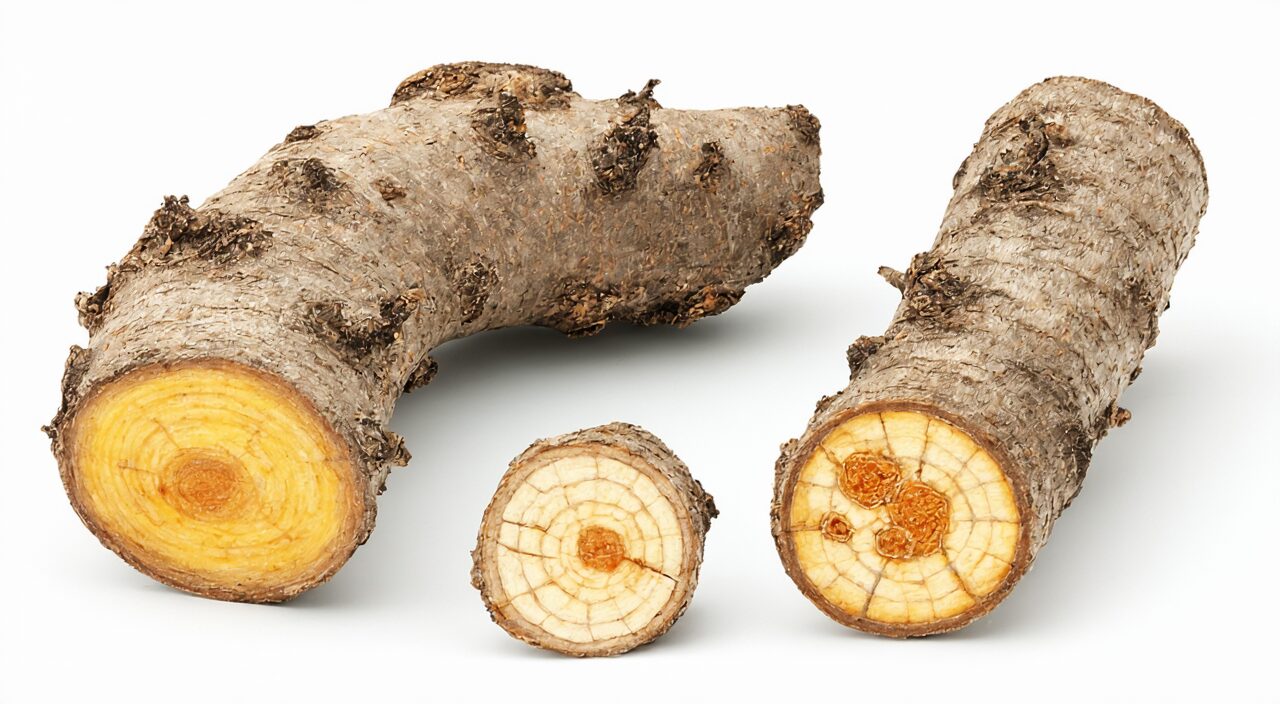
The Chinese herb Cang Zhu is mainly derived from the dried rhizome of Atractylodes lancea (Mao Cang Zhu) or Atractylodes chinensis (Bei Cang Zhu). Visually, the rhizome is irregularly shaped—often bead-like or nodular-cylindrical, slightly curved, typically 3–10 cm long and about 1–2 cm in diameter.
The surface is greyish-brown or dark brown, with wrinkles, transverse curved lines, and remnants of fibrous root scars. When observed carefully, stem scars or bud scars can often be seen at the top, which serve as helpful identification markers. The texture is firm but easily broken. The fractured surface is uneven, revealing a yellowish-white or greyish-white interior. For Mao Cang Zhu, after exposure to air for a short while, many orange-yellow or brownish-red oil spots often become visible—commonly called “cinnabar spots.” Upon prolonged exposure, fine white needle-like crystals may precipitate. These crystals are the exudates of volatile components and were traditionally described as “white hairs.” Bei Cang Zhu has less obvious oil spots, a more fibrous fracture surface, and fewer crystalline exudates, though yellowish-brown oil spots can still be observed.
Odor and taste are also key identification criteria. Cang Zhu has a distinctive, strong aroma, somewhat reminiscent of a camphor-like herbal scent. The taste is slightly sweet, acrid, and bitter. Chewing a small piece typically produces an initial sweetness followed by bitterness, with a mildly pungent sensation. Authentic Cang Zhu possesses a long-lasting, intense aroma, which is crucial for distinguishing it from some adulterants.
What part of Cang Zhu is used medicinally?
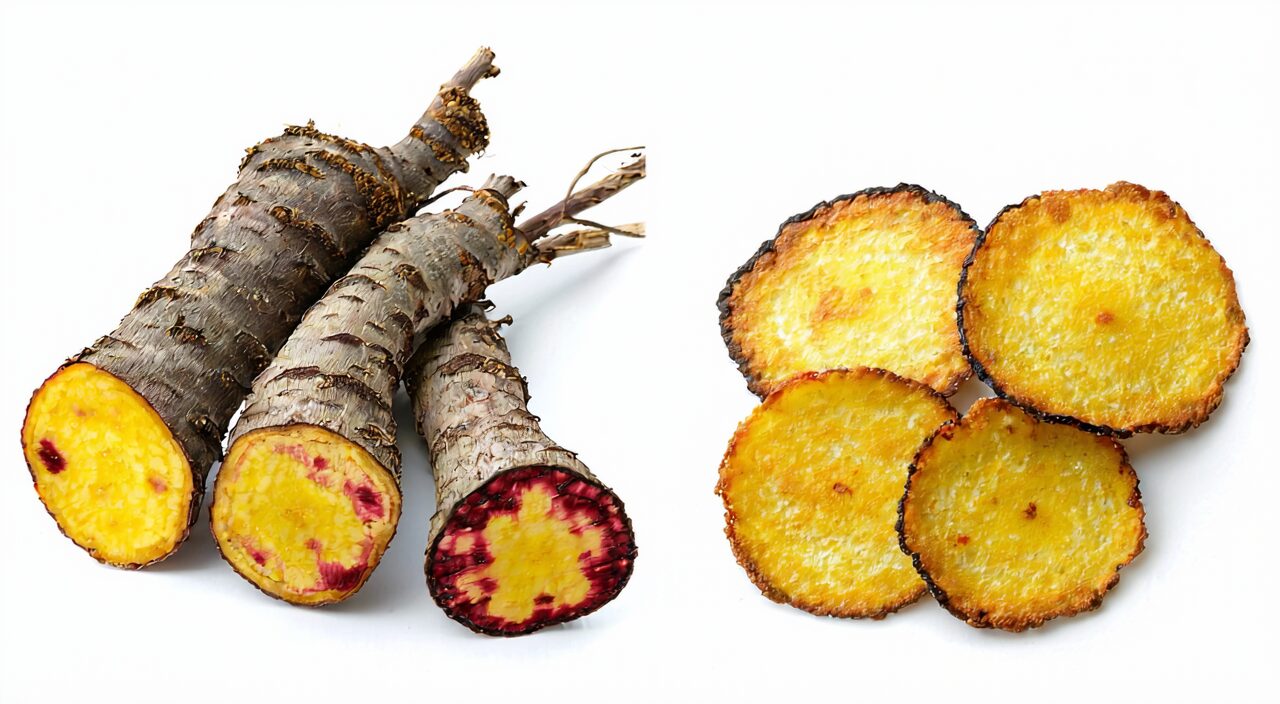
The medicinal part of Cang Zhu is its rhizome. After the plants Mao Cang Zhu or Bei Cang Zhu have grown for several years, the underground rhizomes are usually harvested in spring or autumn. They are cleaned of soil and aerial parts, sun-dried or oven-dried, and then the fibrous roots are knocked off. This yields raw Cang Zhu.
There is also a processed form called bran-fried Cang Zhu (Fu Chao Cang Zhu). To make it, clean Cang Zhu slices are stir-fried with wheat bran until the surface turns deep yellow, after which the bran is sifted out. After bran-frying, the harsh, drying nature of Cang Zhu is moderated, and its aroma changes to a more toasted, slightly burnt note. In traditional practice, bran-fried Cang Zhu is often used when the spleen-strengthening effect is more desired, while raw Cang Zhu is better at expelling wind and eliminating dampness.
From a botanical perspective, although the aerial parts of the plant contain some volatile oils, traditional Chinese medicine has always used only the rhizome. This is the established standard.
How does Traditional Chinese Medicine understand Cang Zhu?
Traditional Chinese medicine (TCM) considers Cang Zhu warm in nature, with a pungent and bitter taste. It enters the Spleen, Stomach, and Liver meridians. Its core actions can be summarized as drying dampness and strengthening the spleen, dispelling wind and scattering cold, and brightening the eyes.
“Drying dampness and strengthening the spleen” is the most recognized use of Cang Zhu. When spleen and stomach functions are impaired by dampness, leading to epigastric and abdominal distension, poor appetite, nausea, loose stools, and a thick, white, greasy tongue coating, Cang Zhu is often a top choice for addressing dampness obstruction in the middle burner. It can warm and dry dampness in the middle burner, restoring the spleen’s transporting and transforming functions. In comparison, Bai Zhu (Atractylodes macrocephala) tends to tonify qi, strengthen the spleen, and consolidate the exterior, whereas Cang Zhu focuses on activating the spleen and drying dampness.
“Dispelling wind and scattering cold” mainly targets symptoms caused by external wind-cold-dampness, such as generalized body aches, a heavy sensation, and a head that feels wrapped, especially in dampness-predominant bi-syndrome (painful obstruction). With its acrid, dispersing, warm, and unblocking nature, Cang Zhu can not only expel wind, cold, and dampness from the exterior but also improve the internal environment by drying dampness.
The “brightening the eyes” application is relatively unique. In some classic texts, Cang Zhu was used for night blindness or blurred vision, often combined with black sesame seeds or animal liver. The rationale is that by strengthening the spleen, drying dampness, and raising clear qi, the eyes can be nourished. However, this is largely based on traditional experience, and modern individuals should combine this with proper medical evaluation.
What have modern studies found about Cang Zhu?
Modern research on Cang Zhu mainly focuses on its volatile oil constituents, from which compounds such as atractylodin, atractylone, and β-eudesmol have been isolated. Some experimental observations suggest that Cang Zhu extracts may exert a bidirectional regulatory effect on gastrointestinal movement and promote digestive fluid secretion. Certain studies also indicate potential anti-inflammatory, antioxidant, and gut microbiota-regulating properties. However, these findings are largely limited to laboratory or animal studies and cannot be directly equated to clinical effects in humans. They merely serve as background references for its traditional uses.
What are the differences between Cang Zhu and Bai Zhu?
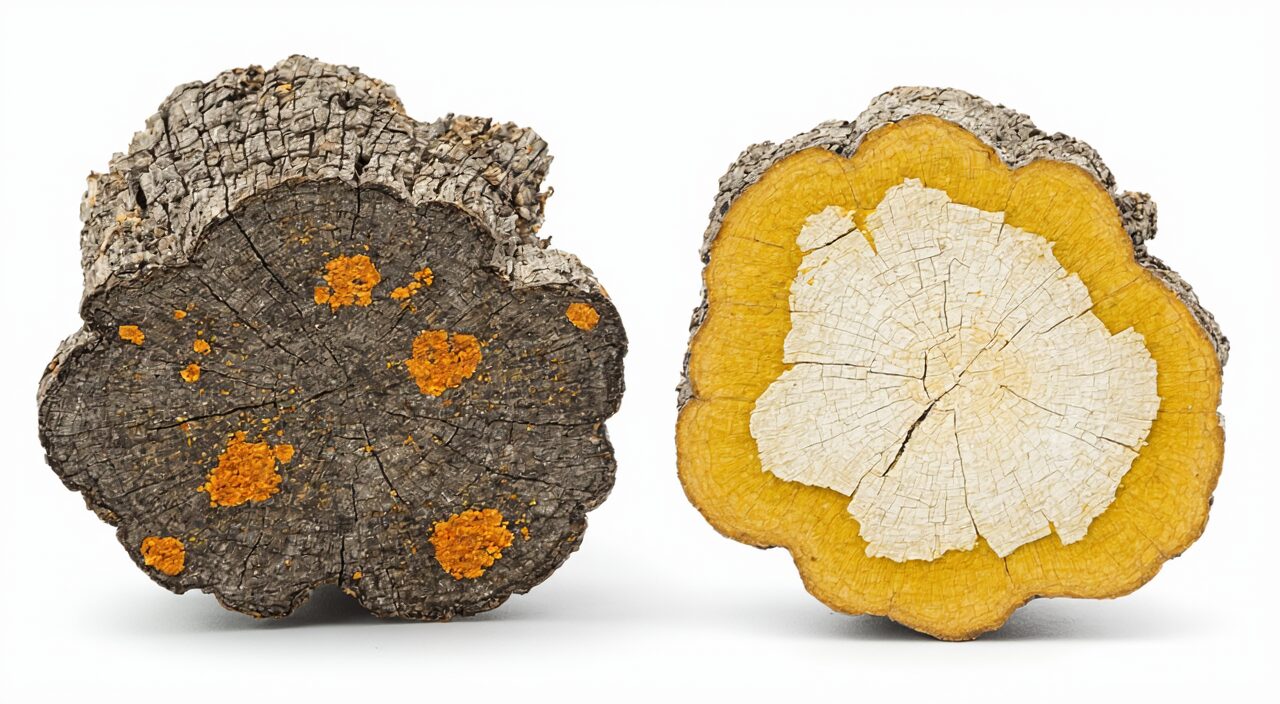
Cang Zhu and Bai Zhu are two herbs frequently used together or compared in TCM formulas, but they come from different plant sources and have distinct characteristics and traditional application emphases.
Regarding their origin, Bai Zhu is the rhizome of Atractylodes macrocephala, while Cang Zhu is the rhizome of Atractylodes lancea or Atractylodes chinensis. In appearance, Bai Zhu rhizomes are often plump, fist-like masses with a greyish-yellow or greyish-brown surface. They have obvious tumor-like protrusions and interrupted longitudinal grooves. The fractured surface is even, yellowish-white to light brown, with cracks. The odor is delicately aromatic, and the taste is sweet and slightly acrid; the texture is relatively moist. Cang Zhu, on the other hand, is nodular, with a yellowish-white fractured surface that often exhibits “cinnabar spots” or white hair-like crystals. Its aroma is intensely aromatic, and its taste is acrid and bitter.
In traditional application, Bai Zhu tends to tonify qi, strengthen the spleen, dry dampness, promote water metabolism, consolidate the exterior to stop sweating, and calm the fetus. Its overall action is more interior-fixating, emphasizing “tonifying” and “consolidating.” Cang Zhu tends to dry dampness, activate the spleen, dispel wind-dampness, and induce sweating to release the exterior. Its overall action is more dispersing, emphasizing “activating” and “dispersing.” In cases of spleen deficiency with severe dampness marked by a thick, greasy tongue coating, Cang Zhu and Bai Zhu are often used together—one to activate, the other to tonify, each contributing its strength. However, this combination should be chosen based on individual constitution and symptoms.
Which herbal formulas commonly include Cang Zhu?
Cang Zhu appears in several classic formulas. The following are representative examples that can serve as an entry point for understanding traditional formulation concepts.
Ping Wei San: Composed of Cang Zhu, Hou Po, Chen Pi, and Gan Cao, this formula is traditionally used for dampness stagnating in the spleen and stomach, with common presentations like epigastric and abdominal distension, poor appetite, bland taste in the mouth, nausea, vomiting, belching, acid reflux, loose stools, and a white, greasy tongue coating. Cang Zhu serves as the main ingredient for drying dampness and activating the spleen.
Yue Ju Wan: Contains five herbs—Cang Zhu, Xiang Fu, Chuan Xiong, Shen Qu, and Zhi Zi. It is traditionally used for the six stagnations of qi, blood, phlegm, fire, dampness, and food, which manifest as chest and epigastric oppression, abdominal distension and pain, acid reflux, and vomiting. Cang Zhu primarily resolves dampness stagnation.
Er Miao San: A simple combination of just Cang Zhu and Huang Bai—one drying, one clearing. It is commonly used for damp-heat pouring downward, resulting in sinew and bone pain, weak and limp lower limbs, and foul, yellow, thick vaginal discharge. It is a representative formula for clearing heat and drying dampness.
Jiu Wei Qiang Huo Tang: Includes Qiang Huo, Fang Feng, Cang Zhu, Xi Xin, Chuan Xiong, Bai Zhi, Sheng Di Huang, Huang Qin, and Gan Cao. It is traditionally indicated for externally contracted wind-cold-dampness with symptoms like chills, fever, headache without sweating, body aches, bitter taste in the mouth, and slight thirst. In this formula, Cang Zhu assists in dispersing wind, cold, and dampness.
Each of these formulas has its own emphasis and must be used based on a comprehensive assessment of individual constitution and current symptoms. They are not suitable for everyone. If you are unable to make this distinction yourself, it is advisable to consult a TCM professional beforehand.
What precautions should be taken when using Cang Zhu?
Although Cang Zhu is a commonly used herb, it is not suitable for indiscriminate use in all situations.
From a traditional perspective, Cang Zhu is warm, dry, and harsh by nature, and it can easily damage yin fluids. Therefore, in any presentation involving yin deficiency with internal heat, insufficient body fluids, dry mouth and tongue, night sweats, or dry, difficult bowel movements, it should be used with caution or avoided. If your constitution tends to be heat-prone, or if you are currently experiencing fever or signs of excess heat, self-administering Cang Zhu is not recommended.
Moreover, the volatile constituents of Cang Zhu are crucial to its medicinal properties. It should be stored in a cool, dry place, tightly sealed and protected from light, to prevent loss of active components and quality deterioration. If Cang Zhu loses its intense aroma, or shows signs of insect infestation or mold, it should be discarded.
For individuals who experience recurrent or persistent gastrointestinal discomfort, heavy body sensation, or concurrent symptoms such as significant weight loss, continuous abdominal pain, black stools, or unusual fatigue, it is important to seek medical attention promptly to rule out other underlying problems. Relying solely on herbal self-treatment is not advisable.
Summary
As a commonly used Chinese herbal medicine, Cang Zhu is the nodular rhizome. Its significant actions of drying dampness, strengthening the spleen, dispelling wind, and scattering cold give it a unique role in traditional therapy. In particular, its contrast with Bai Zhu—one drying and activating, the other tonifying and consolidating—forms a basis for many formula combinations. Understanding this information can help us make more informed judgments when encountering related products. However, whether it is ultimately suitable for you must be considered in combination with your individual constitution and professional advice. This article serves only as educational information and cannot replace any diagnosis or treatment recommendations.