
What Is Qian Nian Jian? Medicinal Part, Identification, and Common Formulas
Qian Nian Jian is a medicinal herb commonly mentioned in traditional Chinese medicine approaches for wind-damp bi pain, soreness and weakness of the lower back and knees, and related patterns. Many people who hear the name “Qian Nian Jian” for the first time may mistake it as meaning “eternal youth” or “long-term health.” In fact, Qian Nian Jian in Chinese medicine comes from the dried rhizome of the Araceae plant Homalomena occulta. Its name carries a positive traditional naming meaning, but it is not equivalent to a modern claim of prolonging life. For overseas Chinese readers, understanding what Qian Nian Jian is usually starts with appearance identification, medicinal part, differences from similar herbs, and common formula directions.
What does Qian Nian Jian look like? How to identify it?
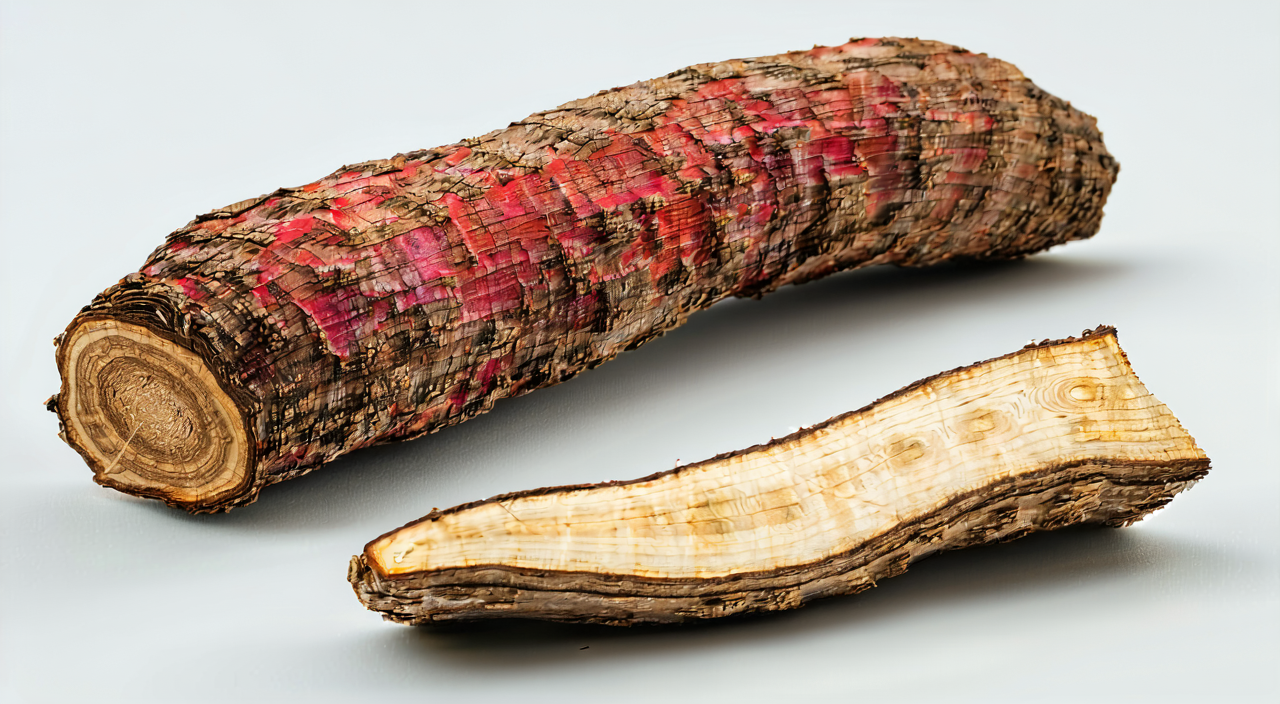
The medicinal part of Qian Nian Jian is the rhizome, so what is commonly seen is usually dried rhizome slices or whole rhizome pieces. It is often cylindrical or slightly curved, sometimes somewhat flattened, with variable length. The surface is mostly brownish-red, yellowish-brown, or dark brown, with distinct ring-like nodes. Remnant root marks or scale leaf scars are sometimes visible on the nodes. The texture is relatively hard; the cut surface is yellowish-brown or brownish-red and quite fibrous, with scattered small vascular bundle dots in some pieces. One of the most distinctive features of Qian Nian Jian is its strong, special aromatic odor. It may taste pungent and slightly bitter, and some descriptions mention a mild irritating sensation.
Identification should not rely on color alone, because Qian Nian Jian from different producing areas and processing methods may vary somewhat in color. It should be judged comprehensively by the cylindrical, slightly curved rhizome, distinct nodes, yellowish-brown cut surface, and strong aroma. There are also counterfeit or adulterated products on the market, so it is recommended to learn about or purchase it through reliable channels and, if necessary, ask a professional to authenticate it. Samples that are overly dark, have an abnormal cut surface, weak odor, or a sour or moldy smell should be treated with caution. In traditional experience, Qian Nian Jian with thick roots, brownish-red color, yellowish-brown cut surface, and strong aroma is generally regarded as having good quality characteristics.
What is the medicinal part of Qian Nian Jian?
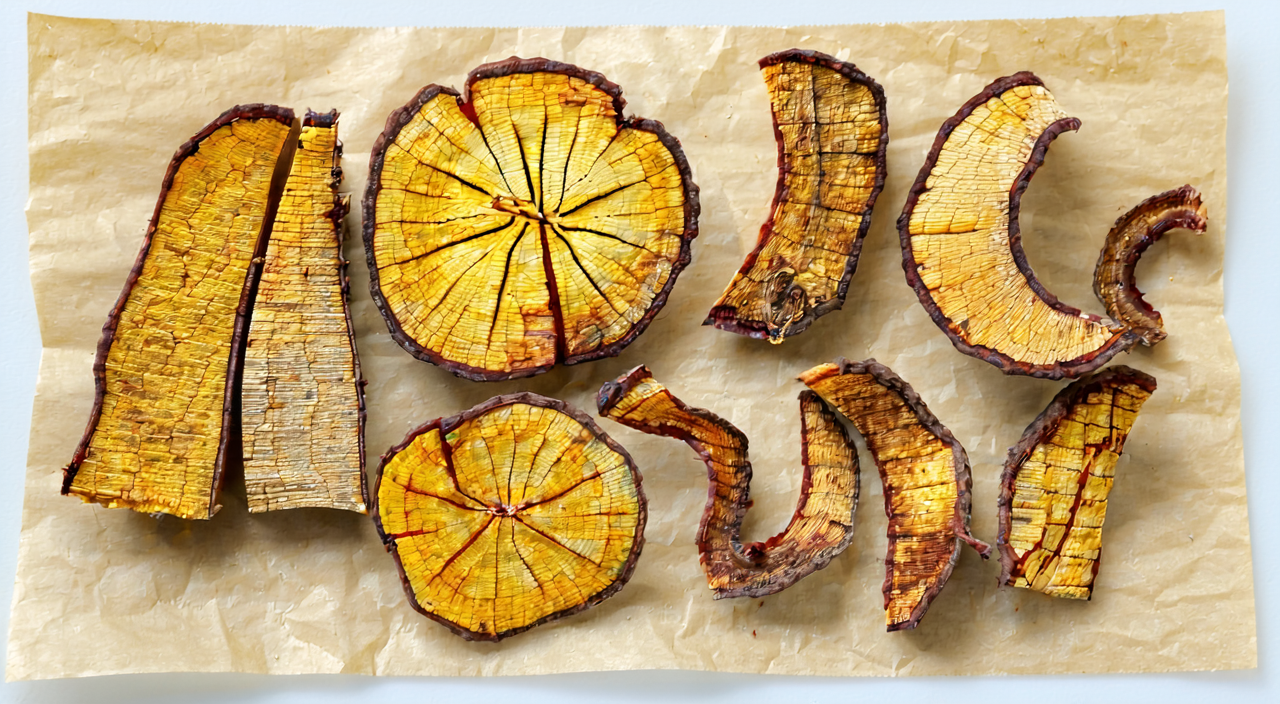
The medicinal part of Qian Nian Jian is the rhizome, not the whole herb, leaves, or fruit. It is usually harvested after the Araceae plant Homalomena occulta has grown for a certain number of years. The aboveground parts, fibrous roots, and sediment are removed, and the rhizome is cleaned, then sun-dried or dried at low temperature. In some regions it is sliced while fresh; in others it is stored as whole rhizome pieces. The quality of the medicinal material is related to harvest time, drying method, and storage conditions.
Because Qian Nian Jian rhizome is rich in volatile oil components, storage generally requires protection from moisture, insects, and light to prevent loss of aroma or mold. If the rhizome becomes soft after absorbing moisture, darkens in color, or loses its odor, it may no longer be suitable for normal use. For general understanding, you can pay attention to whether the rhizome shape, cut surface color, and aroma are typical.
How does traditional Chinese medicine understand Qian Nian Jian?
Traditional Chinese medicine traditionally understands Qian Nian Jian from the perspective of dispelling wind-dampness and strengthening sinews and bones. Its nature and flavor are mostly recorded as pungent and bitter, warm, entering the liver and kidney meridians. It is often used in approaches for wind-damp bi pain, soreness and weakness of the lower back and knees, weakness of the lower limbs, and difficulty bending and stretching the joints. It may be suitable as one ingredient in a formula for people with predominant cold-dampness and impaired movement of the sinews and bones, but it is not suitable for everyone as a single herb.
In traditional materia medica records, Qian Nian Jian is often regarded as one of the herbs that dispel wind-dampness and strengthen sinews and bones. It is applied in formulas for wind-cold-damp pathogens lodged in the limbs and joints, and for weakness of the lower back and knees after prolonged illness. If the presentation is mainly redness, swelling, heat, and pain, or is accompanied by fever, thirst, red tongue with yellow coating, and other heat signs, it may not be appropriate to treat it solely with a pungent-warm herb approach. In clinical application, Qian Nian Jian is rarely used alone. It is often combined with herbs such as Sang Ji Sheng, Du Zhong, Niu Xi, Gou Ji, and Dang Gui to help address lower back, knee, and joint-related discomfort. It must be emphasized that this type of usage belongs to traditional experience and pattern-based thinking, and is not equivalent to targeted treatment in modern medicine. Whether it is suitable to use, how to combine it, and the dosage should all be judged based on individual constitution and the advice of a professional Chinese medicine practitioner.
How does modern research understand Qian Nian Jian?
Modern research on Qian Nian Jian mainly focuses on components such as volatile oils, terpenoids, and flavonoids. Some studies suggest that Qian Nian Jian extracts may show certain activity in experimental models of anti-inflammation, analgesia, and antioxidation, but these are mostly in vitro or animal experiments and cannot yet be directly extrapolated to clear efficacy in humans. Some researchers have also studied its influence on cytokines related to joint inflammation, but the evidence is still insufficient.
Therefore, modern research can serve as a reference for understanding Qian Nian Jian, but it should not be simply equated with an “anti-inflammatory painkiller.” If you have joint pain, swelling, limited mobility, or other problems, especially if they recur or clearly worsen, you should consult a doctor or professional rather than relying only on a single Chinese herb.
What are the differences between Qian Nian Jian, Gu Sui Bu, and Gou Ji?
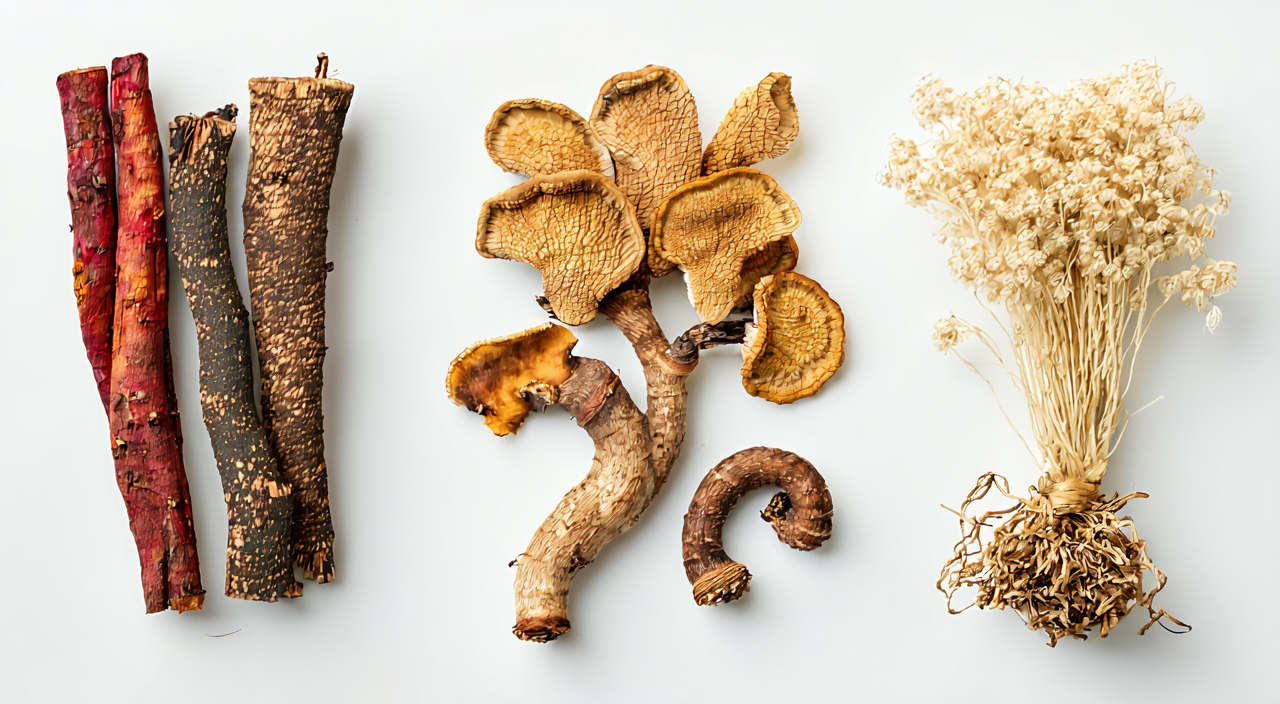
Qian Nian Jian, Gu Sui Bu, and Gou Ji are all herbs commonly encountered in Chinese medicine for regulating sinews, bones, lower back, and knees, but their sources, appearance, and traditional understanding are not the same.
Qian Nian Jian comes from the rhizome of the Araceae plant Homalomena occulta. Its appearance is mostly cylindrical and slightly curved, with a brownish-red to yellowish-brown surface, distinct nodes, a yellowish-brown cut surface, and a strong aroma. Gu Sui Bu is mostly derived from the rhizome of Drynaria fortunei and related species in the family Polypodiaceae. It is commonly seen as flat strips or curved pieces, with a surface densely covered with hairs or showing marks after hair removal; its cut surface color and odor differ from those of Qian Nian Jian. Gou Ji is mostly derived from the rhizome of Cibotium barometz in the family Dicksoniaceae. Its surface is often covered with golden-yellow hairs, and the rhizome is relatively firm; traditionally it is considered to have more pronounced moistening and softening properties.
In terms of traditional actions, Gu Sui Bu tends to be more oriented toward reconnecting sinews and bones and tonifying the kidneys and strengthening bones. Gou Ji tends to tonify the liver and kidneys, strengthen the lower back and knees, and firm the sinews and bones. Qian Nian Jian is more prominent for dispelling wind-dampness and strengthening sinews and bones. Although all three may appear in approaches for soreness and weakness of the lower back and knees and impaired joint movement, they cannot be mixed or substituted for one another. Replacing one herb with another on your own may lead to errors in dosage, combination, and applicable pattern.
Which formulas may contain Qian Nian Jian?
Traditional formulas or Chinese patent medicines containing Qian Nian Jian mainly revolve around dispelling wind and eliminating dampness, strengthening the lower back and knees, and promoting joint movement. Common mentions include Qian Nian Jian Wan, as well as some formulas for strengthening the lower back and kidneys and some formulas for dispelling wind and strengthening sinews. In different formulas, Qian Nian Jian is mostly used as an auxiliary herb, combined with herbs that tonify the liver and kidneys, nourish and activate blood, and dispel wind and free the channels.
Qian Nian Jian Wan
In traditional use, Qian Nian Jian Wan is mostly oriented toward patterns such as soreness and weakness of the lower back and knees, weakness of sinews and bones, and wind-damp bi pain. It is often combined with herbs that tonify the liver and kidneys and strengthen sinews and bones, and is used for chronic stages where wind-cold-damp pathogens predominate while healthy qi is insufficient. Whether it is suitable still needs to be judged according to individual constitution and symptoms.
Formulas for strengthening the lower back and kidneys
Formulas for strengthening the lower back and kidneys usually focus on tonifying the liver and kidneys and strengthening the lower back and knees, and may add Qian Nian Jian to also address wind-dampness. This type of formula is more suitable for patterns traditionally identified as liver-kidney depletion, with soreness and weakness of the lower back, aggravation after exertion, and weakness of the lower limbs.
Formulas for dispelling wind and strengthening sinews
Formulas for dispelling wind and strengthening sinews are mostly used when wind and dampness predominate, with manifestations such as joint pain, difficulty bending and stretching, and heaviness of the limbs. In these formulas, Qian Nian Jian is generally not the main herb, but is combined with Du Huo, Wei Ling Xian, Niu Xi, and others to enhance the actions of freeing the joints and dispelling wind-dampness.
It must be especially reminded that the choice of formula cannot be judged by a single herb alone. Different populations, body constitutions, cold-heat deficiency-excess patterns, disease duration, and whether other diseases are present all affect whether a formula is suitable. Chinese patent medicines containing Qian Nian Jian may also differ in preparation, excipients, and contraindicated populations. Before use, comprehensive judgment should be made based on product instructions, personal circumstances, and professional advice. Long-term or excessive self-administration is not recommended.
What precautions should be taken when using Qian Nian Jian?
Qian Nian Jian is relatively warm and drying. People with yin deficiency with internal heat, dry mouth and throat, red tongue with little coating, frequent night sweats, or dry stools need to be cautious. Pregnant women, breastfeeding women, children, and people with specific underlying diseases are not advised to use it on their own. Traditionally, this type of pungent-warm wind-damp-dispelling herb is considered capable of consuming yin fluids, so it is not suitable for those with a heat-biased constitution or insufficient fluids.
Qian Nian Jian contains volatile oils and has a pungent, strong odor. Some people may be sensitive to volatile oil components and experience stomach discomfort, nausea, or throat irritation. People who are sensitive to smells, have a history of stomach problems, or are prone to allergies should start with a low dose and observe their body’s reaction for a short time when first learning about or using related products. If obvious discomfort occurs after taking a related formula, stop using it and consult a doctor. Also note that although the name Qian Nian Jian contains the word “qian nian,” meaning “thousand years,” it should not be interpreted as promising that long-term use will extend life, ensure longevity, or guarantee health. It is simply the name of the source plant and a traditional naming convention, not a description of efficacy.
Summary
As a traditional herb commonly used for dispelling wind-dampness and strengthening sinews and bones, Qian Nian Jian is essentially derived from its dried rhizome. It is usually identified by its cylindrical, slightly curved appearance, brownish-red to yellowish-brown surface, distinct nodes, yellowish-brown cut surface, and strong aroma. It differs from Gu Sui Bu and Gou Ji in appearance and traditional emphasis. Formulas containing Qian Nian Jian should also be understood and used under professional judgment. This article is for informational reference only and cannot replace professional diagnosis or treatment advice.