
What is Huang Qin? Medicinal Parts, Identification, and Introduction to Common Formulas
Among the wide variety of Chinese medicinal materials, Huang Qin (Scutellaria baicalensis) stands out as a highly recognizable and broadly applied heat-clearing herb. Whether from the perspective of traditional therapeutic approaches or the focus of modern research on plant constituents, Huang Qin holds an important position. For many people overseas who wish to understand Chinese medicine, clarifying questions such as “What is Huang Qin?”, “What does it look like?”, “Why is the root used?”, and “How does it differ from Huang Lian?” is a prerequisite for safe and appropriate use. This article will gradually unfold the introduction from aspects such as botanical source, appearance identification, medicinal part, traditional understanding, differences from Huang Lian, common formulas, and usage precautions.
What Does Huang Qin Look Like? How to Identify It?
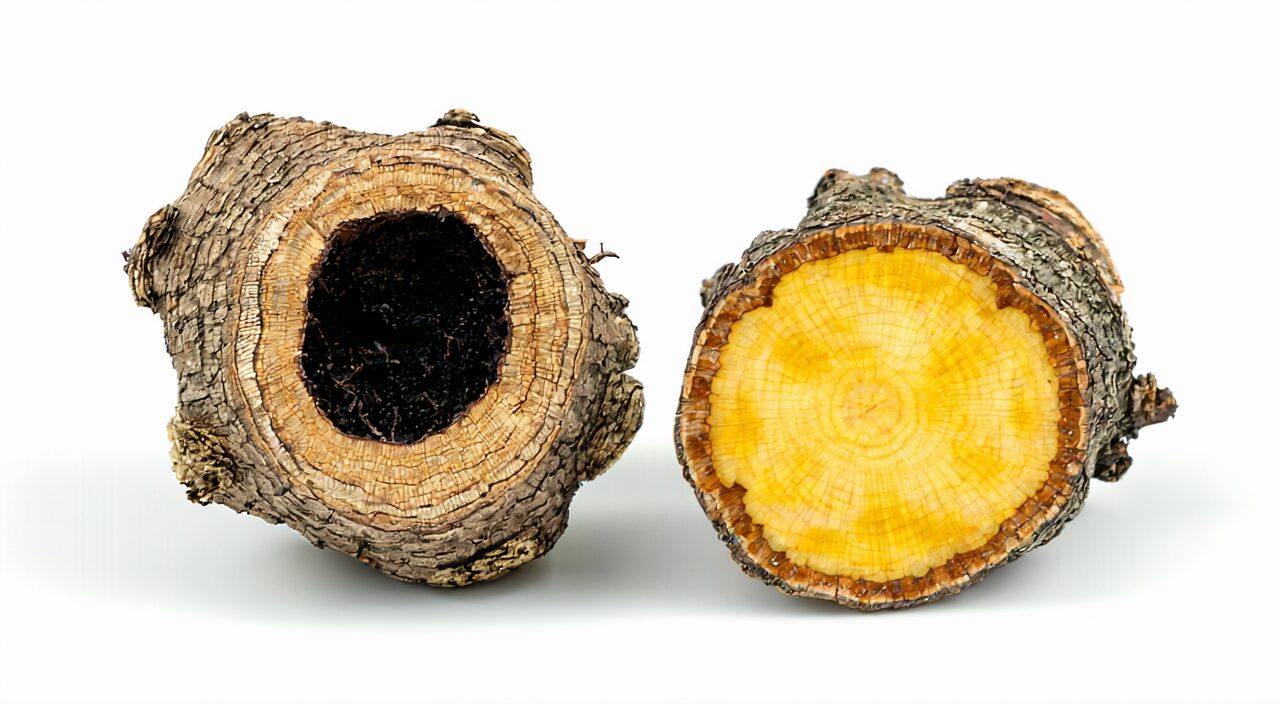
Intact dried Huang Qin root is usually conical or cylindrical, naturally twisted, with the main root thicker at the top and tapering downward, mostly 10 to 25 cm in length. The surface is yellowish-brown or deep yellow; the older the root and the better the quality, the deeper the color tends to be.
Surface Features The upper part of the root is relatively rough, showing twisted longitudinal wrinkles and scars from lateral roots, sometimes with remnants of stem bases; the lower part appears more compact, with fine longitudinal striations and sparse fine root scars.
Fracture Surface and Classification When broken, the fracture surface has a recognizable yellow to yellowish-green color. If slightly moistened with water, the yellow becomes more vivid. According to traditional experience, Huang Qin can be divided into “Ku Qin” and “Zi Qin” (also known as Tiao Qin) based on root texture and fracture surface condition.
- Ku Qin: Usually the older roots with longer growth, the central portion tends to become withered, darkened, or even hollow, sometimes showing a brownish-black cavity on the fracture.
- Zi Qin: Relatively newer roots and their younger parts, firm in texture, with a smooth fracture, solid center, and uniform yellow color.
The two types of material are not absolutely separate but rather reflect different growth stages of the same plant.
Quality Experience In general experience, Huang Qin that is long, thick, well stripped of outer bark, and shows a uniformly yellow fracture is considered better quality. Most commercial medicinal materials are lightly scraped of the root bark, cut into roughly circular or elongated thin slices, and dried before use. This gives them a cleaner appearance and makes decoction and storage easier.
What Is the Medicinal Part of Huang Qin?
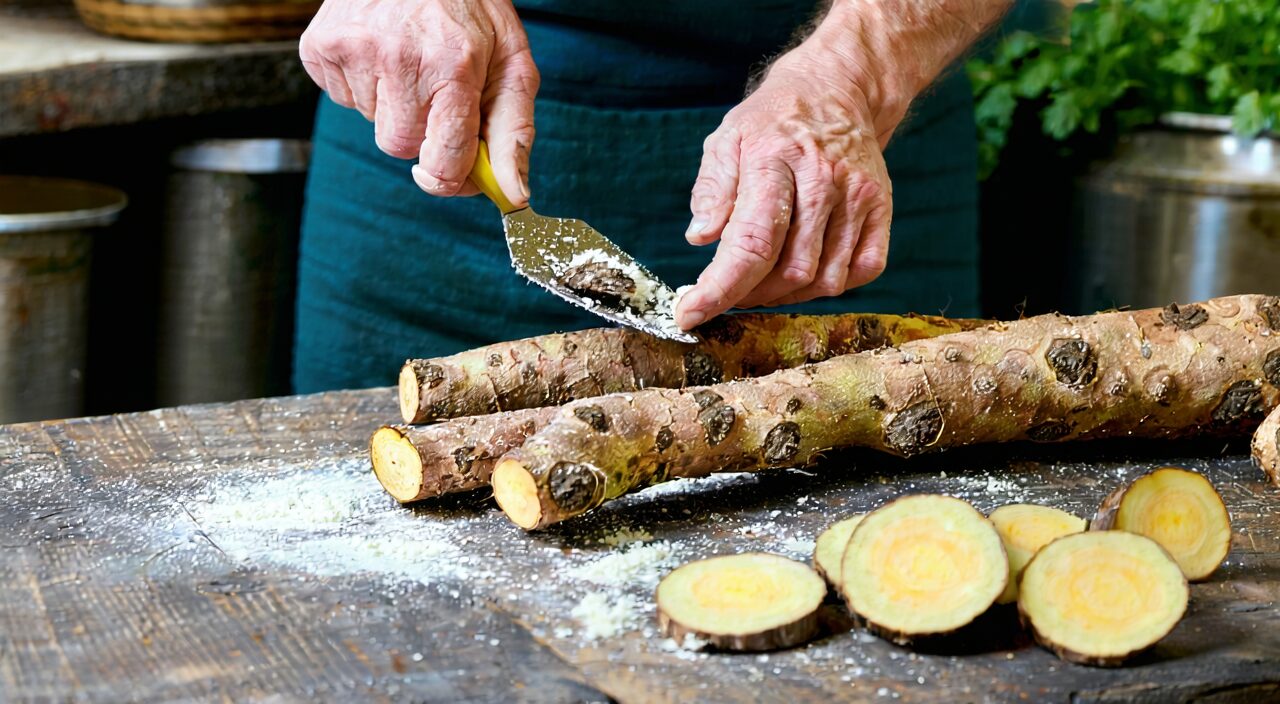
The medicinal part of Huang Qin is its root, a point clearly recorded in herbal texts of all dynasties. The plant sources used mainly include several species of the Scutellaria genus in the Lamiaceae family, but the most common is the dried root of Scutellaria baicalensis Georgi.
Harvesting and processing generally follow these steps:
- Harvesting: Roots can be dug in both spring and autumn, but the largest amount is harvested in autumn after the stems and leaves wither, when more nutrients are concentrated in the root and the tissue is relatively plump.
- Cleaning: After digging, the stems, leaves, and soil are removed.
- Scraping: Traditionally, the outer bark (the “rough skin”) is scraped off, mainly to reduce the earthy smell of the rough surface and give the medicinal material a more uniform appearance.
- Drying and Cutting: Sun-dried, shade-dried, or low-temperature dried; large roots can be cut into thick slices, while thin slices are cut after moistening.
The processed Huang Qin slices have a yellow or yellowish-green fracture surface, are relatively brittle, and break easily. The odor is mild, but a characteristic bitterness can be tasted in the mouth. This bitterness remains noticeable after decoction and is closely related to the traditional positioning of Huang Qin as a heat-clearing and dampness-drying herb. Common prepared slices on the market are roughly circular or elongated thin slices after scraping off the rough bark, with naturally curled edges, and the central area may show a radiating pattern, though not as typical as the “chrysanthemum heart” of some woody roots.
How Does Traditional Chinese Medicine Understand Huang Qin?
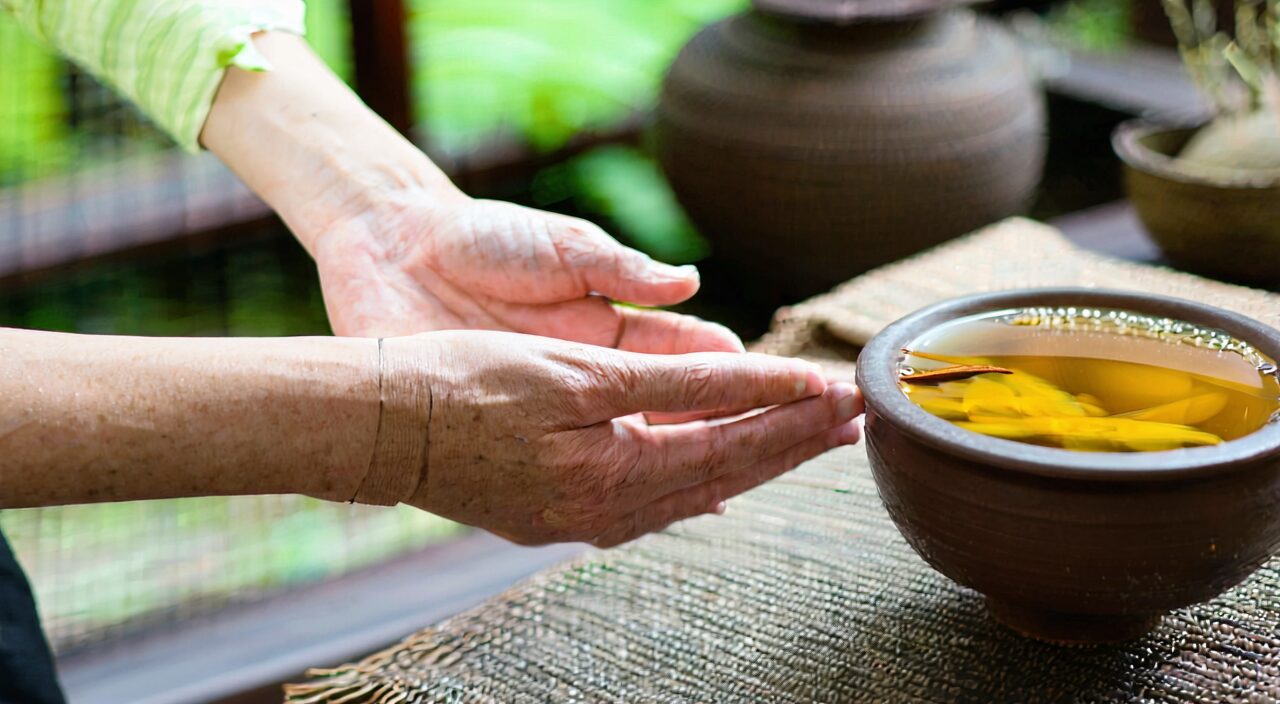
Traditional Chinese medicine’s understanding of Huang Qin is built on long-term use and observation. Its nature and flavor are summarized as bitter and cold, mainly entering the Lung, Gallbladder, Spleen, Large Intestine, and Small Intestine meridians. Bitterness can dry dampness, and cold can clear heat; therefore, Huang Qin is regarded as a representative herb for clearing heat and drying dampness in the traditional system, while also possessing functions such as draining fire and detoxifying, stopping bleeding, and calming the fetus.
In disease mechanisms related to damp-heat, Huang Qin is often referenced for the following directions:
- Early stage of summerheat-dampness or damp-warmth diseases, manifested as heaviness of the body, chest oppression, and a yellow, greasy tongue coating;
- Lung heat cough, manifested as thick, sticky yellow phlegm and sore, swollen throat;
- Certain bleeding tendencies when heat affects the upper burner or the blood aspect, such as epistaxis or hemoptysis (only under appropriate combination);
- Threatened miscarriage with heat signs—though Huang Qin is said to “calm the fetus,” this does not refer to all types of threatened miscarriage.
For those with spleen-stomach deficiency-cold or various discomforts caused by cold, Huang Qin is used relatively less or requires careful combination. Therefore, the use of Huang Qin in Chinese medicine strongly emphasizes “using the formula only when the pattern is present,” and it must be considered comprehensively under pattern differentiation.
What Constituents and Actions of Huang Qin Are of Interest to Modern Research?
From the perspective of modern phytochemistry, Huang Qin contains a variety of flavonoid compounds, among which baicalin, baicalein, wogonoside, and wogonin are the most intensively studied components. These constituents have shown certain activity directions in laboratory studies and some cell or animal research, including antioxidant, anti-inflammatory, antibacterial, and a certain sedative tendency.
Some in vitro experiments suggest that Huang Qin extracts may have inhibitory effects on certain bacteria, viruses, and fungi, but these results cannot simply be equated with direct therapeutic efficacy in the human body. In addition, research has also paid attention to the possible effects of Huang Qin components on liver function and the nervous system, though most of it is still at the stage of mechanism exploration or preliminary investigation.
It is particularly important to note that findings from laboratory studies are not directly equivalent to confirmed clinical conclusions. A relatively prudent attitude is to regard such information as one angle for understanding this herb, rather than as a basis for self-medication. Any statement that directly equates laboratory data with “effective” or “able to treat” may carry a risk of exaggeration.
What Are the Differences Between Huang Qin and Huang Lian?
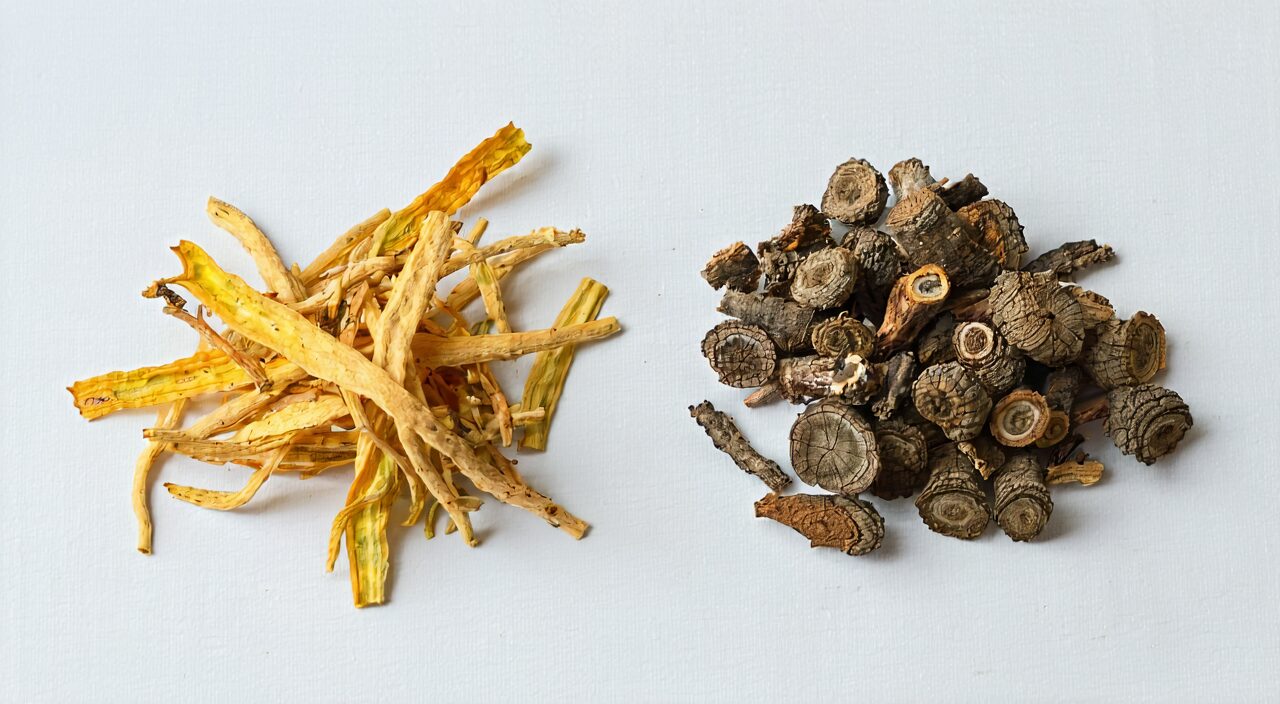
Because both names contain the character “Huang” and both excel in bitterness, coldness, and clearing heat-dampness, Huang Qin and Huang Lian are often compared. However, they have clear differences in botanical origin, medicinal part, appearance, and traditional application emphasis.
| Comparison Item | Huang Qin | Huang Lian |
|---|---|---|
| Botanical Source | Scutellaria baicalensis, a plant in the Lamiaceae family | Plants from the Ranunculaceae family, such as Coptis chinensis, Coptis deltoidea, or Coptis teeta |
| Medicinal Part | Root (the main taproot growing directly downward) | Rhizome (a horizontally running underground stem with shortened internodes) |
| Appearance | Conical or cylindrical, surface yellowish-brown, fracture yellow to yellowish-green, relatively dense texture without obvious node-like features | Often with distinct nodes and rootlet scars, uneven fracture, color tending toward reddish-yellow or dark yellow, sometimes showing radial or “chrysanthemum heart” pattern |
| Taste | Bitterness relatively mild, with a hint of a special odor | Bitterness more prominent and deep; as the folk saying goes, “nothing is more bitter than Huang Lian” |
| Traditional Application Emphasis | Tends to clear heat from the upper burner (lung) and the lesser yang (gallbladder), often used for heat patterns affecting the chest, rib cage, throat, and the region between the exterior and interior | Tends to clear heat from the middle burner (heart and stomach), often used for heart vexation, epigastric stuffiness, vomiting, mouth sores, diarrhea, and other situations involving damp-heat in the heart, stomach, and intestines |
In summary, Huang Qin tends to go upward, while Huang Lian tends more toward the middle burner. This tendency is particularly clear in specific formulas.
Which Formulas Commonly Use Huang Qin?
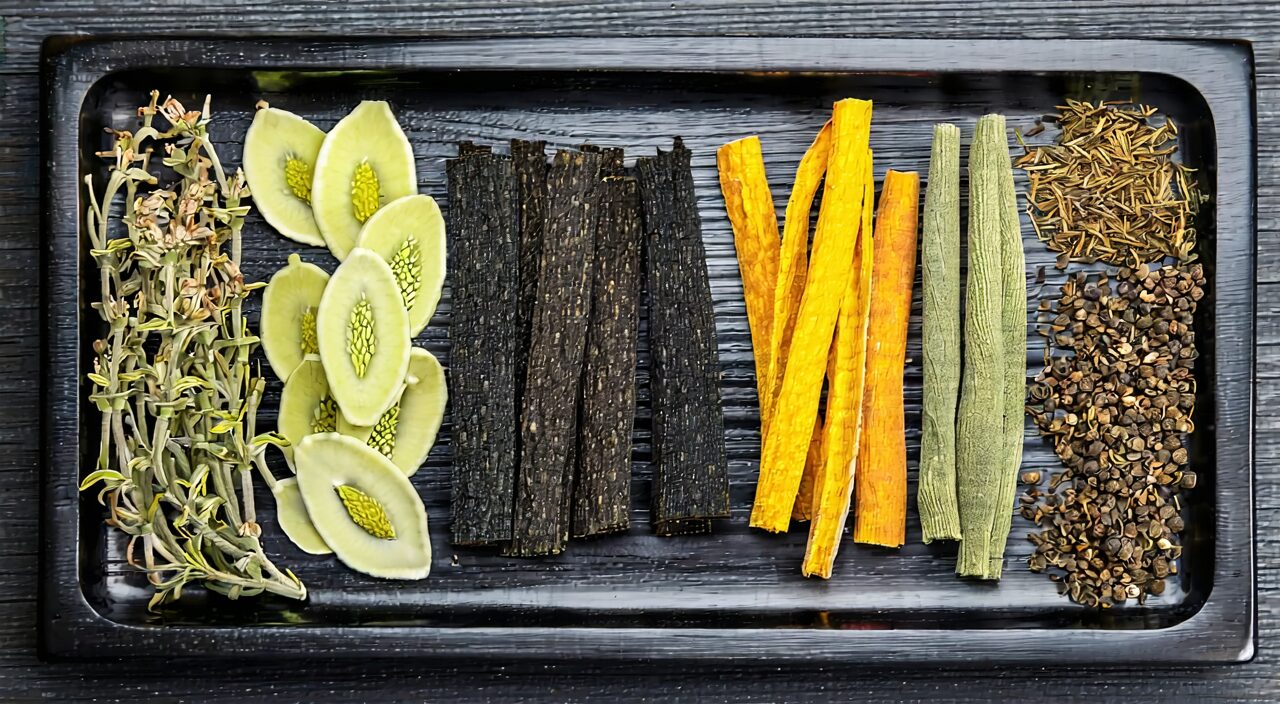
Huang Qin plays an important role in many classical formulas. Below are just a few representative ones that are traditionally well-known and often referenced as study examples.
- Xiao Chai Hu Tang (Minor Bupleurum Decoction): A core representative formula from the Shang Han Lun (Treatise on Cold Damage) for harmonizing the lesser yang. In this formula, Chai Hu (Bupleurum) is the chief herb, and Huang Qin is the deputy; one disperses, the other clears. It mainly addresses patterns such as alternating chills and fever, fullness and discomfort in the chest and rib cage, bitter taste in the mouth, dry throat, and vexation with nausea caused by dysfunction of the lesser yang pivot. Here, Huang Qin clears the pent-up heat in the lesser yang gallbladder to prevent the heat from transmitting inward.
- Huang Qin Tang (Scutellaria Decoction): Praised as the “ancestral formula for treating dysentery,” it is composed of Huang Qin, Shao Yao (Peony), Gan Cao (Licorice), and Da Zao (Jujube). Traditionally used for combined greater yang and lesser yang disease with spontaneous diarrhea. Huang Qin directly clears intestinal damp-heat, working together with Shao Yao to relax tension and harmonize the nutritive aspect. It provides guiding significance for abdominal pain, diarrhea, and foul-smelling dysentery caused by heat pressing on the large intestine.
- Ge Gen Qin Lian Tang (Kudzu, Scutellaria, and Coptis Decoction): Composed of Ge Gen (Kudzu), Huang Qin, Huang Lian, and Gan Cao, it is commonly used for damp-heat diarrhea caused by unresolved exterior pathogen with heat entering the interior. Huang Qin and Huang Lian are combined to clear interior heat, dry dampness, and stop diarrhea, while Ge Gen raises yang and stops diarrhea, addressing both the exterior and interior.
- Ban Xia Xie Xin Tang (Pinellia Heart-Draining Decoction): A representative formula for acrid opening and bitter downbearing that harmonizes the stomach and intestines; it is used for stuffiness syndromes caused by mixed cold and heat (epigastric fullness, vomiting, borborygmus, diarrhea). In the formula, the bitter-cold properties of Huang Qin and Huang Lian are used to clear and downbear heat, while the acrid-warm properties of Gan Jiang (Dried Ginger) and Ban Xia (Pinellia) are paired to restore the qi dynamic in the middle burner.
The above formulas are all traditional well-known preparations and are still frequently used today as models for learning Chinese medicine theory and clinical thinking. However, whether they are suitable for a specific individual needs to be comprehensively judged by combining symptoms, constitution, tongue, and pulse examination, and should be referenced only under the guidance of experienced professionals. One must not apply them mechanically based solely on written descriptions.
What Precautions Should Be Taken When Using Huang Qin?
Although Huang Qin has a broad background of traditional application, there are still a series of issues that need attention during use.
- Those with spleen-stomach deficiency-cold should not use it for long: Huang Qin has a relatively strong bitter-cold nature. For people with spleen-stomach deficiency-cold, cold pain in the abdomen, and loose stools without damp-heat signs, it is not suitable for long-term or large-dose use. If one’s constitution tends toward cold and digestive function is weak, misuse may aggravate sensations such as abdominal distension, aversion to cold, and poor appetite.
- Dosage and duration require professional evaluation: Even for situations with heat signs, dosage and duration of administration need to be evaluated by a professional; prolonged use of a single herb is not advisable.
- Combination experience should not be applied mechanically: Traditional empirical associations such as “Huang Qin ascends when processed with wine, clears liver-gallbladder fire with pig bile, and abates chills and fever with Chai Hu” also require professional judgment and cannot be arbitrarily combined based on anecdotal experience alone.
- Pregnant women should exercise extra caution: Although Huang Qin occasionally appears in traditional formulas for calming the fetus, the premise is the specific presence of heat disturbing the fetal origin. If there are no heat signs or the constitution is cold-biased, it is not suitable. Pregnant women should use medication under the guidance of a physician or licensed TCM practitioner and must not self-administer because of the saying “Huang Qin calms the fetus.”
- Seek timely medical care for severe or persistent discomfort: If the body experiences long-term, recurrent, or relatively severe discomfort such as persistent diarrhea, bloody stools, unremitting high fever, severe abdominal pain, jaundice, or marked emaciation, one should not expect a single herb to resolve the issue and should promptly consult a physician or professional health provider to avoid delaying the condition.
Summary
As a traditional heat-clearing and dampness-drying herb, the core value of Huang Qin lies in its appropriate use under the specific disease mechanisms of “heat” and “dampness.” From appearance, its yellowish-brown outer bark, yellow fracture surface, and the difference between Ku Qin and Zi Qin can help us initially identify it. From the medicinal part, the root is the only part used. From traditional understanding, Huang Qin’s bitter-cold nature determines that it is mainly applied to lung heat, lesser yang heat, intestinal damp-heat, and several other directions.
Compared with the easily confused Huang Lian, the two have clear differences in botanical origin, medicinal part, visual traits, and traditional application positions. Classic formulas containing Huang Qin, such as Xiao Chai Hu Tang, Huang Qin Tang, Ge Gen Qin Lian Tang, and Ban Xia Xie Xin Tang, demonstrate its unique place in compound prescriptions. No matter from which angle you learn about Huang Qin, the key lies in combining it with your own constitution and specific circumstances, and consulting a qualified professional when needed to avoid blind self-use.