
What Is Qin Jiao? Medicinal Parts, Identification Methods, and Common Formulas
Qin Jiao is often mentioned in Chinese medicine formulas, and many people who are new to Chinese medicinal materials may confuse it with similar-looking root herbs such as Long Dan Cao. For overseas Chinese readers, understanding the source, root characteristics, traditional uses, and boundaries of use of Qin Jiao is more meaningful than simply remembering the herb name. This article focuses on what Qin Jiao is, what it looks like, how to identify it, common formulas, and precautions for use.
What Is Qin Jiao? Source and Common Plant Origins
Qin Jiao is the dried root of Gentianaceae plants such as Gentiana macrophylla, Gentiana straminea, Gentiana crassicaulis, or Gentiana dahurica. This means that “Qin Jiao” in Chinese medicine is not from a single plant source, but rather a medicinal material formed from the roots of several closely related plants after specific harvesting and processing methods. Traditionally, Qin Jiao uses the root as the medicinal part. After digging, the roots undergo steps such as removing soil and sand, sweating, and drying, forming features such as a yellowish-brown or grayish-yellow surface with longitudinal grooves or twisted striations. Different sources of Qin Jiao may vary in size, root shape, and cross-section details, which is important to note during identification.
What Does Qin Jiao Look Like? How to Identify It
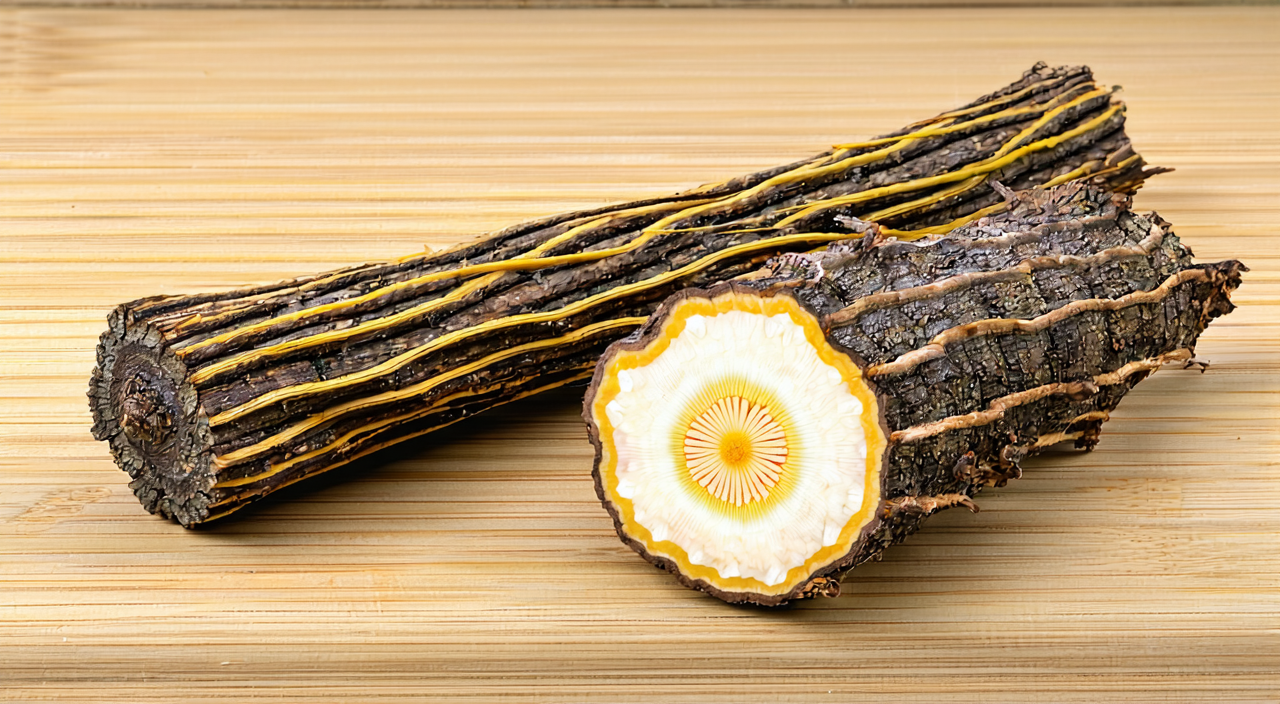
Qin Jiao is usually cylindrical or conical in shape, with a thicker upper end and a slightly thinner lower end. In some pieces, the root head is swollen. The surface is yellowish-brown or grayish-yellow with longitudinal or slightly twisted grooves. For some plant sources such as Gentiana straminea, the root head is often formed by several small roots clustered together, giving it a twisted, braided appearance. The root of Gentiana crassicaulis is generally thicker, while the root of Gentiana dahurica is thinner. The cross-section of Qin Jiao is often yellowish-white or whitish with radiating striations, traditionally called a “chrysanthemum heart,” which is an important feature for identification. The odor is somewhat distinctive, and the taste is bitter and slightly astringent. It should be noted that the appearance of the herb is affected by place of origin, harvest time, and processing methods. In practice, identification is best done by combining cross-section, texture, and odor.
What Is the Medicinal Part of Qin Jiao? Harvesting and Processing
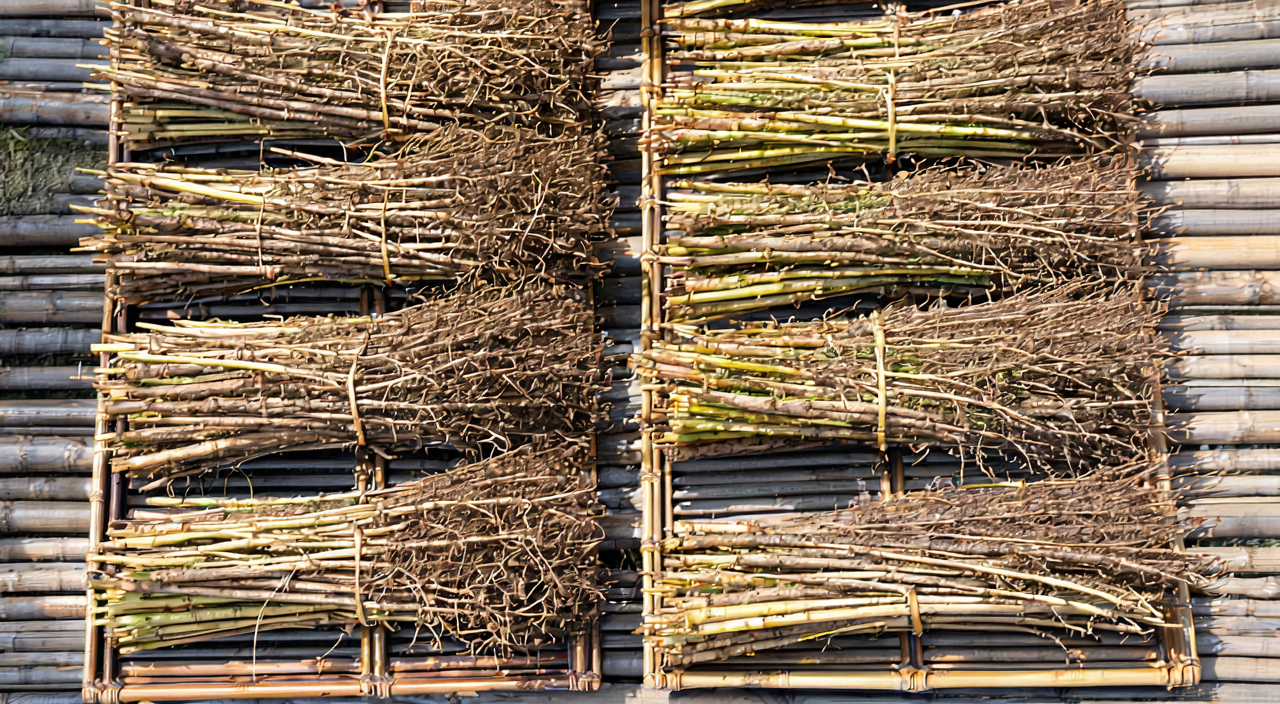
The medicinal part of Qin Jiao is the dried root. It is generally harvested in spring and autumn, with autumn harvest being more common. After harvesting, soil and fibrous roots are removed first, and then the roots are dried to a certain degree. Some are piled up for sweating, which changes the surface color and odor, and then dried further. Sweating is a common step in traditional processing and is generally considered to help alter the appearance and some odor characteristics of the medicinal material. Because the root bark of Qin Jiao is relatively thin, longitudinal wrinkles or grooves easily form after drying. Therefore, moisture should be avoided during storage and transportation to prevent mold and insect infestation.
How Traditional Chinese Medicine Understands Qin Jiao
In traditional Chinese medicine theory, Qin Jiao is commonly classified as an herb that dispels wind-dampness, unblocks collaterals and relieves pain, reduces deficiency heat, and clears damp-heat. For traditional presentations such as heaviness and soreness in the limbs and joints and impaired movement related to “wind-dampness obstructing the collaterals,” Qin Jiao may be one of the directions used in formula combinations. It is also often included in formulas for signs such as tidal fever and subjective heat sensation caused by deficiency heat, as well as traditional patterns related to damp-heat such as yellowing of the body and difficult urination. It should be emphasized that these are traditional directions of use based on pattern differentiation, not a simple one-to-one correspondence between an herb and a symptom. Whether Qin Jiao is suitable must be judged by combining individual constitution, symptom presentation, tongue and pulse findings, and other formula ingredients. Self-use based on a single presentation alone is not recommended.
What References Does Modern Research Provide?
Modern phytochemical research often isolates iridoids, alkaloids, flavonoids, and other constituents from Qin Jiao, and experimental studies have observed potential anti-inflammatory, analgesic, liver-protective, and immunomodulatory effects. These studies provide some reference for understanding the traditional uses of Qin Jiao, but experimental research is not equivalent to clinical conclusions in humans, nor does it directly mean that Qin Jiao is suitable for everyone. For general readers, modern research is better understood as background information rather than a replacement for pattern differentiation and dosage control.
How Does Qin Jiao Differ from Long Dan Cao and Wei Ling Xian?
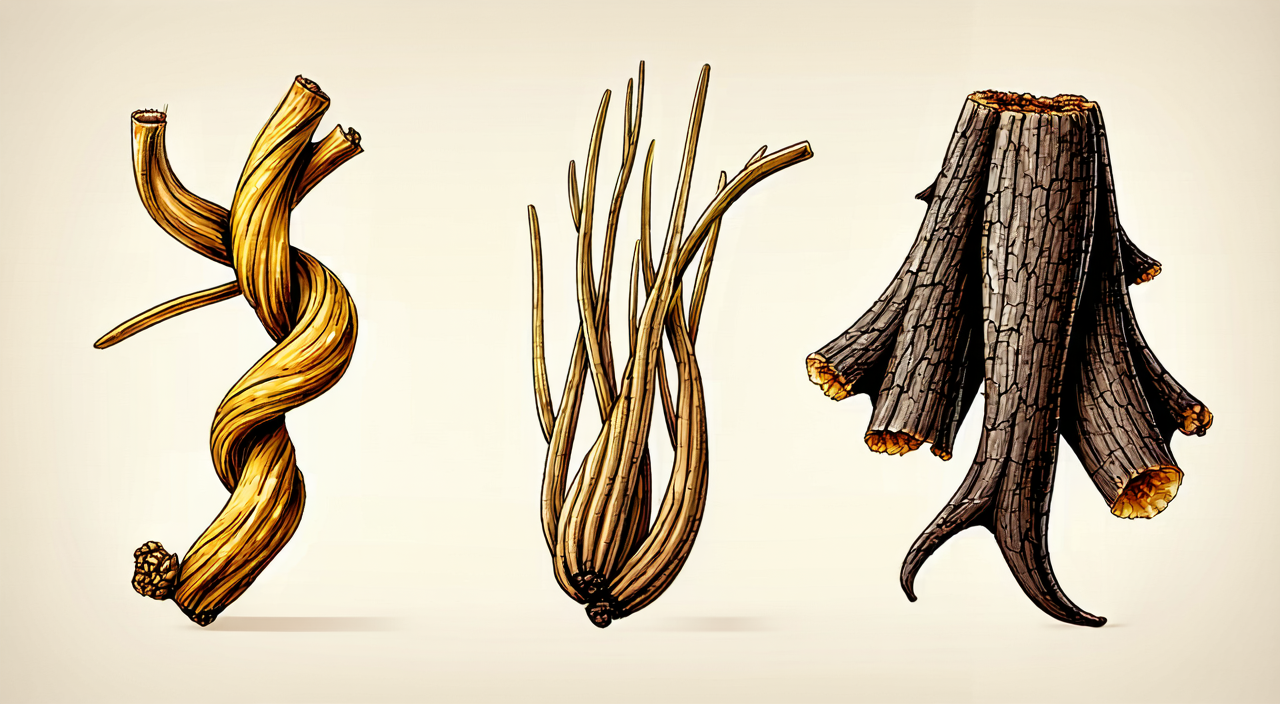
Qin Jiao and Long Dan Cao both belong to the Gentianaceae family and can sometimes be confused by appearance, but their plant sources, medicinal properties, and treatment focus are different. Long Dan Cao is the dried root and rhizome of Gentiana manshurica, Gentiana scabra, Gentiana triflora, or Gentiana rigescens. It has a more pronounced bitter taste and is traditionally used more to clear heat, dry dampness, and drain liver and gallbladder fire. Although Qin Jiao is also bitter, it has an additional slight astringency and is traditionally used more to dispel wind-dampness, unblock collaterals, and reduce deficiency heat. In appearance, Long Dan Cao often has a relatively short rhizome with many thin roots, and its cross-section color and striations differ from Qin Jiao, whose “chrysanthemum heart” is more obvious. Wei Ling Xian comes from plants in the Ranunculaceae family, a different family from Qin Jiao. It is often used as a wind-damp-dispelling, collateral-unblocking, and pain-relieving herb. Its rhizome is cylindrical, its roots are slender, and the outer bark easily falls off. Its taste is mild or slightly bitter. For simple differentiation, one can first look at the plant family and root shape, then combine the degree of bitterness and traditional use directions. However, actual herb identification is best done with reference to physical samples, specimens, or a professional’s judgment.
Which Formulas Use Qin Jiao?
Qin Jiao appears in many traditional formulas, reflecting its comprehensive positioning of dispelling wind, unblocking collaterals, reducing deficiency heat, and clearing damp-heat. Commonly mentioned formulas include Da Qin Jiao Tang, which is traditionally often used for patterns related to wind pathogen initially invading the collaterals and is usually combined with blood-nourishing, blood-activating, and heat-clearing herbs; Qin Jiao Bie Jia San, which is often used for directions involving deficiency heat and bone-steaming tidal fever, in combination with Bie Jia, Di Gu Pi, Chai Hu, and others; Du Huo Ji Sheng Tang, a formula often used for chronic bi syndrome with liver and kidney deficiency and qi-blood deficiency, in which Qin Jiao serves as an ingredient for dispelling wind-dampness and relieving bi pain; and Qing Zao Tang, which involves the traditional understanding of damp-heat with dual damage to qi and yin, in which Qin Jiao is often included as one of the combinations for clearing damp-heat and freeing the joints. It should be noted that these formulas have complete combination structures and applicable scenarios. Formula names are only records in traditional formula books and do not mean they can be selected by name alone. Whether they should be used and how they should be modified should be determined by a professional based on specific constitution and condition.
What Precautions Should Be Taken When Using Qin Jiao?
Although Qin Jiao is commonly used, it is not suitable for everyone. Traditionally, people with spleen-stomach deficiency-cold, frequent diarrhea, or loose stools should use it with caution. Some studies suggest that Qin Jiao may have certain effects on blood pressure, so people with low blood pressure especially need to consult a professional before self-use. Pregnant women, breastfeeding women, children, and people taking other medications are not advised to use it on their own without professional guidance. Long-term or high-dose use is also not advisable, because individual differences may cause discomfort. If obvious gastrointestinal discomfort, dizziness, fatigue, or worsening of original symptoms occurs during use, use should be stopped and medical attention sought promptly. If related symptoms do not improve for a long time, repeatedly worsen, or are accompanied by obvious palpitations, chest tightness, difficulty breathing, severe pain, black stools, weight loss, and other signs, professional medical help should be sought as early as possible rather than relying on a single herb or formula.
Summary
What is Qin Jiao? It can be understood from three aspects: source, medicinal part, and traditional use directions. It comes from the dried roots of several Gentianaceae plants, and identification requires attention to root shape, surface longitudinal grooves, and cross-section striations. Traditional Chinese medicine mostly understands it from the perspectives of dispelling wind-dampness, unblocking collaterals and relieving pain, reducing deficiency heat, and clearing damp-heat. Traditional formulas containing Qin Jiao should be used under pattern differentiation and should not be applied mechanically based on the herb name alone. For general readers, the key to understanding this medicinal herb lies in recognizing its characteristics and boundaries. Specific use should still be combined with individual circumstances and professional consultation.