
Who is Gan Mai Da Zao Tang suitable for? Composition, effects and contraindications

In daily life, many people go through periods of significant emotional ups and downs, inexplicable inner irritability, restless sleep at night, or even the urge to cry without an obvious reason. From the perspective of traditional Chinese medicine, these manifestations are sometimes not simply “bad moods” but are related to imbalances in the internal organs, qi, and blood.
Although Gan Mai Da Zao Tang is made up of just a few common medicinal substances, it has a deep traditional history of use in these areas. This article will help readers gain a clearer understanding of the formula from the perspectives of its composition, traditional understanding, the groups that may benefit, situations where caution is needed, and its differences from several commonly compared formulas.
Traditional Origin and Core Concept of Gan Mai Da Zao Tang
Gan Mai Da Zao Tang was first recorded in Zhang Zhongjing’s “Jin Gui Yao Lue” (Synopsis of the Golden Chamber) during the Han Dynasty. The original text states it is used for “women with visceral agitation, who tend to feel sadness and desire to cry as if possessed by spirits, and who yawn frequently.” The term “visceral agitation” (zang zao) does not refer to a specific organic disease as understood in modern medicine, but is a traditional Chinese medicine summary of a state characterized by emotional fluctuation, restlessness, and a sense of mental disorientation, often associated with dysfunction of the heart, liver, and spleen, and particularly closely related to “malnourishment of the heart spirit.”
From a formula design perspective, Gan Mai Da Zao Tang does not use heavy sedatives to calm the spirit or bitter-cold herbs to clear heat. Instead, it employs licorice, wheat, and jujube to gently settle the restless state through a sweet, harmonizing, and heart-nourishing approach. This “sweetness to moderate” concept reflects the characteristic of traditional Chinese medicine in aligning with the body’s tendencies when addressing combined emotional and physical disorders.
Composition of the Three Herbs and Their Individual Actions
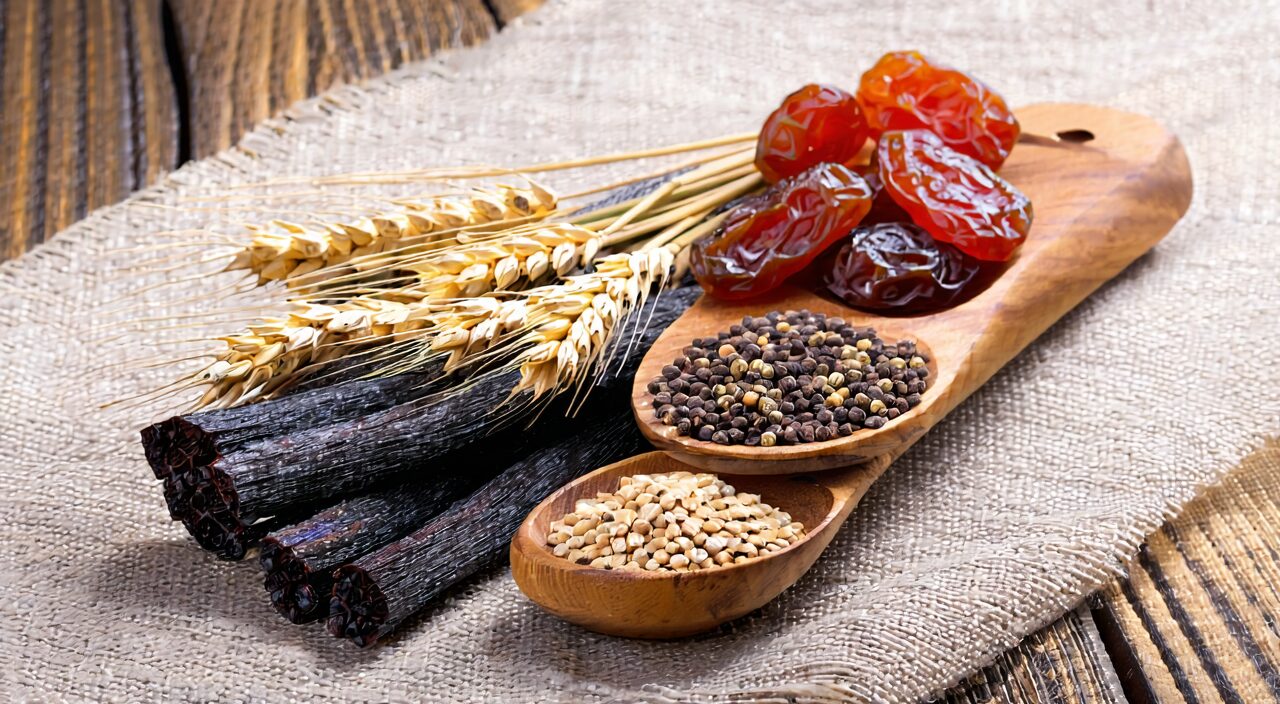
The composition of Gan Mai Da Zao Tang is very simple, yet each of the three herbs has its own emphasis, together forming a harmonious whole. The following table summarizes the composition and the traditional understanding of their roles in the formula:
| Herb | Typical Dosage Range (Traditional Reference) | Role in the Formula |
|---|---|---|
| Licorice (Gan Cao) | Around 9 g | Tonifies the spleen, boosts qi, harmonizes the middle, and moderates urgency; it can moderate the nature of other herbs and ease emotional tension. |
| Wheat (Xiao Mai) | Around 15–30 g | Nourishes the heart and relieves vexation. Traditionally believed to calm the heart spirit, it has a soothing and nurturing effect on restlessness and low mood caused by heart yin insufficiency. |
| Jujube (Da Zao) | Around 5–10 pieces | Tonifies the middle, boosts qi, nourishes blood, and calms the spirit. It harmonizes the other herbs and also assists in nourishing the heart, calming the spirit, and soothing emotions. |
It should be noted that the dosages in the table above are only general reference ranges for traditional decoctions. In actual application, adjustments must be made based on individual constitution, symptom presentation, and professional judgment; they should not be copied blindly.
Who Might Be Suitable to Consider Gan Mai Da Zao Tang

Gan Mai Da Zao Tang is not suitable for all emotional or sleep-related troubles. Traditionally, it is more oriented towards the following types of presentations characterized by “malnourishment of the heart spirit and disharmony of the middle burner.” If a person frequently experiences several of the following over a period of time, and has no significant excess heat, phlegm-fire, or history of severe emotional disorders, this formula can be seen as a point of reference, but individual assessment is still needed:
- Significant emotional fluctuation: a tendency to feel sad or want to cry, sometimes without being able to explain why, and even an aching sense of emptiness inside.
- An inner sense of irritability and restlessness, but not the kind of fury that makes one want to lash out; rather, a trivial, oppressive annoyance, often accompanied by inexplicable sighing and the feeling that taking deep breaths provides some relief.
- Unstable sleep: not particularly difficult to fall asleep, but sleep is very shallow, with many dreams. One wakes up at the slightest sound and feels unrested upon waking.
- During the day, frequent yawning, a dazed sensation, and difficulty concentrating—not necessarily sleepiness, but more of a mental fatigue.
- The above manifestations tend to appear more easily after emotional stress, or have some connection with physical fluctuations such as the menstrual cycle or perimenopause.
In such cases, Gan Mai Da Zao Tang’s approach of nourishing the heart, calming the spirit, harmonizing the middle, and moderating urgency may offer some support. However, its mode of action tends to be gentle and slow, more akin to a form of nourishment and soothing rather than a “powerful drug” that rapidly reverses mood or sleep.
Situations Requiring Caution or Avoidance
Although the herbs in Gan Mai Da Zao Tang are mild in nature, it is still a formula with a clear therapeutic bias and is not suitable for everyone. Self-administration without proper differentiation in the following situations may delay treatment or worsen discomfort:
- Severe psychological or psychiatric issues that have not been professionally evaluated, such as major depression, severe anxiety disorder, or bipolar disorder. This formula should not be relied upon alone for regulation; a psychiatric specialist must first make a clear diagnosis and formulate a treatment plan.
- Clear signs of excess heat or phlegm-fire harassing the heart, such as dry mouth and bitter taste, constipation, flushed face and red eyes, irritability and quick temper with strength, and a red tongue with thick yellow greasy coating. Gan Mai Da Zao Tang is sweet, moderating, and nourishing; using it in such cases may instead cause the pathogenic heat to linger.
- People with pronounced internal phlegm-dampness or spleen deficiency with dampness encumbrance who have symptoms such as epigastric and abdominal fullness and distension, very poor appetite, and sticky, incomplete bowel movements. The phlegm-dampness issue should be addressed first, otherwise the sweet herbs may aggravate the sensation of stagnation in the middle burner.
- Special populations such as pregnant or breastfeeding women, infants and young children, and individuals with diabetes or poorly controlled blood sugar. Because the formula contains sweet herbs like jujube, it must be used cautiously under medical guidance, carefully weighing the risks and benefits.
- Those already taking other medications, especially antidepressants, sedative-hypnotics, or hormonal drugs. Self-combination must be avoided; a professional should be informed for assessment to prevent interactions.
Furthermore, if sleep problems or emotional fluctuations progressively worsen and are accompanied by physical signs such as palpitations, chest tightness, difficulty breathing, persistent headache, severe abdominal pain, unexplained weight loss, or black stools, it is advisable to seek medical attention promptly rather than relying on self-regulation.
How Gan Mai Da Zao Tang Differs from Suan Zao Ren Tang, Gui Pi Tang, Tian Wang Bu Xin Dan, and Xiao Yao San
In discussions related to Chinese patent medicines or formulas, Gan Mai Da Zao Tang is often compared with Suan Zao Ren Tang, Gui Pi Tang, Tian Wang Bu Xin Dan, and Xiao Yao San. Although all of them may address issues such as emotions and sleep, their emphases and suitable constitutional patterns differ markedly. The following table can help quickly distinguish their respective orientations:
| Formula | Core Strategy | Emotional & Sleep Presentation | Main Associated Symptoms & Constitutional Tendency |
|---|---|---|---|
| Gan Mai Da Zao Tang | Gently moderates with sweetness, harmonizes the middle, nourishes the heart and eases urgency | Sadness with desire to cry, mental confusion, light sleep, frequent yawning | Heart-spirit malnourishment, middle burner disharmony, no obvious excess heat |
| Suan Zao Ren Tang | Nourishes blood and calms the spirit, clears heat and relieves vexation | Deficiency vexation with inability to sleep, palpitations with unease | Dry throat and mouth, liver blood deficiency, internal disturbance of deficiency heat |
| Gui Pi Tang | Boosts qi and supplements blood, fortifies the spleen and nourishes the heart | Insomnia, palpitations, forgetfulness | Poor appetite, physical fatigue, sallow complexion, dual deficiency of heart and spleen |
| Tian Wang Bu Xin Dan | Enriches yin and clears heat, nourishes the heart and calms the spirit | Palpitations and insomnia, mental fatigue and forgetfulness | Heat in the palms and soles, mouth and tongue sores, heart and kidney yin deficiency |
| Xiao Yao San | Soothes the liver and relieves constraint, nourishes blood and fortifies the spleen | Emotional depression, irritability with a tendency to anger | Distending pain in the sides, menstrual irregularities, liver constraint with blood deficiency and spleen weakness |
Difference from Suan Zao Ren Tang
Suan Zao Ren Tang also comes from the “Jin Gui Yao Lue.” Its core is nourishing blood, calming the spirit, clearing heat, and relieving vexation. It focuses on insomnia caused by liver blood deficiency with internal disturbance of deficiency heat, commonly presenting as deficiency vexation with inability to sleep, palpitations with unease, and dry throat and mouth. Gan Mai Da Zao Tang, on the other hand, is more oriented towards the “visceral agitation” state, characterized by emotional fragility, sadness with a desire to cry, and mental confusion without necessarily having obvious heat signs. In short, Suan Zao Ren Tang calms the spirit while clearing deficiency heat, whereas Gan Mai Da Zao Tang focuses on gentle sweet moderation, harmonizing the middle, and nourishing the heart to ease urgency.
Difference from Gui Pi Tang
Gui Pi Tang is a representative formula for boosting qi, supplementing blood, fortifying the spleen, and nourishing the heart. It is suitable for insomnia, palpitations, forgetfulness, poor appetite, physical fatigue, and a sallow complexion due to dual deficiency of the heart and spleen. It addresses a broader level of qi and blood deficiency than Gan Mai Da Zao Tang, particularly when there are signs of spleen qi deficiency such as poor appetite, lack of strength, and excessive rumination. Gan Mai Da Zao Tang, in contrast, does not focus on fortifying the spleen and supplementing qi, but rather on nourishing the heart, easing urgency, and calming the heart spirit.
Difference from Tian Wang Bu Xin Dan
Tian Wang Bu Xin Dan is often used for palpitations, insomnia, mental fatigue, forgetfulness, heat in the palms and soles, and mouth and tongue sores caused by heart and kidney yin deficiency with flaring of deficiency fire. Its power to enrich yin and clear heat is relatively strong. Gan Mai Da Zao Tang involves virtually no heat-clearing action and contains no herbs to supplement kidney yin. It follows a gentler, more everyday emotion-soothing approach. One tends toward nourishing yin, subduing fire, and calming the spirit; the other toward sweet moderation, nourishing the heart, and settling the spirit.
Difference from Xiao Yao San
Xiao Yao San soothes the liver, relieves constraint, nourishes blood, and fortifies the spleen. It is commonly used for emotional depression, distending pain in the sides, menstrual irregularities, headache, and dizziness due to liver constraint, blood deficiency, and spleen weakness. Xiao Yao San has a distinct liver-soothing and qi-regulating effect, targeting a state of “constraint” (yu). Gan Mai Da Zao Tang, on the other hand, is more oriented towards malnourishment of the heart and middle burner, with an emotional tone of “agitation” (zao) and “sadness” (bei) rather than “constraint” (yu) and “anger” (nu). Therefore, their entry points on the emotional level are different.
The value of understanding these differences lies not in self-prescribing, but in gaining a more detailed understanding of one’s own symptom tendencies, so as to provide more specific clues when communicating with a professional. Every formula corresponds to certain constitutional and pathomechanism prerequisites. Arbitrarily substituting or combining formulas without pattern differentiation may lead to unexpected reactions.
Summary
Gan Mai Da Zao Tang is a simple, clearly conceived heart-nourishing and spirit-calming formula. Traditionally, it is often used for conditions based on heart-spirit malnourishment and middle burner disharmony, such as restlessness, sadness with the desire to cry, and light sleep. Its core lies in “gently harmonizing the middle with sweetness,” rather than clearing heat, heavy sedation, or strong supplementation.
The population suitable for considering this formula often presents with emotional fragility, an empty and irritable feeling in the chest, a tendency to sigh and yawn, shallow sleep with pronounced fatigue, and no significant excess heat, phlegm-fire, or severe emotional disorders. Those with internal excess heat, phlegm-dampness stagnation, severe unassessed psychiatric conditions, special physiological stages, or poor blood sugar control should exercise caution.
This article is for educational reference on traditional Chinese medicine knowledge, helping readers understand the thinking behind a formula and its scope of applicability, and should not replace professional diagnosis or treatment advice. Any health-related decision should be made in consideration of individual actual circumstances, with guidance from a licensed TCM practitioner or physician.