
Who Is Gegen Qinlian Decoction Suitable For? Composition, Effects, and Precautions

Among traditional Chinese medicine formulas, some famous prescriptions specifically address complex situations where “there is a problem on the exterior and discomfort inside as well,” and Gegen Qinlian Decoction is one of them. Many overseas Chinese users wonder whether this formula is suitable for them when fever and diarrhea occur at the same time. From the perspective of traditional Chinese medicine, this article organizes the composition of Gegen Qinlian Decoction, the patterns for which it is commonly used, as well as unsuitable conditions and contraindications requiring special attention. It also compares it with several easily confused formulas such as Gegen Decoction and Huoxiang Zhengqi Powder, helping everyone establish a clear and restrained understanding.
Understanding Gegen Qinlian Decoction from “Exterior Pathogen Unresolved, Interior Heat Diarrhea”
Gegen Qinlian Decoction was first recorded in Zhang Zhongjing’s Treatise on Cold Damage and is traditionally regarded as a formula that releases the exterior and clears interior heat.
“Exterior pathogen unresolved” refers to the presence of external pathogenic factors at the body’s surface, manifesting as mild fever, aversion to wind, or inhibited sweating. “Interior heat” mainly indicates internal damp-heat, especially in the large intestine, resulting in diarrhea, foul-smelling stools, and a burning sensation at the anus.
In understanding such conditions, Chinese medicine does not simply treat fever and diarrhea separately but views the body as a whole. The idea behind Gegen Qinlian Decoction is to use Gegen (Pueraria) to disperse pathogens from the exterior and raise clear yang to relieve exterior symptoms and diarrhea, while using Huangqin (Scutellaria) and Huanglian (Coptis) to clear interior heat, dry dampness, and stop diarrhea. This approach of “treating both the exterior and interior simultaneously” is exactly what distinguishes it most from other antidiarrheal or exterior-releasing formulas.
Composition and Formula Analysis of Gegen Qinlian Decoction
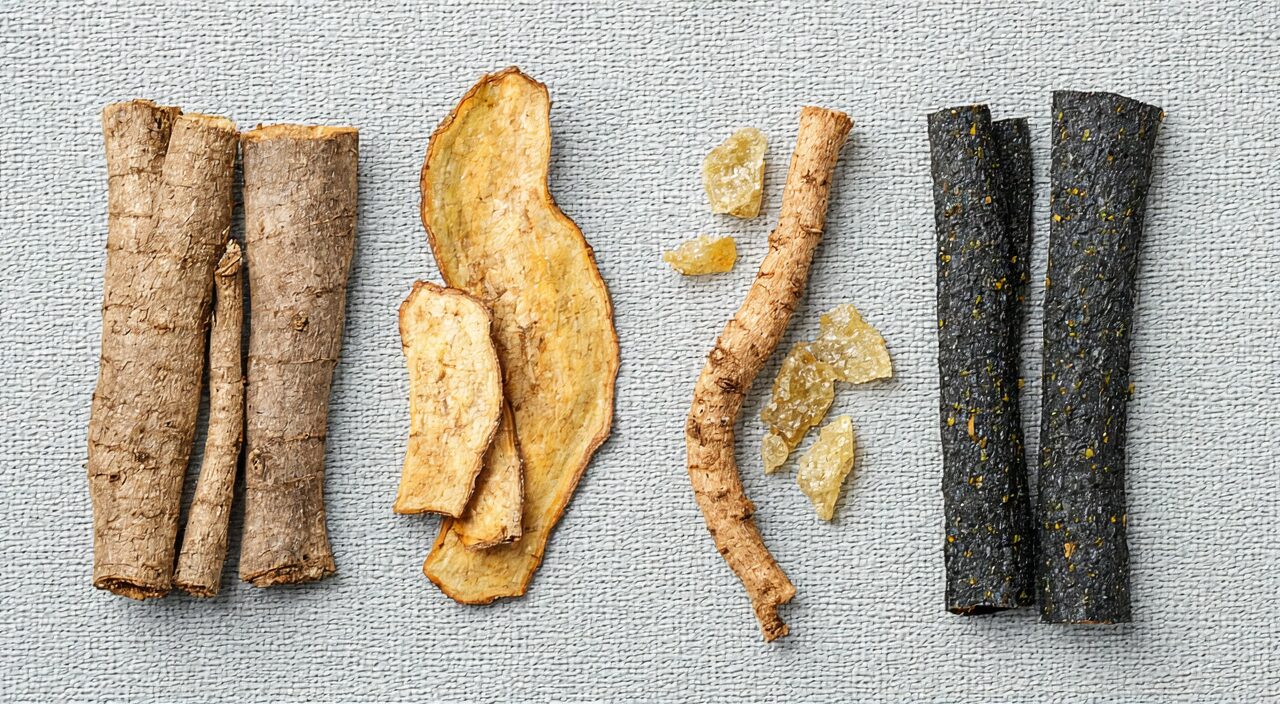
The composition of Gegen Qinlian Decoction is very concise, with only four herbs, yet each has its role and they work together. The traditional understanding of the combination is roughly as follows:
| Herb | Traditional Action | Role in the Formula |
|---|---|---|
| Gegen (Pueraria) | Raises the clear yang of the spleen and stomach, releases the muscles and reduces fever | Addresses both fever caused by exterior pathogens and raises the clear and descends the turbid to help improve diarrhea |
| Huangqin (Scutellaria) | Clears heat and dries dampness, drains fire and resolves toxin | Mainly helps clear heat from the upper body and large intestine, assisting in eliminating interior heat |
| Huanglian (Coptis) | Clears heat and dries dampness, drains fire and resolves toxin | Its heavy nature can strengthen the intestines and stop diarrhea; it targets damp-heat in the middle jiao and large intestine to enhance antidiarrheal effect |
| Zhignacao (Prepared Licorice) | Tonifies the spleen and harmonizes the center, moderates the actions of other herbs | Eases the irritation of bitter-cold herbs on the stomach and intestines, protecting stomach qi |
As can be seen from this simple table, the entire formula primarily clears heat and dries dampness while also taking into account exterior release and harmonizing the center. This structure also determines that it is not suitable for all types of diarrhea.
Conditions for Which It Is Traditionally Used

Based on the above combination logic, traditional Chinese medicine practitioners, when using Gegen Qinlian Decoction, usually pay attention to the following series of manifestations. These manifestations can serve as an initial direction for understanding but do not imply that self-diagnosis is appropriate.
Common suitable patterns may include:
- Fever, though not necessarily very high, possibly accompanied by slight aversion to wind or inhibited sweating
- Diarrhea, with stools that are mostly loose and foul-smelling, possibly dark yellow or containing mucus
- A burning sensation at the anus during or after defecation
- Thirst with a desire to drink water, and urine that is somewhat yellow
- Tongue coating mostly yellow and greasy, and the tongue body somewhat red
When these manifestations are combined, Chinese medicine often categorizes them as “damp-heat diarrhea” or “exterior pathogen with interior heat.” If it is simply diarrhea after catching a chill, or long-term unformed stools without any heat signs, it usually does not fall into this direction.
It must be particularly noted that the above descriptions are based only on traditional experience. Suitability still needs to be assessed in combination with individual constitution, symptom presentation, and professional judgment. One should not apply a formula based solely on a few symptoms.
Unsuitable Individuals and Conditions
Gegen Qinlian Decoction is generally bitter and cold, and it is often inappropriate in the following situations, or may even aggravate discomfort:
- Cold-damp diarrhea: Stools are clear and watery, without an obvious foul smell; the abdomen prefers warmth and pressure; tongue coating is white and greasy or white and slippery. This type requires warming and transforming cold-damp, which is completely opposite to the direction of Gegen Qinlian Decoction.
- Spleen-deficiency loose stools: Long-term unformed stools, or stools that are dry at first and then loose, but without a distinct anal burning sensation; instead, there is easy fatigue and poor appetite. Such problems need more spleen-strengthening and qi-tonifying rather than clearing heat.
- Dehydration and severe conditions: If diarrhea is frequent and there are signs of dehydration such as dry mouth, sunken eyes, very little urine, and listlessness, or if accompanied by persistent high fever, severe abdominal pain, bloody stools, or black stools, seek medical attention immediately and do not consider any formula on your own.
- Special populations: Pregnant women, infants and young children, the elderly and frail, and those who are constitutionally deficient and cold in the spleen and stomach should not apply this formula on their own without professional diagnosis. Chinese medicine generally emphasizes stopping once the illness is relieved; bitter-cold herbs should not be taken for a long time, and the composition needs to be adjusted according to constitution.
Furthermore, if symptoms do not improve after using a formula with a similar direction, or if reactions such as nausea or worsening abdominal pain occur, one should stop and reassess the direction, and seek medical help if necessary.
Differences Between Gegen Qinlian Decoction and Several Similar Formulas
Many overseas Chinese users are interested in the differences between Gegen Qinlian Decoction and other common formulas, especially Gegen Decoction (which also contains Pueraria), as well as Huoxiang Zhengqi Powder, Huanglian Jiedu Decoction, and Shenling Baizhu Powder. Below is a brief comparison based on traditional indication directions to help clarify their respective emphases:
- Gegen Decoction vs Gegen Qinlian Decoction: Gegen Decoction mainly promotes sweating to release the exterior, raises fluids, and relaxes the sinews. It is commonly used for exterior wind-cold excess patterns with no sweating, aversion to wind, and stiffness/discomfort in the neck, without pronounced interior heat with diarrhea. Gegen Qinlian Decoction, on the other hand, is used when the exterior pathogen is unresolved and interior heat diarrhea has appeared. In short, one emphasizes releasing the exterior and relaxing the sinews, while the other emphasizes releasing the exterior, clearing interior heat, and stopping diarrhea.
- Huoxiang Zhengqi Powder vs Gegen Qinlian Decoction: Huoxiang Zhengqi Powder is commonly used for exterior wind-cold and internal dampness stagnation, leaning toward transforming dampness, releasing the exterior, regulating qi, and harmonizing the center. It is mostly used for cold-damp type diarrhea or vomiting, often accompanied by head heaviness, chest oppression, nausea, and clear watery stools. This is very different from the damp-heat diarrhea with anal burning and thirst seen in Gegen Qinlian Decoction.
- Huanglian Jiedu Decoction vs Gegen Qinlian Decoction: Huanglian Jiedu Decoction purely focuses on clearing heat, draining fire, and resolving toxicity, targeting fire toxin and exuberant heat in the triple burner, such as high fever with irritability, dry mouth and throat, and bleeding due to heat. It does not have an obvious exterior pattern and is not specifically designed for diarrhea. Gegen Qinlian Decoction addresses both the exterior and interior, with a focus on damp-heat diarrhea.
- Shenling Baizhu Powder vs Gegen Qinlian Decoction: Shenling Baizhu Powder is a formula that strengthens the spleen, benefits qi, percolates dampness, and stops diarrhea. It is suitable for spleen-deficiency leading to loose stools, often accompanied by fatigue, poor appetite, and abdominal distension without heat signs. This is completely opposite to the excess and heat type diarrhea treated by Gegen Qinlian Decoction – one tends to tonify spleen deficiency, while the other tends to clear excess heat.
These comparisons only represent rough divisions in traditional application. Actual pattern differentiation is far more complex than relying on a single symptom. It is recommended to use these formulas as an orientation for understanding, not as a direct basis for choosing a treatment.
Summary
Gegen Qinlian Decoction, in Chinese medicine classification, is a formula that releases the exterior, clears interior heat, and stops diarrhea. It is often used in situations where the exterior pathogen is not yet resolved and interior heat with diarrhea has appeared. Its composition is simple, but its cold nature is clear, so it is only relevant for the direction of damp-heat type diarrhea. Cold-damp, spleen deficiency, and dehydration conditions are not suitable.
For chronic, recurrent, or symptomatically complex diarrhea, especially when accompanied by pronounced fever, severe abdominal pain, dehydration, black stools, weight loss, etc., one should not self-apply any formula but should seek professional medical help in a timely manner. This article provides only popular science references from the perspective of traditional experience and cannot replace professional diagnosis or personalized health advice.