
Who Is Liang Ge San Suitable For? Composition, Benefits, and Contraindications

Many overseas Chinese suffering from recurrent mouth ulcers, dry and sore throat, red and swollen gums, accompanied by constipation and irritability, may think of the name “Liang Ge San.” It is a traditional heat-clearing and fire-purging formula, but not all cases of “heat” are applicable.
This article, from the perspective of Chinese herbal formula theory, sorts out the design concept, composition, common applicable directions, usage contraindications of Liang Ge San, as well as its differences from Huang Lian Jie Du Tang, Da Cheng Qi Tang, Dao Chi San, Qing Wei San, and others, to help you establish a more comprehensive reference framework.
Understanding the Design Concept of Liang Ge San from “Clearing the Upper and Purging the Lower”
In traditional Chinese medicine, when dealing with certain fire-heat syndromes, it is not simply about “clearing heat”; more attention is paid to the origin and pathway of the fire-heat. Liang Ge San originates from Tai Ping Hui Min He Ji Ju Fang, and its formulation concept is often summarized as “clearing the upper and purging the lower, using purging to replace clearing.”
“Ge” refers to the diaphragm, which connects upward to the throat, mouth, and tongue, and downward to the gastrointestinal tract. When fire-heat is congested in the upper and middle jiao:
- Fire-heat flaring upward can easily cause mouth and tongue sores, sore and swollen throat, flushed face and red eyes, irritability and fever;
- Heat accumulation in the middle jiao and obstruction of bowel qi can lead to constipation and scanty dark urine.
If only the upper jiao is cleared, the fire-heat may remain stagnant and not dissipate; if only purging is used, the upward-flaming tendency may not truly be resolved.
The approach of Liang Ge San is to simultaneously use herbs like Forsythia, Gardenia, Scutellaria, and Peppermint to clear and disperse heat from the upper and middle jiao, while using Rhubarb and Mirabilite to unblock the bowels and purge heat, guiding the fire-heat pathogen to be expelled through the stool—just like lifting the lid while clearing the passage below.
This concept of resolving both exterior and interior is precisely the key distinction of Liang Ge San from formulas that solely clear heat or solely purge.
Common Composition of Liang Ge San and the Direction of Action of Each Herb
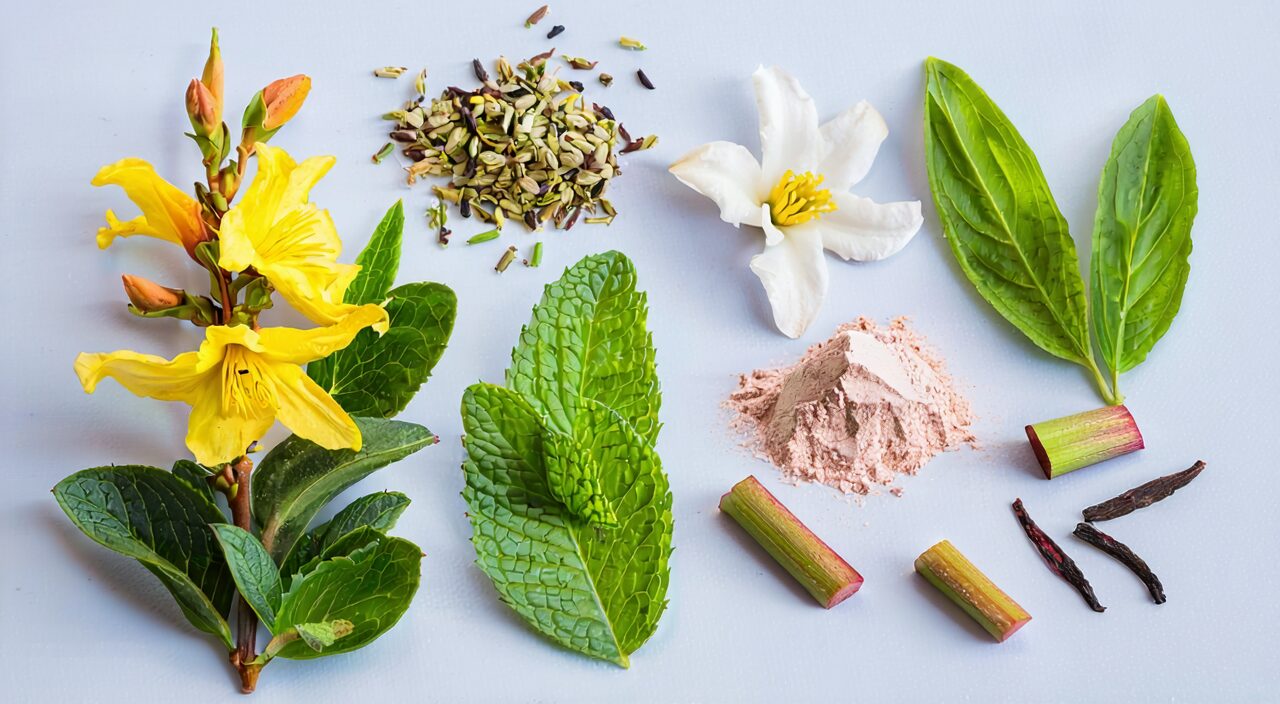
The common composition of traditional Liang Ge San and the general direction of action of each herb can be referenced in the table below. Specific dosages need to be adjusted by practitioners based on actual syndrome presentations and should not be self-applied.
| Herb | Traditional Direction of Action in the Formula |
|---|---|
| Forsythia (Lian Qiao) | Clears heat and resolves toxicity, vents and disperses stagnant heat in the upper jiao |
| Gardenia (Zhi Zi) | Clears and drains fire from all three jiao, guides heat downward |
| Scutellaria (Huang Qin) | Clears and drains lung heat in the upper jiao, dries dampness and purges fire |
| Peppermint (Bo He) | Disperses wind-heat, clears and benefits the throat, head, and eyes |
| Rhubarb (Da Huang) | Drains downward to relieve accumulation, unblocks the bowels and purges heat |
| Mirabilite (Mang Xiao) | Softens hardness and moistens dryness, assists Rhubarb in purging heat and promoting bowel movements |
| Licorice (Gan Cao) | Harmonizes all herbs, protects the stomach and soothes the middle jiao |
| Lophatherum (Dan Zhu Ye) | Clears the heart and relieves irritability, guides heat out through urination |
Some versions may add honey or a small amount of white honey according to circumstances to moderate the strong and vigorous nature of Rhubarb and Mirabilite. The overall combination prevents excessive bitter cold from damaging the stomach while synergistically acting on the upper, middle, and lower jiao to form a three-dimensional clearing and draining effect.
Several Situations Where the Approach of Liang Ge San May Be Considered

From the perspective of traditional pattern differentiation, Liang Ge San is more often considered for excess heat syndromes characterized by intense pathogenic heat in the upper and middle jiao and heat accumulation in the diaphragm.
Common manifestations usually appear simultaneously, and judgment should not be based on a single symptom alone:
- Mouth and tongue sores
- Swollen and painful gums
- Red, swollen, and sore throat
- Flushed face and red eyes
- Irritability, fever, and chest and diaphragm heat
- Accompanied by dry and difficult bowel movements, scanty and yellow urine
It is particularly important to note that Liang Ge San targets situations of excess heat congestion. If mouth ulcers recur but with mild pain, a pale complexion, aversion to cold, and loose stools, it likely belongs to upward flaming of deficient fire or spleen-stomach deficiency cold, and the approach of Liang Ge San is not suitable.
Therefore, whether it is appropriate to consider this direction must be judged by a professional based on tongue manifestation, pulse condition, and overall constitution.
Contraindications and Populations Who Are Not Suitable
The following populations or situations are generally not recommended to follow the direction of Liang Ge San on their own, or need to be approached with extreme caution:
- Spleen-stomach deficiency cold, usually prone to diarrhea, unformed stool, cold abdomen;
- Deficiency-type constipation caused by qi deficiency or yang deficiency failing to promote movement (e.g., difficulty in defecation, stool not necessarily dry and hard, often accompanied by fatigue);
- Pregnant and breastfeeding women;
- Elderly, frail, or those with long-term illness and weak constitution;
- People with recurrent and lingering oral or throat symptoms but without obvious heat signs and constipation.
Additionally, if symptoms persist without relief, repeatedly worsen, or if persistent high fever, severe abdominal pain, chest pain, palpitations, or blood in the stool occur, one should not rely solely on herbal formula regulation and should seek medical help promptly.
Key Differences Between Liang Ge San and Formulas like Huang Lian Jie Du Tang
When encountering issues related to “fire-heat,” readers often wish to distinguish the respective focuses of formulas like Liang Ge San, Huang Lian Jie Du Tang, Da Cheng Qi Tang, Dao Chi San, and Qing Wei San. Below is a brief comparison from the perspective of traditional pattern differentiation:
- Liang Ge San vs. Huang Lian Jie Du Tang
Huang Lian Jie Du Tang uses the intensely bitter and cold herbs Coptis, Scutellaria, Phellodendron, and Gardenia to directly suppress fire toxins in all three jiao, emphasizing clearing heat, purging fire, and eliminating toxins without a bowel-clearing design. Liang Ge San, on the other hand, clears the upper and purges the lower, providing an exit route for fire-heat through the stool, making it more likely to be considered for excess heat syndromes with concurrent bowel qi obstruction.
- Liang Ge San vs. Da Cheng Qi Tang
Da Cheng Qi Tang is a representative formula for drastically purging heat accumulation, targeting Yangming bowel excess with severe fullness, distention, firmness, and heaviness, and its purgative force is intense. Liang Ge San’s purgative action is relatively milder and simultaneously clears and disperses heat from the upper jiao, with the disease location more biased above the diaphragm.
- Liang Ge San vs. Dao Chi San
Dao Chi San clears the heart and promotes urination, mainly used for mouth sores and scanty dark painful urination caused by heart channel fire-heat moving downward to the small intestine; it is generally not used for constipation. Liang Ge San focuses equally on clearing the upper and purging the lower, with less emphasis on urinary abnormalities.
- Liang Ge San vs. Qing Wei San
Qing Wei San clears the stomach and cools the blood, commonly used for stomach fire toothache, bleeding gums, and foul breath. Although it also involves oral and dental issues, it does not address the diaphragm and intestines to the same extent as Liang Ge San, and the “upper heat and lower stagnation” characteristic of addressing both the interior and exterior is not prominent.
Understanding these differences helps avoid simply applying a formula at the first sign of mouth sores or constipation, but to grasp the key pathogenesis from a holistic perspective.
Summary
Liang Ge San is a traditional formula with actions of clearing the upper, purging the lower, clearing fire, and promoting bowel movements. Its formulation concept focuses on situations where fire-heat exists in the upper and middle jiao simultaneously with obstructed bowel qi.
For cases involving oral, tongue, and throat excess heat manifestations combined with constipation and feverishness, it can serve as a direction to understand. However, whether it can be specifically referenced and how it should be combined must be carefully judged by a TCM practitioner based on the four diagnostic methods.
Special populations such as those with spleen-stomach deficiency cold, deficiency-type constipation, and pregnant women are generally not suitable to use Liang Ge San. It differs from formulas like Huang Lian Jie Du Tang and Da Cheng Qi Tang in disease location, pathogenesis, and herbal composition, and should not be simply substituted.
This article is for TCM knowledge popularization and reference only and cannot replace professional diagnosis or treatment advice. If you have related discomfort, it is recommended to first consult a qualified TCM practitioner or medical institution, and after a clear diagnosis, choose the direction of regulation suitable for your individual situation.