
Who Is Ling Gan Wu Wei Jiang Xin Tang Suitable For? Composition, Benefits, and Contraindications

If you tend to develop a cough with clear, watery white phlegm after exposure to cold or in autumn/winter, sometimes accompanied by chest tightness or even a cold back, many people start looking into classical Chinese herbal formulas for support. Ling Gan Wu Wei Jiang Xin Tang is a formula often brought up in exactly this scenario. It is not as widely known as some common cold formulas, but it has a clear application strategy for treating “cold-phlegm cough.”
This article explains, from the perspective of traditional Chinese medicine, the composition, core actions, the type of people it tends to suit, and common situations where it may be misapplied. It also compares it with several formulas that sound similar in function, to provide a more complete framework for understanding different choices.
Composition of Ling Gan Wu Wei Jiang Xin Tang and the Role of Each Herb
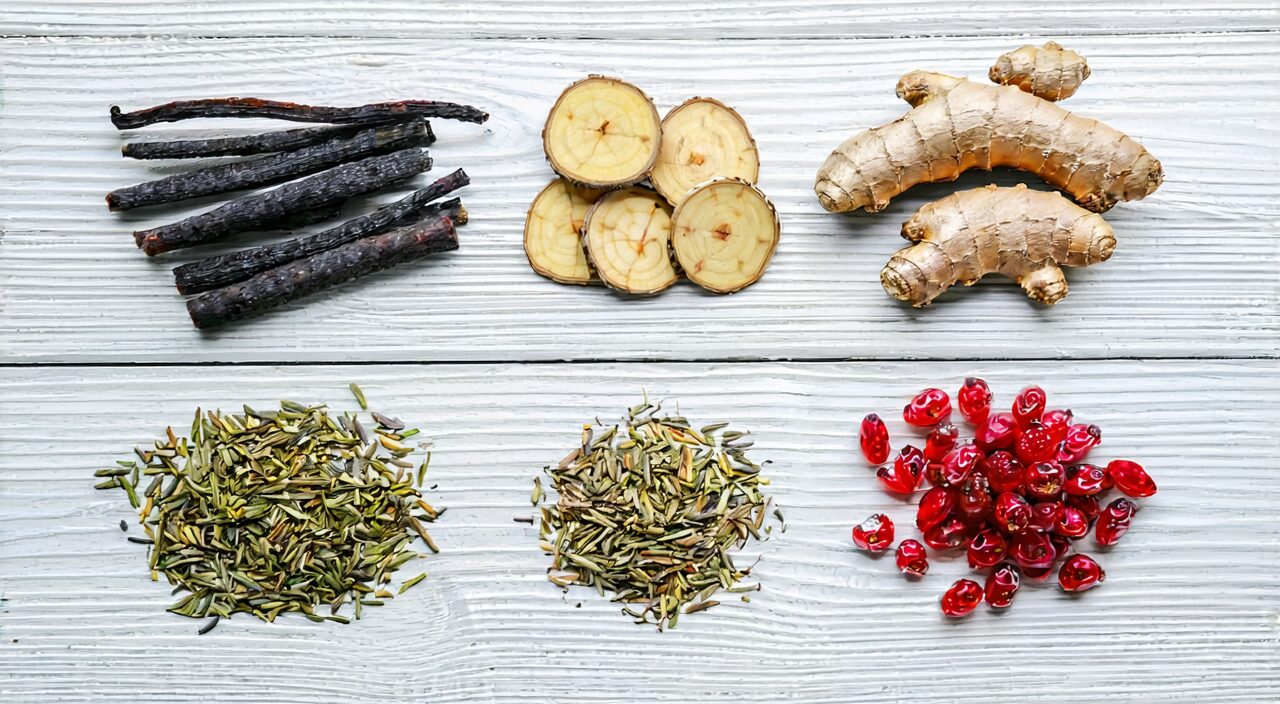
Ling Gan Wu Wei Jiang Xin Tang originates from the Synopsis of the Golden Chamber (Jin Gui Yao Lue). The original formula consists of five herbs: Poria (Fu Ling), Licorice (Gan Cao), Dried Ginger (Gan Jiang), Asarum (Xi Xin), and Schisandra (Wu Wei Zi). Unlike some exterior-releasing formulas, this formula focuses primarily on “warming the lungs and transforming thin mucus” – that is, warming the lung qi and resolving retained cold-phlegm.
Below is its basic composition and the traditional role of each herb within the formula:
| Herb | Common Dosage Reference Range | Traditional Functional Direction in This Formula |
|---|---|---|
| Poria (Fu Ling) | 12–15 g | Strengthens the spleen and percolates dampness, guiding already formed thin mucus downward |
| Licorice (Gan Cao) | 6–9 g | Harmonizes the middle burner, supplements qi, and moderates the actions of the other herbs |
| Dried Ginger (Gan Jiang) | 9–12 g | Warms the lungs and disperses cold, warming and transforming cold-phlegm |
| Asarum (Xi Xin) | 3–6 g | Warms the lungs, transforms thin mucus, and disseminates lung qi |
| Schisandra (Wu Wei Zi) | 6–9 g | Astringes lung qi to prevent excessive dissipation from warming and dispersing |
From a combination standpoint, Dried Ginger and Asarum form the core pair for warming and dispersing cold-phlegm. Poria provides an exit route for dampness, while Schisandra exerts an astringent action to prevent excessive scattering of lung qi. Licorice plays a buffering and harmonizing role in the middle. This structure of “dispersing with astringency, warming with percolation” is the foundation for its action on patterns where cold-phlegm lies latent in the lungs.
Traditional Functional Approach of Ling Gan Wu Wei Jiang Xin Tang
In traditional Chinese medicine, this formula is often understood from the perspective of “cold-phlegm lodging in the lungs.” The term cold-phlegm can be simply understood as insufficient yang qi in the body causing slowed fluid metabolism, leading to the formation of clear, watery phlegm in the lungs. In such cases, merely suppressing cough often yields only temporary results; one needs to warm and transform the cold-phlegm and restore the lung’s regulating function.
Therefore, the traditional actions of Ling Gan Wu Wei Jiang Xin Tang center on warming the lungs to transform thin mucus, resolving phlegm, and stopping cough. It is not a “broad-spectrum” formula for all types of cough, but rather has relatively clear cold-phlegm indicators. In many cases, it is used during the chronic cough regulation stage after an external wind-cold invasion has been resolved on the surface, yet cold-phlegm remains retained in the lungs.
It is important to emphasize that in traditional usage such formulas are selected based on pattern differentiation. Whether it is suitable must be determined by comprehensively considering individual constitution, symptom presentation, and professional advice; it cannot be simply applied based on the name of a disease.
Potentially Suitable Population: Manifestation Characteristics of Cold-Phlegm Cough

If we imagine Ling Gan Wu Wei Jiang Xin Tang as a regulation tool, its “keyhole” is cold-phlegm lodged in the lungs. The following manifestations are often viewed as characteristics relatively well-matched with the formula’s approach and can serve as points of reference:
- Cough with expectoration of white, clear-watery or frothy phlegm
- Cough worsens upon cold exposure or consuming cold drinks, and eases with warmth
- Accompanied by chest oppression, a feeling of stuffiness in the epigastric region, and sometimes a sensation of difficult breathing
- Aversion to cold, cold sensation in the back, or cold hands and feet
- Tongue body tends to be pale with a white, slippery or white, greasy coating
- No obvious heat signs such as pronounced fever, red swollen sore throat
When several of these features appear simultaneously, with chronic cough and profuse clear watery phlegm as the primary complaint, traditional Chinese medicine practitioners may consider Ling Gan Wu Wei Jiang Xin Tang as one of the reference directions. However, the severity and presence of accompanying patterns vary greatly from person to person, so judgment must be made in light of the actual situation.
Situations Where It May Not Be Suitable
Not all cough or phlegm conditions are suitable for this approach. The following types of presentations are generally considered incongruent with the direction of Ling Gan Wu Wei Jiang Xin Tang and may even worsen discomfort:
- Phlegm-heat cough: Yellow, sticky phlegm; chest tightness with feverish sensation; dry mouth and tongue; red tongue with yellow coating
- Yin deficiency dry cough: Dry cough with little phlegm, hoarse voice, dry throat and mouth, heat sensation in palms and soles
- Wind-heat invading the lungs: Cough with obvious sore throat, fever, red tip of the tongue, thirst with preference for cold drinks
- Special physiological periods: Such as pregnancy, breastfeeding, or extremely weak constitution; must be evaluated under strict professional guidance
In addition, if a cough persists without resolution, or is accompanied by chest pain, breathing difficulty, blood-streaked sputum, unexplained weight loss, etc., it is advisable to seek prompt medical evaluation and not attempt to use formulas on your own.
Distinctions from Xiao Qing Long Tang, Er Chen Tang, Ling Gui Zhu Gan Tang, and Su Zi Jiang Qi Tang
When exploring directions around “cold-phlegm” and “phlegm-dampness,” several formulas are often compared side by side. Although they all involve phlegm-rheum, their emphases and the level of herb action are distinctly different.
Ling Gan Wu Wei Jiang Xin Tang vs. Xiao Qing Long Tang
Xiao Qing Long Tang is also a commonly used formula for treating cold-phlegm, but its scope of action is more “dual exterior-interior.” Xiao Qing Long Tang not only warms the lungs to transform thin mucus but also has a stronger function of releasing the exterior and dispersing cold. It is often used when external cold and internal phlegm coexist, with signs such as chills and fever still present. Ling Gan Wu Wei Jiang Xin Tang, by contrast, is more targeted at the stage after exterior symptoms have resolved but cold-phlegm still remains in the lungs, focusing on warming the lungs and transforming thin mucus with only weak exterior-releasing power.
Ling Gan Wu Wei Jiang Xin Tang vs. Er Chen Tang
Er Chen Tang is based on Pinellia and Tangerine Peel, emphasizing drying dampness and transforming phlegm, regulating qi and harmonizing the middle. It is commonly used for damp-phlegm cough with easily expectorated profuse phlegm, and a feeling of fullness in the chest and epigastrium. The phlegm in Er Chen Tang tends toward “damp-phlegm,” where the cold-heat attribute is not as pronounced; Ling Gan Wu Wei Jiang Xin Tang, on the other hand, strongly emphasizes “cold-phlegm,” with the warming nature of Dried Ginger and Asarum standing out, targeting a more cold-predominant, clear watery phlegm.
Ling Gan Wu Wei Jiang Xin Tang vs. Ling Gui Zhu Gan Tang
Ling Gui Zhu Gan Tang has Poria and Cinnamon Twig as its core, mainly aiming to warm yang to strengthen the spleen, promote diuresis, and transform thin mucus. It is commonly used for middle-yang deficiency causing internal water-rheum with symptoms like distention and fullness in the chest and hypochondrium, dizziness, and palpitations. Its disease location is more in the middle burner, and the site of fluid retention is broader. Ling Gan Wu Wei Jiang Xin Tang focuses on the lungs, with cough and watery phlegm as typical indicators. Thus, although both involve “warming transformation,” one emphasizes strengthening the spleen and promoting urination, while the other emphasizes warming the lungs.
Ling Gan Wu Wei Jiang Xin Tang vs. Su Zi Jiang Qi Tang
Su Zi Jiang Qi Tang’s direction is to direct qi downward, relieve panting, warm and transform phlegm-dampness. It is often used for upper excess and lower deficiency patterns with profuse phlegm congestion, wheezing and cough. Its characteristic is “taking the downward direction as priority,” suitable for people with pronounced rebellious lung qi accompanied by a sensation of wheezing. Ling Gan Wu Wei Jiang Xin Tang leans more toward warming and transforming cold-phlegm, and is a better fit for those who present primarily with cough and clear watery phlegm without marked wheezing.
Understanding these differences can help identify a regulation approach that may correspond to one’s own situation among the many formulas with similar-sounding names. Of course, formula selection requires comprehensive assessment and is not a simple matter of matching symptoms one by one.
Summary
Ling Gan Wu Wei Jiang Xin Tang is a classical formula centered on “cold-phlegm lodging in the lungs.” Traditionally, it is used for people whose manifestations—cough, clear watery phlegm, chest tightness, aversion to cold—align relatively well with a cold-phlegm pattern. Its combination strategy focuses on warming the lungs to transform thin mucus, resolve phlegm, and stop cough, which differs conceptually from many modern over-the-counter cough products.
At the same time, this formula is not a universal cough remedy. For cough types such as phlegm-heat, yin deficiency, or wind-heat, it not only may fail to provide beneficial help but could even aggravate discomfort. Compared with formulas like Xiao Qing Long Tang, Er Chen Tang, Ling Gui Zhu Gan Tang, and Su Zi Jiang Qi Tang, each has its own focus, and understanding the differences can lead to a more rational choice.
This article is for educational reference only and cannot replace professional diagnosis or treatment advice. If a cough recurs without resolution, or is accompanied by more complex bodily sensations, please be sure to consult a Chinese medicine practitioner or relevant professional for individualized assessment based on your specific constitution and symptoms.