
What Is Pao Jiang? Medicinal Part, Identification Methods, and Common Formulas
Pao Jiang is a Chinese herbal medicine obtained by standardized processing of dried ginger (Gan Jiang). Many people, when they first hear of Pao Jiang, confuse it with the fresh ginger sold in grocery stores or the common dried ginger used in herbal prescriptions. In fact, the origin, processing method, and application of these three are significantly different. Simply put, Pao Jiang is made by further processing dried ginger. Its surface appears charred black or dark brown, while the interior remains brownish, and its smell changes from the pungent spiciness of dried ginger to a roasted aroma. The following will give you a comprehensive understanding of Pao Jiang from its appearance identification, medicinal part, traditional Chinese medicine understanding, modern research, differences from Gan Jiang and Jiang Tan, common formulas, and precautions for use.
What Does Pao Jiang Look Like? How to Identify It?
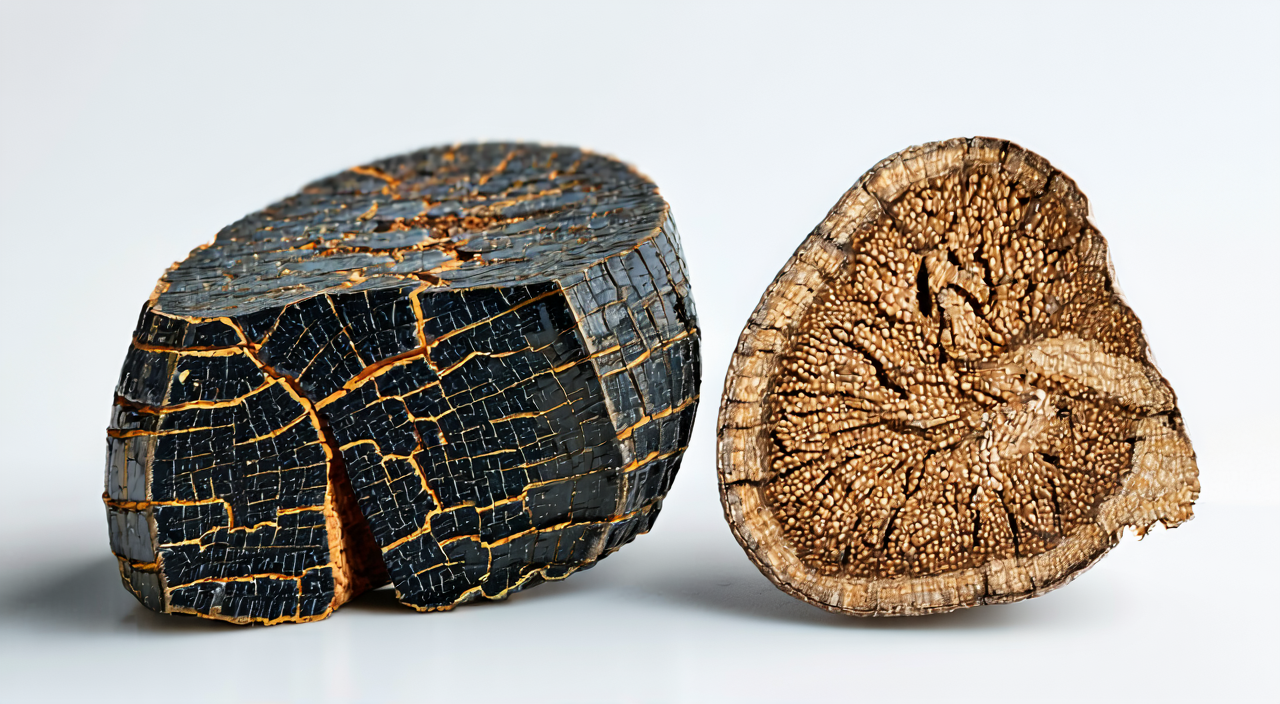
The appearance of Pao Jiang is quite distinctive. As long as you grasp a few key points, you can distinguish it from dried ginger and dried fresh ginger slices.
- Shape: Mostly irregular slice-like or thick pieces, with cracks often appearing along the edges upon shrinkage. The texture is light and loose, and it breaks easily when pulled apart by hand, with an uneven cross-section.
- Surface color: The outer skin is mostly dark brown or charred black, sometimes with residual yellowish-brown traces of dried ginger. The cut or broken surface is brownish or dark brown, noticeably darker than dried ginger.
- Texture and feel: It feels light and spongy in the hand, unlike the firm and dense texture of dried ginger. The cross-section shows a fine granular feel.
- Smell and taste: It has a characteristic roasted-like aroma, with a slight hint of spiciness, different from the strong pungency of dried ginger. Upon tasting, the pungent sensation is relatively mild, often with a subtle bitterness and roasted note.
When purchasing or identifying, check whether the surface of Pao Jiang shows large areas of carbonization or complete charring, which may indicate excessive processing. Traditionally, Pao Jiang of good quality is considered to have a charred black surface, brown interior, and a light, crisp texture. The process of identifying Pao Jiang is also a way to understand the concept of “preserving nature” in processing—allowing the medicinal substance to retain some of its original properties while acquiring new therapeutic directions.
What Is the Medicinal Part of Pao Jiang?
The medicinal part of Pao Jiang is the processed product of the dried rhizome of Zingiber officinale (ginger). Specifically, fresh ginger rhizomes are first washed, sliced or cut into pieces, and then sun-dried or dried at low temperature to make dried ginger (Gan Jiang). Then, the dried ginger is processed according to specified methods, either by stir-frying with sand or directly dry-frying until the surface is charred black and the interior is brownish. After sieving out the sand or removing it directly, Pao Jiang is obtained. Therefore, Pao Jiang is not made by directly slicing and charring fresh ginger; it undergoes a two-step transformation: from fresh ginger to dried ginger, and then from dried ginger to Pao Jiang. This change in processing makes Pao Jiang milder in its traditional Chinese medicine properties, shifting from the acrid, hot, and dry nature of Gan Jiang to a more moderate effect, biased toward warming the channels and stopping bleeding and warming the middle and stopping pain.
How Does Traditional Chinese Medicine Understand Pao Jiang?
In traditional Chinese medicine theory, the properties and channel tropism of Pao Jiang are often summarized as bitter, astringent, and warm, entering the Spleen and Liver channels. Compared with Gan Jiang, Pao Jiang has reduced acrid dispersing nature, while its tendency to warm and retain, and to secure and astringe becomes more prominent.
- Warming the channels and stopping bleeding: This is the most commonly mentioned traditional therapeutic direction for Pao Jiang. For bleeding due to deficiency cold, such as some cases of excessive menstrual bleeding with pale blood color, accompanied by a cold sensation in the lower abdomen or aversion to cold and cold limbs, the traditional approach is to combine Pao Jiang with other warming interior and astringent herbs, aiming to warm the channels and secure the blood rather than simply stopping bleeding. It should be noted that this is only suitable for deficiency cold patterns; it is completely unsuitable for excess heat bleeding.
- Warming the middle and stopping pain: Pao Jiang can also be used for abdominal cold pain, vomiting, and diarrhea due to deficiency cold of the middle burner. Because of the processing, its dry and harsh nature is reduced, making it less irritating to the stomach compared with dried ginger. For some cases of stomach pain due to deficiency cold or abdominal pain after exposure to cold, Pao Jiang can be seen in formulas. However, whether it is suitable needs to be determined based on tongue appearance, pulse, and other symptoms, and cannot be generalized.
In addition, some formulas that warm the interior may choose to replace Gan Jiang with Pao Jiang, under accurate syndrome differentiation, in order to reduce the reaction of dryness and heat.
What Does Modern Research Say About Pao Jiang?
Modern studies have found that during the processing of Pao Jiang, gingerol-related components decompose, transform, or volatilize, resulting in a marked decrease in content, while some volatile components also decrease with heating. This partly explains why Pao Jiang has reduced pungency and lower irritancy. At the same time, the roasted aroma substances generated after processing are also related to reactions like the Maillard reaction. However, this does not mean “Pao Jiang is non-irritating,” nor can it be simply understood as “safer.” For individuals with sensitive mucous membranes, large doses may still cause stomach discomfort. Furthermore, pharmacological research related to the hemostatic effects of Pao Jiang is also underway, but most are still in the experimental stage and are far from drawing conclusions to replace clinical use. Therefore, one should not judge efficacy or replace conventional medical treatment based solely on preliminary modern research.
What Are the Differences Between Pao Jiang, Gan Jiang, and Jiang Tan?
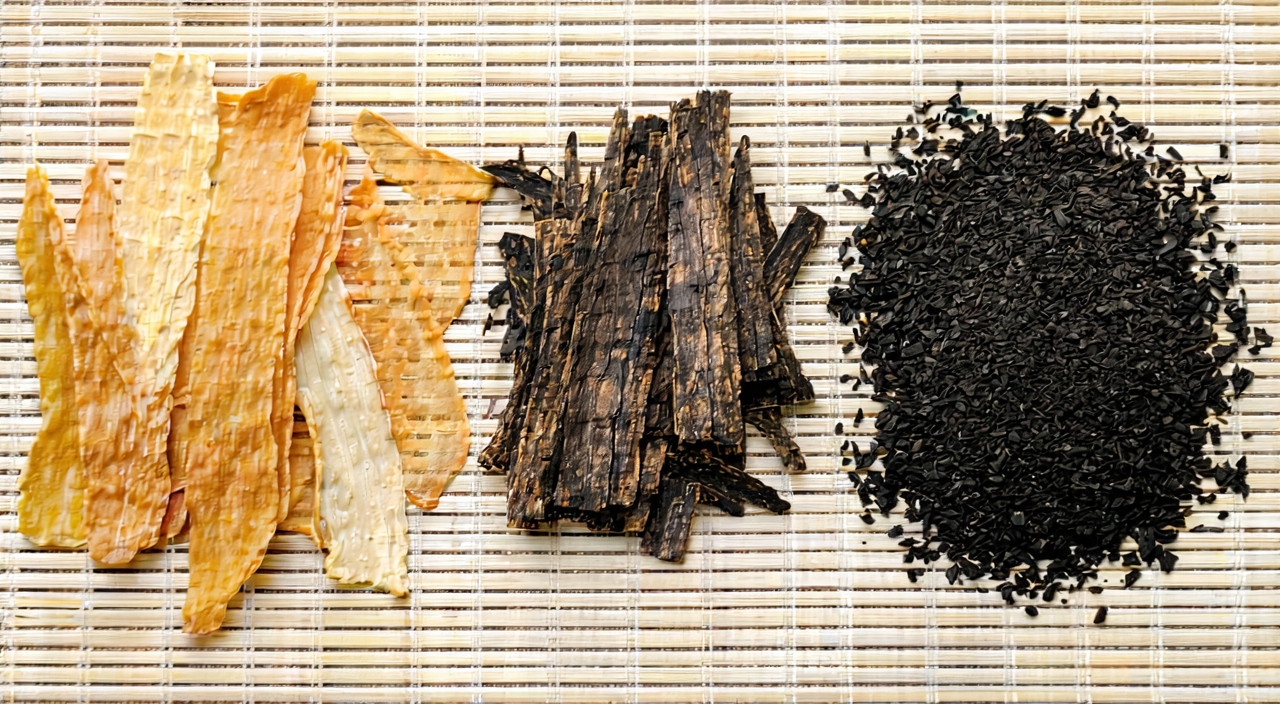
These three are easily confused, and a simple comparison helps clarify the concepts.
| Type | Preparation Method & Appearance | Traditional Therapeutic Direction |
|---|---|---|
| Gan Jiang (Dried Ginger) | Dried rhizome of fresh ginger; surface yellowish-white or greyish-yellow, texture firm, cross-section yellowish-white or pale yellow, fibrous, strongly pungent and spicy. | Warmer the middle and disperse cold, restore yang and free the vessels, dry dampness and resolve phlegm; often used for epigastric and abdominal cold pain, vomiting, diarrhea, cold-induced wheezing and cough, etc. |
| Pao Jiang (Processed Ginger) | Gan Jiang processed through sand-frying or stir-frying until the surface is charred black and the interior is brown; lightweight and crisp, cross-section brown, with a roasted aroma. | Warm the channels and stop bleeding, warm the middle and stop pain; focuses on deficiency cold bleeding and deficiency cold abdominal pain. |
| Jiang Tan (Charred Ginger) | Usually Gan Jiang or Pao Jiang further carbonized until fully charred; surface charred black, cross-section also charred brown or carbon black, extremely weak pungency. | Astringent and hemostatic action is more prominent, mostly used for bleeding disorders, but with stronger securing and astringing force, and its acrid dispersing nature is almost lost. |
As can be seen, Pao Jiang lies between Gan Jiang and Jiang Tan, retaining a certain warming nature while enhancing the tendency to secure and astringe. The three cannot be arbitrarily substituted for each other, especially Jiang Tan, which has a stronger bias toward stopping bleeding; improper use may affect the movement of qi and blood.
Which Formulas Use Pao Jiang?
Pao Jiang appears with some frequency in certain traditional formulas for warming the channels to stop bleeding and warming the middle. Below are several representative directions for understanding, but specific prescriptions must be determined by a professional through syndrome differentiation.
- Huang Tu Tang (Yellow Earth Decoction): This formula originates from the Jin Gui Yao Lue (Essential Prescriptions from the Golden Cabinet) and is mainly used for bleeding problems caused by spleen yang deficiency failing to govern the blood, such as hematochezia, uterine bleeding, stool with dark blood, and cold limbs. In the formula, Zao Xin Huang Tu (oven earth) serves as the chief herb, combined with Bai Zhu, Fu Zi, Sheng Di Huang, E Jiao, and Huang Qin; Pao Jiang is used for its warming, retaining, and yang-assisting hemostatic effect. Huang Tu Tang has strict indications and is not suitable for excess heat bleeding or damp-heat bleeding.
- Pao Jiang San (Processed Ginger Powder): Although there are multiple versions of Pao Jiang San in ancient texts such as the Tai Ping Sheng Hui Fang, the basic approach often uses Pao Jiang as the principal herb, combined with other qi-regulating, hemostatic, or warming interior medicinals to regulate abdominal pain, excessive menstrual bleeding, and other conditions caused by deficiency cold. This embodies the historical practice of Pao Jiang directly exerting its warming channel and astringing blood effects as a main herb.
- Warming Channel and Stopping Bleeding Formulas: In modifications of formulas like Wen Jing Tang (Warming Channel Decoction) from the Jin Gui Yao Lue, Pao Jiang is sometimes used to strengthen the warming channel and securing blood effects for conditions of deficiency cold with stasis or cold congealing blood stasis. However, the original Wen Jing Tang uses Sheng Jiang (fresh ginger); substituting with Pao Jiang is a modification that must be adapted to the specific constitution.
- Li Zhong (Regulate the Middle) Modifications: Li Zhong Tang uses Gan Jiang primarily to warm the middle and disperse cold. When encountering deficiency cold of the middle burner that cannot tolerate the dryness and harshness of Gan Jiang, or when accompanied by slight deficiency bleeding, ancient practitioners would substitute Gan Jiang with Pao Jiang to create modified formulas such as Pao Jiang Li Zhong Tang. This is commonly used for deficiency cold abdominal pain, loose stools, absence of thirst, and cold hands and feet.
Clearly, the use of Pao Jiang in the above formulas has clear indications, inseparable from the core syndrome differentiation of “deficiency cold.” One must never use it whenever bleeding occurs.
What Precautions Should Be Taken When Using Pao Jiang?
Before using Pao Jiang, there are several points that need to be taken seriously.
- Not suitable for those with yin deficiency fire effulgence or excess heat bleeding: Pao Jiang is warm in nature. If there are signs of yin deficiency with internal heat such as hot palms and soles, dry mouth and throat, red tongue with scanty coating, or signs of excess heat such as bright red bleeding, heavy flow, thirst, and constipation, using Pao Jiang may worsen the condition. Such presentations should be treated by a professional; do not self-select formulas containing Pao Jiang.
- Those with stomach discomfort should exercise caution: Although Pao Jiang is less irritating than Gan Jiang, individuals with overly sensitive stomachs or those in the active phase of acute gastritis or gastric ulcer may still experience discomfort. It is recommended to use under professional guidance and monitor reactions.
- Do not judge the degree of processing at home: Pao Jiang processing has legal standards. It is difficult for individuals to control the heat when dry-frying at home, easily leading to under-processing or excessive carbonization, altering the medicinal nature or even introducing harmful substances. It is advisable to purchase from regular channels and not to process it yourself.
- Extra caution for pregnant women or special constitutions: Medication during pregnancy requires extreme caution. Even if there are signs of deficiency cold, the decision to use and how to use it must be made under strict evaluation by a physician. Do not self-try just because it is considered “mild.”
- Do not take large doses of the single herb for a long time: Even for suitable constitution types, Pao Jiang should be used within a certain treatment cycle and combined with an overall formula, rather than taking large doses of the single herb long-term. Once symptoms improve, the protocol should be adjusted under professional guidance.
Summary
As a processed product of dried ginger, Pao Jiang primarily acts on deficiency cold bleeding and deficiency cold pain of the middle burner in traditional Chinese medicine. Its characteristics of warming the channels to stop bleeding and warming the middle to stop pain stem from its shift toward warming, retaining, and astringing properties after processing. To understand Pao Jiang, it must be placed in comparison with Gan Jiang and Jiang Tan in order to accurately grasp its scope of application. At the same time, this must be based on authentic, professional TCM syndrome differentiation. This article is for scientific reference only and cannot replace professional diagnosis or treatment advice. If you have related needs, please be sure to consult a qualified Chinese medicine professional.