
What Is Xiang Ru? Medicinal Parts, Identification Tips, and Common Formulas
In the humid heat of summer, many people turn to aromatic herbs that can transform dampness. Xiang Ru (Mosla chinensis) holds a special place among traditional herbs for addressing summer-related discomfort. It is commonly used when the body feels heavy and uneasy after exposure to cold during hot weather or after consuming too many cold drinks. But what does Xiang Ru actually look like? Which parts are used medicinally? How is it different from the more familiar Huo Xiang (Patchouli)? And what classic formulas feature it? This article will cover these basics from a Chinese medicine perspective.
What Does Xiang Ru Look Like? How to Identify It
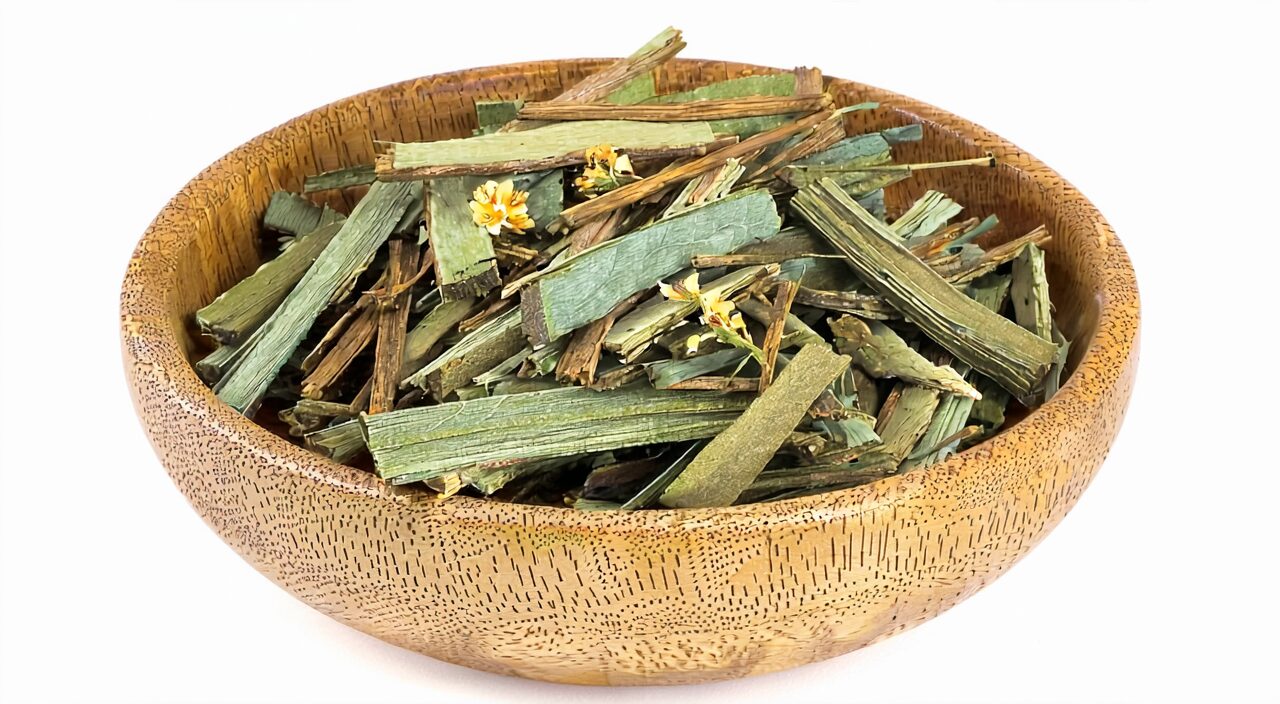
Xiang Ru is the dried aerial part of plants in the Lamiaceae family, such as Mosla chinensis or Mosla chinensis ‘Jiangxiangru’. Depending on processing, it can be used raw or fresh. When examining the herb, several features help with identification. The stem is often square-shaped, yellowish-green or purplish-brown with nodes, brittle and easily broken. The leaves are opposite, mostly wrinkled and broken, unfolding to an ovate or long ovate shape with serrated edges. The most distinctive feature is the spike-like inflorescence at the top, with bilabiate flowers and broad ovate bracts; sometimes purplish-brown residual flowers or small nutlets are visible. Herbal pieces are usually irregularly fragmented, mixing stems, leaves, and flowers. The aroma is clear and strong, becoming more pronounced when rubbed. This intense and refreshing fragrance is a key identifying characteristic; if the scent is weak, the material may have been stored too long or be of poor quality.
What Are the Medicinal Parts of Xiang Ru?
In Chinese herbal medicine, Xiang Ru uses the dried aerial parts of the plant. This includes the stems, leaves, and inflorescences. The traditional harvest time is summer and autumn when the stems and leaves are lush and the flowers have just begun to bloom. The plant is cut, impurities are removed, and it is dried in the sun or shade. In some regions, it is cut into short sections before drying for convenience in later dispensing. During harvesting and processing, care is taken to preserve the volatile oil components as much as possible. Prolonged exposure to strong sunlight or piling up while fresh is avoided to prevent excessive loss of aroma, which is traditionally believed to affect its medicinal potential.
How Does Chinese Medicine Understand Xiang Ru?
In traditional Chinese medicine theory, Xiang Ru is pungent in flavor and slightly warm in nature, entering the Lung and Stomach channels. It is traditionally believed to release the exterior and promote sweating, transform dampness and harmonize the middle, and promote urination to reduce edema. Its aromatic nature can transform dampness, and its pungent-warm quality can disperse. It is commonly used for external contraction of wind-cold in summer with internal damage by dampness. This pattern often arises from seeking excessive coolness in summer, such as catching a chill in an air-conditioned room or overeating raw and cold foods, leading to internal dampness retention while the body surface is constrained by cold. Symptoms include aversion to cold, fever, heavy head and body, absence of sweat, chest oppression, nausea, and diarrhea. In such cases, Xiang Ru can serve as a key herb to help disperse external cold and transform turbid dampness in the middle burner. At the same time, Xiang Ru can disseminate Lung qi, and by inducing sweating it can promote urination, which may be helpful when edema with scanty urine is present. However, these actions are based on traditional usage concepts; whether they suit a personal situation requires evaluation of one’s constitution and professional assessment.
What Has Modern Research Found?
Modern research has mainly focused on the chemical constituents and pharmacological activities of Xiang Ru. It contains volatile oil such as thymol, carvacrol, and p-cymene, as well as flavonoids and phenolic acids. Experimental studies show that its volatile oil has certain antibacterial and antiviral effects, and substances like thymol can inhibit excessive contraction of gastrointestinal smooth muscle. These findings provide some corroboration from a compositional standpoint for the traditional understanding of releasing the exterior and transforming dampness. However, most studies are still in vitro or animal experiments, and the specific mechanisms of action in the human body require more research. As a science communication note, the above information serves only as directional background and cannot be directly equated with clinical efficacy.
What Are the Differences Between Xiang Ru and Huo Xiang?
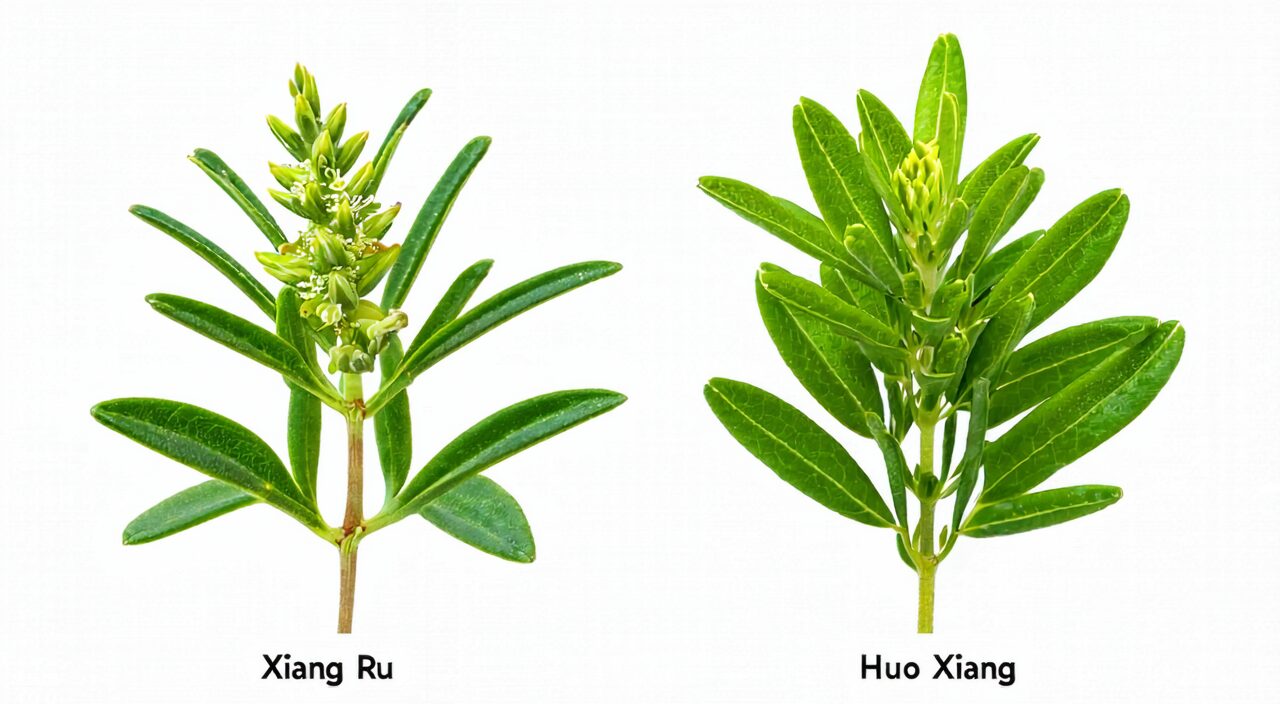
Both Xiang Ru and Huo Xiang (Pogostemon cablin or Agastache rugosa) are Lamiaceae plants with aromatic qualities, often used in hot and humid seasons. However, they have distinct differences in appearance, aroma, and traditional application focus. In appearance, Huo Xiang also has square stems, but its leaves are wider, heart-shaped or ovate, with coarse serrations and soft hairs on the surface; when dried, the color leans toward grayish-green. Xiang Ru has thinner stems, smaller leaves, and prominent spike-like inflorescences. Aroma-wise, Huo Xiang’s scent is deeper, sweet, and slightly cooling, while Xiang Ru’s fragrance is sharper and more pungent, somewhat like mint mixed with herbal notes. In terms of application focus, Huo Xiang excels at transforming dampness and awakening the spleen, harmonizing the middle and stopping vomiting. Its nature is slightly warm but not drying, and it is more commonly used for damp-turbidity encumbering the spleen that leads to epigastric stuffiness, vomiting, and poor appetite. Xiang Ru excels at inducing sweating to release the exterior and also promotes urination, making it more suitable for summer wind-cold with internal dampness where there is no sweating. There is a traditional saying: “Using Xiang Ru in summer is like using Ma Huang (Ephedra) in winter,” reflecting its stronger sweat-inducing effect compared to Huo Xiang. Therefore, although both are used in the same season, they are not interchangeable.
Which Formulas Use Xiang Ru?
Xiang Ru appears in quite a few classic formulas throughout medical history. Below are several commonly referenced ones, mostly built around the idea of addressing summer dampness with external cold. Xiang Ru San (Mosla Powder): From the “Taiping Huimin Heji Ju Fang” (Formulary of the Bureau of People’s Welfare Pharmacies), composed of Xiang Ru, Bai Bian Dou (hyacinth bean), and Hou Po (magnolia bark). Traditionally used for summer external wind-cold with internal damp damage, with signs such as aversion to cold, fever, heavy head and headache, absence of sweat, chest oppression, abdominal pain, vomiting, and diarrhea. Xiang Ru acts as the chief herb with its pungent-warm dispersing quality while also transforming dampness and harmonizing the middle; Hou Po moves Qi, expands the middle, and eliminates dampness and fullness; Bai Bian Dou strengthens the spleen and transforms dampness. The three together disperse wind-cold and transform dampness, forming a traditional combination for summer cold-damp patterns. Xin Jia Xiang Ru Yin (Newly Modified Mosla Drink): From “Wen Bing Tiao Bian” (Systematic Differentiation of Warm Diseases), it is a modified version of Xiang Ru San. On top of Xiang Ru and Hou Po, Jin Yin Hua (honeysuckle flower), Lian Qiao (forsythia), and fresh Bian Dou Hua (hyacinth bean flower) are added. Its concept emphasizes summerheat-dampness complicated by cold with internal depressed heat, presenting as fever, aversion to cold, no sweating, thirst, and a red face. Here Xiang Ru induces sweating to release the exterior, while Jin Yin Hua and Lian Qiao clear and vent internal heat, suiting mixed cold and heat presentations better. Huang Lian Xiang Ru Yin (Coptis-Mosla Drink): Different texts have formulas under this name, but the general idea is that Xiang Ru releases the exterior via sweating paired with Huang Lian (coptis) that clears heat and dries dampness. It applies to summer dampness internally brewing with external cold, manifesting as body heat, irritability, thirst, diarrhea, and scanty dark urine, adding more heat-clearing strength compared to plain Xiang Ru San. It must be noted that the use of these formulas must be based on specific constitution and pattern differentiation. Even if symptoms appear similar, the internal balance of cold, heat, deficiency, and excess may vary among individuals. Consulting a professional before use is recommended.
Precautions for Using Xiang Ru
Although Xiang Ru is a traditional herb, several important points need attention when using it. First, Xiang Ru has a relatively strong sweat-inducing effect, so those with exterior deficiency and spontaneous sweating or who tend to sweat too easily should exercise caution to avoid depleting Qi and damaging fluids. Second, it is suitable for situations where one has caught a chill in summer with no sweating; if summerheat is predominant without obvious cold constraining the exterior (i.e., high fever, profuse sweating, irritability, and thirst), using Xiang Ru alone is not appropriate, as its warm-dispersing nature might worsen fluid damage. Third, those with Yin deficiency constitution or depleted fluids should also avoid it due to its pungent-warm dispersing nature. Additionally, because Xiang Ru has a strong aroma, decocting time should not be too long; it is generally recommended to add it near the end of decoction or steep in boiling water. Prolonged boiling dissipates the volatile components and may irritate the digestive tract. Finally, if discomfort persists or worsens, or if accompanied by high fever, severe vomiting or diarrhea, or dehydration, seek medical attention promptly rather than relying solely on a single herb for regulation.
Summary
Xiang Ru is a traditional herb frequently mentioned during hot and humid seasons. Its identification features center on a square stem, opposite leaves, spike-like inflorescence, and intense, aromatic fragrance. The medicinal part is the dried aerial portion. While it shares the Lamiaceae family with Huo Xiang, they differ in appearance, aroma, and application focus and should be carefully distinguished in use. Classic formulas such as Xiang Ru San, Xin Jia Xiang Ru Yin, and Huang Lian Xiang Ru Yin are all built around the concept of cold-dampness or combined heat patterns, but personal suitability must account for individual constitution and professional guidance. This article is purely for herbal knowledge education; any specific usage decisions should be based on professional assessment.