
What Is Xiao Hui Xiang? Medicinal Parts, Identification, and Common Formulas
When mentioning xiao hui xiang (fennel seed), many people living overseas think of the slender, sweetly aromatic seeds used in cooking, or the yellow-green spice displayed next to cumin in supermarkets. But what exactly is xiao hui xiang? Is it the same as star anise? Which part is used for medicinal purposes? We can sort out these questions by looking at its botanical characteristics, traditional Chinese medicine understanding, and common formulas.
What Does Xiao Hui Xiang Look Like? How to Identify It
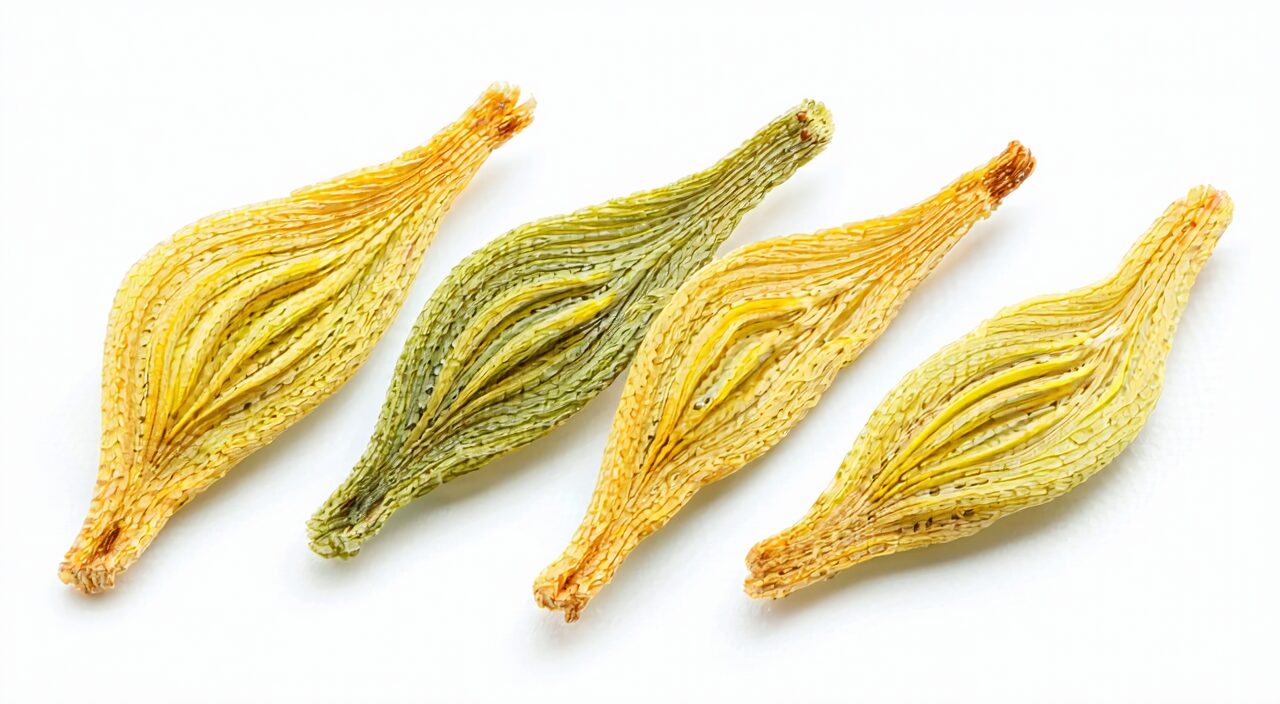
Xiao hui xiang comes from the ripe fruit of the Apiaceae plant fennel, and what we usually see is its dried form. It is not conspicuous when fresh, but its dried features are very distinctive.
Whole xiao hui xiang fruits are typically slender cylinders, slightly pointed at both ends, looking somewhat like miniature rice grains. On closer inspection, they are actually cremocarps composed of two mericarps, which often separate during the drying process, so we more commonly see single, slightly curved mericarps. Each mericarp is about 4–8 mm long and 1.5–2.5 mm in diameter, with a yellow-green or pale yellow surface.
The most crucial detail for identification is its longitudinal ribs. Each xiao hui xiang fruit has five prominent main ribs running from the base to the tip, with distinct ridge-like protrusions that feel firm. Rubbing it between your fingertips reveals a rough texture, and a closer sniff reveals a special sweet aroma, somewhat reminiscent of licorice, without any pungency. If you gently bite into it, the taste is initially sweet, followed by a slight numbness and a sweet aftertaste, and this clean sweetness is one of the clues to distinguish it from similar spices.
In the market, xiao hui xiang is sometimes confused with dill seed. Dill seeds are flatter, thinner, and have a pale wing-like edge, with a cooler, crisper aroma and none of the deep sweetness of xiao hui xiang. Therefore, grasping the four characteristics — “yellow-green, slender mericarp, five longitudinal ribs, sweet aroma” — will generally enable reasonably accurate identification of xiao hui xiang.
What Is the Medicinal Part of Xiao Hui Xiang?
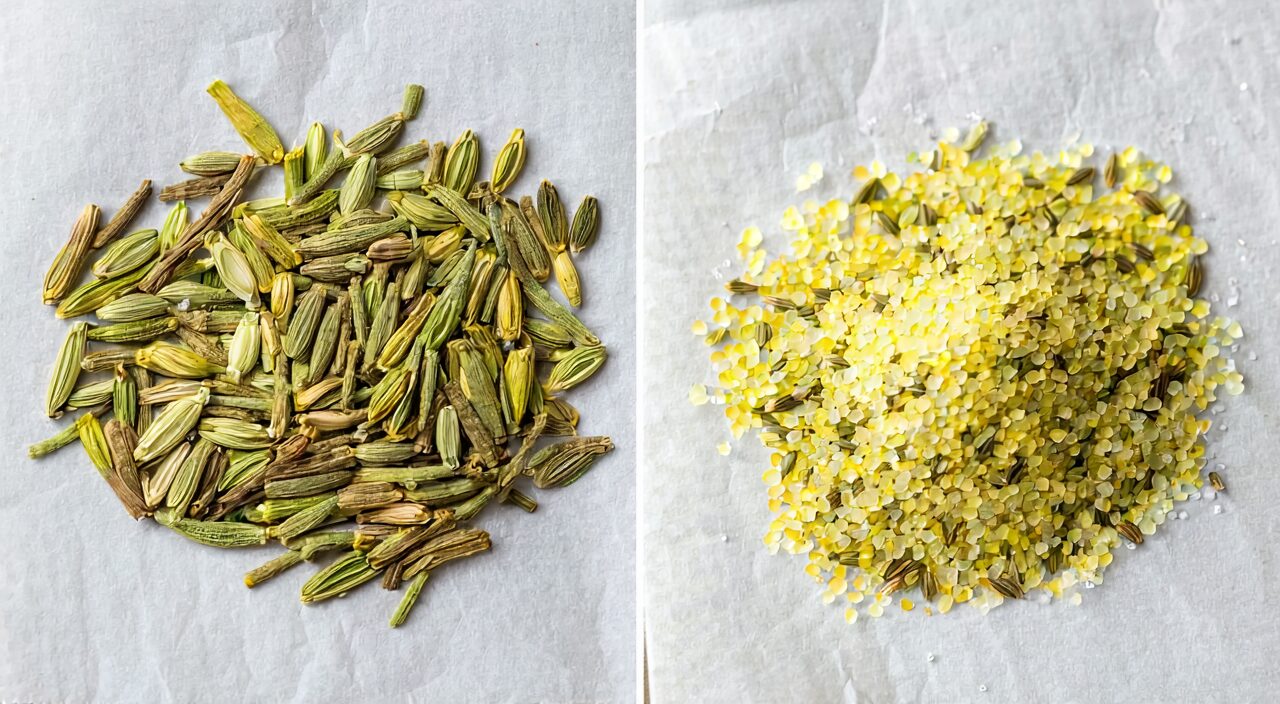
The medicinal part of xiao hui xiang is the ripe fruit of fennel. Every autumn, when the fruit turns from green to yellow-green, nearing maturity but not yet fully split, the whole plant or infructescence is harvested. The fruits are knocked off, impurities removed, and sun-dried to become the medicinally used “xiao hui xiang”.
Traditionally, dried xiao hui xiang fruits that are large, plump, yellow-green in color, and have a strong aroma are considered superior. To enhance its cold-dispersing and pain-relieving effects, xiao hui xiang is sometimes stir-fried with salt water to produce salt-processed xiao hui xiang. The salt-processed product is slightly darker in color with a deeper, more stable aroma, and its nature and flavor become pungent, sweet, and warm. Salt-processed xiao hui xiang is more commonly used in approaches that warm the lower jiao and regulate the middle to harmonize the stomach, but not everyone using xiao hui xiang needs the salt-processed version. The raw herb and stir-fried products each have their own emphasis and should be chosen based on individual conditions.
When using it, one should note that although the commonly used dosage of medicinal xiao hui xiang is not large, it is not advisable to exceed the dosage casually. In conventional decoctions, each dose is often around 3–6 grams, and external use should follow specific formula instructions. If you need to decoct formulas containing xiao hui xiang, it is best to consult an experienced Chinese medicine practitioner rather than adjusting the ingredients on your own.
How Does Chinese Medicine Understand Xiao Hui Xiang?
In Chinese medicine theory, xiao hui xiang is often classified as an interior-warming herb. Its nature and flavor are pungent, sweet, and warm, and it enters the liver, kidney, spleen, and stomach meridians. Traditionally, it is used to address cold-predominant constitutions and discomforts, mainly understood through the two directions of “dispersing cold to stop pain” and “regulating qi and harmonizing the stomach.”
Dispersing cold to stop pain primarily addresses abdominal pain, hernia distension, and cold testicular pain caused by cold congealing in the lower jiao. The ancients habitually described this type of cold pain as “cold pain,” which worsens with cold and lessens with warmth. Xiao hui xiang, with its warming nature, can gently warm and unblock, and disperse cold pathogens. This approach is often considered in chronic, deficient-cold type issues.
Regulating qi and harmonizing the stomach utilizes xiao hui xiang’s aromatic, spleen-awakening, and qi-moving, chest-diaphragm-soothing characteristics to promote smooth qi flow in the middle jiao. When symptoms like cold stomach pain, fullness, poor appetite, nausea with a desire to vomit, and belching appear, and the constitution tends toward cold, combining xiao hui xiang with fresh ginger, sha ren (Amomi Fructus), and chen pi (Citri Reticulatae Pericarpium) can often provide a gentle regulating effect.
It is important to note that Chinese medicine’s application of xiao hui xiang is always based on pattern differentiation. If the cold-heat nature of the body is misjudged — for example, if a person has yin deficiency with hyperactive fire, a red tongue with little coating, a tendency for mouth ulcers, hot palms and soles, night sweats, and irritability — then using pungent-warm xiao hui xiang may cause discomfort. Therefore, even for a common seasoning or medicinal herb, one should not simply start from the idea of “warming” but must first have a clear understanding of their own constitution.
How Does Xiao Hui Xiang Differ from Star Anise and Cumin?
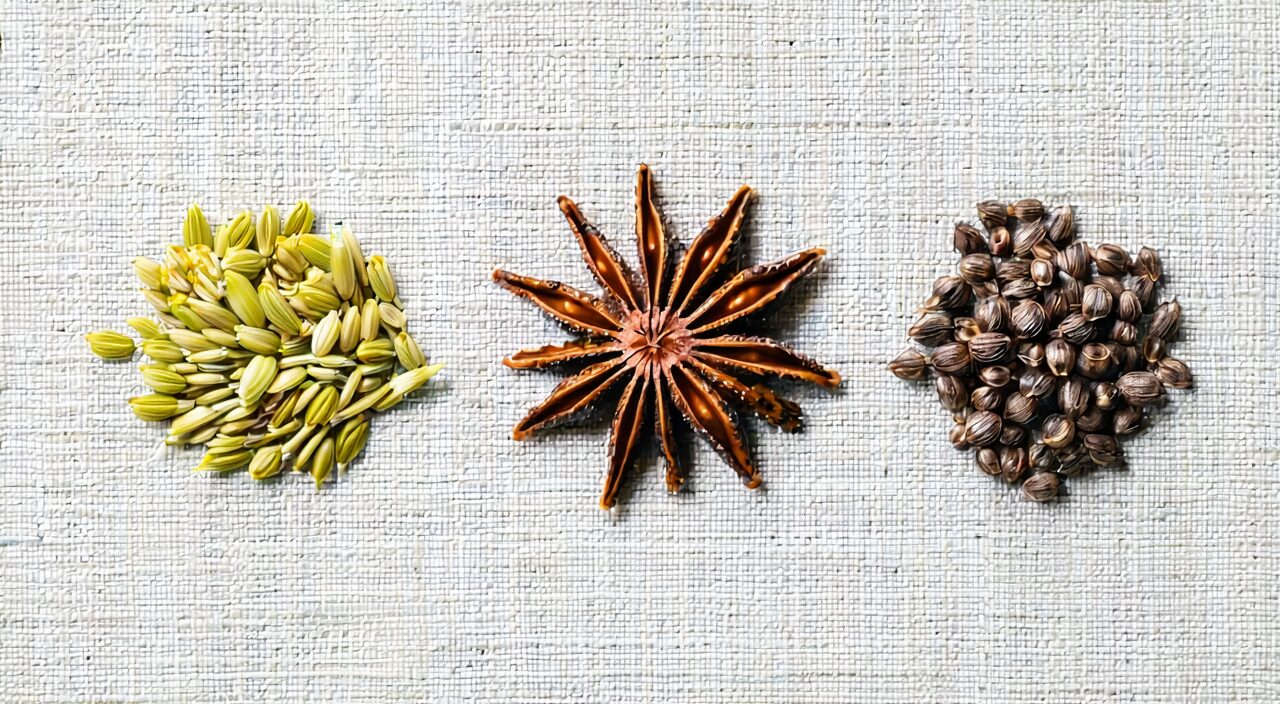
This question is often confused overseas because these three spices have some visual similarities but distinctly different aromas.
Although xiao hui xiang and star anise both have “hui xiang” in their Chinese names, their origins and forms are quite different. Star anise is the dried ripe fruit of the Magnoliaceae plant Illicium verum, the “star” spice we often use when braising meat, typically composed of 7–9 follicles arranged in a star shape, reddish-brown, with one smooth seed in each follicle, and a strong, sweet-pungent aroma. Xiao hui xiang is the cremocarp of an Apiaceae plant, tiny like a grain, yellow-green, with a sweeter and milder aroma. In traditional use, star anise leans more toward warming the middle and dispersing cold, regulating qi and stopping pain, with stronger action often used for cold hernia, abdominal pain, and lower back pain; xiao hui xiang has a gentler action and is more often used for warming the middle, harmonizing the stomach, and soothing the lower jiao. They cannot be used interchangeably, and one should choose according to flavor when cooking as well.
The distinction between xiao hui xiang and cumin is even more noteworthy. Cumin is the ripe fruit of the Apiaceae plant Cuminum cyminum. Its fruits are also slender mericarps, but the color is darker, mostly dark brown or dark yellow-brown. The longitudinal ribs on the surface are not as prominent as on xiao hui xiang, but rather it has a fine, downy texture. In aroma, cumin is pungently fragrant and intense, with a unique volatile oil scent, and tastes spicy and irritating; xiao hui xiang is sweet and mild. Cumin also has some limited use in Chinese medicine, leaning more toward warming the middle, dispersing food stagnation, and awakening the spleen, mostly used in cases of meat retention or as a seasoning.
In short: xiao hui xiang is small, yellow-green, with a sweet aroma; star anise is large, star-shaped, with a strong sweet-pungent aroma; cumin is dark brown with a pungent, intense aroma. These three differ in appearance, aroma, and use, and can be distinguished based on these characteristics when purchasing and cooking.
What Insights Does Modern Research Offer?
As research into xiao hui xiang has gradually deepened, modern phytochemistry and pharmacology have also identified some noteworthy directions. Xiao hui xiang fruit contains volatile oil, whose main components include trans-anethole, fenchone, estragole, and others, along with flavonoids, fatty acids, and sterols. These constituents may be associated with activities such as antioxidation, spasmolysis, and regulation of gastrointestinal motility.
Some in vitro experiments and animal studies suggest that xiao hui xiang volatile oil demonstrates certain antibacterial and antifungal effects and relaxes some gastrointestinal smooth muscles, which may provide partial modern perspectives for the traditional uses of “regulating qi and harmonizing the stomach” and “dispersing cold to stop pain.” However, these studies are mostly at a preliminary stage and still some distance from clinical recommendation; they cannot be simply equated with medicinal efficacy. Any claim that directly elevates modern research to “xiao hui xiang can treat a certain disease” needs to be approached with caution.
Furthermore, the concentration of xiao hui xiang volatile oil requires attention. High-dose fennel essential oil has shown neurological effects in animal experiments, so when using essential oil products, the dosage must be strictly controlled, and oral ingestion of high-concentration essential oils should be avoided. It should also not be taken in large quantities as a daily health supplement.
Which Formulas Use Xiao Hui Xiang?
Given xiao hui xiang’s characteristics of warming and dispersing cold congealing in the lower jiao, and regulating qi to harmonize the stomach, it appears in quite a few classical formulas. The following examples are relatively well-known combinations, offered only as reference for understanding traditional usage directions and are not a recommendation to self-administer.
Nuan Gan Jian (Liver-Warming Decoction) is often regarded as a representative formula for warming the liver and kidney and moving qi to stop pain. In addition to xiao hui xiang, it is combined with rou gui (cinnamon bark), wu yao (Linderae Radix), chen xiang (Aquilariae Lignum Resinatum), etc., suitable for lower abdominal cold pain, hernia, and distending pain caused by cold in the liver and kidney. These conditions usually worsen with cold and are relieved by warmth. The formulation approach of Nuan Gan Jian combines warming and tonifying with qi movement, allowing xiao hui xiang to warm the lower jiao without stagnating the qi mechanism.
Tian Tai Wu Yao San (Tiantai Lindera Powder) is a formula primarily built around wu yao, combined with xiao hui xiang, mu xiang (Aucklandiae Radix), qing pi (Citri Reticulatae Pericarpium Viride), and other qi-moving herbs, traditionally used for small intestinal hernias and radiating lower abdominal pain caused by cold congealing and qi stagnation. In this formula, xiao hui xiang and wu yao enhance each other’s ability to disperse cold and relieve pain, providing a combined approach of moving and dispersing for wandering, shifting pains without fixed locations in cold-pattern conditions. The premise for using such formulas remains confirming that cold is the dominant pattern; if there is mixed damp-heat, the assessment needs to be reconsidered.
Shao Fu Zhu Yu Tang (Lower Abdominal Stasis-Expelling Decoction) originates from Yi Lin Gai Cuo and takes activating blood and expelling stasis as its main direction. It uses xiao hui xiang, gan jiang (dried ginger), rou gui, and other warming-unblocking herbs to assist in resolving stasis. The reasoning is that cold congealing tends to impede blood circulation, so warming and unblocking can help resolve stasis. Xiao hui xiang plays a role here mainly in warming the lower origin and assisting blood flow, suitable for cases where cold causes stasis, such as lower abdominal masses and irregular menstruation. Those with qi and blood deficiency or obvious heat signs are not appropriate candidates for this formula.
Hui Xiang Ju He Wan (Fennel and Tangerine Seed Pill) is a prepared Chinese medicine mainly composed of fennel-type herbs and ju he (Citri Reticulatae Semen), commonly used for cold hernia abdominal pain, testicular swelling, and sagging sensations. This formula uses both xiao hui xiang and star anise, combined with ju he, chuan lian zi (Toosendan Fructus), and other liver-soothing and mass-dissipating substances, focusing on addressing lower jiao cold-dampness and qi stagnation. When using such prepared medicines, one must carefully review product instructions to see if the indicated patterns match one’s own presentation, avoiding misuse of a formula not suited to one’s cold-heat diagnosis.
The approaches contained in these formulas have strict combination ratios and ranges of application. Whether they are suitable for yourself still requires integrating your constitution, symptoms, and professional judgment. Especially for recurrent abdominal pain, hernias, or conditions accompanied by nausea and vomiting, abnormal stools, or palpable masses, it is best to seek medical attention first rather than self-experimenting with formulas.
What Should Be Noted When Using Xiao Hui Xiang?
Although xiao hui xiang is a common dual-purpose food and medicine with generally good safety at the small doses used in daily cooking, there are still a few points that require special attention in specific situations.
First, those with yin deficiency and hyperactive fire should not use it in large amounts or long-term. If you often experience dry mouth and throat, hot palms and soles, night sweats, irritability, insomnia, and a red tongue with little moisture, this indicates relatively deficient body yin and hyperactive empty fire. The pungent-warm nature of xiao hui xiang may aggravate these discomforts.
Second, caution is needed during pregnancy. Xiao hui xiang traditionally has a degree of warming, unblocking, and dispersing action. Pregnant women should generally avoid consuming it in large quantities and certainly should not casually take the medicinal herb or essential oil products containing xiao hui xiang, to avoid interfering with the stable state of pregnancy.
Third, xiao hui xiang essential oil is not equivalent to the food seasoning. Undiluted high-concentration fennel essential oil applied directly to the skin may cause irritation or allergic reactions; taken orally in large doses, it is even more likely to cause adverse neurological effects. When using essential oil products, follow safety guidelines and never blindly assume “natural is safe.”
Fourth, if there are serious digestive problems, such as severe abdominal pain, persistent vomiting, black stools, or unexplained weight loss, dietary adjustments or a single herb clearly will not suffice, and medical examination must be sought promptly. At such times, xiao hui xiang can only be seen as a complementary seasoning and should not be expected to provide therapeutic benefits.
Finally, whether using xiao hui xiang as a daily spice or taking formulas and prepared medicines containing it, comprehensive judgment should be made based on individual constitution and specific manifestations, avoiding bandwagon usage.
Summary
Xiao hui xiang is an Apiaceae fruit that holds a place from the kitchen to the herbal formula. Its slender cremocarp, yellow-green exterior, and sweet aroma make it easily distinguishable from star anise and cumin. Traditional Chinese medicine primarily understands xiao hui xiang from the perspectives of dispersing cold to stop pain and regulating qi to harmonize the stomach, but its specific use requires distinguishing cold and heat patterns, paying attention to yin deficiency with hyperactive fire, pregnancy, and other special states, and recognizing that the daily spice is not equivalent to medicinal use. This article serves only as a popular science reference and cannot substitute for professional diagnosis or treatment advice. Any persistent discomfort should be promptly addressed with professional help.