
TCM Understanding of Postpartum Hair Loss and Recovery Care

Many new mothers suddenly notice hair everywhere — on combs, pillows, bathroom drains — around three to six months after giving birth, and it’s hard not to panic. This seemingly out-of-control hair shedding actually has a clear physiological basis in modern medicine, and traditional Chinese medicine has accumulated extensive experience in postpartum recovery over the centuries.
This article will sort through the whole picture of postpartum hair loss from a TCM perspective, helping you understand the changes your body is going through while offering gentle care directions suitable for breastfeeding. However, please remember that any care approach should be undertaken cautiously after understanding your personal constitution.
Why Hair Loss Concentrates After Childbirth
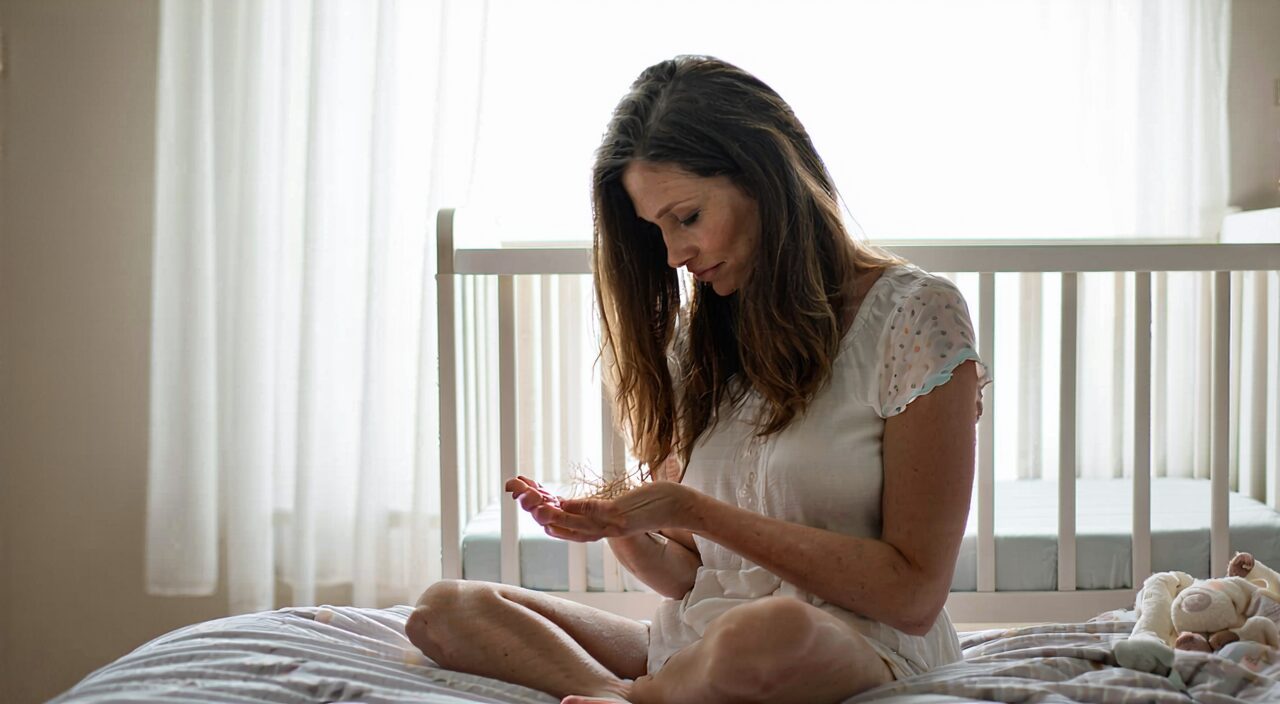
From a modern medical standpoint, high estrogen levels during pregnancy prolong the growth phase of hair follicles, keeping many hairs that would normally fall out firmly on the scalp. After delivery, estrogen levels drop rapidly, and those overstayed hairs enter the resting and shedding phase together, leading to a noticeable increase in hair fall over a short period. In essence, this is the body correcting its previous imbalance and usually does not require special treatment.
TCM also has a unique explanatory framework for this, focusing more on the mother’s overall state of qi and blood.
Depletion from Childbirth and Qi and Blood Deficiency
There is a saying in TCM that after childbirth all the channels and collaterals are empty. This emptiness primarily refers to a massive depletion of qi and blood. Whether it’s the blood loss and physical exertion during delivery or the essence and blood supplied to the fetus throughout pregnancy, the mother is left in a state of “excessive deficiency.”
Hair is the surplus of blood, meaning the nourishment and luster of hair are closely related to the moistening and nourishment provided by blood. When qi and blood are insufficient, the body prioritizes meeting the core needs of the organs and breastfeeding, so supply to peripheral areas like the hair naturally diminishes, resulting in hair loss.
Postpartum Blood Stasis and Qi and Blood Circulation
Besides deficiency, another easily overlooked postpartum feature is stasis. If lochia discharge is not smooth during uterine involution, or if emotional constraint or liver qi stagnation occurs, blood stasis can form.
If blood stasis is not removed, new blood cannot be generated. Not only are qi and blood insufficient, but their flow is also impeded, leaving the scalp even less nourished. Therefore, TCM care for postpartum hair loss seldom focuses purely on “tonifying”; often slight dredging is considered alongside supplementation.
Common TCM Pattern Types and Care Directions
Every postpartum woman presents differently. Some only lose hair, while others also experience fatigue, palpitations, insufficient milk supply, or sleep problems. TCM combines these accompanying symptoms with tongue and pulse diagnosis to assess constitutional imbalances. The main types are generally qi and blood deficiency and kidney deficiency.
Qi and Blood Deficiency Type
This is the most common type in the early postpartum period. Along with hair loss, mothers often experience the following:
- Weak voice, easy fatigue
- Sallow or pale complexion
- Sweating with minimal exertion
- Thin and scanty breast milk
- After menstruation returns, light flow with pale color
- Pale, slightly swollen tongue with teeth marks on the edges
When facing such a presentation, traditional TCM often approaches from the angle of nourishing the heart and spleen, boosting qi, and generating blood. Formulas or patent medicines like Gui Pi Wan and Ba Zhen Wan have been historically used in medical texts for patterns of heart and spleen qi and blood deficiency, sallow complexion, and malnourishment of hair. They more or less help replenish the body’s raw material stores, allowing the hair to gradually receive the foundational substances needed for recovery.
Kidney Deficiency Type
The kidney stores essence, and its flourishing manifests in the hair. Some women’s hair loss is mainly at the top of the head or along the hairline, possibly accompanied by:
- Soreness and weakness of the lower back and knees
- Frequent nighttime urination
- Decline in memory
- Aversion to cold and drafts
This picture is relatively more common in women who have had multiple births or are of advanced maternal age. The care approach tends more toward supplementing the kidney, replenishing essence, and securing and generating hair. However, postpartum kidney deficiency is often intertwined with qi and blood deficiency, so in practice it is rarely about solely fortifying kidney yang; instead, gentle supplementation of the liver and kidney, attending to essence and blood, is more common.
It must be emphasized that Gui Pi Wan, Ba Zhen Wan, and similar formulas mentioned above are only traditional references for understanding care direction, and do not imply they can be used casually during breastfeeding. In particular, some compound preparations may contain herbs unsuitable for nursing mothers — for instance, known He Shou Wu (Polygonum multiflorum) and its preparations carry a risk of liver injury and should be strictly avoided during breastfeeding. Any internal Chinese patent medicine must be used under the guidance of a physician or pharmacist familiar with your individual situation. Never purchase and take them on your own.
Safety Principles for Postpartum Care During Breastfeeding

Postpartum hair loss happens right during the breastfeeding period, which makes many mothers hesitant even if they want to actively take care of it. The following principles may help you try some measures within a safe scope.
Food-Based Care First, Medicinal Supplementation with Caution
TCM dietary therapy is an important part of postpartum care. Provided there are no allergies or discomfort, you can consume moderate amounts of the following ingredients to continuously supply the body with materials for generating blood and nourishing hair:
- Black sesame, black beans, walnuts, mulberries
- Goji berries, red dates, longan
- Pork liver, lean meat, and so on
Some traditional medicinal dishes — such as Danggui (Angelica sinensis) and ginger lamb soup (only after lochia has cleared and in the absence of heat signs), Huangqi (Astragalus) stewed chicken soup, and black sesame paste — can also be incorporated as part of your daily diet after consulting a professional.
Meridian Dredging of the Scalp
Gently comb or use your fingertips to brush the scalp from the forehead to the back of the head every day for five to ten minutes, until you feel a slight warmth on the scalp. This method can unblock the meridians of the head and promote local qi and blood circulation; since it involves no internal use, it’s very safe. If combined before bedtime with pressing and kneading acupoints like Baihui (DU20) and Fengchi (GB20), it is often considered helpful for calming the mind and reducing hair loss.
Sleep and Emotional Management
Sleep deprivation after birth is almost unavoidable, but try to rest while your baby sleeps — even a short nap is vital for qi and blood recovery.
As for emotions, TCM holds that excessive thinking damages the spleen and pent-up anger damages the liver, both of which can indirectly worsen hair loss. It is unrealistic to expect a new mother not to be anxious at all, but you can purposefully carve out some moments of solitude or deep breathing, or communicate with family members to share the load of childcare. These seemingly ordinary daily practices are actually the foundation that allows the body to navigate the recovery period smoothly.
Situations That Require Attention
Although most postpartum hair loss gradually improves within six to twelve months as the body self-regulates, some signs may indicate a need for professional evaluation. When the following occur, it is not advisable to simply view them as ordinary postpartum hair loss:
- Hair loss lasting too long — still shedding heavily after more than one year
- Bald patches that are clearly round and patchy
- Unexplained sudden weight changes
- Significant abdominal pain
- Prolonged absence of menstruation after childbirth
- Low mood that affects day-to-day infant care
- Persistent palpitations, chest tightness, severe insomnia, or black stools
If any of the above is present, it is advisable to seek medical attention promptly to rule out other underlying issues.
Summary
Postpartum hair loss is essentially a natural compensatory response after the body has gone through enormous exertion. In most cases it is temporary and recoverable. Through the approach of supplementing qi and blood and freeing stagnation, TCM provides relatively systematic experience for caring for the body during this phase, but the intensity and safety of any care must always take the special breastfeeding period as a premise.
Whether adjusting your diet, changing lifestyle habits, or considering the use of traditional tonifying patent medicines such as Ba Zhen Wan, Gui Pi Wan, or Bu Zhong Yi Qi Wan, it is advised to first fully understand your own constitution and then make choices in conjunction with the judgment of a professional TCM physician. In particular, avoid products that contain herbs with known risks, such as He Shou Wu. Do not overlook the potential impact on yourself and your baby out of an urgent desire to regrow hair.
Give yourself some time and give your body some time — that is the most important thing in postpartum recovery.