
Who Is Shao Fu Zhu Yu Tang Suitable For? Composition, Effects, and Contraindications

Many people become acquainted with the name “Shao Fu Zhu Yu Tang” (Minor Abdomen Stasis-Expelling Decoction) when exploring traditional Chinese medicine approaches for recurrent lower abdominal cold pain, heavy menstrual clotting, and delayed menstruation. It is not a formula to be taken casually; rather, it is a traditional stasis-removing formula designed from the perspective of cold congealing blood stasis. This article will focus on its composition rationale, the situations it was traditionally used for, who might be more suitable, situations requiring great caution, and differences from similar formulas such as Gui Zhi Fu Ling Wan and Wen Jing Tang, to help establish a relatively clear understanding framework.
Origin and Traditional Positioning of Shao Fu Zhu Yu Tang
Shao Fu Zhu Yu Tang is a formula from Wang Qingren’s “Yi Lin Gai Cuo” (Corrections on Errors in the Medical Forest) of the Qing Dynasty. Wang Qingren had a profound understanding of blood stasis, and this formula primarily targets “stasis in the lesser abdomen,” especially blood stasis related to cold pathogens.
According to traditional Chinese medicine theory, cold has a congealing and stagnating nature. When cold pathogens invade the lower burner, the flow of qi and blood is easily obstructed, gradually forming blood stasis, which can manifest as cold pain, fixed stabbing pain, and blood clots. Shao Fu Zhu Yu Tang is precisely based on this idea, using a combination of warming, unblocking, and blood-activating methods to address states of cold-induced blood stasis.
It does not merely “activate blood,” but combines blood-activating actions with warming the channels and dispersing cold, which determines its distinctly different application direction from other blood-activating formulas.
Composition and Brief Interpretation of Shao Fu Zhu Yu Tang
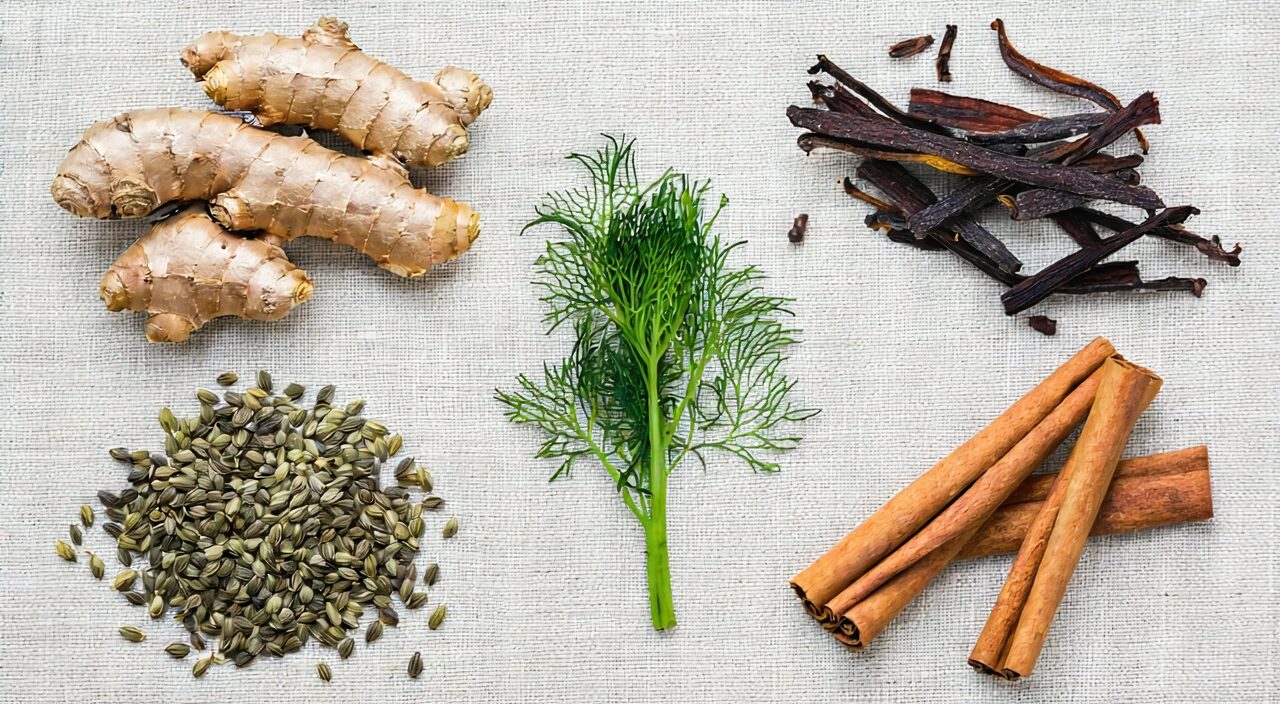
Traditionally, Shao Fu Zhu Yu Tang consists of ten herbs, which can be viewed as a cooperation between channel-warming/cold-dispersing herbs and blood-activating/stasis-expelling herbs. The following table lists the common components and their functional directions in the formula, facilitating understanding of its overall strategy.
| Herb | Common Functional Direction in the Formula |
|---|---|
| Xiao Hui Xiang (Fennel) | Disperses cold and regulates qi, with a particular inclination toward lower burner cold |
| Gan Jiang (Dried Ginger) | Warms the middle and disperses cold, assists yang qi movement |
| Yan Hu Suo (Corydalis) | Regulates qi, activates blood, and relieves pain; often used for discomfort caused by blood stasis and qi stagnation |
| Mo Yao (Myrrh) | Activates blood, disperses stasis, and arrests pain |
| Dang Gui (Chinese Angelica) | Nourishes and activates blood, regulates menstruation and relieves pain |
| Chuan Xiong (Szechuan Lovage Root) | Activates blood, moves qi, warms and unblocks the channels |
| Chi Shao (Red Peony Root) | Cools the blood and disperses stasis; used together with warming herbs to prevent excessive dryness |
| Pu Huang (Cattail Pollen) | Activates blood and dispels stasis; commonly used when blood stasis and clots are pronounced |
| Wu Ling Zhi (Flying Squirrel Dung) | Activates blood, disperses stasis, and relieves pain |
| Guan Gui (Cinnamon Bark) | Warms the channels, unblocks vessels, and assists yang qi circulation |
From this composition, it can be seen that warming herbs account for a considerable proportion, so its regulating direction is biased toward cold patterns and blood stasis patterns, rather than blood-heat or excess-heat conditions. This is an important prerequisite for determining suitability.
Manifestations That May Be Suitable for Shao Fu Zhu Yu Tang

In traditional Chinese medicine, when using a formula like this, the judgment relies on “pattern” rather than a single symptom. Shao Fu Zhu Yu Tang is often discussed for cold congealing blood stasis pattern—meaning the body presents a cluster of cold and stasis-stagnation manifestations. If the following conditions occur simultaneously, they may traditionally point toward understanding this formula, but it still needs to be combined with individual constitution and professional judgment.
Characterized by lower abdominal cold pain, preferring warmth and pressure
A sensation of coldness in the lower abdomen, dull or stabbing pain that worsens with cold and improves with warmth, even feeling comfortable with heat application—this is characteristic of cold pain. The warming channel, cold-dispersing, and blood-activating actions of Shao Fu Zhu Yu Tang are precisely designed for this type of discomfort.
Women’s menstrual issues accompanied by signs of cold stasis
Some women experience delayed menstrual cycles, scanty but heavy clotting, dark-colored blood, lower abdominal cold pain or bearing-down pain during menstruation, along with usually cold hands and feet, and aversion to cold. In traditional gynecological regulation, these are often categorized as clues of cold congealing blood stasis:
- Delayed menstrual cycles, scanty menstrual flow
- Many blood clots, dark menstrual color
- Lower abdominal cold pain or bearing-down pain during menstruation, relieved by warmth
- Usually cold hands and feet, fear of cold and aversion to chill
Shao Fu Zhu Yu Tang is often considered as an object of study in such situations. However, it must be emphasized that the causes of menstrual problems are complicated, and one should not determine suitability based solely on blood clots.
Tongue and pulse references
From the tongue picture, a pale-dark tongue body or the presence of stasis spots/petechiae, with a white tongue coating, may suggest cold stasis. As for the pulse, it often manifests as deep and wiry or hesitant. All these need to be comprehensively assessed by professionals in combination with the overall picture.
It is important to clarify that the descriptions above are only clues in traditional pattern differentiation, and do not imply that the formula can be used merely because one symptom is present. The more cold congealing blood stasis characteristics that match, the more it may be worth further understanding; if the presentations are mixed or exactly opposite, it is likely unsuitable.
Situations Where Shao Fu Zhu Yu Tang May Be Unsuitable
Discussing contraindications of a formula is often more important than exploring its suitable populations. Shao Fu Zhu Yu Tang is overall warming and strongly moving and activating blood, so the following situations require special caution.
Pregnancy and preconception period
This formula has a relatively strong blood-activating force and is traditionally contraindicated during pregnancy. If there is a pregnancy plan or a possibility of pregnancy, one should avoid self-administering such formulas and consult a professional before using any medication.
Those with bleeding tendencies or excessively heavy menstruation
Because the formula contains multiple blood-activating herbs, for those who already have heavy menstrual flow, prolonged periods, or a tendency to bleed easily, including those with bleeding disorders, it may increase the risk of bleeding and is generally inappropriate.
Constitution with excess heat or yin deficiency with fire effulgence
If the body presents heat signs—such as dry mouth and bitter taste, preference for cold drinks, flushed face, constipation, red tongue with yellow coating—or signs of yin deficiency like heat in palms and soles, night sweats, red tongue with little coating, the warm and drying nature of Shao Fu Zhu Yu Tang may instead promote heat and damage yin, making it unsuitable.
Other special populations requiring careful evaluation
People with severe liver or kidney dysfunction, those taking anticoagulant medications, or those with acute abdominal pain accompanied by fever all need comprehensive evaluation by a physician and cannot simply decide based on formula descriptions.
Moreover, if the lower abdominal pain is not cold pain but burning pain or distending pain that rejects pressure, accompanied by fever, yellowish thick discharge, etc., these often indicate damp-heat or infection and are not within the consideration scope of Shao Fu Zhu Yu Tang.
Comparison Between Shao Fu Zhu Yu Tang and Similar Formulas
Another important way to figure out whether Shao Fu Zhu Yu Tang suits oneself is to compare it with several frequently mentioned formulas, distinguishing them by core rationale and emphasis.
Shao Fu Zhu Yu Tang vs. Gui Zhi Fu Ling Wan
Both Shao Fu Zhu Yu Tang and Gui Zhi Fu Ling Wan are commonly used for stasis in the lower abdomen, but their emphases differ significantly.
Gui Zhi Fu Ling Wan uses Cinnamon Twig to warm and unblock the blood vessels, combined with Poria, Peach Kernel, Tree Peony Bark, and Peony, leaning toward slowly dispersing concretions and gatherings, with a nature that harmonizes the ying and wei while activating blood. Traditionally, it is more often discussed for masses, unsmooth menstruation, and a constitution that tends toward excess rather than deficiency.
Shao Fu Zhu Yu Tang has a stronger warming and dispersing force, especially suitable for cold-induced stasis patterns with pronounced cold signs and lower abdominal cold pain.
Simple comparison:
- When cold pain is prominent, preferring warmth and pressure, the approach leans more toward Shao Fu Zhu Yu Tang’s warming channel and activating blood strategy.
- When stasis is obvious but cold signs are not severe, Gui Zhi Fu Ling Wan may be more commonly mentioned.
Shao Fu Zhu Yu Tang vs. Wen Jing Tang
Wen Jing Tang (Channel-Warming Decoction), also sourced from “Jin Gui Yao Lue” (Essential Prescriptions of the Golden Cabinet), is likewise a formula for warming the channel, dispersing cold, and regulating menstruation. But Wen Jing Tang contains Evodia, Ophiopogon Tuber, Donkey-Hide Gelatin, and Ginseng, simultaneously caring for blood nourishment, yin nourishment, and qi supplementation. It addresses a pattern of thoroughfare and conception vessel deficiency-cold accompanied by blood stasis, often with symptoms like irregular menstruation, bothersome heat in the palms, and dry lips; the constitution tends to be more deficient.
Shao Fu Zhu Yu Tang focuses on attacking stasis and relieving pain, with insufficient nourishing power, leaning more toward excess patterns.
Traditionally:
- For those with deficiency-cold mixed with stasis, weak and thin body, scanty menstruation, Wen Jing Tang may be more suitable.
- For those with prominent cold-stasis excess pathogens, pain that refuses pressure, robust constitution with stasis lumps, the direction of Shao Fu Zhu Yu Tang is more fitting.
Shao Fu Zhu Yu Tang vs. Tao Hong Si Wu Tang
Tao Hong Si Wu Tang (Four Substances Decoction with Peach Kernel and Safflower) is Si Wu Tang plus Peach Kernel and Safflower, primarily nourishing and activating blood. It is often used for menstrual irregularities due to blood deficiency accompanied by stasis and unsmooth menstruation. Its nature is moderate, emphasizing both blood nourishment and stasis transformation.
Shao Fu Zhu Yu Tang, by contrast, is biased toward warming, dispersing, and pain relief, with relatively weaker blood-nourishing effects.
In comparison:
- For menstrual issues mainly due to blood deficiency: such as pale complexion, dizziness, light-colored menses, few clots — Tao Hong Si Wu Tang is more commonly explored.
- For menstrual issues mainly due to cold stasis: obvious cold pain, dark purple clots — Shao Fu Zhu Yu Tang may be considered more often.
Shao Fu Zhu Yu Tang vs. Si Wu Tang
Si Wu Tang is a foundational formula for nourishing blood and regulating menstruation, mainly used for blood deficiency. Its own blood-activating strength is not strong; when blood stasis manifestations are evident, additional herbs are usually added. Shao Fu Zhu Yu Tang can be seen as having undergone a major adjustment in the direction of warming and dispersing cold stasis, making the two formulas quite different.
If the presentation is purely blood deficiency without obvious cold-stasis pain, Shao Fu Zhu Yu Tang is generally not needed.
The above comparisons only serve to illustrate differences in traditional usage directions of different formulas and do not imply one is superior. Whether actual use is necessary and which approach to choose needs to be combined with detailed four-diagnosis information and determined by professionals.
Summary
Shao Fu Zhu Yu Tang is a traditional formula designed around the state of cold congealing blood stasis. Using herbs like Xiao Hui Xiang (Fennel), Gan Jiang (Dried Ginger), and Guan Gui (Cinnamon Bark) to warm the channels and disperse cold, combined with Dang Gui (Chinese Angelica), Chuan Xiong, Pu Huang (Cattail Pollen), and Mo Yao (Myrrh) to activate blood and expel stasis, it mainly addresses lower abdominal cold pain, heavy menstrual clotting, aggravation on exposure to cold, and preference for warmth and pressure. Its suitability depends on the simultaneous presence of cold signs and stasis signs. It is unsuitable for excess heat, yin deficiency with fire effulgence, bleeding tendencies, and pregnancy.
Compared to formulas like Gui Zhi Fu Ling Wan, Wen Jing Tang, and Tao Hong Si Wu Tang, Shao Fu Zhu Yu Tang places more emphasis on warming, unblocking, activating blood, and relieving pain. This distinction is very valuable when assessing one’s own situation. In any case, physical discomfort involves many individual factors. While learning about such traditional formulas, it is recommended to combine personal constitution and professional judgment and avoid self-application.