
Who Is Ban Xia Hou Po Tang Suitable For? Composition, Effects, and Contraindications Explained

Have you ever felt as if a plum pit is stuck in your throat — you can’t swallow it and can’t cough it out, especially when you’re stressed, anxious, or upset? Traditional Chinese medicine often attributes such manifestations to “phlegm-qi binding,” and Ban Xia Hou Po Tang is a classic formula that addresses it by moving qi, dispersing masses, directing rebellious qi downward, and resolving phlegm.
This article will explore the composition, traditional effects, suitable and unsuitable populations for Ban Xia Hou Po Tang, as well as how it differs from Er Chen Tang, Wen Dan Tang, Chai Hu Shu Gan San, and Xiao Chai Hu Tang, to help you build a clearer understanding.
Where Does Ban Xia Hou Po Tang Come From?

Ban Xia Hou Po Tang originates from the Jin Gui Yao Lue (Essential Prescriptions from the Golden Cabinet). The original text describes it for “a sensation of a piece of roasted meat stuck in the throat” in women — meaning a feeling of something that cannot be spit out or swallowed in the throat. Later generations extended its use to address patterns of qi stagnation and phlegm congealing caused by emotional constraint, qi dynamic depression, and impaired body fluid circulation.
When constrained liver qi affects the spleen and stomach’s transportation and transformation, body fluids tend to condense into phlegm. The phlegm and qi ascend along the meridians and bind in the throat, easily leading to symptoms such as a foreign body sensation in the throat, chest tightness, and distension and fullness in the hypochondriac region.
Composition of Ban Xia Hou Po Tang
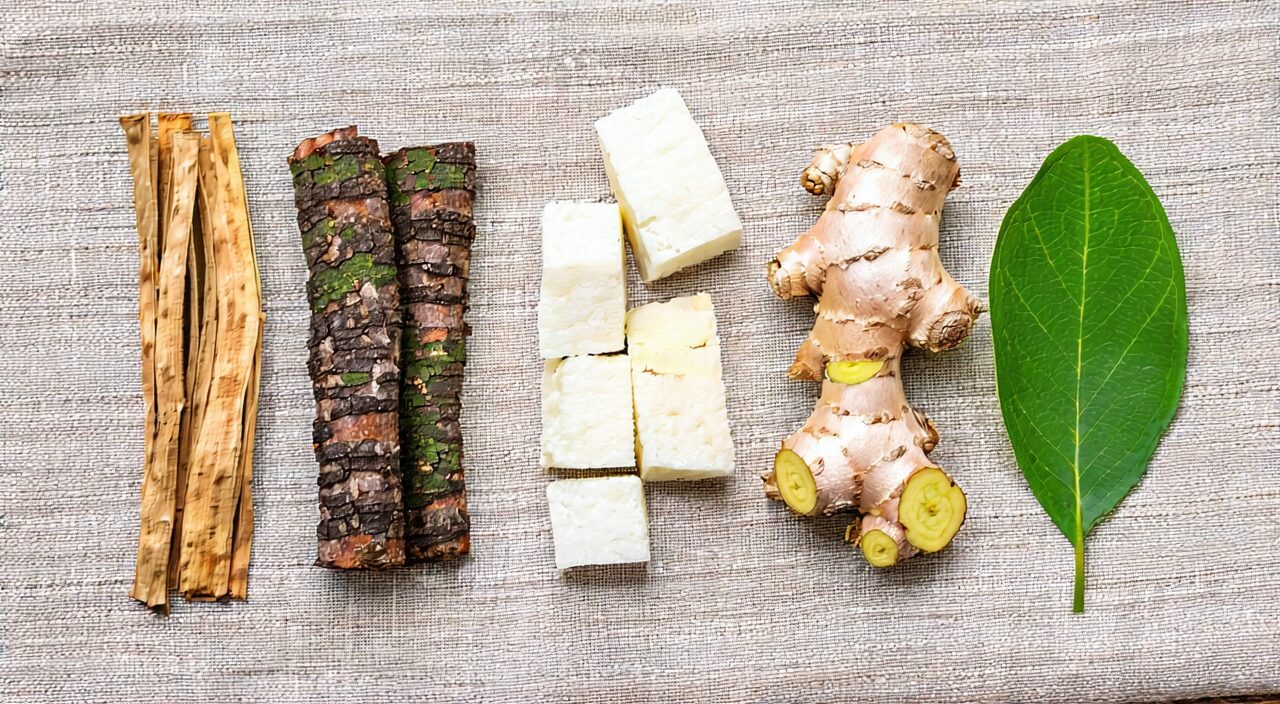
This formula consists of five herbs, with a very concise structure. Traditionally, these herbs work together to move qi, disperse masses, direct rebellious qi downward, and resolve phlegm.
| Herb | Traditional Role |
|---|---|
| Ban Xia (Pinellia Rhizome) | Dries dampness and resolves phlegm, directs rebellious qi downward and disperses masses; the core herb in the formula |
| Hou Po (Magnolia Bark) | Moves qi, dries dampness, directs rebellious qi downward and relieves fullness; helps eliminate qi stagnation in the chest and abdomen |
| Fu Ling (Poria) | Strengthens the spleen and percolates dampness, reducing the source of phlegm production |
| Sheng Jiang (Fresh Ginger) | Warms the middle, directs rebellious qi downward, resolves phlegm and dispels congested fluids; enhances the power to harmonize the stomach and stop vomiting |
| Zi Su Ye (Perilla Leaf) | Regulates the lung and soothes the liver, moves qi and relieves stuffiness in the chest; assists qi dynamic circulation |
The combination of these five herbs does not focus merely on resolving phlegm; it emphasizes regulating the qi dynamic so that phlegm disperses following the movement of qi. Therefore, the key to understanding it is not “it is suitable whenever there is phlegm in the throat,” but rather determining whether there are specific signs of qi depression and phlegm congealing.
Ban Xia Hou Po Tang Effects and Action Directions
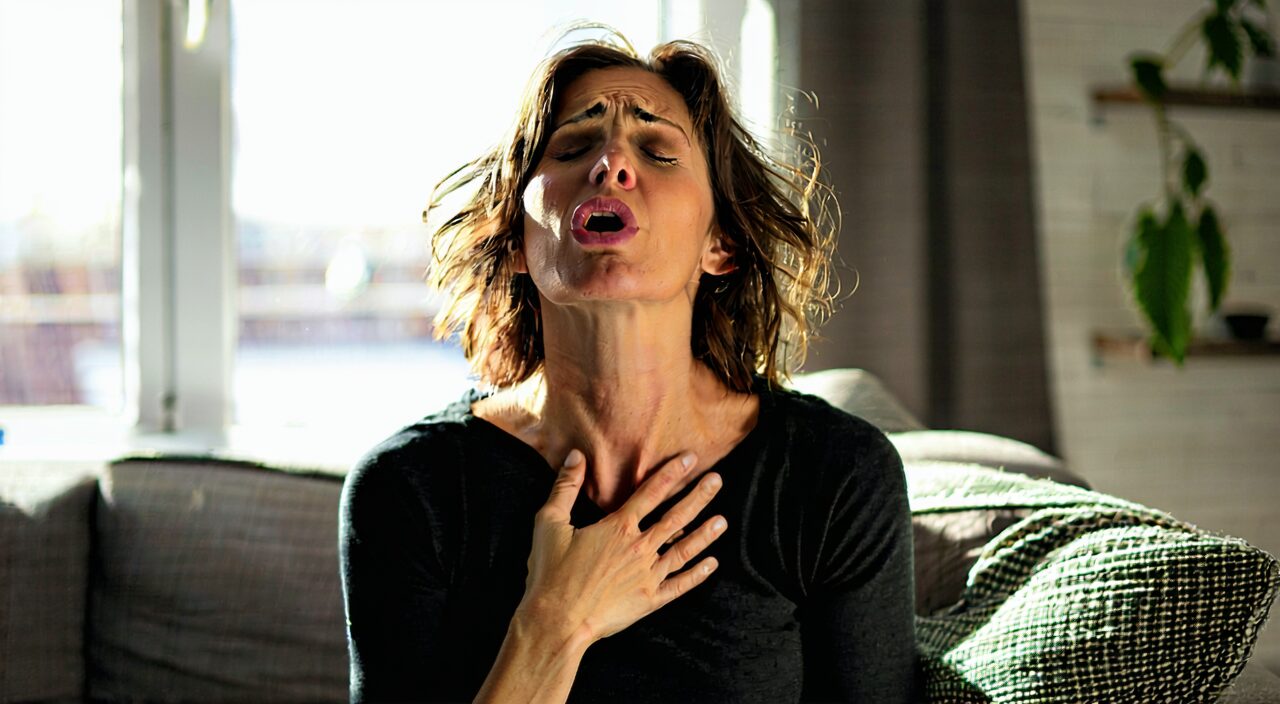
From a traditional Chinese medicine perspective, the core action of Ban Xia Hou Po Tang is moving qi and dispersing masses, directing rebellious qi downward and resolving phlegm. It is commonly used for the following conditions caused by phlegm-qi binding:
- A subjective sensation of a foreign body obstruction in the throat, with no obvious organic lesions found on examination, and symptoms worsen with emotional fluctuations.
- A feeling of stuffiness or distension in the chest, hypochondrium, or behind the sternum, often with the urge to sigh or take a deep breath.
- Frequent belching, nausea, or a sensation of stomach qi rising upward, accompanied by copious, white, sticky phlegm.
- Low mood, irritability, or excessive rumination, together with signs of weak digestive function and a white, greasy tongue coating.
These directions all point to the mutual binding of “qi” and “phlegm.” Thus, traditionally, it is not seen as a simple phlegm-resolving formula but one that focuses on smoothing the qi dynamic and resolving stagnation.
Who Is Ban Xia Hou Po Tang Suitable For?

From the perspective of constitution and symptom characteristics, the following groups may be candidates for whom traditional Chinese medicine would consider the Ban Xia Hou Po Tang approach. However, this does not mean they can all use it directly; it must be determined based on individual circumstances.
People Who Often Feel a Foreign Body Sensation in the Throat but Tests Show No Abnormalities
When there is a sensation of something stuck in the throat, but laryngoscopy or gastroscopy shows no polyps, tumors, or obvious reflux lesions, and the symptoms fluctuate in severity according to emotional states, it is traditionally considered consistent with the characteristics of phlegm-qi binding.
People Easily Triggered by Emotional Fluctuations to Have Chest Tightness and Bloating
Those under high stress or with long-term emotional constraint who easily experience chest tightness, intercostal distension, belching, or a feeling of relief after burping or belching, and who also have copious phlegm or a plum pit sensation, may benefit from understanding the approach of regulating qi and resolving phlegm.
People with Internal Phlegm-Dampness Combined with Qi Depression Signs
Individuals who are not particularly robust, often have copious phlegm, a sticky mouth taste, a white greasy tongue coating, along with tendencies toward anxiety, sensitivity, and suppressing anger, are often categorized under “phlegm-qi binding” during treatment.
However, even if the above descriptions match, it is recommended to first have a comprehensive evaluation by a professional TCM practitioner through observation, listening, inquiry, and pulse-taking, because a foreign body sensation in the throat may be related to other causes as well.
Ban Xia Hou Po Tang Contraindications and Unsuitable Populations

Not all throat discomfort is suitable for Ban Xia Hou Po Tang. The following situations require extra caution or should be avoided for self-treatment:
When Throat Discomfort Has Not Ruled Out Organic Problems
If the foreign body sensation in the throat is accompanied by difficulty swallowing, persistent hoarseness, pain, or neck lumps, necessary examinations must be done first to rule out vocal cord polyps, nodules, thyroid issues, or space-occupying lesions. The approach of regulating phlegm and qi should not replace diagnosis.
People with Yin Deficiency Dry Cough or Obvious Lung Heat
Those with dry throat and mouth, dry cough with little phlegm, blood-streaked sputum, red tongue with scant coating, or tidal fever and night sweats indicating yin deficiency with internal heat: Ban Xia Hou Po Tang is warming and drying and may aggravate dryness and heat signs. Traditionally, the approach of nourishing yin and moistening dryness would be considered first, rather than using this formula directly.
People with Obvious Excess Heat or Phlegm Heat
When there are prominent heat signs such as coughing up yellow, thick phlegm, sore and red throat, fever, thirst with a preference for cold drinks, and dry stool, the warming, drying, qi-moving Ban Xia Hou Po Tang is not suitable. Such cases require different strategies aimed at clearing heat and resolving phlegm.
Children, Pregnant Women, Breastfeeding Women, and Those with Weak Constitutions
These special populations are more sensitive to herbal substances and should never self-medicate without a doctor’s detailed assessment. People with extremely weak constitution, shortness of breath, disinclination to speak, and a lusterless complexion should first strengthen their vital qi rather than focusing on moving qi and dispersing masses.
Differences Between Ban Xia Hou Po Tang and Similar Formulas
When learning about Ban Xia Hou Po Tang, many people come across Er Chen Tang, Wen Dan Tang, Chai Hu Shu Gan San, and Xiao Chai Hu Tang. Although they all involve phlegm- and qi-related directions, their emphases differ significantly.
Differences Between Ban Xia Hou Po Tang and Er Chen Tang
| Comparison Item | Ban Xia Hou Po Tang | Er Chen Tang |
|---|---|---|
| Core Action | Move qi, disperse masses, direct rebellious qi downward, resolve phlegm | Dry dampness, resolve phlegm, regulate qi and harmonize the middle |
| Pathomechanism Emphasis | Qi depression is primary, body fluids stagnate, phlegm and qi bind in throat and chest/hypochondrium | Heavy phlegm-dampness in the middle burner, spleen and stomach disharmony |
| Typical Manifestations | Foreign body sensation in throat, fluctuating with emotions, chest tightness, belching | Cough with copious phlegm, nausea, chest oppression, heavy limbs |
| Action Location | Preferentially toward throat, chest and hypochondrium | Preferentially toward the middle burner |
In short, Er Chen Tang focuses on drying dampness and resolving phlegm, while Ban Xia Hou Po Tang focuses on moving qi, dispersing masses, and directing rebellious qi downward. There is a clear difference in traditional application.
Differences Between Ban Xia Hou Po Tang and Wen Dan Tang
| Comparison Item | Ban Xia Hou Po Tang | Wen Dan Tang |
|---|---|---|
| Core Action | Move qi, disperse masses, direct rebellious qi downward, resolve phlegm | Clear the gallbladder, harmonize the stomach, calm the spirit |
| Pathomechanism Emphasis | Qi depression and phlegm congealing, binding upward in the throat | Gallbladder and stomach disharmony, phlegm-heat harassing upward |
| Typical Manifestations | Foreign body sensation in throat, chest tightness and belching, worsening with emotional fluctuations | Vexation, insomnia, easily startled, dizziness, bitter taste |
| Modification Direction | Mainly move qi and direct rebellious qi downward | Concurrently clear heat and calm the spirit |
If, besides the foreign body sensation in the throat and chest tightness, there are also pronounced vexation, bitter taste, insomnia, and dream-disturbed sleep, the traditional approach may lean more toward Wen Dan Tang or related variations rather than using Ban Xia Hou Po Tang alone.
Differences Between Ban Xia Hou Po Tang and Chai Hu Shu Gan San
| Comparison Item | Ban Xia Hou Po Tang | Chai Hu Shu Gan San |
|---|---|---|
| Core Action | Move qi, disperse masses, direct rebellious qi downward, resolve phlegm | Soothe the liver, regulate qi, invigorate blood and alleviate pain |
| Pathomechanism Emphasis | Qi stagnation and phlegm congealing, qi depression with concomitant fluid impairment | Liver qi depression, impeded blood circulation |
| Typical Manifestations | Foreign body sensation in throat, chest tightness, belching, copious phlegm | Chest and hypochondriac distension and pain, emotional depression, premenstrual breast distension |
| Phlegm Sign Characteristics | Phlegm-qi binding, phlegm signs evident | Phlegm manifestations often not prominent |
If the main issues are low mood and distending pain in the hypochondriac region, and phlegm manifestations are not prominent, the traditional approach may consider Chai Hu Shu Gan San first.
Differences Between Ban Xia Hou Po Tang and Xiao Chai Hu Tang
| Comparison Item | Ban Xia Hou Po Tang | Xiao Chai Hu Tang |
|---|---|---|
| Core Action | Move qi, disperse masses, direct rebellious qi downward, resolve phlegm | Harmonize the Shao Yang, strengthen the vital and dispel pathogenic factors |
| Pathomechanism Emphasis | Local qi dynamic and phlegm binding | Shao Yang channel qi dynamic obstruction, half exterior half interior |
| Typical Manifestations | Foreign body sensation in throat, chest tightness, belching | Alternating chills and fever, fullness and distress in the chest and hypochondrium, vexation with frequent vomiting, silent and no desire to eat |
| Regulation Level | Predominantly local qi dynamic | Predominantly whole-body qi dynamic, harmonizing exterior and interior |
Although both formulas use Ban Xia, Xiao Chai Hu Tang focuses on harmonizing the exterior and interior and strengthening the vital while expelling pathogens, while Ban Xia Hou Po Tang concentrates on directing rebellious qi downward and dispersing masses. Their applicable scopes do not overlap.
Summary
Ban Xia Hou Po Tang, as a classic formula for moving qi and dispersing masses, directing rebellious qi downward and resolving phlegm, is traditionally used mainly to improve manifestations such as a foreign body sensation in the throat, chest tightness, belching, and emotional depression caused by phlegm-qi binding. It is suitable as a point of reference for populations who match this pathomechanism, but it is rather unsuitable for those with unexamined organic throat problems, yin deficiency with dry cough, predominant excess heat, and special populations such as children and pregnant women.
Among the many formulas involving “phlegm” and “qi,” Er Chen Tang leans toward drying dampness and resolving phlegm; Wen Dan Tang concurrently addresses the gallbladder and stomach while calming the spirit; Chai Hu Shu Gan San emphasizes soothing the liver and regulating qi; and Xiao Chai Hu Tang excels at harmonizing the Shao Yang. Each has a different focus and cannot substitute for one another. Understanding these differences helps you more rationally distinguish approaches when facing specific symptoms, combined with professional advice.
No matter how closely your self-reported description aligns with a formula’s indications, it is recommended to first consult a qualified TCM professional, undergo a comprehensive constitutional assessment, and then consider whether it is appropriate to use. This article provides only traditional knowledge popularization and cannot replace professional diagnosis or treatment advice.