
Who Should Take Baihe Gujin Decoction? Ingredients, Benefits, and Contraindications

Many people come across the name “Baihe Gujin Decoction” (Lily Bulb Lung-Consolidating Decoction) when struggling with a lingering cough, persistent throat dryness, and hoarseness. In traditional Chinese medicine, it is not a universal cough remedy but has a fairly specific therapeutic direction. For readers wondering whether this formula might be suitable for themselves or their family, this article offers a relatively comprehensive framework by exploring its composition, indications, contraindications, and how it differs from other common formulas.
The Starting Point for Understanding Baihe Gujin Decoction
In TCM theory, Baihe Gujin Decoction primarily addresses the pattern of “lung-kidney yin deficiency with flaring of deficiency fire.” The lung is a delicate organ that prefers moisture and detests dryness; the kidney governs water. If kidney yin is insufficient and fails to nourish lung yin upward, lung dryness with fluid impairment easily occurs.
This can trigger a chain of reactions: rebellious lung qi leads to coughing, deficiency fire scorches fluids resulting in scanty, sticky phlegm, the throat loses nourishment causing dryness and hoarseness, and even the stirring of deficiency fire may produce afternoon tidal fever and night sweats.
The design concept of Baihe Gujin Decoction is often summarized as “mutual generation of metal and water” — by nourishing the yin of the lungs and kidneys, yin fluids become abundant, deficiency fire descends spontaneously, and manifestations such as cough and throat dryness also improve accordingly. It does not simply suppress coughing but focuses on restoring the moistening and nourishing state of the lungs and kidneys.
The Core Composition of Baihe Gujin Decoction
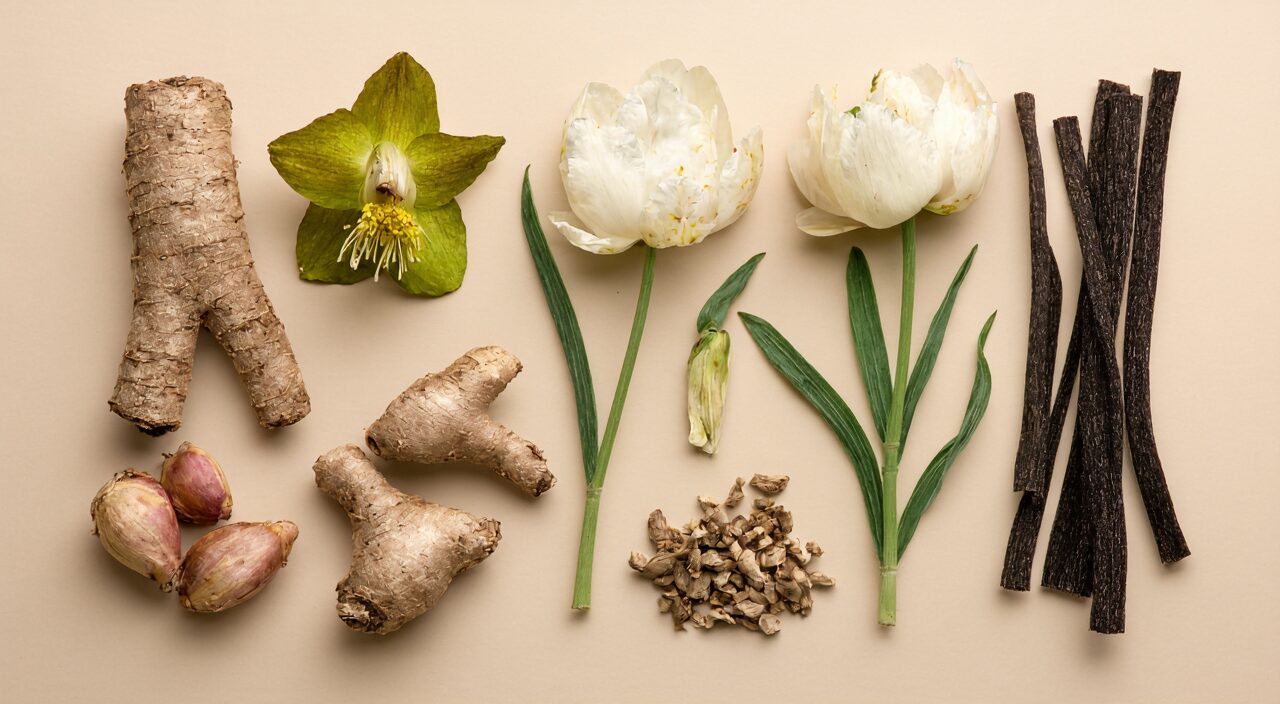
To understand a formula, start with its composition. Baihe Gujin Decoction consists of a combination of multiple Chinese herbs that work together, each with its own emphasis. The following table lists its common ingredients and simple reference dosages (for understanding only, not representing actual clinical doses):
| Herb | Common Reference Dosage (g) | General Role in the Formula |
|---|---|---|
| Baihe (Lily Bulb) | 12 | Nourishes yin and moistens the lung, clears the heart and calms the spirit |
| Sheng Dihuang (Raw Rehmannia Root) | 12 | Enriches yin and clears heat, cools blood and generates fluids |
| Shu Dihuang (Prepared Rehmannia Root) | 12 | Nourishes yin and tonifies blood, benefits essence and fills marrow |
| Maidong (Ophiopogon Tuber) | 9 | Nourishes yin and moistens the lung, benefits the stomach and generates fluids |
| Xuanshen (Scrophularia Root) | 9 | Enriches yin and subdues fire, resolves toxin and benefits the throat |
| Danggui (Chinese Angelica Root) | 6 | Tonifies blood and invigorates blood, moistens dryness and stops coughing |
| Baishao (White Peony Root) | 6 | Nourishes blood and astringes yin, softens the liver and relieves urgency |
| Chuanbeimu (Sichuan Fritillaria Bulb) | 6 | Clears heat and transforms phlegm, moistens the lung and stops coughing |
| Jiegeng (Platycodon Root) | 6 | Opens the lung and benefits the throat, guides the herbs upward |
| Gancao (Licorice Root) | 3 | Harmonizes the other herbs, moistens the lung and stops coughing |
Baihe combined with Sheng Dihuang, Shu Dihuang, and Maidong predominantly nourishes lung and kidney yin. Xuanshen helps subdue deficiency fire and benefit the throat. Danggui and Baishao nourish blood and moisten dryness. Chuanbeimu moistens the lung, transforms phlegm, and stops coughing. Jiegeng guides the herbs upward while also opening and lifting lung qi. Gancao harmonizes all ingredients and moistens the lung. The entire prescription is predominantly moistening and gently clearing, making it suitable mainly for coughs related to yin-blood insufficiency and fluid depletion.
Situations That May Serve as Reference Indications

Baihe Gujin Decoction is traditionally used to regulate coughs caused by lung-kidney yin deficiency with flaring deficiency fire. In terms of everyday observations, the following types of presentations are more likely to be taken into consideration by professionals, but they need to be assessed together with the individual’s overall condition:
- Dry cough with little phlegm, or blood-streaked sputum: The cough is predominantly dry, with scanty, sticky phlegm that is difficult to expectorate, occasionally with a small amount of blood streaks.
- Throat dryness and hoarseness: A persistent sensation of a dry, rough throat that is not significantly relieved by drinking water, voice easily becomes hoarse after talking, dryness more pronounced at night or upon waking.
- Afternoon tidal fever and night sweats: Sensation of heat in waves during the afternoon or evening, sweating after falling asleep at night that stops upon waking.
- Dry mouth, red tongue with little coating: Frequent dry mouth, tongue body tending to be red with scanty or peeled coating, pulse thready and rapid.
These manifestations often appear in combination rather than as a single symptom. In conditions such as chronic bronchitis, recovery phase of bronchiectasis, chronic pharyngitis, or recovery stage of pulmonary tuberculosis, if the pattern differentiation belongs to lung-kidney yin deficiency, Baihe Gujin Decoction may traditionally be considered as one reference direction.
However, constitution and severity of illness vary from person to person. Whether it is necessary to use this formula and how to use it should still be determined by consulting a TCM professional, and one should not judge on their own.
Who Should Not Use It and Contraindicated Situations
Baihe Gujin Decoction is relatively cloying and moistening, and is not suitable for all types of cough. The following situations generally advise against self-selection; instead, consult a professional physician for a clear diagnosis:
- Wind-cold cough: Loud cough with thin, white, clear phlegm, accompanied by aversion to cold, fever, nasal congestion with clear discharge, headache, and body aches. At this time, dispelling wind and dispersing cold is needed; cloying, moistening herbs may trap the pathogen.
- Phlegm-damp cough: Cough with copious white phlegm that is easy to expectorate, chest tightness, epigastric stuffiness, tongue coating white and greasy. The many yin-nourishing and moistening herbs in the formula can easily promote dampness and generate phlegm, aggravating discomfort.
- Exuberant phlegm-heat: Rapid, coarse cough with yellow, sticky phlegm, possibly accompanied by fever, thirst, marked throat swelling and pain, red tongue with yellow greasy coating. At this stage, the approach should focus on clearing heat and transforming phlegm; Baihe Gujin Decoction does not match the pattern.
- Severe acute infection or high fever phase: Such as acute pneumonia, acute exacerbation of bronchitis, where the pathogenic factor is raging. It is not advisable to use tonifying and yin-enriching substances too early.
- Those with spleen-stomach deficiency cold who tend to loose stools: Herbs like Sheng Dihuang, Shu Dihuang, Xuanshen, and Maidong are cool and moistening, which may impair spleen-stomach transportation, causing abdominal distension, loose stools, or reduced appetite. If digestive function is normally weak and prone to diarrhea, extra caution is needed.
- Special populations such as pregnant women and infants: Assessment must be made under strict medical guidance; self-reference is not advisable.
Furthermore, for long-term, recurrent cough, or cough accompanied by significant chest pain, difficulty breathing, large amounts of blood in sputum, marked weight loss, or hoarseness persisting for more than three weeks, priority should be given to medical consultation to rule out structural diseases rather than self-prescribing formula-based regulation.
Differences from Several Similar Formulas
There are many clinical approaches to regulating cough, and the names of formulas are easily confused in the market. Below, from the perspective of therapeutic emphasis, Baihe Gujin Decoction is differentiated from several common formulas to help readers build a clearer impression.
Mai Wei Di Huang Wan (Ophiopogon-Schisandra Rehmannia Pill)
Mai Wei Di Huang Wan is based on Liu Wei Di Huang Wan with the addition of Maidong and Wuweizi. It emphasizes nourishing the kidney and lung and grasping qi to calm panting. It is commonly used for chronic cough and deficiency-type panting, soreness and weakness of the lower back and knees, and dry throat and mouth due to lung-kidney yin deficiency. However, its cough-suppressing and phlegm-transforming power is weaker than that of Baihe Gujin Decoction.
If coughing is not severe but panting and lower back soreness dominate, Mai Wei Di Huang Wan may traditionally be considered more often. Baihe Gujin Decoction more intensively addresses cough and throat dryness caused by insufficient lung yin with deficiency fire disturbing the upper body.
Sang Ju Yin (Mulberry Leaf and Chrysanthemum Decoction)
Sang Ju Yin is a mild pungent-cool exterior-releasing formula, primarily targeting early-stage wind-heat with manifestations such as cough, mild fever, slight thirst, and sore throat. It dispels wind, clears heat, and opens the lung to stop coughing. It addresses residual external pathogens not yet cleared, not internal injury due to yin deficiency.
Baihe Gujin Decoction, on the other hand, is entirely an internal nourishing formula and should not be used too early when external pathogens have not been cleared. One is exterior-oriented and clearing, while the other is interior-oriented and moistening — their directions are clearly different.
Zhi Sou San (Stop-Coughing Powder)
Zhi Sou San is commonly used for cough and throat itching, difficult expectoration caused by wind pathogen invading the lung. It works regardless of cold or heat and is characterized by being “warm, moist, and neutral — neither cold nor hot.” Its emphasis is on diffusing lung qi, stopping cough, and transforming phlegm, applicable to both new and chronic coughs.
In contrast, Baihe Gujin Decoction emphasizes enriching yin and moistening the lung, targeting deficiency patterns. It should not be used if phlegm-dampness is severe or external pathogens are unresolved. Zhi Sou San has a broader application range, whereas Baihe Gujin Decoction is more specific to lung-kidney yin deficiency patterns.
Yang Yin Qing Fei Tang (Yin-Nourishing Lung-Clearing Decoction)
Yang Yin Qing Fei Tang consists of Sheng Dihuang, Maidong, Xuanshen, Beimu, Danpi, Bohe, etc. Originally designed for diphtheria, it emphasizes nourishing yin and clearing the lung while moderately dissipating toxin. It is often used for yin deficiency lung dryness, throat swelling and pain, dry cough with scanty phlegm, and similar conditions.
It shares yin-nourishing and lung-moistening effects with Baihe Gujin Decoction, but Yang Yin Qing Fei Tang has slightly stronger clearing power, focusing more on throat swelling and pain and diphtheria recovery phases. Baihe Gujin Decoction simultaneously supplements both lung and kidney, adding Shu Dihuang, Danggui, Baishao, and other blood-nourishing and essence-supplementing herbs, making it more cloying.
- If lung dryness is more prominent while kidney deficiency is not obvious, Yang Yin Qing Fei Tang may be another reference direction.
- If lung and kidney are both deficient, with yin-blood insufficiency and obvious tidal fever and night sweats, Baihe Gujin Decoction’s structure is more suitable.
The differences between these formulas ultimately need to be distinguished by combining tongue and pulse diagnosis, constitution, and specific symptom combinations. One cannot simply match based on one or two symptoms.
Precautions from Understanding to Judgment

As a classical formula, Baihe Gujin Decoction’s composition has accumulated considerable experience through historical application. However, every formula has clear indications. TCM emphasizes “use the formula only when the corresponding pattern is present.” If the pattern does not match, the effect will be suboptimal and may even worsen the condition.
If you are considering this formula for cough, throat dryness, or related issues, several points merit attention:
- First clarify whether symptoms belong to “deficiency” or “excess,” and whether they arise from “external contraction” or “internal injury.” According to TCM theory, the patterns suitable for Baihe Gujin Decoction are mostly deficiency and interior patterns. If external pathogens, phlegm-dampness, or phlegm-heat are mixed in, it is not appropriate.
- The duration of symptoms, accompanying manifestations, and overall constitution must all be taken into account. Do not apply the formula solely based on “dry cough.”
- If you are already using modern medications or other therapeutic regimens, consult a doctor before judging whether concurrent use of this type of formula is appropriate.
This article is for educational reference only and cannot replace professional diagnosis or treatment advice. Whether it is suitable, what dosage to use, and how long to use it must be determined by a TCM physician after comprehensive assessment using the four diagnostic methods.
Summary
Baihe Gujin Decoction is one of the representative TCM formulas for nourishing the lung and kidney and moistening the lung to stop cough. Its core concept is to subdue deficiency fire by supplementing lung-kidney yin. It is traditionally used for dry cough with little phlegm, dry throat and hoarseness, afternoon tidal fever, night sweats, and other manifestations related to lung-kidney yin deficiency.
Since the formula is moistening in nature, it is generally not suitable for wind-cold cough, phlegm-damp cough, phlegm-heat cough, or those with spleen-stomach deficiency cold prone to diarrhea. It should also be avoided in acute severe conditions or special states.
Compared with formulas like Mai Wei Di Huang Wan, Sang Ju Yin, Zhi Sou San, and Yang Yin Qing Fei Tang, Baihe Gujin Decoction is more specifically positioned for concurrent lung and kidney deficiency with yin-blood insufficiency. A correct distinction helps better understand its place. No formula should be used blindly without individual pattern differentiation. It is advisable to make a reasonable choice under the guidance of a TCM professional based on your own condition.