
Who is You Gui Wan Suitable For? Composition, Benefits, and Contraindications Explained

Many people tend to experience aversion to cold, cold limbs, weak and sore knees, increased night urination, or low energy during autumn and winter. In traditional Chinese medicine (TCM), these manifestations are often associated with “kidney yang deficiency” or “decline of mingmen fire.”
You Gui Wan originates from the Ming Dynasty physician Zhang Jingyue’s “Jing Yue Quan Shu” (The Complete Works of Jingyue). It is one of the representative formulas for warming and tonifying kidney yang, as well as replenishing essence and marrow. This article discusses its composition, traditional application directions, unsuitable situations, and how it differs from common kidney-tonifying formulas. It aims to help readers gain a clearer understanding of this classic formula and avoid self-selecting it without pattern differentiation.
1. Origin and Traditional Positioning of You Gui Wan
In “Jing Yue Quan Shu,” Zhang Jingyue stated: “One who excels at tonifying yang must seek yang within yin; thus yang will receive yin’s assistance and generate endlessly.” You Gui Wan was formulated based on this concept.
It does not simply use large amounts of warming yang medicinals. Instead, on the foundation of yin-nourishing and essence-replenishing herbs such as Shu Di Huang (prepared rehmannia root), Shan Yao (Chinese yam), Shan Zhu Yu (cornus fruit), and Gou Qi Zi (goji berry), it adds Lu Jiao Jiao (deerhorn glue), Tu Si Zi (dodder seed), Du Zhong (eucommia bark), and Dang Gui (Chinese angelica root), then slightly warms the fire of the mingmen with Rou Gui (cinnamon bark) and Zhi Fu Zi (processed aconite root).
This approach avoids the potential depletion of yin and blood caused by pure warming, while also providing a material basis for yang qi by replenishing essence and blood. Traditionally, it is used for individuals with relatively pronounced kidney yang deficiency accompanied by essence and blood depletion.
2. Composition of You Gui Wan at a Glance
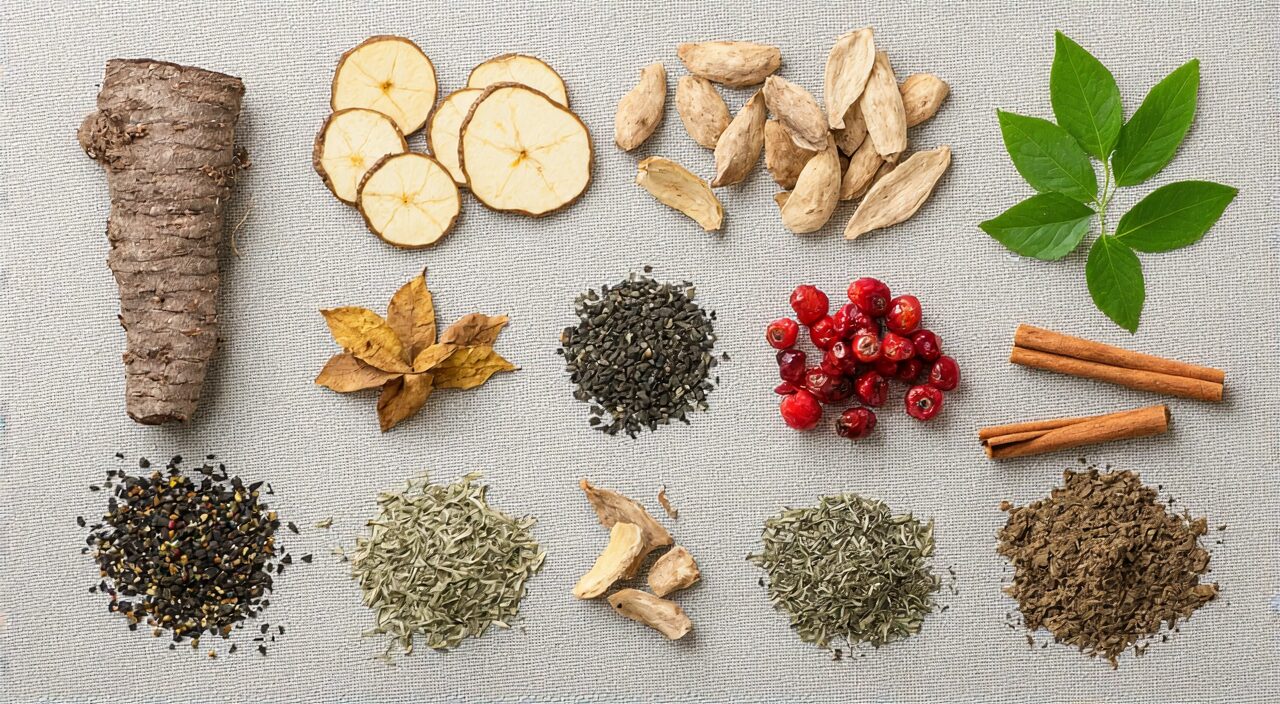
You Gui Wan is composed of the following herbs. The traditional understanding of each herb in the formula is roughly as follows:
| Herb | Traditional Understanding |
|---|---|
| Shu Di Huang (Prepared Rehmannia Root) | Nourishes yin, tonifies blood, replenishes essence and marrow; acts as the sovereign herb |
| Shan Yao (Chinese Yam) | Tonifies spleen, stabilizes kidney, boosts qi and nourishes yin |
| Shan Zhu Yu (Cornus Fruit) | Tonifies liver and kidney, astringes and secures |
| Gou Qi Zi (Goji Berry) | Nourishes liver and kidney, benefits essence and brightens eyes |
| Lu Jiao Jiao (Deerhorn Glue) | Warms and tonifies liver and kidney, benefits essence and nourishes blood; a substance with strong affinity to flesh and blood |
| Tu Si Zi (Dodder Seed) | Tonifies kidney, stabilizes essence, nourishes liver and brightens eyes |
| Du Zhong (Eucommia Bark) | Tonifies liver and kidney, strengthens sinews and bones |
| Dang Gui (Chinese Angelica Root) | Tonifies blood, invigorates blood, regulates menstruation and relieves pain |
| Rou Gui (Cinnamon Bark) | Supplements fire and assists yang, leads fire back to its source |
| Zhi Fu Zi (Processed Aconite Root) | Restores yang and rescues from collapse, supplements fire and assists yang; requires pre-decoction and processing |
From the combination, it is evident that yin-nourishing and yang-tonifying actions proceed in parallel, with a greater emphasis on yin-nourishing substances. This is a distinctive feature of You Gui Wan that differentiates it from purely yang-warming formulas.
3. What Symptom Directions Are Traditionally Applied?

In TCM pattern differentiation, You Gui Wan is often considered for a range of manifestations caused by “kidney yang deficiency and decline of mingmen fire.” These manifestations may include:
- Aversion to cold and cold limbs: The body feels colder than others around, especially below the waist and in the hands and feet, with a preference for warmth and aversion to cold.
- Soreness, weakness, and cold pain in the lower back and knees: The lower back and knees feel sore, weak, and have a cold painful sensation, which may not improve with movement.
- Low spirits / Fatigue: Mental weariness, shortness of breath, reluctance to speak, easy fatigability, and a general lack of energy throughout the day.
- Increased night urine, clear and profuse urine: Frequent trips to the bathroom at night, with clear and copious urine, sometimes even difficulty controlling it.
- Loose stools or chronic diarrhea: Tendency toward diarrhea, or early morning (dawn) diarrhea accompanied by a cold sensation in the abdomen.
- Decline in reproductive function: Males may experience impotence, premature ejaculation, cold semen and infertility; females may experience uterine cold infertility, clear and thin vaginal discharge, etc.
Important note: The above manifestations require comprehensive assessment. One should not self-diagnose kidney yang deficiency based on just one or two symptoms. For example, simple fatigue or back soreness could also be related to overwork or poor lifestyle habits and does not necessarily indicate kidney yang deficiency.
If symptoms recur persistently over a long period, or are accompanied by significant anxiety, palpitations, chest tightness, pain, or abnormal weight loss, it is advisable to consult a doctor promptly rather than self-prescribing a formula.
4. Situations Where You Gui Wan Is Not Appropriate
You Gui Wan is generally warming and tonifying in nature. Therefore, it is usually not suitable for the following situations, or requires cautious evaluation by a professional:
- Yin deficiency with fire effulgence: Manifestations include dry mouth and throat, heat sensation in the palms and soles, tidal fever, night sweats, irritability, insomnia, red tongue with little coating, etc. Using warming herbs in such conditions may aggravate the deficiency fire.
- Internal exuberance of damp-heat: Manifestations include thick, greasy yellow tongue coating, bitter or sticky taste in the mouth, yellow and scanty urine, sticky, foul-smelling stools or a low-grade fever that does not subside, etc. Warming tonification is inappropriate in this case.
- Excess heat patterns: For high fever, flushed face, constipation, scanty dark urine, etc., warming tonification is contraindicated.
- During colds and fevers: When external pathogens have not been cleared, it is not advisable to use tonifying and warming substances.
- Pregnancy, breastfeeding, and children: These special populations have complex conditions requiring higher medication safety standards and must be evaluated under a physician’s guidance.
- Allergy to ingredients: The formula contains deerhorn glue and aconite, among others; those with allergic constitutions need to pay extra attention.
Furthermore, You Gui Wan is not a daily health supplement and is not suitable for long-term use without pattern differentiation. If you have a chronic disease history or are taking other medications, it is also necessary to understand potential interactions in advance.
5. Differences Between You Gui Wan and Jin Gui Shen Qi Wan, Gui Fu Di Huang Wan, Liu Wei Di Huang Wan, and Zuo Gui Wan
Many people are confused about these kidney-tonifying formulas. Although they are all related to the “kidney,” their emphasis differs:
- Jin Gui Shen Qi Wan: Originating from “Jin Gui Yao Lue” (Essential Prescriptions from the Golden Cabinet), it adds Niu Xi (achyranthes root) and Che Qian Zi (plantain seed) to the base of Gui Fu Di Huang Wan. It emphasizes warming yang to transform qi and promoting urination to reduce swelling. It is often used for kidney yang deficiency leading to internal stagnation of water-dampness, such as heavy sensation in the waist, swollen feet, and difficult urination. Its water-promoting tendency is obvious, differing from You Gui Wan’s strong tonification of original yang and essence and marrow.
- Gui Fu Di Huang Wan: Composed of Liu Wei Di Huang Wan (Shu Di Huang, Shan Yao, Shan Zhu Yu, Fu Ling, Mu Dan Pi, Ze Xie) plus Rou Gui and Fu Zi. It can warm and tonify kidney yang, but its tonifying strength is gentler than You Gui Wan. Moreover, because it contains the three “draining” herbs (Fu Ling, Mu Dan Pi, Ze Xie), it both tonifies and drains, making it more suitable for milder kidney yang deficiency that does not require major essence replenishment.
- Liu Wei Di Huang Wan: Primarily nourishes kidney yin, with three tonifiers and three drainers. Suitable for kidney yin deficiency causing soreness and weakness in the lower back and knees, dizziness, tinnitus, night sweats, dry throat and mouth, etc. It is not suitable for those with yang deficiency and aversion to cold.
- Zuo Gui Wan: Also created by Zhang Jingyue, it purely tonifies true yin without fire-draining substances. It is used for prominent true yin deficiency and essence/marrow depletion, manifesting as dizziness, sore back, weak legs, spontaneous sweating, and night sweats. Not suitable for yang deficiency individuals. You Gui Wan and Zuo Gui Wan are a yin-yang pair, corresponding respectively to mingmen fire decline and true yin depletion.
Therefore, You Gui Wan’s uniqueness lies in “vigorously tonifying kidney yang and replenishing essence and blood.” It is more suitable for relatively obvious kidney yang depletion with concurrent essence and blood deficiency, presenting with severe aversion to cold, cold pain in the back and knees, impotence, seminal emission, and mental exhaustion.
However, this does not mean You Gui Wan is “stronger”; rather, it depends on whether it matches an individual’s constitution.
Summary
You Gui Wan, as a classic formula for warming and tonifying kidney yang and replenishing essence and marrow, may traditionally be suitable for manifestations caused by kidney yang deficiency and essence/blood deficiency, such as aversion to cold with cold limbs, soreness, weakness and cold pain in the lower back and knees, frequent night urination, and low spirits.
However, it is not suitable for conditions like yin deficiency with fire effulgence, internal damp-heat, excess heat patterns, or during colds and fevers. Special populations should also exercise caution. Meanwhile, although Jin Gui Shen Qi Wan, Gui Fu Di Huang Wan, Liu Wei Di Huang Wan, and Zuo Gui Wan are all related to the kidney, their emphases and application ranges differ significantly and cannot be used interchangeably.
Everyone’s constitution and specific manifestations are different. Whether You Gui Wan is suitable depends on a comprehensive assessment of one’s overall condition, ideally through TCM pattern differentiation. This article is for informational reference only and cannot replace professional diagnosis or treatment advice. If you experience significant discomfort or worsening symptoms, please seek medical help promptly.