
Who is Zuo Gui Wan Suitable For? Ingredients, Benefits, and Precautions

Many people interested in TCM health maintenance have heard of “Zuo Gui Wan,” especially when experiencing symptoms related to kidney deficiency, and they may wonder if it is right for them. In traditional Chinese medicine, regulating the kidneys is not simply about “tonifying the kidney”; distinctions must be made between kidney yin, kidney yang, and kidney essence. Zuo Gui Wan is a representative formula focusing on nourishing kidney yin and replenishing essence. This article will discuss its formulation principles, traditional uses, suitable and unsuitable populations, and its differences from common formulas such as Liu Wei Di Huang Wan, helping readers form a preliminary and clear understanding.
Understanding Zuo Gui Wan Through the Lens of “True Yin Deficiency”
Zuo Gui Wan originates from the “Jing Yue Quan Shu” by the Ming dynasty physician Zhang Jingyue. The original formula was not designed for a single symptom but centered around the core state of “true yin deficiency.” In TCM, true yin can be generally understood as the body’s deeper yin fluids and foundation of essence. When true yin is deficient and essence and blood are insufficient, the body lacks the substances needed to nourish bones, enrich the brain marrow, and moisten the orifices.
The approach of Zuo Gui Wan is “pure tonification without purgation,” unlike some formulas that also clear deficiency heat or drain dampness while tonifying. It consists almost entirely of nourishing and replenishing herbs, making it suitable for typical kidney yin and essence deficiency where signs of heat or dampness are not evident.
If there is yin deficiency accompanied by obvious fire hyperactivity or damp-heat, Zuo Gui Wan alone may not be appropriate, and adjustments with other herbs are often needed.
Composition of Zuo Gui Wan and Its Herbs
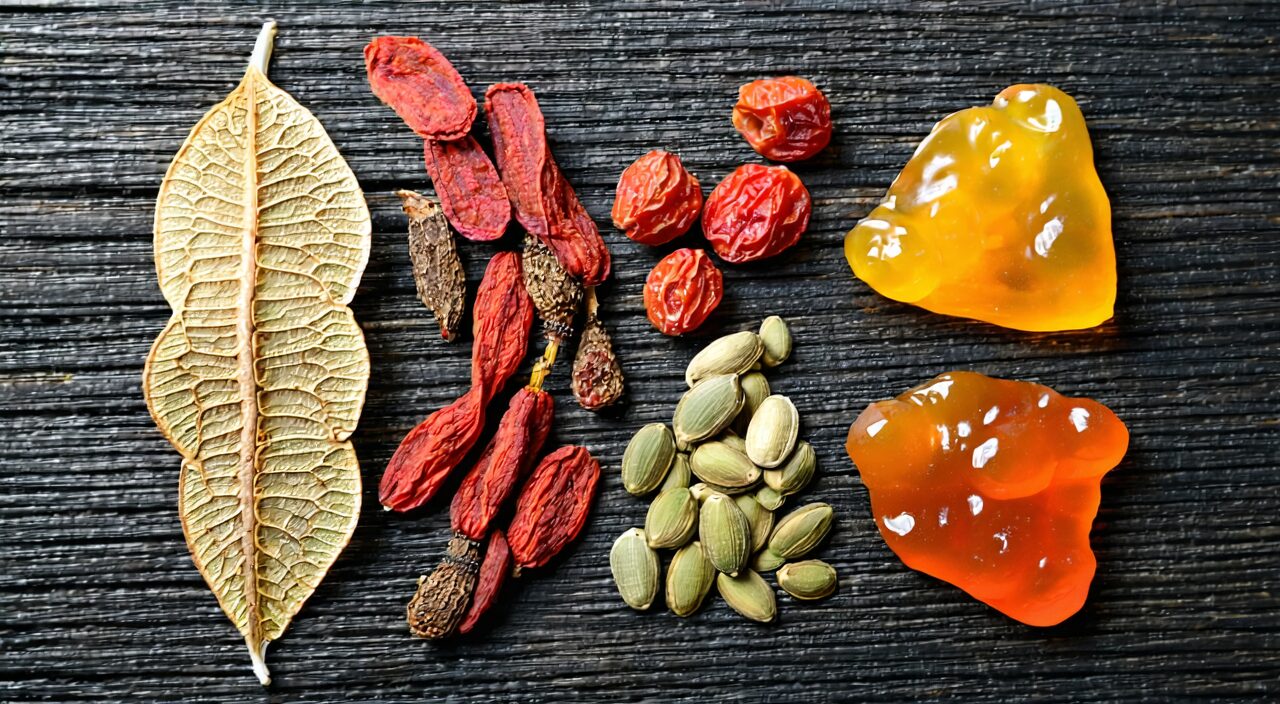
To understand a formula, examining its composition often gives an intuitive sense of its direction. The classic composition of Zuo Gui Wan is shown in the table below:
| Herb | Traditional Role in the Formula |
|---|---|
| Shu Di Huang (Rehmannia) | Nourishes yin, tonifies blood, benefits essence and fills marrow; the sovereign herb |
| Shan Yao (Chinese Yam) | Tonifies spleen and stomach, consolidates kidney and benefits essence |
| Gou Qi Zi (Goji Berry) | Nourishes liver and kidney, benefits essence and improves vision |
| Shan Zhu Yu (Cornus) | Tonifies liver and kidney, astringes and prevents leakage |
| Chuan Niu Xi (Cyathula) | Invigorates blood, unblocks menstruation, tonifies liver and kidney, strengthens sinews and bones, and guides the formula downward |
| Tu Si Zi (Cuscuta Seed) | Tonifies liver and kidney, secures essence and reduces urination |
| Lu Jiao Jiao (Deer Antler Glue) | Warmly tonifies liver and kidney, benefits essence and nourishes blood |
| Gui Ban Jiao (Turtle Shell Glue) | Nourishes yin, subdues yang, benefits kidney and strengthens bones |
From the composition, we can see that Shu Di Huang, Gui Ban Jiao, and Gou Qi Zi primarily nourish yin and replenish essence. Lu Jiao Jiao and Tu Si Zi gently incorporate warming and yang-supporting substances within the yin-nourishing framework, reflecting the principle of “seeking yin within yang,” with the aim of promoting better generation of yin essence.
The entire formula essentially contains no herbs that clear heat or drain dampness, so its nature is relatively cloying and rich. For individuals with weak digestion or heavy internal dampness, it may be difficult to metabolize.
Characteristics of Individuals Potentially More Suited to Zuo Gui Wan

It should be noted that whether to use Zuo Gui Wan should be determined based on individual constitution, specific symptoms, and professional judgment. The following are traditionally recognized constitutional tendencies that align more with Zuo Gui Wan’s approach, for reference only:
- Frequently feeling soreness and weakness in the lower back and knees, especially after exertion or prolonged standing, without a distinct heat sensation, more of a dull aching weakness.
- Prone to dizziness, tinnitus, memory decline, and a feeling of mental fogginess, along with a dry mouth and desire to drink water but not liking icy drinks.
- Sleep tends to be light with lots of dreams, but not the kind of insomnia caused by heart vexation and fire hyperactivity.
- Complexion appears dull and lackluster; hair tends to grey prematurely or fall out; nails are brittle and thin. In TCM, this is associated with essence and blood failing to nourish the upper body.
- Males may experience nocturnal emission or low semen volume; females may have scanty menstruation or delayed cycles, related to blood and essence insufficiency.
Not all these signs need to be present; as long as the general direction matches “kidney yin and essence deficiency with insufficient essence and blood” and there are few obvious signs of heat, dampness, or pronounced cold intolerance, they may fall within the scope of consideration for Zuo Gui Wan. However, this is not a black-and-white determination; constitutions are often complex, so avoid making a self-diagnosis lightly.
Situations Requiring Caution or Where Use Is Not Recommended
Because Zuo Gui Wan is mainly cloying and replenishing, the unsuitable population is quite clear. The following conditions are traditionally considered unsuitable:
- Significant yang deficiency with cold intolerance: Persistent cold hands and feet, cold pain in the lower back and knees, preference for hot drinks, low energy, and tendency to diarrhea. This is more indicative of kidney yang deficiency or essence-blood depletion with devitalized yang where cold signs dominate. Such cases are often more suited to You Gui Wan or similar warming and essence-fortifying approaches rather than Zuo Gui Wan’s pure yin nourishing.
- Damp-heat or phlegm-damp constitution: Thick, greasy tongue coating; bitter taste and sticky mouth; sticky, unformed bowel movements; heavy body; oily face; or overweight with soft muscles. The cloying nature of Zuo Gui Wan may exacerbate dampness and make digestion even more difficult.
- Spleen-stomach deficiency with weak digestion: Easily bloated, poor appetite, loose stools, and feeling of fullness after very small amounts of nourishing foods. The herbs in Zuo Gui Wan require strong digestive ability for absorption and transformation, so those with weak digestion often need to regulate the spleen and stomach first or combine spleen-promoting herbs.
- During colds, fevers, or acute inflammation: The body is dealing with external pathogens and is unsuitable for replenishing formulas.
- Pregnancy, breastfeeding, children, or those with specific medical conditions: These populations require strict evaluation under professional guidance and should not consider self-use.
If lower back and knee soreness is accompanied by obvious redness, swelling, heat and pain; or dizziness is accompanied by significant blood pressure fluctuations; or chronic insomnia is accompanied by marked palpitations and anxiety, these may point to more complex causes. Consulting a doctor should be prioritized over relying on a single formula.
Differences Between Zuo Gui Wan and Several Common Kidney-Tonifying Formulas
Many people compare Zuo Gui Wan with Liu Wei Di Huang Wan, even thinking they are completely interchangeable. In reality, the emphasis of these formulas is quite different.
Differences from Liu Wei Di Huang Wan
| Comparison Dimension | Liu Wei Di Huang Wan | Zuo Gui Wan |
|---|---|---|
| Composition Characteristics | Three tonics and three drainers, contains Ze Xie (Alisma), Mu Dan Pi (Moutan), Fu Ling (Poria) | Pure tonification without draining; mainly cloying and replenishing |
| Main Emphasis | Nourishes kidney yin while also clearing mild deficiency heat and draining dampness | Nourishes kidney yin, replenishes essence and marrow; more focused tonification |
| Suitable Presentations | Kidney yin insufficiency with mild deficiency heat: palms and soles hot, dry mouth and throat, tidal fever, night sweats, etc. | Significant yin-essence deficiency without obvious heat signs: lower back and knee soreness, dizziness, tinnitus, insufficient essence and blood |
| Simple Understanding | Broader scope, suitable for yin deficiency with heat | Stronger essence-fortifying action, suitable for yin-essence deficiency without obvious heat |
Differences from You Gui Wan
| Comparison Dimension | You Gui Wan | Zuo Gui Wan |
|---|---|---|
| Core Direction | Warms and tonifies kidney yang, replenishes essence and blood | Nourishes kidney yin, replenishes essence and marrow |
| Key Differentiation | Clear cold signs: aversion to cold, cold limbs, cold pain in lower back and knees, low spirits | Mainly dryness, soreness, and essence deficiency, without marked cold or heat bias |
| TCM Correspondence | Kidney yang deficiency, declined life gate fire | True yin deficiency, essence and blood depletion |
If cold intolerance is prominent, You Gui Wan is often prioritized; if dryness, soreness, and essence deficiency dominate without a clear cold or heat bias, Zuo Gui Wan’s approach may be more suitable.
Differences from Zhi Bai Di Huang Wan
| Comparison Dimension | Zhi Bai Di Huang Wan | Zuo Gui Wan |
|---|---|---|
| Formula Characteristic | Liu Wei Di Huang Wan base plus Zhi Mu (Anemarrhena) and Huang Bai (Phellodendron); strong heat-clearing effect | Pure yin-essence tonification without heat-clearing herbs |
| Applicable Direction | Obvious yin deficiency with fire hyperactivity: tidal fever, night sweats, dry mouth and sore throat, tinnitus with emission and strong internal heat | Not obvious deficiency heat; primarily essence deficiency |
| Caution | If no fire hyperactivity, using it may over-clear heat and damage yang qi | If fire hyperactivity is prominent, using it alone may not reduce the sense of heat |
Thus, the presence or absence of obvious deficiency fire is a key differentiation point.
Differences from Qi Bao Mei Ran Dan
| Comparison Dimension | Qi Bao Mei Ran Dan | Zuo Gui Wan |
|---|---|---|
| Focus | Tonifies liver and kidney, darkens hair, secures essence and blood; commonly used for premature greying, hair loss, loose teeth | Replenishes kidney yin-essence; widely used for systemic soreness and marrow insufficiency |
| Action Characteristics | Tends towards the blood aspect and liver/kidney, more upper-body manifestations | More targeted at the root of kidney yin-essence deficiency, more whole-body |
| Selection Thought | Often combined with upper signs of essence-blood failing to nourish, such as hair and teeth | Often combined with overall deficiency signs like lower back and knees, brain marrow, and essence-blood |
Which direction to choose should be determined based on overall symptom presentation.
All formulas mentioned in this article are for comparative and educational purposes regarding traditional usage directions. They do not suggest that any one formula can directly replace another, nor should one be considered inherently better; the choice depends on which better matches the individual’s actual condition.
Summary
Zuo Gui Wan is a classic formula grounded in nourishing kidney yin and replenishing essence. Traditionally, it is used for manifestations such as lower back and knee soreness, dizziness, tinnitus, dry mouth, and essence-blood insufficiency caused by true yin deficiency and essence-blood depletion. Its greatest difference from Liu Wei Di Huang Wan is its “pure tonification without draining,” making it less suitable for those with internal deficiency heat or dampness. Compared with You Gui Wan, it represents the yin-yang counterpart, with the key distinction being the presence or absence of cold intolerance.
Each person’s constitution is often complex and multi-layered, potentially involving simultaneous yin deficiency, yang deficiency, phlegm-dampness, qi stagnation, etc. Therefore, it is not recommended to self-select a formula based on just one or two symptoms. If related symptoms recur, persist for a long time, or are accompanied by significant anxiety, palpitations, chest tightness, pain, weight loss, or other changes, it is advisable to seek an in-person evaluation by a professional doctor. This article is for informational purposes only and cannot replace professional diagnosis or treatment advice.