
Who Is Ju Pi Zhu Ru Tang Suitable For? Composition, Benefits, and Precautions

Recurrent hiccups, nausea, and a sensation of wanting to vomit without being able to—these issues related to “rebellious stomach qi” are often understood in traditional Chinese medicine from the perspective of the stomach qi’s descending function and the balance of cold, heat, deficiency, and excess. Among the many classical formulas that descend rebellious qi, Ju Pi Zhu Ru Tang (Tangerine Peel and Bamboo Shavings Decoction) is a very representative choice. However, it is not a universal formula that covers every type of hiccup and vomiting; in its use, it is especially important to differentiate the constitution and the direction of symptoms. This article will explore Ju Pi Zhu Ru Tang’s formula characteristics from the perspectives of composition, traditional actions, suitable populations, contraindications, and differences from similar formulas, helping overseas readers gain a clearer understanding of this therapeutic approach.
Background of Ju Pi Zhu Ru Tang
Ju Pi Zhu Ru Tang was first recorded in the Essentials from the Golden Cabinet (Jin Gui Yao Lue), a formula specifically designed by Zhang Zhongjing for “yue ni” (hiccups with rebellious qi). Yue ni, in simple terms, refers to symptoms such as hiccups, retching, and a sensation of qi rushing upward. In traditional understanding, it is often associated with stomach deficiency complicated by heat and the failure of qi to descend. In later generations, this formula has also been commonly used for patterns seen during recovery from prolonged illness, when stomach qi has not yet been fully restored and there are concurrent signs of deficiency–irritability, mild fever, and dry mouth.
Composition and Formulation Logic
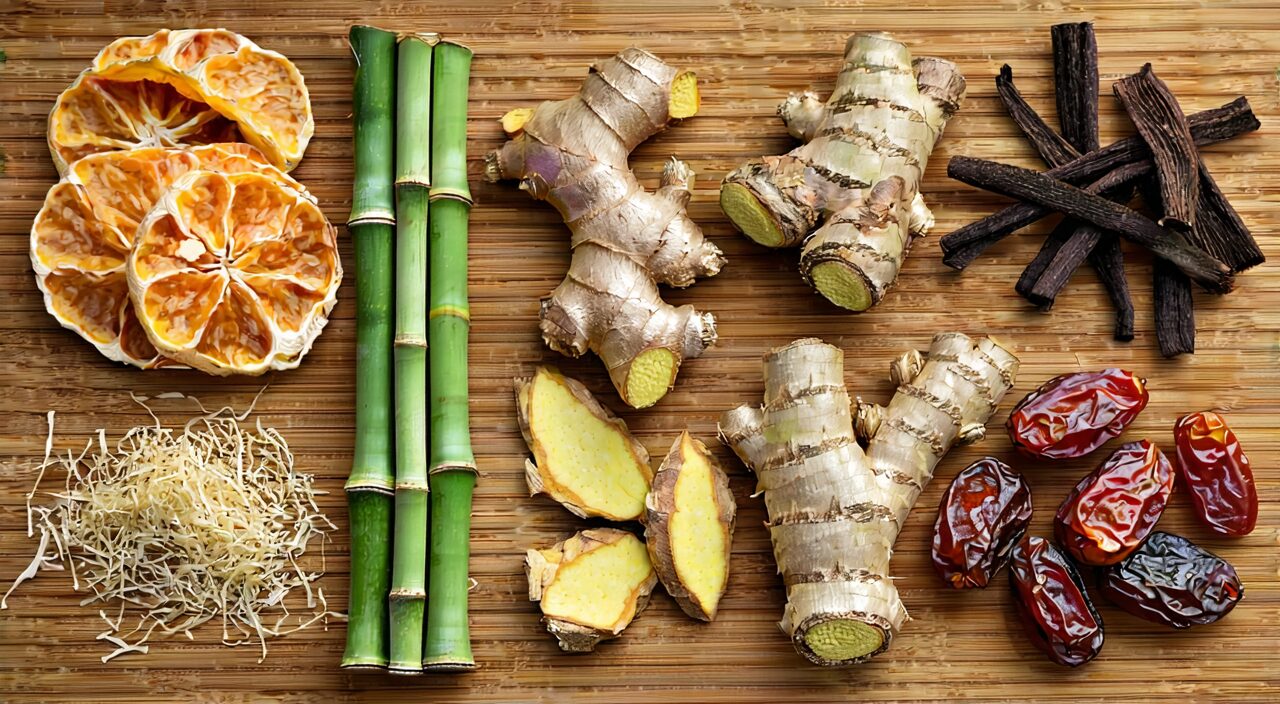
The entire formula is built around “descending rebellious qi to stop hiccups, supplementing qi and clearing heat.” The ingredients are concise but clearly structured. The original dosages and the traditional actions of each herb are as follows:
| Medicinal | Original Dosage | Traditional Action |
|---|---|---|
| Ju Pi (Tangerine Peel) | 2 sheng | Regulates qi and harmonizes the stomach, dries dampness and transforms phlegm, descends rebellious qi to stop hiccups |
| Zhu Ru (Bamboo Shavings) | 2 sheng | Clears heat and transforms phlegm, eliminates irritability and stops vomiting, harmonizes the stomach and descends rebellious qi |
| Da Zao (Jujube, Chinese Date) | 30 pieces | Supplements the center and boosts qi, moderates the nature of the other herbs |
| Sheng Jiang (Fresh Ginger) | 0.5 jin | Harmonizes the stomach and stops vomiting, disperses water–qi |
| Gan Cao (Licorice) | 5 liang | Supplements the spleen and boosts qi, harmonizes all medicinals |
| Ren Shen (Ginseng) | 1 liang | Supplements the qi of the spleen and stomach |
From a formulation perspective, Ju Pi (Tangerine Peel) and Zhu Ru (Bamboo Shavings) form the core: one moves qi and warms the middle, while the other clears and drains deficiency–heat, working together to restore the normal downward movement of stomach qi. Combined with Ren Shen (Ginseng), Gan Cao (Licorice), and Da Zao (Jujube) to boost qi and harmonize the middle, and Sheng Jiang (Fresh Ginger) to descend rebellious qi and stop vomiting, the entire formula is traditionally seen as one that simultaneously clears and supplements, focusing on unblocking and descending. It is suitable for situations where stomach deficiency is accompanied by heat signs and the qi rebels and fails to descend.
It is worth noting that the original dosages are quite large; in modern clinical practice, they are almost always adjusted according to the specific situation and are not applied directly. Thus, understanding the composition is more about grasping the principles of formulation and the underlying logic.
Traditional Actions and Effects
From the perspective of traditional formula studies, the main action of Ju Pi Zhu Ru Tang can be summarized as “descending rebellious qi to stop hiccups, supplementing qi and clearing heat.” It is not a simple, strong antiemetic; rather, it supplements the qi of the spleen and stomach and clears deficiency–heat from the stomach, allowing the qi mechanism to descend naturally. Therefore, in many classical texts, this formula tends to be used for hiccups of a deficiency nature without pronounced heat, rather than for sudden vomiting caused by exuberant excess heat or qi rebelliousness due to cold congealing.
This approach of “clearing, supplementing, and descending rebellious qi” also defines its relatively specific range of application—it is more suited to rebellious stomach qi caused by stomach qi deficiency and internal disturbance of deficiency–heat, rather than for every case of “hiccups” regardless of cause.
Who Is Ju Pi Zhu Ru Tang Suitable For?

From a traditional pattern-differentiation perspective, people who may be suitable for the therapeutic direction represented by Ju Pi Zhu Ru Tang typically share some of the following characteristics:
- Hiccups that occur repeatedly, varying in intensity, with a sound that is not loud, unlike the deep and tight sound of excess–cold patterns;
- Accompanied by nausea or retching, but without violent vomiting or uncontrollable emesis;
- A frequent sensation of deficiency–fullness in the stomach area, or a feeling of hunger that is not true hunger, with poor appetite and a tendency for mild bloating;
- Dry mouth, but without a desire to drink large amounts of cold fluids, sometimes accompanied by deficiency–irritability and restless sleep;
- A tongue that tends to be red with little coating, or pale-red and dry, and a pulse that tends to be weak and slightly rapid.
These manifestations have traditionally been classified as “stomach deficiency with heat, qi rebellious and failing to descend.” They are commonly seen in people who are weak from prolonged illness, are just recovering from a major disease, or whose spleen–stomach function is constitutionally weak, especially when combined with emotional upset or dietary irregularities. For such individuals, Ju Pi Zhu Ru Tang may be a relevant approach to understand. Whether it is ultimately appropriate, however, must be comprehensively evaluated based on the individual’s constitution, the current specific situation, and the judgment of a professional.
In addition, in modern times, under professional guidance, this formula has also been referenced for cases of hyperemesis gravidarum presenting with deficiency–heat and rebellious vomiting, or as an auxiliary support for certain post-chemotherapy nausea belonging to a pattern of stomach deficiency with heat. It must be emphasized that such cases must be determined by an experienced practitioner after strict pattern differentiation; individuals should never self-prescribe based on these references.
Contraindications and Situations Where It Should Not Be Used
Precisely because Ju Pi Zhu Ru Tang has a clear range of applicability, the following situations are generally not suitable:
- Stomach-cold hiccups: The hiccup sound is deep and slow, aggravated by cold or intake of cold and raw food, and relieved by warm water or external warmth. It is often accompanied by a fear of cold, absence of thirst, and a pale tongue with a white, slippery coating. Using the heat-clearing Zhu Ru (Bamboo Shavings) in such cases may worsen the discomfort; an approach of warming the middle and descending rebellious qi would be more appropriate.
- Severe excess heat patterns: If there is high fever, intense thirst with a craving for cold drinks, bad breath, constipation, flushed face and red eyes, and a dry yellow tongue coating, the priority is to drain excessive heat rather than to supplement qi and clear heat. Ju Pi Zhu Ru Tang’s action is relatively mild, so it should not be chosen without guidance.
- Acute severe vomiting and serious gastrointestinal diseases: Sudden, severe vomiting, inability to take any food or water, accompanied by intense abdominal pain, vomiting of blood, dark tarry stools, or marked weight loss—these often indicate acute abdominal conditions, gastrointestinal bleeding, or other serious diseases. In such cases, immediate medical attention is required. One must never treat them as ordinary “hiccups” or “nausea” and delay treatment.
- Special populations: Pregnant women, breastfeeding women, infants, young children, the elderly, and those with severe heart, liver, or kidney dysfunction should not refer to or use any formulas without a detailed evaluation by a Chinese medicine practitioner. Likewise, those with allergies to any of the individual herbs should avoid it.
In summary, although Ju Pi Zhu Ru Tang has a good effect in descending rebellious qi and harmonizing the stomach, once the pattern is misidentified—for example, if the assessment of cold and heat is wrong, or the condition already exceeds the scope of functional regulation—it will not only be difficult to achieve the expected effect but may also mask the real problem.
Differences Between Ju Pi Zhu Ru Tang and Xuan Fu Dai Zhe Tang
Among the formulas that descend rebellious qi and harmonize the stomach, Xuan Fu Dai Zhe Tang (Inula and Hematite Decoction) is often discussed together with Ju Pi Zhu Ru Tang. Both originate from the Treatise on Cold Damage and Miscellaneous Diseases and can be used for hiccups, belching, and nausea. However, a closer look reveals distinctly different emphases.
Xuan Fu Dai Zhe Tang is composed of Xuan Fu Hua (Inula Flower), Dai Zhe Shi (Hematite), Ban Xia (Pinellia Rhizome), Sheng Jiang (Fresh Ginger), Ren Shen (Ginseng), Gan Cao (Licorice), and Da Zao (Jujube). It focuses more on “stomach deficiency with phlegm obstruction and rebellious qi that fails to descend.” The typical presentation is frequent belching, a sensation of stuffiness and hardness in the epigastrium (a blocked feeling in the stomach area), and even a sense of discomfort after a hiccup. The formula employs Xuan Fu Hua and Dai Zhe Shi to heavily settle and descend rebellious qi, and Ban Xia to transform phlegm and dissipate masses—overall it leans toward subduing phlegm–qi. In contrast, Ju Pi Zhu Ru Tang primarily clears heat and regulates qi; it does not use heavy mineral substances to settle, and its overall tendency is to clear and supplement. It is more suited to stomach deficiency with superimposed heat, where heat disturbs and causes qi to rebel.
To put it simply: Xuan Fu Dai Zhe Tang is more inclined toward “phlegm–qi stuffiness and blockage” presenting with belching and hiccups, with a tongue coating that tends to be slimy; Ju Pi Zhu Ru Tang is more inclined toward “deficiency–heat harassing the upper body” presenting with hiccups and retching, with a tongue that is red and short on fluids.
Brief Comparison with Ding Xiang Shi Di Tang, Ban Xia Xie Xin Tang, and Zuo Jin Wan
Although these formulas all involve nausea and hiccups, their underlying pathogenesis differs significantly. A side-by-side comparison makes it easier to see the different pattern-differentiation approaches:
| Formula | Core Orientation | Typical Manifestations | Key Difference from Ju Pi Zhu Ru Tang |
|---|---|---|---|
| Ding Xiang Shi Di Tang (Clove and Persimmon Calyx Decoction) | Warm the middle and descend rebellious qi | Stomach cold from deficiency, weak hiccup sound, aggravated by cold and relieved by warmth | The direction of cold versus heat is opposite; strict differentiation is required |
| Ban Xia Xie Xin Tang (Pinellia Heart-Draining Decoction) | Simultaneously address cold and heat, disperse stuffiness and resolve masses | Epigastric stuffiness and fullness, nausea and vomiting, borborygmus and diarrhea, tongue coating that is a mix of yellow and white and slimy | The pathogenesis is mixed cold and heat involving the intestines; Ju Pi Zhu Ru Tang is more for stomach deficiency with heat, and borborygmus and diarrhea are not usually the main symptoms |
| Zuo Jin Wan (Left Metal Pill) | Clear and drain liver fire, descend rebellious qi and stop vomiting | Liver fire invading the stomach, gastric upset and acid reflux, bitter taste in the mouth, hypochondriac pain | The heat tends to be liver–stomach fire rushing upward; deficiency–heat manifestations are not obvious |
Understanding the differences between these formulas is not meant to encourage people to choose a formula for themselves, but rather to help them, when reading relevant information, understand why similar symptoms of “hiccups” and “nausea” can lead to completely different therapeutic pathways in Chinese medicine.
Summary
Ju Pi Zhu Ru Tang is a structurally concise formula from traditional Chinese medicine for descending rebellious qi. Its core approach is to descend rebellious qi to stop hiccups, supplement qi, and clear heat. It is commonly used for hiccups, retching, and deficiency–irritability caused by stomach deficiency with heat and rebellious qi that fails to descend. Its target population is relatively specific: it requires certain deficiency–heat characteristics, and it cannot be considered for every case of hiccups or nausea.
At the same time, it differs clearly from formulas such as Xuan Fu Dai Zhe Tang, Ding Xiang Shi Di Tang, Ban Xia Xie Xin Tang, and Zuo Jin Wan in terms of pathogenic emphasis, which is a reflection of the Chinese medicine principle of “treating the same disease with different methods.” Therefore, when faced with recurrent hiccups and nausea, it is not advisable to self-apply any particular formula. Instead, after understanding its rationale, the condition should be evaluated by a professional based on specific symptoms and constitution. This article is solely for educational purposes on traditional formula knowledge and cannot replace professional diagnosis or individualized recommendations.