
Who is Xinyi San Suitable For? Composition, Benefits and Contraindications

Many people experience nasal congestion, a constant runny nose with clear discharge, and an uncomfortable stuffy sensation in the forehead during seasonal changes or after catching a cold. In traditional Chinese medicine, this is often related to “wind-cold” affecting the nasal passages. Xinyi San is a frequently mentioned formula that mainly addresses this by dispelling wind-cold and unblocking the nasal passages.
However, not all nasal congestion is suitable for Xinyi San; using it incorrectly may actually worsen the discomfort. This article will explain Xinyi San’s composition, traditional benefits, who it is more suitable for, its contraindications, and how it differs from formulas like Cang Er Zi San, to help you better understand this formula.
Understanding Xinyi San from the Perspective of Dispelling Wind-Cold and Unblocking Nasal Passages

When dealing with a stuffy nose, traditional Chinese medicine does not only look at the nose itself but considers the condition of the entire body. When external wind-cold invades, lung qi is affected, and the upward movement of qi cannot reach the nasal passages smoothly, easily leading to nasal congestion, clear nasal discharge, and decreased sense of smell. Xinyi San is designed along this line of thought, primarily targeting nasal obstruction caused by wind-cold, rather than all nasal problems.
The Traditional Direction of Xinyi San is “Dispersing and Unblocking” Rather Than “Tonifying”
Xinyi San focuses on dispersing cold, expelling wind, and unblocking the orifices, with its actions directed outward and upward. Traditionally it is used for unresolved exterior patterns where wind-cold is still at the body surface, rather than for long-term rhinitis caused by deficiency. If you often feel short of breath, fatigued, or sweat easily, such conditions might need to be addressed from the perspective of replenishing qi and securing the exterior, rather than directly using Xinyi San.
Overview of Xinyi San’s Composition
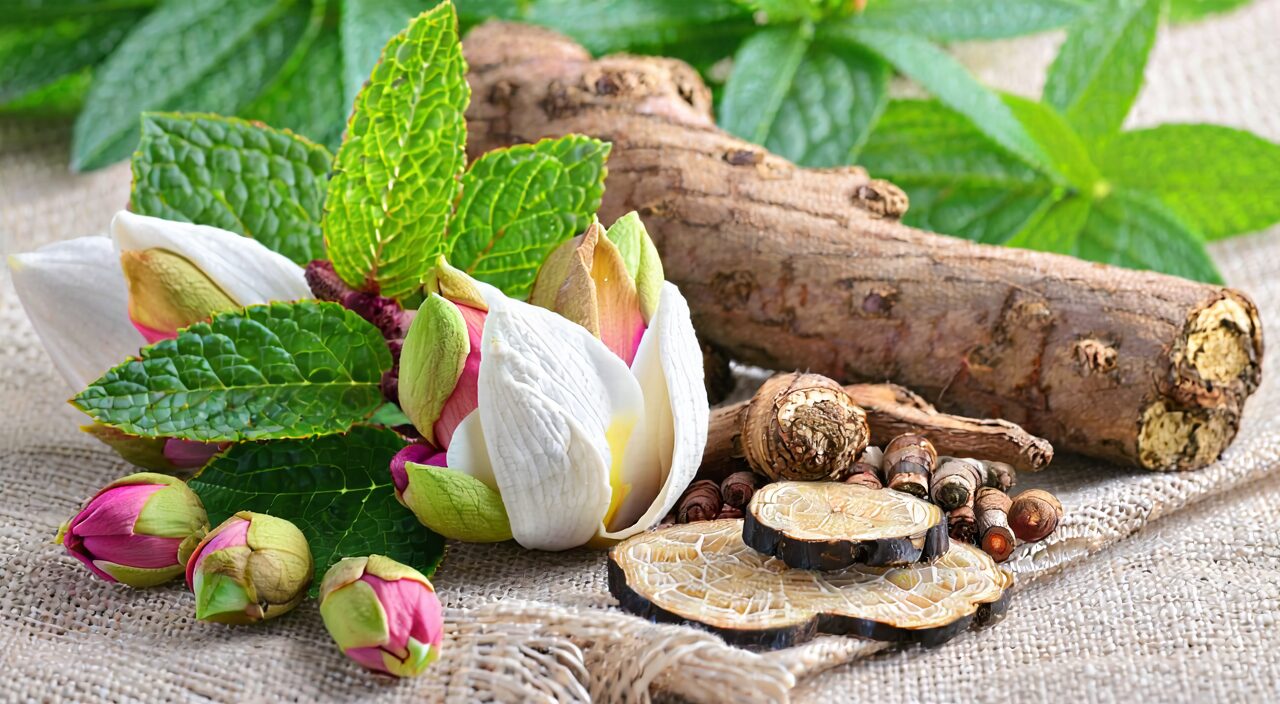
Understanding the composition of a formula gives a clearer idea of why it suits certain conditions. Xinyi San commonly includes the following herbs, each with its own emphasis, which work together to achieve the goal of dispersing cold and unblocking the orifices.
| Herb | Traditional Functions Emphasis |
|---|---|
| Xin Yi (Magnolia Flower) | Unblocks nasal passages, disperses wind-cold; often used as a guiding herb for nasal congestion |
| Bai Zhi (Angelica Dahurica) | Dispels wind-cold, dries dampness and unblocks orifices; especially suitable for frontal distension |
| Xi Xin (Asarum) | Warms the channels and disperses cold, opens and unblocks nasal passages; used for more severe wind-cold nasal congestion |
| Qiang Huo (Notopterygium) | Releases the exterior and disperses cold, adept at dealing with wind-cold-dampness affecting the upper body |
| Fang Feng (Saposhnikovia) | Expels wind and releases the exterior, overcomes dampness and relieves pain, helps disperse external wind |
| Sheng Ma (Cimicifuga) | Raises yang qi, vents external pathogens, assists in guiding the formula upward |
| Gan Cao (Licorice) | Harmonizes the other herbs, moderates the acrid dispersing nature of the other ingredients |
Specific herbs may vary slightly among different medical records, but the overall strategy centers on acrid-warm dispersing and diffusing. Note that this is a traditional composition reference; modern preparations may have adjustments, so always follow the product instructions and advice from a qualified professional.
Who Is Xinyi San More Suitable For?

From a traditional syndrome differentiation perspective, Xinyi San is more suitable for wind-cold type nasal obstruction. In other words, its key manifestations are predominantly cold signs and a blocked nose.
Common Indications
- Significant nasal congestion that worsens with cold: Nasal congestion becomes worse when the weather turns cold or after exposure to wind, and improves in warmer environments.
- Clear, watery nasal discharge: The mucus is clear or white and thin rather than yellow and thick.
- Distension and discomfort in the head and forehead: A feeling of fullness, heaviness or pressure in the forehead or brow ridge area, sometimes associated with general head discomfort.
- May be accompanied by mild aversion to cold: The body is sensitive to wind and cold, but generally without obvious heat signs like fever, thirst, or a red, swollen throat.
If the above manifestations are typical, Xinyi San might be a traditional option worth knowing about. However, individual constitutions vary, and it is advisable to make a comprehensive judgment based on tongue and pulse diagnosis.
Cases Requiring Caution and Unsuitable Groups
Some nasal discomfort may resemble wind-cold but is actually not suitable for Xinyi San. The following situations require special attention:
- Yellow, thick nasal discharge or a sensation of heat in the nose: If the mucus is yellow, sticky, possibly with a foul smell, or there is a feeling of heat inside the nose, this often indicates wind-heat or damp-heat. Using Xinyi San, which is based on acrid-warm herbs, may aggravate the condition.
- Tendency to nosebleeds: Xinyi San contains many acrid-dispersing herbs which may promote reckless movement of blood. People who frequently have nosebleeds or have a dry nasal cavity prone to bleeding are advised not to use it on their own.
- Yin deficiency with fire hyperactivity constitution: Those who easily experience dry mouth, hot palms and soles, malar flushing, night sweats, and a red tongue with little coating already have insufficient yin fluids; further using acrid-dispersing herbs may easily consume body fluids.
- Pregnant women, children, and special populations: These groups have unique physical conditions and require extra caution. Such formulas should not be used without professional guidance.
Any long-term, recurring, or severe nasal congestion, especially accompanied by severe headache, vision changes, progressively worsening unilateral nasal congestion, or recurrent nosebleeds, should prompt a timely medical visit to rule out other causes rather than self-medicating.
Differences Between Xinyi San and Similar Formulas
While learning about Xinyi San, many people also come across formulas like Cang Er Zi San, Yin Qiao San, Chuan Xiong Cha Tiao San, and Yu Ping Feng San. Their applications differ, and clarifying these differences is crucial to avoid misuse.
Cang Er Zi San
Cang Er Zi San is also commonly used for nasal congestion, but it is more suited to wind-heat or wind-dampness obstructing the nasal passages. The nasal discharge may change from clear to turbid, or there may be mild yellow mucus and frontal distension and pain. Besides orifice-opening herbs like Xin Yi and Bai Zhi, it also includes Cang Er Zi to strengthen the unblocking effect on the nasal passages.
In comparison, Xinyi San leans more toward acrid-warm dispersing of cold, while Cang Er Zi San leans more toward unblocking the orifices and transforming turbidity, highlighting different emphases on cold and heat. If clear nasal discharge and a strong aversion to cold are prominent, Xinyi San may be more suitable. If turbid discharge and a heavy head sensation are more obvious, Cang Er Zi San may be worth considering.
Yin Qiao San
Yin Qiao San is a classic formula for wind-heat exterior patterns, often used for fever, sore throat, thirst, and yellow, thick nasal discharge—all signs of heat. Its direction is acrid-cool releasing the exterior and clearing heat-toxins. Xinyi San, on the other hand, focuses on acrid-warm dispersing of cold, a completely different approach. Confusing Yin Qiao San with Xinyi San, and applying acrid-cool to wind-cold or acrid-warm to wind-heat, would both be incorrect.
Chuan Xiong Cha Tiao San
The main direction of Chuan Xiong Cha Tiao San is to dispel wind and relieve pain, especially suitable for headaches caused by wind invading the head. It may be accompanied by nasal congestion and aversion to wind, but unblocking the nose is not its primary focus; its core actions are to dispel wind, invigorate blood, and stop pain. If headache is the main complaint and nasal congestion is only a very mild accompanying symptom, Chuan Xiong Cha Tiao San may be what to look into, rather than directly using Xinyi San.
Yu Ping Feng San
Yu Ping Feng San is a formula for boosting qi and securing the exterior, suitable for those with a weak constitution who catch colds easily, sweat on slight exertion, and frequently experience recurrent nasal congestion and itching with a deficient-cold tendency. Its approach is entirely different from Xinyi San: Xinyi San focuses mainly on expelling pathogens, while Yu Ping Feng San focuses on strengthening the body’s rightness.
If you are easily fatigued, short of breath, and suffer from frequent minor illnesses, you may need Yu Ping Feng San to strengthen the body’s defenses rather than relying on Xinyi San to temporarily unblock the nose. Long-term reliance on acrid-dispersing formulas while neglecting constitutional regulation may not benefit overall health.
Daily Considerations and a Holistic View

In terms of lifestyle, regardless of the type of nasal problem, avoiding wind and cold, keeping warm, and preventing overexertion are very basic forms of self-care.
Diet-wise, cold-natured foods such as icy drinks, raw and cold fruits may worsen clear, watery nasal discharge, so they can be appropriately reduced. Keeping indoor air circulating and avoiding dryness and dust irritation can also help relieve nasal discomfort.
It is important to note that the use of Chinese herbal formulas is based on pattern differentiation. Even classical formulas should not be used casually without distinguishing between cold, heat, deficiency, or excess. This article is for informational purposes only and does not constitute any usage advice. Whether Xinyi San should be considered must be determined based on individual constitution, specific symptoms, and guidance from a qualified professional.
Summary
In traditional Chinese medicine, Xinyi San is a formula targeting wind-cold induced nasal obstruction. It addresses symptoms like nasal congestion, clear nasal discharge, and head or forehead discomfort by dispelling wind-cold and unblocking the nasal passages. It is suitable for patterns with clear cold signs, thin and clear mucus, and worsening with cold, and is unsuitable for those with yellow, thick nasal discharge, nasal heat, yin deficiency with fire hyperactivity, or bleeding tendencies.
When choosing a treatment direction, it is vital to distinguish between cold and heat, deficiency and excess, especially paying attention to the differences between Xinyi San and formulas like Cang Er Zi San and Yin Qiao San. For long-term, recurrent nasal issues, it is advisable to first clarify the root cause before making further plans.