
TCM Causes and Precautions for Acid Reflux & Heartburn: Liver-Stomach Disharmony, Stomach Heat, or Food Stagnation?

After a meal, it feels like there’s a burning fire in your chest, sour fluid surges up into your throat, and it’s especially uncomfortable when you lie down—many people have experienced this sensation of acid reflux and heartburn. You may have tried various methods: drinking soda water, taking acid-suppressing medications. Sometimes they provide temporary relief, but other times the symptoms keep coming back, or even get worse after suppression. This leads many to turn to Traditional Chinese Medicine (TCM), hoping to find a regulation approach that suits their constitution better, starting from the root.
In TCM, acid reflux and heartburn are not independent disease names. They are discussed under categories such as “epigastric noise,” “acid regurgitation,” and “acid swallowing.” Their occurrence isn’t solely a stomach problem; it often involves coordination with the liver and spleen. More importantly, the cause of reflux can be completely opposite in different people: some are pushed upward by “heat,” while others are blocked by “cold,” and there are even mixed cold-heat patterns. If you simply use heat-clearing remedies, in cases of deficiency-cold or mixed cold-heat constitutions, it won’t work—it may even worsen the discomfort.
This article explores the possibilities behind acid reflux and heartburn from several common TCM pattern types, and introduces some traditional Chinese patent medicines often used in relevant directions, as a reference for further understanding.
Why Acid Reflux and Heartburn Can’t Just Be Blamed on “Fire”
When mentioning acid reflux and a burning sensation in the chest, many people’s first reaction is “excessive internal heat,” so they self-medicate with bitter-cold heat-clearing drugs. This may bring temporary relief to some with excessive stomach heat, but more often, the root cause of acid reflux and heartburn is disordered “qi movement” of the stomach.
TCM holds that stomach qi naturally descends; after digestion, food should be transmitted downward. If, for some reason, stomach qi fails to descend and instead rises upward, carrying acidic gastric fluids up with it, it causes acid reflux, heartburn, and belching.
There are many reasons for stomach qi to rise counterflow:
- Liver qi invading the stomach: When you’re stressed, anxious, or angry, liver qi stagnation forms and transversely attacks the stomach, pushing stomach qi upward.
- Stomach heat exuberance: Excessive intake of spicy, greasy, fried foods, or long-term alcohol consumption causes heat to accumulate in the stomach and intestines, steaming upward.
- Food stagnation: Eating too much or too many mixed foods at once overwhelms the spleen and stomach’s transportation function. Food ferments in the stomach, producing gas and acid.
- Spleen-stomach deficient cold: When the spleen’s transportation ability is insufficient, internal cold-dampness generates, also affecting the stomach’s downbearing function.
Thus, from a TCM perspective, acid reflux and heartburn result from multiple intertwined factors. You cannot simply “clear heat just because you see heat.” Below, we detail several common pattern types and their daily life manifestations.
Liver-Stomach Disharmony: When Emotions Fluctuate, Acid Surges Upward

In clinics and daily life, you often see a group of people: whenever they get angry, nervous, or are under pressure for a few continuous days, their stomach churns, and acid reflux, heartburn, and belching follow one after another. They may also feel distension and discomfort in the rib sides. In traditional TCM, this is largely understood as “liver-stomach disharmony,” most commonly liver-stomach depressive heat or liver qi invading the stomach.
Typical Manifestations
- Acid reflux and heartburn are clearly linked to emotions: worse when upset, better when calm.
- Often accompanied by chest tightness, rib-side distension, and frequent sighing.
- Bitter taste in mouth, dry throat, sometimes the sensation of something stuck in the throat.
- Tongue edges red, thin yellow or yellow greasy coating.
Liver qi is like the body’s “dispatcher.” If the dispatcher gets blocked up, it may mistakenly affect its neighbor—the stomach—causing the stomach’s “downward passage” to suddenly reverse. Long-standing liver qi depression can easily transform into fire; this is called “liver-stomach depressive heat.”
Traditional Chinese Patent Medicine Application Ideas
In the use of traditional Chinese patent medicines for such cases, Jia Wei Xiao Yao Wan (Supplemented Free and Easy Wanderer Pill) and Zuo Jin Wan (Left Metal Pill) are two frequently mentioned directions.
- Jia Wei Xiao Yao Wan: Based on Xiao Yao Wan’s liver-soothing and depression-relieving formula, it adds heat-clearing herbs. For those whose long-term liver depression has slightly transformed into heat, experiencing obvious acid reflux and heartburn during emotional fluctuations along with dry mouth, irritability, and tendency to lose temper, it’s often taken as a traditional regulation approach. Whether it suits an individual still depends on their specific constitution, symptoms, and professional advice.
- Zuo Jin Wan: The formula is simple, containing only Coptis (Huang Lian) and Evodia (Wu Zhu Yu). Coptis is bitter-cold and clears stomach heat; Evodia is acrid-warm and soothes the liver to direct qi downward. The combination of cold and warm targets acid reflux, epigastric noise, bitter taste, and rib pain caused by “liver fire invading the stomach.” It is traditionally used to relieve chest and rib-side distension and pain, vomiting, and acid swallowing. Note, however, that Zuo Jin Wan’s Coptis dosage far exceeds Evodia’s, making it cold in nature. It truly suits cases with obvious heat signs. For deficiency-cold or mixed cold-heat, Zuo Jin Wan alone may be unsuitable.
If you find your acid reflux and heartburn closely tied to emotional ups and downs, don’t rush to use heat-clearing remedies. Observe your tongue and overall feeling first: Are the tongue edges and tip red with obvious bitter taste and irritability? Or despite reflux, do you fear cold and have loose stools? This judgment directly determines whether to choose a liver-clearing, fire-draining approach or a warming middle-jiao and soothing liver approach.
Stomach Heat Reflux: Bitter Taste, Bad Breath, and a Constant Heated Feeling in the Stomach
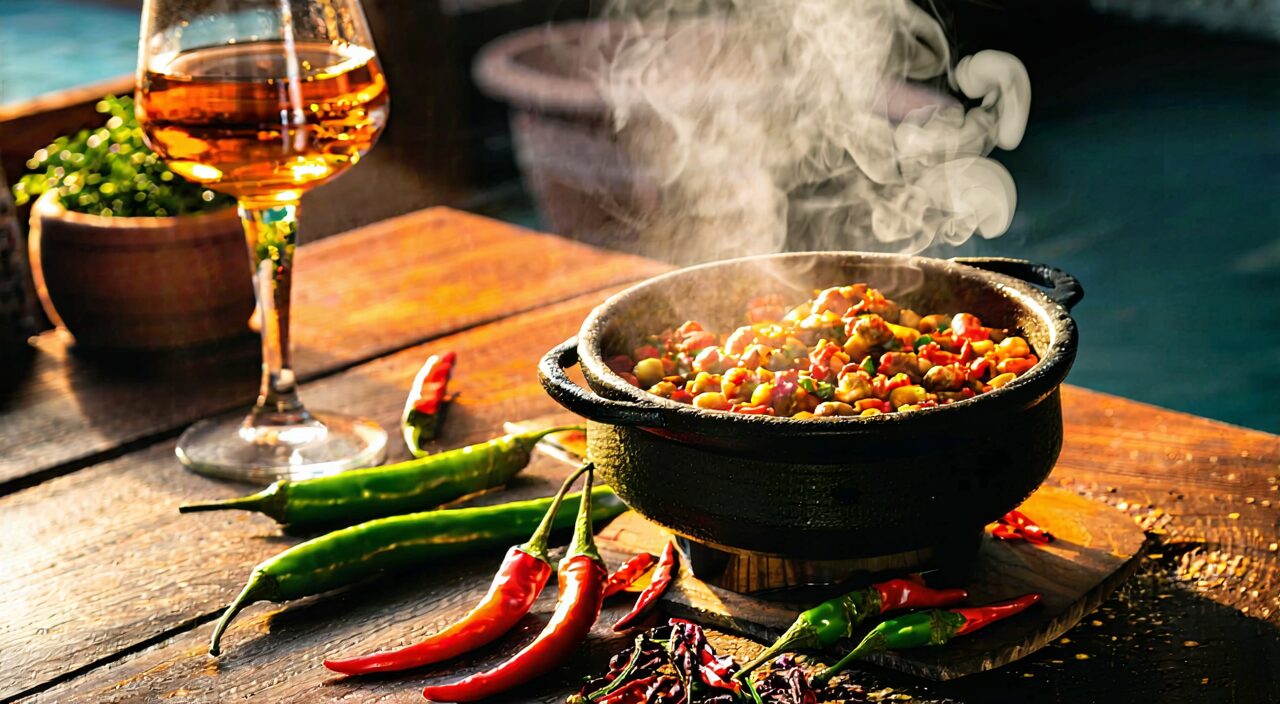
There’s another type of acid reflux and heartburn less linked to emotions and more related to diet. Those who favor strong flavors—hot pot, barbecue, spicy hot pot, or drink high-proof alcohol regularly—gradually accumulate a pathogenic heat in the stomach. This heat steams upward, carrying acidic fluids, producing an intensely burning sensation.
Typical Manifestations
- Obvious burning sensation in the chest and epigastric area; drinking cool water temporarily relieves it.
- Bitter taste, dry mouth, bad breath, easy gum swelling and pain.
- During reflux, the upward force of acid is stronger, sometimes with “heartburn” spreading to the throat.
- Stools tend to be dry and hard; urine is yellow.
- Tongue body red, with yellow coating or even burnt yellow.
Stomach heat exuberance type reflux truly belongs to “having fire,” but long-term blind use of bitter-cold fire-clearing drugs is still not recommended. Bitter-cold substances can easily damage stomach qi with prolonged use, possibly temporarily suppressing symptoms but laying the groundwork for weak transportation function later.
Traditional Chinese Patent Medicine Application Ideas
Zuo Jin Wan remains a traditional choice when stomach heat is obvious and liver qi discomfort is also present. If it’s purely stomach fire exuberance without obvious rib-side distension or emotional triggers, some TCM practitioners consider approaches focusing on clearing and draining stomach fire, using formulas containing Coptis, Gypsum (Shi Gao), Gardenia (Zhi Zi), etc. In the patent medicine field, choices for simple stomach-heat reflux need more careful differentiation. It is advisable to combine product instructions, personal conditions, and professional advice for a comprehensive decision; don’t self-medicate with heat-clearing and fire-draining drugs casually.
Food Stagnation Reflux: Belching with a Putrid Smell, Bloated and Stuck After Meals

Some people’s acid reflux and heartburn follow a clear pattern—they almost always occur after eating too much or too greasy food. Especially after several consecutive holiday feasts, when lying down at night, the stomach feels full, acid pushes up against the throat, belching smells putrid or sour, and the chest feels oppressive. This is likely what TCM calls “food stagnation transforming into heat” causing acid reflux.
Typical Manifestations
- Clear history of dietary indiscretion, often overeating or consuming large amounts of greasy, sweet, rich foods before onset.
- Acid reflux and belching smell sour-putrid, like fermented sourness.
- Epigastric distension, blockage, even pain, tender to pressure, slightly relieved after belching or passing gas.
- May be accompanied by nausea, aversion to food, difficult or sloppy stools with strong odor.
- Tongue coating thick and greasy, often thick white greasy or yellow greasy.
Food sitting in the stomach without timely transportation is like a pile of wet garbage fermenting under high temperatures, producing sour putrid qi that rushes upward—this is an intuitive understanding of food stagnation reflux.
Traditional Chinese Patent Medicine Application Ideas
Bao He Wan (Harmony-Preserving Pill) is one of the classic formulas for treating food stagnation. It is traditionally used to promote digestion, remove stagnation, harmonize the stomach, and direct counterflow downward. For acid reflux, putrid belching, abdominal bloating, and poor appetite after overeating or mixing foods, it can serve as a reference direction. However, Bao He Wan leans toward dispersing and has strong “dispersing” power; it is not suitable for long-term use. If food stagnation has resolved but reflux persists, Bao He Wan cannot be continued; a new pattern differentiation is needed to see if the spleen’s transportation is inherently insufficient.
Easily Overlooked Mixed Cold-Heat: Both Aversion to Cold and Acid Reflux

Clinically, there’s another challenging scenario: some people clearly have acid reflux and heartburn, yet simultaneously fear cold, can’t eat cold things, and experience stomach bloating or diarrhea right after consuming cold items. If you only use heat-clearing medicine, the cold enters the stomach, further damaging the spleen and stomach, potentially worsening reflux. But if you assume fear of cold equals deficiency-cold and use warming tonics, it may aggravate heat and make heartburn worse. This is typical mixed cold-heat: the stomach contains both heat and cold, or spleen deficient cold-dampness coexists with stomach heat.
Typical Manifestations
- Acid reflux and heartburn, but the stomach fears cold, prefers warm water, and dares not touch raw/cold foods.
- Sometimes dry mouth and bitter taste; other times bland or sticky mouth.
- Stools may be dry or loose, or start dry then turn loose, with no obvious pattern.
- Tongue body may be pale, but tongue coating yellow-greasy; or tongue red but coating white.
This pattern often forms because the spleen and stomach are inherently weak, with poor transportation, causing water-dampness to stagnate, qi movement to be unsmooth, and depression to transform into heat—thus a mixed cold-heat situation. It differs from pure stomach heat with unitary heat signs; it combines cold and heat, deficiency and excess.
Traditional Chinese Patent Medicine Application Ideas
For mixed cold-heat reflux, Xiang Sha Liu Jun Wan (Costus and Amomum Six Gentlemen Pill) can serve as a traditional reference, but it mainly warms the middle-jiao, strengthens the spleen, moves qi, and transforms dampness; its heat-clearing strength is weak. Xiang Sha Liu Jun Wan is more suited to epigastric discomfort, belching, poor appetite, and loose stools caused by spleen deficiency with qi stagnation and dampness obstructing the middle-jiao. If there are obvious heat signs, Xiang Sha Liu Jun Wan alone may be insufficient, requiring combination with other regulation approaches. Traditionally, formulas for mixed cold-heat such as Ban Xia Xie Xin Tang (Pinellia Heart-Draining Decoction) also need to be modified by a physician according to specific conditions. Therefore, when you judge that you have both cold signs (fear of cold) and heat signs (reflux, heartburn), it is inadvisable to self-select medicine; consult a professional promptly.
Some Reminders on Diet and Lifestyle Regulation

Adjustments in diet and daily habits are vital for alleviating acid reflux and heartburn; they often form the foundation of regulation itself. The following suggestions are not treatment methods, but can help reduce the frequency and severity of reflux at the daily level.
Adjust Eating Rhythm
- Slow down eating speed and chew thoroughly. Gobbling food increases stomach burden and easily swallows excess air.
- Eat smaller, more frequent meals; stop at 70–80% fullness to avoid excessive stomach distension causing pressure.
- Reduce intake of high-fat, high-sugar, spicy, and overly hot foods, which may stimulate gastric acid secretion and worsen stomach heat or food stagnation.
Pay Attention to Post-Meal Posture and Clothing
- Do not lie down immediately after eating. Keep upright or at least reclining for 30 minutes to 1 hour.
- If nighttime reflux is obvious, elevate the upper body slightly while sleeping to use gravity to reduce acid backflow.
- Avoid tight clothing around the waist and abdomen; give your stomach a comfortable space.
Identify Your “Triggers”
- For some people, coffee, strong tea, chocolate, mint, carbonated beverages, and acidic fruits easily induce or worsen reflux. Try keeping a food diary to identify your sensitive foods.
- Maintain emotional stability. If you clearly have a liver-stomach disharmony pattern, managing emotions, moderate exercise, and regular routines are often more important than medication.
Gentle TCM Dietary Therapy Attempts
- For those tending toward stomach heat with bitter taste and yellow coating, try a small amount of dandelion water or mild dandelion root tea. Traditionally believed to clear stomach heat, but not suitable for spleen-stomach deficient cold.
- When there’s food stagnation bloating and reflux, use a small amount of roasted barley sprout (Mai Ya), hawthorn (Shan Zha), and tangerine peel (Chen Pi) boiled in water as tea. It helps digest food and move qi, but avoid excessive hawthorn if there’s excessive acid with no food accumulation, as it may stimulate acid secretion.
- For spleen deficiency with dampness but no obvious cold/heat, regularly eat Chinese yam, millet, lotus seeds—foods that strengthen the spleen and harmonize the stomach.
It should be emphasized that dietary therapy is merely an auxiliary attempt and cannot replace necessary medical assessment.
When Should You See a Doctor?

Although TCM pattern differentiation and regulation offer rich individualized approaches, acid reflux and heartburn itself may also be a manifestation of gastroesophageal reflux disease (GERD), esophagitis, or even more complex conditions. If the following situations occur, seek timely help from a gastroenterologist or TCM professional for a clear diagnosis; do not delay by self-regulating:
- Persistent acid reflux and heartburn, frequent episodes every week, severely affecting life.
- Difficulty swallowing, pain behind the sternum when swallowing, or sensation of food “stuck” in the chest.
- Blood mixed in reflux, or black stools (tarry stools), which may indicate gastrointestinal bleeding.
- Unexplained significant weight loss, anemia, or repeated vomiting.
- Severe, prolonged, recurrent acid reflux and heartburn, or accompanied by significant anxiety, palpitations, chest tightness, or abnormal breathing should also be evaluated by a doctor or professional to rule out other system problems.
TCM and modern medicine are not opposed. When symptoms are complex or alarm signs appear, gastroscopy and other tests help clarify the actual condition of the esophagus and stomach, which is crucial for developing a safe regulation plan.
Summary
From a TCM viewpoint, acid reflux and heartburn cannot be generalized simply as “stomach heat” or “excessive internal heat.” They may relate to liver qi discomfort, dietary stagnation, heat brewing in the stomach, even spleen-stomach deficient cold, mixed cold-heat, and many other factors. Correctly distinguishing your primary pattern—emotion-related liver-stomach disharmony, diet-related stomach heat or food stagnation, or a mixture of cold, heat, deficiency, and excess—is key to avoiding inappropriate medication.
Traditionally, Chinese patent medicines such as Jia Wei Xiao Yao Wan, Zuo Jin Wan, Bao He Wan, and Xiang Sha Liu Jun Wan correspond to different pathogenesis directions, but each has its own application scope and limitations; they are not universally appropriate. Any regulation approach guided by TCM theory must be based on individualized pattern differentiation and combined with product instructions and professional advice for comprehensive judgment.
Daily dietary regulation, emotional management, and lifestyle improvements form the foundation for preventing and reducing acid reflux and heartburn. When reflux and heartburn persist without relief, or when warning signs like painful swallowing or black stools appear, seeking timely medical attention and receiving proper examinations is the most prudent choice.