
TCM Interpretation of Spleen Deficiency Patterns & Common Chinese Patent Medicines: How to Identify Spleen Qi Deficiency and Spleen Yang Deficiency?

In daily life, many people notice signals such as persistent low energy, speaking in a weak voice, feeling bloated after eating only a little, and long-term loose or unformed stools. These sensations easily bring to mind “spleen deficiency.” In Traditional Chinese Medicine (TCM), spleen deficiency patterns are indeed a common category of bodily states, but it is not a vague umbrella term. It can be subdivided into conditions such as Spleen Qi Deficiency, Spleen Yang Deficiency, and Spleen Failing to Govern the Blood, each with different key manifestations and distinct approaches to regulation.
This article aims, from the perspective of traditional Chinese medicine, to help readers gain an initial understanding of the common subtypes of spleen deficiency patterns, and to learn the directions for which classic formula preparations such as Shen Ling Bai Zhu San (Ginseng, Poria and Atractylodes Macrocephala Powder), Ren Shen Jian Pi Wan (Ginseng Spleen-Fortifying Pill), and Fu Zi Li Zhong Wan (Aconite Middle-Regulating Pill) are commonly applied, so that everyone can have a clearer framework when facing relevant information.
Basic TCM Understanding of Spleen Deficiency Patterns
The “spleen” referred to in Chinese medicine is not completely equivalent to the spleen organ in modern anatomy. It points more toward a functional system, primarily responsible for transporting and transforming the essence of food and fluids, raising clear yang, and governing the blood. When this system’s function becomes weak, a series of manifestations centered on decreased digestion and absorption capacity and insufficient energy supply tend to appear — that is what is commonly called spleen deficiency pattern.
Spleen deficiency pattern is not a single model. Traditionally, it is divided into different subpatterns based on the degree of impairment and the specific scope of impact. Among them, Spleen Qi Deficiency is the foundation. On top of this, if it further develops, it may lead to insufficient yang qi (Spleen Yang Deficiency), or it may affect the spleen’s function of governing the blood, resulting in Spleen Failing to Govern the Blood. Understanding these subtypes helps avoid the mistake of treating all spleen deficiency issues as the same and blindly applying a single regulation method.
The Three Main Types of Spleen Deficiency Patterns
Spleen Qi Deficiency: Early Signals of Insufficient Transportation and Transformation Power
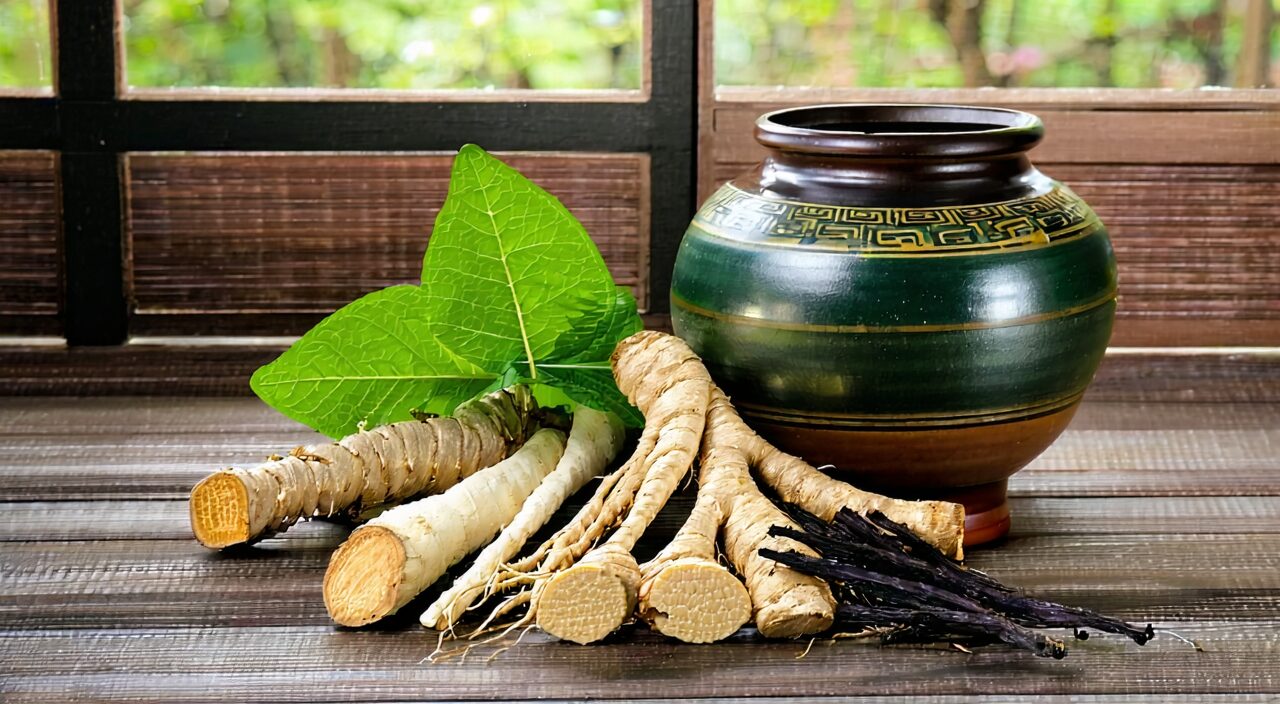
Spleen Qi Deficiency is the most common stage of spleen deficiency patterns. It can be understood as insufficient driving force for spleen transportation and transformation. Typical manifestations often revolve around the words “deficiency” and “weakness”: feeling spiritless and fatigued all day, having no desire to speak, low and weak voice, decreased appetite, feeling distended or stuffy in the epigastric region or abdomen after eating only a little, more pronounced fullness after meals, stools often unformed or tending to be loose. The complexion may be sallow or lack luster, the tongue body is pale and tender, and the tongue coating tends to be white.
Traditionally, when encountering such Spleen Qi Deficiency manifestations, experienced TCM practitioners would consider starting from fortifying the spleen and supplementing qi. Among commonly available Chinese patent medicines, Ren Shen Jian Pi Wan (Ginseng Spleen-Fortifying Pill) and Shen Ling Bai Zhu San (Ginseng, Poria and Atractylodes Macrocephala Powder) often appear in related discussions, but the focuses of the two are not completely the same.
- The formula design of Ren Shen Jian Pi Wan leans towards fortifying the spleen and harmonizing the stomach, promoting digestion and removing food stagnation. It is relatively more suitable for Spleen Qi Deficiency accompanied by marked loss of appetite, post-meal fullness, belching, and other dyspeptic symptoms.
- The composition of Shen Ling Bai Zhu San simultaneously takes into account fortifying the spleen and supplementing qi, as well as percolating dampness and checking diarrhea. It is more commonly used for Spleen Qi Deficiency complicated by dampness retention, manifesting as loose stools, heavy sensation in the body, white and greasy tongue coating, and so on.
It must be emphasized that such formula preparations represent only one direction of traditional application. Whether they are specifically suitable for an individual still needs to be determined in combination with one’s own constitution, symptom characteristics, and by referring to product instructions or consulting a professional.
Spleen Yang Deficiency: When Qi Deficiency Further Damages Yang Qi
If the state of Spleen Qi Deficiency persists for a long time, or is influenced by factors such as consuming cold and raw foods or overusing cold-natured medications, it may implicate yang qi and develop into Spleen Yang Deficiency. The core of Spleen Yang Deficiency is the appearance of “cold” manifestations on top of qi deficiency.
In addition to common spleen deficiency manifestations such as fatigue, poor appetite, and abdominal distension, individuals with Spleen Yang Deficiency usually have a relatively obvious tendency to feel cold, especially cold hands and feet that never seem warm. There may often be a cold sensation in the abdomen or vague pain; this abdominal pain often feels better upon warmth and pressure but worsens with cold stimulation. Stools are not only unformed but may even become watery, thin, or contain undigested food. The tongue body is pale, plump and tender, with tooth marks on the edges, and the coating is white and slippery — these are reference signals of yang deficiency failing to transform water-dampness.
For such cold-deficiency states of Spleen Yang Deficiency, classical formula preparations often employ Fu Zi Li Zhong Wan (Aconite Middle-Regulating Pill), a medicine that warms the middle and fortifies the spleen. Fu Zi Li Zhong Wan contains herbs with a relatively strong warming nature, such as processed aconite (Fu Zi), mainly addressing middle burner cold-deficiency and lack of yang qi. However, precisely because it is warming in nature, if one merely has mild Spleen Qi Deficiency without obvious cold signs, mistakenly using such acrid-hot and strongly warming formulas may instead bring discomfort like dryness-heat and dry mouth. Therefore, distinguishing between Spleen Qi Deficiency and Spleen Yang Deficiency is very meaningful for avoiding situations where “deficiency cannot tolerate supplementation” or “mixed cold and heat patterns.”
Spleen Failing to Govern the Blood: Bleeding Tendency from Loss of Governing Power
Another important function of the spleen is to govern the blood — keeping the blood circulating within the vessels. When spleen deficiency endures for a long time, qi becomes insufficient and cannot effectively hold and govern the blood, potentially leading to the pattern of Spleen Failing to Govern the Blood. This type is characterized by common Spleen Qi Deficiency symptoms being overlaid with chronic, mild but recurrent bleeding manifestations — for example, easy bruising under the skin, gums that tend to ooze blood, and in women, possibly excessively heavy menstrual flow, prolonged menstruation. In a minority of cases, occult blood in the stool or dark stools may also appear.
Spleen Failing to Govern the Blood is a relatively complex pattern. The appearance of bleeding often suggests that spleen qi has become deficient to a certain degree. At this point, relying solely on ordinary spleen-fortifying diets or self-selecting Chinese patent medicines is no longer a prudent approach. Especially for women with long-term heavy menstrual bleeding or recurrent gastrointestinal bleeding, prompt medical consultation is necessary to rule out organic pathological changes and receive professional treatment from TCM specialists or integrated Chinese and Western medicine.
Key Differentiating Points Between Spleen Qi Deficiency and Spleen Yang Deficiency
To facilitate everyday differentiation, one can think of Spleen Qi Deficiency as “insufficient power” and Spleen Yang Deficiency as “insufficient power coupled with inadequate heating.” The specific differences can be referenced in the table below:
| Differentiating Point | Spleen Qi Deficiency | Spleen Yang Deficiency |
|---|---|---|
| Sensation of Cold and Heat | Usually no obvious aversion to cold | Almost always accompanied by aversion to cold, cold hands and feet |
| Abdominal Sensation | Mainly post-meal distension and stuffiness | Cold-pain in the abdomen, improved by warmth |
| Stool Condition | Loose stool, unformed | Thin, watery, possibly with undigested food |
| Tongue Appearance | Pale tongue with white coating | Pale, plump tongue with tooth marks; white, slippery coating |
The importance of this differentiation lies in the fact that some Chinese patent medicines for regulating spleen deficiency are themselves neutral or tend toward bland and leaching in nature. For instance, although Shen Ling Bai Zhu San is overall quite balanced, herbs like Fu Ling (Poria) and Yi Yi Ren (Coix Seed) tend to be bland, leaching, and dampness-draining. This can be acceptable for pure Spleen Qi Deficiency with dampness, but if mistakenly used in typical Spleen-Stomach Yang Deficiency and coldness (Spleen Yang Deficiency), it might worsen the cold feeling in the abdomen. On the other hand, Fu Zi Li Zhong Wan is warming and suitable for cold-deficiency, but not suitable for Spleen Qi Deficiency without obvious cold signs, and it is also unsuitable for those with concurrent damp-heat or yin deficiency with internal heat. Therefore, the use of any traditional formula preparation should be based on pattern differentiation. One should not simply self-select a medicine just because the term “spleen deficiency” is mentioned.
Coexistence of Spleen Deficiency with Other Patterns: Dampness Stagnation and Food Accumulation

Spleen deficiency often does not exist in isolation; it easily interacts with problems such as dampness stagnation and food accumulation. The spleen governs the transportation and transformation of water-dampness. Once spleen qi is weak, water-dampness metabolism becomes impaired, leading to internal generation of dampness pathogens — forming a situation of spleen deficiency with exuberant dampness. At this point, beyond fatigue and loose stools, there may also be a heavy sensation in the head and body, thick greasy tongue coating, a bloated feeling in the body, and so on. It is for this direction of Spleen Qi Deficiency with dampness that Shen Ling Bai Zhu San is often used.
Moreover, as the spleen’s transportation capacity declines, food can more easily stagnate in the gastrointestinal tract, leading to food accumulation. Such individuals may, in addition to abdominal distension, also experience belching with a rotten or sour odor, sour and foul breath, and stools containing undigested food residue. In such cases, simply fortifying the spleen may not be sufficient; sometimes, the strategy of promoting digestion and removing food stagnation needs to be combined. Among traditional Chinese patent medicines, Ren Shen Jian Pi Wan, due to its ingredients that take into account herbs for dispersing food and harmonizing the stomach, has more applicability for spleen deficiency with food accumulation. Yet whether dampness dominance or food stagnation is the main problem, or whether both coexist, requires specific analysis. One must not arbitrarily stack high doses or multiple drugs on one’s own.
Dietary and Lifestyle Recommendations for Strengthening the Spleen in Daily Life
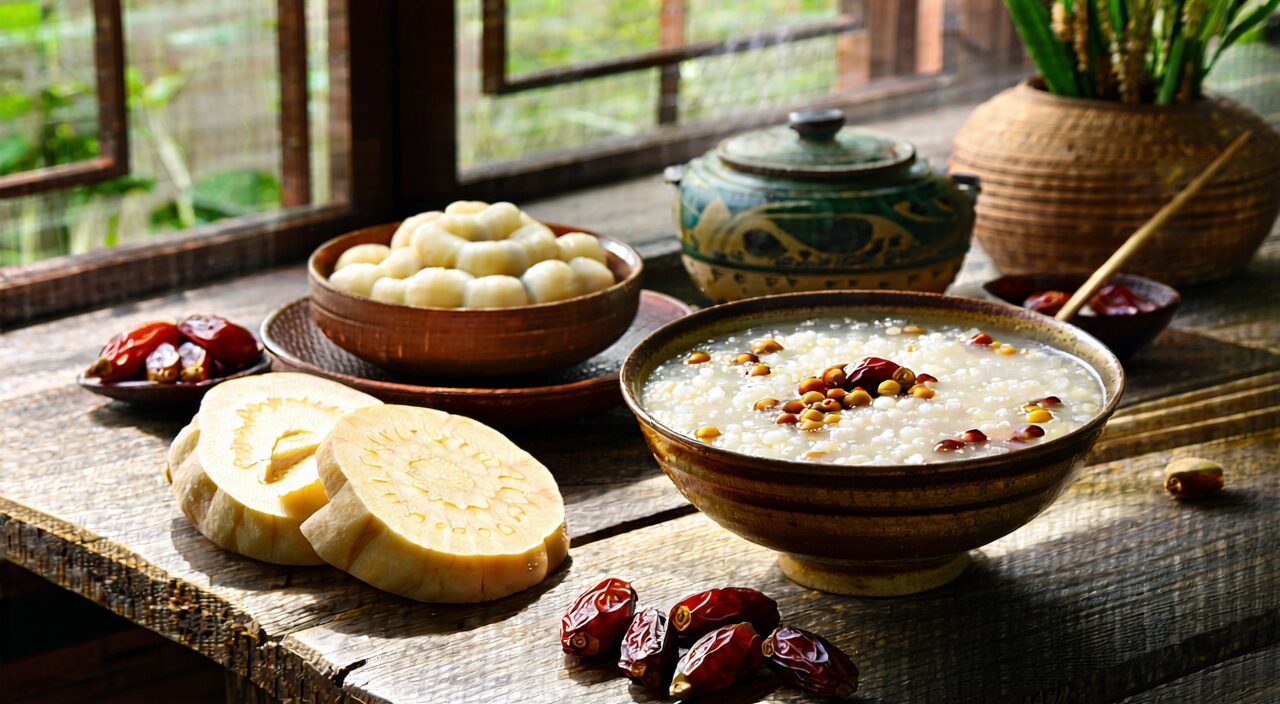
For mild states of Spleen Qi Deficiency, daily regulation can put some effort into diet and daily habits. Traditional experience holds that the spleen and stomach like warmth and dryness and dislike dampness and cold. The following directions can be taken as auxiliary reference:
- In diet, it is advisable to choose warm, easy-to-digest foods, such as millet porridge, Chinese yam, lotus seeds, red dates, white hyacinth beans, and poria cakes.
- Cooking methods should lean towards steaming, boiling, and stewing, while reducing deep-frying and raw or cold foods. Raw and cold fruits, ice-cold drinks, and cold mixed vegetable dishes can easily damage spleen yang, so they should be consumed in moderation even in summer.
- The regularity of eating is very important: eat at fixed times and in fixed amounts, chew slowly and carefully, and avoid going hungry one meal and overstuffing the next.
- Taking an appropriate walk after meals helps the qi mechanism flow, but vigorous exercise should be avoided.
- Emotional adjustment is equally critical. Excessive rumination and worry secretly consume qi and blood. Traditional theory holds that “overthinking injures the spleen.” Keeping the emotions stable and avoiding long-term anxiety and tension has a positive effect on the recovery of spleen and stomach function.
It is necessary to remind readers that the above dietary and lifestyle recommendations are supportive health preservation directions and cannot replace professional treatment when necessary. Even ingredients considered spleen-fortifying, such as Chinese yam and lotus seeds, should be consumed in moderation according to digestive capacity; excessive consumption can easily cause bloating.
Situations That Require More Attention

Although spleen deficiency patterns are very common in ordinary constitutions, not all instances of fatigue, abdominal distension, and unformed stools are simply functional weaknesses. Some chronic digestive system diseases, endocrine disorders, or even early-stage wasting diseases may also present with outward signals similar to “spleen deficiency.” It is especially advisable to promptly consult a doctor or professional when the following circumstances arise:
- Long-standing spleen deficiency manifestations accompanied by unexplained significant weight loss;
- Anemia, pale complexion, and progressively worsening fatigue;
- Recurrent dark stools, blood in the stool, large areas of subcutaneous bruising, or heavy menstrual bleeding in women;
- Persistent abdominal pain or discomfort that does not improve with warmth or pressure;
- After regular adjustments are made, the discomfort persists for several weeks without improvement.
These symptoms may indicate that the body has issues requiring further examination. The regulation of Chinese patent medicines is more focused on fine-tuning and balancing body states and is not suitable for coping with severe, progressive, or organic diseases. Therefore, if self-observation is inconclusive, seeking a professional TCM practitioner for face-to-face pattern differentiation, combined with necessary modern medical examinations, is a more prudent approach.
Summary
Spleen deficiency pattern is not a vague label but a group of bodily states that need to be approached with nuanced differentiation. Spleen Qi Deficiency mainly manifests as fatigue, poor appetite, post-meal abdominal distension, and loose stools, and is usually related to weakened transportation and transformation function of the spleen. Spleen Yang Deficiency adds obvious cold signs on top of this, such as aversion to cold, cold hands and feet, and cold abdominal pain that is relieved by warmth. Spleen Failing to Govern the Blood presents as a chronic tendency to bleed and often represents a situation where spleen deficiency has existed for a longer period.
Chinese patent medicines such as Shen Ling Bai Zhu San, Ren Shen Jian Pi Wan, and Fu Zi Li Zhong Wan each have their own focus in traditional application, corresponding respectively to directions such as Spleen Qi Deficiency with dampness, Spleen Deficiency with food accumulation, and Spleen Yang Deficiency with cold. When used, they must be matched to individual differences and pattern characteristics and should not be confused.
Daily spleen maintenance can start with warm, easy-to-digest foods, regular eating, and emotional adjustment, but these methods mainly play a supplementary role. If one suspects they have spleen deficiency, especially when long-term loose stools, abdominal pain, weight loss, or bleeding signals are present, the most important thing is not to hastily “match oneself” and select a certain Chinese patent medicine, but to first, through professional pattern differentiation, clarify one’s own state and the root of the problem, and then, under professional guidance, choose a suitable regulation approach. This can both prevent misuse and care for one’s body from a more holistic perspective.