
Baohe Wan vs Xiangsha Liujun Wan vs Shenling Baizhu San: Which One Fits Your Symptoms?

In daily health management, Baohe Wan, Xiangsha Liujun Wan, and Shenling Baizhu San are frequently mentioned. Many people feel they are all related to “poor spleen and stomach function” and “poor digestion,” but a closer look at their descriptions reveals different emphases. Faced with these three common Chinese patent medicines, many hesitate: Which one to choose after overeating? Which one for long-term poor appetite and bloating? And which direction to consider for loose stools?
This article does not provide standard answers. Instead, it sorts out the core differences of the three approaches from the traditional Chinese medicine understanding of spleen and stomach discomfort, helping readers make a clearer initial judgment based on their main manifestations.
Formulation Directions of the Three Approaches
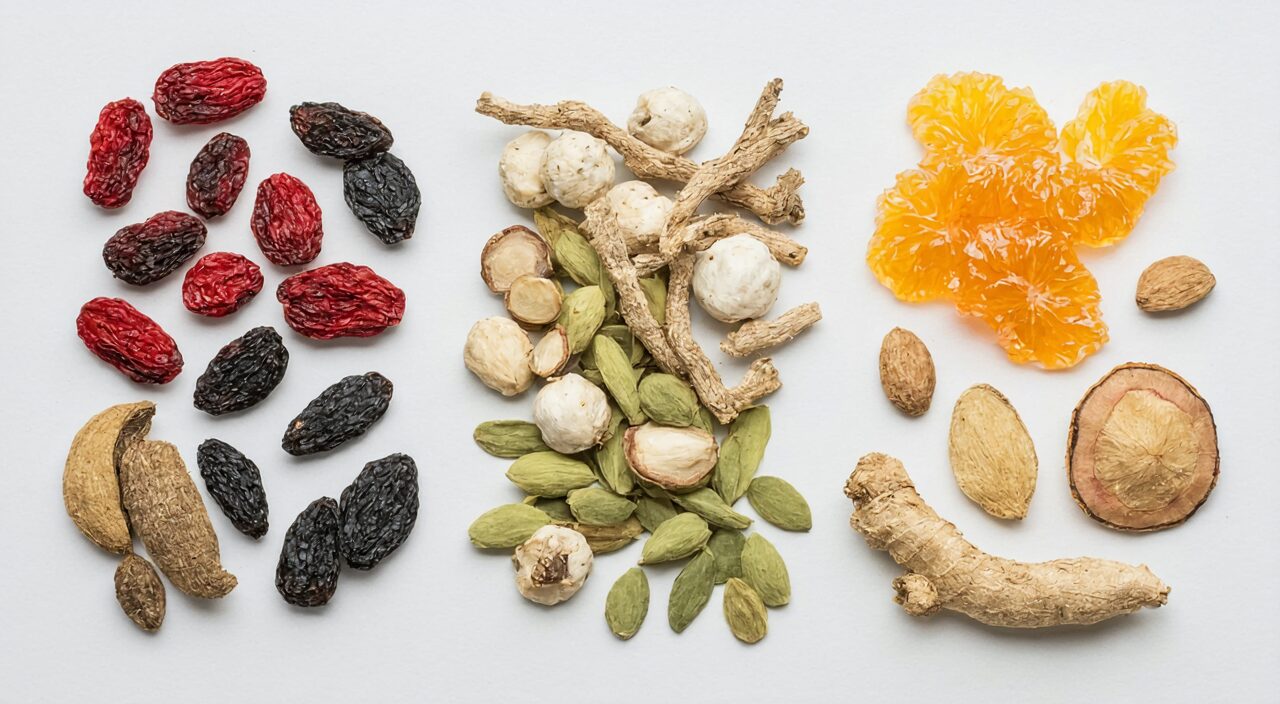
Although all three Chinese patent medicines center on the middle burner, their formulation directions are distinctly different. Understanding this is key to differentiating them.
Baohe Wan: Mainly Eliminates Food Stagnation and Guides It Outward
The traditional formulation of Baohe Wan focuses on “eliminating” and “guiding,” mainly targeting situations of dietary irregularities and internal food accumulation.
In the formula, Shan Zha (Hawthorn), Shen Qu (Massa Medicata Fermentata), and Lai Fu Zi (Radish Seed) are commonly used to resolve various types of food accumulation:
- Shan Zha (Hawthorn): Tends to resolve stagnation from fatty meats and greasy foods
- Shen Qu (Massa Medicata Fermentata): Tends to resolve stagnation from grains, rice, and alcoholic beverages
- Lai Fu Zi (Radish Seed): Is adept at resolving stagnation from flour-based foods and phlegm
Chen Pi (Tangerine Peel), Ban Xia (Pinellia Tuber), and Fu Ling (Poria) in the formula tend to harmonize the stomach and transform dampness and phlegm, while Lian Qiao (Forsythia Fruit) is often considered when food accumulation turns into heat.
Overall, Baohe Wan belongs to an approach that mainly expels pathogenic factors. Its focus is on eliminating tangible accumulation and restoring gastrointestinal patency. This approach targets more acute excess-type manifestations caused by short-term improper diet.
Xiangsha Liujun Wan: Primarily Regulates Qi and Strengthens the Spleen
Xiangsha Liujun Wan’s formulation is characterized by a combination of “tonifying” and “moving.” Its core is the base formula Si Jun Zi Tang (Four Gentlemen Decoction), consisting of Ren Shen (Ginseng), Bai Zhu (White Atractylodes), Fu Ling (Poria), and Gan Cao (Licorice). This is the classic combination traditionally used to tonify spleen and stomach qi. On this basis:
- Chen Pi (Tangerine Peel) and Ban Xia (Pinellia Tuber) are added, leaning towards drying dampness, transforming phlegm, regulating qi, and harmonizing the stomach;
- Then Mu Xiang (Aucklandia Root) and Sha Ren (Amomum Fruit) are added to enhance the power of moving qi and awakening the spleen.
Therefore, the approach of Xiangsha Liujun Wan is to simultaneously strengthen spleen qi and rectify qi stagnation. What it addresses is often not a single episode of food accumulation, but a state where the spleen is too weak to transport and transform, leading to inhibited qi movement. When the spleen is deficient, it lacks the power to propel; when qi stagnates, the middle burner becomes distended. These two often influence each other. This approach leans more towards getting the middle burner moving on a foundation of tonification.
Shenling Baizhu San: Mainly Strengthens the Spleen and Eliminates Dampness
Shenling Baizhu San is also based on Si Jun Zi Tang, but its direction leans more towards “eliminating dampness” and “stopping diarrhea.”
In addition to Ren Shen, Bai Zhu, Fu Ling, and Gan Cao, the formula includes Shan Yao (Chinese Yam), Lian Zi (Lotus Seed), Bai Bian Dou (White Hyacinth Bean), and Yi Yi Ren (Coix Seed). These are often used to tonify the spleen and percolate dampness, and many have astringent properties to stop diarrhea. Sha Ren (Amomum Fruit) in the formula mainly plays the role of awakening the spleen and regulating qi, ensuring the formula tonifies without causing stagnation. Jie Geng (Platycodon Root) has been interpreted by physicians through generations as carrying the medicine upward, indirectly achieving the effect of “reinforcing earth to generate metal.”
If one term could summarize the therapeutic approach of Shenling Baizhu San, it would be “tonifying the spleen and percolating dampness.” What it suits is often not food accumulation, nor simple qi stagnation and distension, but manifestations of loose stools, diarrhea, fatigue, and lassitude caused by spleen deficiency failing to transport and transform water-dampness, leading to unclear separation of clear and turbid.
Emphases for Three Typical User Profiles

Due to the different formulation directions of the three Chinese patent medicines, their corresponding common user profiles also have clear distinctions. Here, the three are contrasted side-by-side for easier understanding of their respective emphases.
Food Accumulation Stagnation Type — May Look Into Baohe Wan
This type is often clearly associated with recent diet. Common manifestations include:
- Epigastric and abdominal distension and fullness, even pain, after excessive food intake; pressure worsens the distension
- Belching, acid reflux, strong breath odor, foul-smelling stools or stools mixed with undigested food
- Thick, greasy tongue coating; often a slippery pulse
The core problem for this group is “tangible stagnation.” Symptoms like nausea and aversion to food often markedly improve once the food accumulation is cleared. If the above manifestations occur only occasionally due to festive gatherings or holiday overeating, the traditional preference leans towards the approach of eliminating food stagnation and guiding it out. However, if symptoms recur chronically or are accompanied by clear signs of deficiency, mono-therapy with the resolving and guiding method is not advised.
Spleen Deficiency with Qi Stagnation Type — May Look Into Xiangsha Liujun Wan
This group typically lacks an obvious trigger of gross overeating. Rather, they experience a long-term sensation of obstructed middle burner movement. Common manifestations include:
- Epigastric bloating and fullness, but with fluctuating intensity: markedly worse after meals and slightly relieved on an empty stomach
- Poor appetite; feeling blocked even when eating very little
- Prone to belching; distension may be temporarily relieved after belching
- Accompanied by mental fatigue, a sallow complexion, stools that are either loose or require straining but are not hard lumps
- Tongue body tends to be pale; tongue coating is white or white and greasy; pulse tends to be forceless and wiry
The distension in this case stems more from the spleen qi lacking power to propel, causing qi to stagnate in place. Simply using the approach of resolving food stagnation might offer temporary relief, but problems like fatigue and recurrent bloating are harder to solve. Therefore, traditionally, the approach focuses on tonifying spleen qi while simultaneously regulating qi and rectifying stagnation.
Spleen Deficiency with Dampness Excess Type — May Look Into Shenling Baizhu San
The core contradiction for this type lies not in distension, but in “dampness” and “diarrhea.” Common manifestations include:
- Chronically unformed stools, with increased frequency; occasionally, diarrhea is triggered after consuming even slightly greasy or cold/raw food
- Stools often contain undigested food particles, but without a strong foul odor
- Slight dietary indiscretions easily cause gurgling sounds in the abdomen
- Accompanied by heavy, fatigued limbs; a yellowish, puffy complexion; a swollen tongue body with teeth marks on the edges; white, greasy tongue coating
- Overall low energy, poor stamina, soft and flabby muscles
From the perspective of traditional Chinese medicine, this describes a typical pattern of spleen deficiency failing to transport and transform water-dampness, leading to clear and turbid substances mixing and descending. At this time, focusing on resolving food or moving qi often fails to address the root issues of loose stools and fatigue. The approach of percolating dampness, tonifying the spleen, and astringing would be more suitable.
Key Symptom Comparison Table
For a more intuitive comparison of the differences among the three, a simplified comparison guide is listed below:
| Reference Dimension | Baohe Wan | Xiangsha Liujun Wan | Shenling Baizhu San |
|---|---|---|---|
| Primary Direction | Eliminate food and guide out stagnation | Regulate qi and strengthen the spleen | Strengthen the spleen and eliminate dampness |
| Common Triggers | Excessive or difficult-to-digest food intake | Weak spleen transformation and transport | Spleen deficiency with exuberant dampness |
| Distension Characteristics | Severe post-meal distension, refuses pressure | Distension varies in intensity, worse after meals | Distension not prominent, or mild abdominal bloating |
| Stool Condition | Foul-smelling stools, loose or containing food residue | Loose stools, or sensation of incomplete evacuation | Chronic loose, unformed stools; non-foul smelling |
| Tongue Manifestation | Thick, greasy tongue coating | Pale tongue with white or white-greasy coating | Swollen tongue body, teeth marks on edges, white-greasy coating |
| Energy State | Fatigue during distension, recovers after food clears | Persistent fatigue, poor mental energy | Heavy, fatigued limbs; tires easily |
It should be noted that this is only a generalization based on common situations. Real-world presentations often overlap, and the same person may exhibit different emphases at different stages depending on their constitutional background.
Can They Be Combined and How to Choose During Overlapping Phases
In traditional practice, these Chinese patent medicines are not entirely impossible to use sequentially with adaptation, but the premise must be clear. Arbitrary self-combination is generally not recommended.
When a person has both obvious food accumulation and chronic spleen deficiency manifestations, traditional practice might adopt a strategy of “treating the acute symptoms, then addressing the root cause”:
- For example, during a phase of epigastric distension and thick, greasy tongue coating following binge eating, one might first consider resolving food stagnation. After the stagnation lessens and the tongue coating begins to thin, then shift towards strengthening the spleen and boosting qi.
- If food accumulation is not severe, but distension from spleen deficiency and qi stagnation persists long-term, then directly focusing on strengthening the spleen and regulating qi might be more conducive to restoring the normal transportation function of the middle burner.
Another easily overlooked situation is when someone clearly has no more food accumulation but continues to experience chronic epigastric bloating, loose stools, and fatigue. Continuing the Baohe Wan approach in this case may not only fall short of expectations but might further deplete spleen and stomach qi.
If you find it difficult to differentiate, you can conduct a simple review considering the following angles:
- Is the distension worsened by pressure, or is it relieved by pressure?
- Is the tongue coating thick and greasy, or is the tongue pale with teeth marks?
These points offer reference value for determining direction.
How to choose during overlapping phases ultimately depends on judging which core issue currently bothers you the most. Is it unbearable post-meal distension, or is it chronic loose stools affecting quality of life? This often determines the primary current contradiction. When necessary, a comprehensive evaluation by a TCM practitioner or pharmacist combining observation, listening, inquiry, and pulse-taking is recommended.
Unsuitable Situations and Precautions
When the following conditions occur, consulting a doctor should be prioritized over self-selection of these Chinese patent medicines:
- Severe, persistent epigastric or abdominal pain that does not resolve, or pain referring to the back or shoulders
- Vomiting blood, black, tarry stools, or blood in the stool
- Unexplained significant weight loss
- Prolonged fever, night sweats, jaundice
- Difficulty swallowing, pain upon eating, or recurrent vomiting
- Acute abdomen, gastrointestinal perforation, intestinal obstruction, or other surgical conditions
Additionally, if emotional factors such as anxiety and depression are extremely prominent and digestive issues are highly synchronized with emotional fluctuations, Chinese patent medicines solely for regulating the middle burner are often insufficient, and a comprehensive assessment is needed.
Pregnant women, breastfeeding women, infants and young children, and individuals with liver or kidney insufficiency should exercise particular caution before considering any Chinese patent medicine and must consult professional advice first.
Although Chinese patent medicines are conveniently accessible, they still fall under the category of pharmaceutical products. Before use, carefully read the product insert, paying attention to contraindicated populations and precautions.
Summary
Although Baohe Wan, Xiangsha Liujun Wan, and Shenling Baizhu San all pertain to digestive issues, their traditional application directions are distinctly different:
- Baohe Wan’s focus is on “eliminating,” making it more suitable for stages with evident food accumulation and distension that refuses pressure;
- Xiangsha Liujun Wan’s focus is on “tonifying while simultaneously moving,” making it more suitable for long-term distension, belching, and other qi stagnation manifestations arising from a foundation of spleen deficiency;
- Shenling Baizhu San’s focus is on “tonifying the spleen and percolating dampness,” making it more suitable for states of spleen deficiency with exuberant dampness and chronically unformed stools.
In real life, these three conditions may coexist or appear successively, and different constitutions will have different emphases. The differentiation made in this article only provides a framework for understanding your own situation and cannot replace specific in-person diagnosis and pattern identification. Before use, it is recommended to combine your overall manifestations, tongue and pulse findings, and product label information. When necessary, consult a TCM practitioner or pharmacist, making the choice more reliable and better aligned with your current actual needs.