
Who Is Fang Feng Tong Sheng San Suitable For? Composition, Benefits, and Contraindications

Many people pay attention to Fang Feng Tong Sheng San because they have heard it can simultaneously address discomforts related to “internal heat” and “external invasion,” such as constipation, dry mouth, bitter taste, aversion to heat, oily skin prone to acne, and so on.
But in traditional Chinese medicine, every formula has its corresponding pattern range; you cannot simply apply it just because one or two symptoms appear.
This article will help you organize a relatively complete cognitive framework around the composition of Fang Feng Tong Sheng San, its traditionally understood actions, the populations it may be more suitable for, contraindications that require special attention during use, and how it differs from several common formulas.
Origin of Fang Feng Tong Sheng San
Fang Feng Tong Sheng San first appeared in the Xuanming Lun Fang and was created by the Jin-Yuan period physician Liu Wansu. The original formula’s intent is to “release both the exterior and interior,” meaning to simultaneously address wind-heat stagnation on the body surface and damp-heat accumulation in the interior.
In the traditional pattern differentiation system, such conditions are often summarized as “excess in both exterior and interior.” Simply put, it means the body has relatively obvious characteristics of repletion and heat stagnation both internally and externally, rather than a tendency toward deficiency cold or yin deficiency.
Therefore, Fang Feng Tong Sheng San is not a formula targeting one single problem, but a compound formula that both disperses exterior wind pathogens and clears interior damp-heat.
Traditionally, it is often used for presentations where “external wind-heat and internal latent heat” coexist, such as fever and aversion to cold with exterior patterns still present, while simultaneously presenting with internal heat signs like constipation, scanty dark urine, red tongue with yellow greasy coating, etc.
Composition of Fang Feng Tong Sheng San
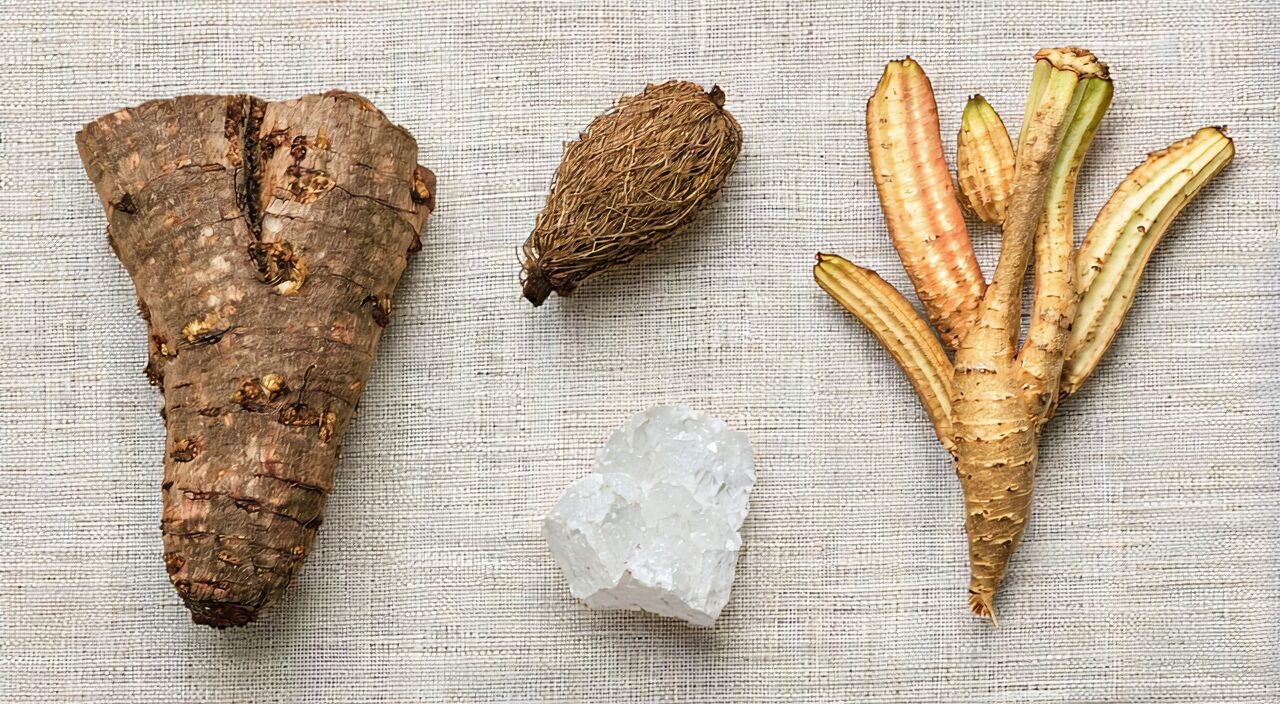
The composition of Fang Feng Tong Sheng San is relatively large, reflecting the approach of releasing both the exterior and interior and regulating qi and blood simultaneously. Below are the conventional herbal constituents and their general directions of action within the formula; dosage proportions need to be adjusted according to patterns and are not specifically noted here.
| Herb | Traditionally understood direction of action |
|---|---|
| Fang Feng, Jing Jie, Bo He, Ma Huang | Release the exterior and expel pathogens, relieve wind-heat stagnation in the skin and muscles |
| Da Huang, Mang Xiao | Unblock the bowels and drain heat, clear and purge intestinal accumulation |
| Zhi Zi, Hua Shi | Clear and drain damp-heat, guiding damp-heat out through urination |
| Shi Gao, Huang Qin, Lian Qiao | Clear heat from the qi level and upper jiao, also capable of resolving toxins and dispersing heat |
| Jie Geng | Diffuse the lungs and benefit the throat, carry the medicinals upward |
| Dang Gui, Bai Shao, Chuan Xiong | Nourish and harmonize the blood, prevent damage to the blood level from excessive dispersing |
| Bai Zhu, Gan Cao | Fortify the spleen and protect the middle burner, safeguard the spleen and stomach qi |
From the composition, we can see that while the entire formula disperses, purges, and clears, it also includes herbs that nourish blood and fortify the spleen, aiming to expel pathogens without injuring the upright qi.
Nevertheless, the overall emphasis is still on attacking pathogens, making it suitable for individuals with a relatively strong constitution and clear manifestations of repletion and heat stagnation.
Traditional Chinese Medicine Understanding of the Actions of Fang Feng Tong Sheng San
From the perspective of traditional Chinese medicine, the actions of Fang Feng Tong Sheng San can be summarized as follows:
- Release exterior and dissipate heat: By using herbs like Ma Huang, Fang Feng, and Bo He to disperse external wind and vent exterior pathogens, it alleviates heat-related discomfort in the head and face, tight skin, and aversion to heat when external wind-heat is present.
- Unblock bowels and purge excess: Da Huang and Mang Xiao promote defecation and drain heat, addressing internal accumulation, dry stool constipation, and abdominal distension.
- Clear heat and eliminate dampness: Zhi Zi, Hua Shi, Shi Gao, Huang Qin, etc., clear internal heat stagnation and damp-heat, suitable as a reference when presentations include bitter taste, dry mouth, dark urine, and oily sticky skin.
- Harmonize qi and blood: Dang Gui, Bai Shao, and Chuan Xiong nourish and activate blood while clearing heat and dispersing, reducing discomfort that might arise from excessive dispersing.
Overall, Fang Feng Tong Sheng San targets a relatively typical state of “excess in both exterior and interior with a predominance of damp-heat,” and it is not a daily regulating or tonifying type of formula.
Populations That May Be More Suitable
Based on traditional usage experience with Fang Feng Tong Sheng San, the following types of presentations are more likely to occur in the “excess in both exterior and interior” pattern. If multiple features are present simultaneously, it may serve as a direction for further understanding.
However, it must be emphasized that whether it is truly suitable must be determined by combining tongue coating, pulse conditions, and the overall cold-heat and deficiency-excess status of the entire body; it cannot be determined based on only one or two symptoms.
- Robust or sturdy build: Full muscles, decent physical strength, often averse to heat, tends to sweat easily, and sweating is not comfortable.
- Long-term tendency toward constipation: Stool tends to be dry and hard, difficult to pass, accompanied by a feeling of abdominal distension, while food intake is not small.
- Bitter taste, dry mouth, and strong breath: Frequently feels a sticky mouth, still dry after drinking water, tongue coating tends to be yellow thick or greasy.
- Oily skin, prone to rashes: Excessive oil on the face, chest, and back, easily developing red papules, folliculitis, and skin eruptions. Traditionally, this is considered related to damp-heat stagnation in the skin.
- Easily prone to heat signs: Such as red eyes, sore throat, swollen gums, dark yellow urine, feeling of body heat, pulse often floating-rapid or slippery-rapid.
If you happen to see reflections of yourself in several of the above manifestations, you can use them as clues for judgment, but you still need a professional to conduct a comprehensive assessment based on the four diagnostic methods. Do not self-diagnose and prepare the formula on your own.
Who Should Not Use Fang Feng Tong Sheng San
Since Fang Feng Tong Sheng San generally leans toward attacking pathogens and clearing heat, the following types of conditions are usually not suitable, and may even increase the burden on the body:
- People with spleen-stomach deficiency cold: Often prone to diarrhea, unformed stools, abdominal coldness, stomach distension and pain after eating cold food, pale enlarged tongue with tooth marks. Using this formula may worsen diarrhea and decrease appetite.
- People with qi and blood deficiency: Pale or sallow complexion, easily fatigued, palpitations, shortness of breath, scanty menstrual flow with pale color. The dispersing and purging actions of Fang Feng Tong Sheng San may further consume qi and blood.
- People with yin deficiency and internal heat: Heat in the palms and soles, dry mouth and throat, night sweats, red tongue with little coating. This “deficiency heat” is fundamentally different from the “excess heat” targeted by Fang Feng Tong Sheng San; misuse may damage yin fluids.
- People with weak constitution, chronic wasting diseases, the elderly, children, pregnant women, and breastfeeding women: These special populations often have insufficient upright qi and cannot withstand dispersing and purging medicinals; self-administration is not advised.
- People without obvious interior excess heat signs, just mild skin issues or occasional constipation: Such cases usually do not require such a potent formula; blind use may actually disturb normal bowel rhythm.
If the body condition is complex, for example, presenting both dry mouth and bitter taste while easily fatigued and sensitive to cold, it indicates a mixed cold-heat pattern that requires even more careful pattern differentiation; one must avoid aggressively clearing or purging in a single direction.
Differences from Several Common Formulas
Some people may confuse Fang Feng Tong Sheng San with formulas like Bao He Wan, Long Dan Xie Gan Tang, Huang Lian Jie Du Tang, and Er Chen Tang, because they all involve digestive issues, damp-heat, and signs of heat. Below is a brief comparison from the perspective of traditional pattern differentiation to help clarify their respective emphases.
| Formula | Core Direction | Emphasis and Difference |
|---|---|---|
| Bao He Wan | Digest food, remove stagnation, harmonize the stomach, and eliminate fullness | More suitable for abdominal distension, belching with rancid odor, acid regurgitation, sticky or difficult bowel movements caused by food accumulation, with an overall food-stagnation excess pattern; no obvious exterior signs or systemic damp-heat. |
| Long Dan Xie Gan Tang | Clear excess fire of the liver and gallbladder, drain damp-heat from the lower jiao | Often used for hypochondriac pain, bitter taste, red eyes, tinnitus, turbid urination, yellow sticky vaginal discharge, etc., with damp-heat mainly along the liver and gallbladder channels. Fang Feng Tong Sheng San has a broader scope, covering both exterior and interior, qi and blood levels, and does not limit itself to the liver and gallbladder. |
| Huang Lian Jie Du Tang | Bitter-cold clear heat, purge fire and resolve toxins | Suitable for intense fire toxin in the triple jiao, such as high fever, restlessness, dry mouth and throat, vomiting blood, purpura, etc. It contains no exterior-releasing herbs or purgatives, differing significantly from the “release exterior and unblock interior” structure of Fang Feng Tong Sheng San. |
| Er Chen Tang | Dry dampness, transform phlegm, regulate qi, and harmonize the middle | Aimed at cough with profuse phlegm, nausea, vomiting, chest and epigastric fullness due to internal phlegm-dampness. Its overall approach is managing dampness and phlegm, with virtually no heat-clearing or purging strength, differing from the damp-heat and fire toxin direction of Fang Feng Tong Sheng San. |
As can be seen, even if symptoms partially overlap, the underlying pathogenesis emphasis is different. When consulting information in daily life, do not equate formulas just because a symptom appears similar; a comprehensive understanding based on whole-body presentations is necessary.
Summary
Fang Feng Tong Sheng San is a traditional formula primarily focused on attacking pathogens by releasing both the exterior and interior, and it excels at managing complex situations of “excess in both exterior and interior with a predominance of damp-heat.” Traditionally, it serves as a reference direction when presentations include a robust build, constipation, bitter taste, oily skin, and obvious heat signs.
Precisely because its medicinal strength is relatively potent, it is not suitable for people with spleen-stomach deficiency cold, qi and blood deficiency, yin deficiency, and various special populations; it should not be applied casually.
This article is for informational reference only, helping you understand the pattern differentiation thinking behind constitution and symptoms from the perspective of Chinese herbal formulas, and does not constitute any medical advice. If you have doubts about whether you are suitable for such formulas, or if you experience severe, recurrent, or persistent discomfort, please consult a TCM professional in a timely manner and make a judgment based on the four diagnostic methods.