
Who Is Gui Pi Tang Suitable For? Composition, Benefits, and Contraindications

Many people in daily life may simultaneously experience several troubling issues: being easily fatigued, having a poor appetite, light sleep with many dreams and easy waking, as well as poor memory and occasional palpitations. Traditional Chinese medicine often interprets these manifestations from the perspective of “heart-spleen deficiency,” and Gui Pi Tang is a classic representative formula precisely aimed at this pattern. Because it combines the actions of replenishing qi to strengthen the spleen and nourishing blood to calm the mind, it is frequently asked about by overseas users interested in holistic health: Who is Gui Pi Tang actually suitable for? What herbs does it consist of? What directions need attention during its use? This article provides a restrained, systematic overview centered on these questions.
Understanding Gui Pi Tang’s Regulatory Approach from the Perspective of Heart-Spleen Deficiency
In traditional Chinese medicine understanding, the “spleen” governs transportation and transformation and is the source of qi and blood production; the “heart” governs the blood vessels, stores the spirit, and is closely related to sleep, emotions, and memory. If there is prolonged excessive thinking, irregular eating habits, or a constitutionally weak body, it may affect the spleen’s transportation function, leading to insufficient production of qi and blood. Consequently, heart blood also fails to receive adequate nourishment, making the state of heart-spleen deficiency relatively likely to occur.
The design rationale of Gui Pi Tang is precisely to address both aspects simultaneously: “replenishing qi to strengthen the spleen” and “nourishing blood to calm the mind.” By supplementing spleen qi, the body is better able to generate qi and blood; at the same time, blood-nourishing and mind-calming herbs are incorporated to help stabilize the spirit. With this synchronized regulation, traditional application often provides relatively comprehensive care for the composite issues mentioned above—fatigue, poor appetite, restless sleep, palpitations, and forgetfulness.
It should be noted that Gui Pi Tang does not directly act on one specific symptom, but rather regulates the overall constitutional tendency of “heart-spleen deficiency.” Therefore, whether it is suitable or not depends on whether the overall presentation conforms to this direction, rather than judging based on a single symptom alone.
Core Composition of Gui Pi Tang
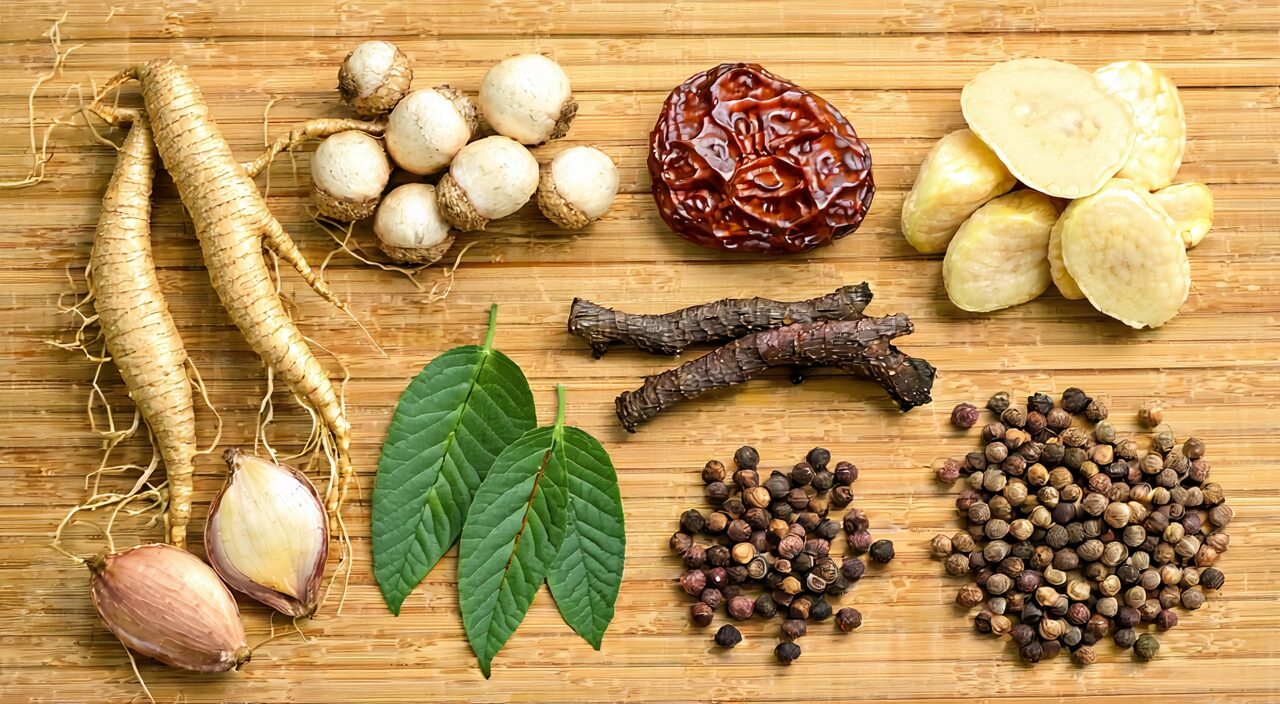
The classic composition of Gui Pi Tang gives consideration to the coordination of qi supplementation, blood nourishment, mind calming, and qi-regulating spleen-awakening, avoiding excessive cloying. The table below briefly lists the commonly used herbal ingredients and their main roles in the formula.
| Herb | Main Role |
|---|---|
| Ren Shen | Greatly tonifies original qi, strengthens spleen and benefits lungs |
| Bai Zhu | Strengthens spleen and replenishes qi, dries dampness |
| Huang Qi | Replenishes qi and raises yang, secures the exterior |
| Dang Gui | Nourishes and invigorates blood, regulates menstruation |
| Long Yan Rou | Tonifies heart and spleen, nourishes blood and calms the mind |
| Suan Zao Ren | Nourishes heart and liver, calms the mind |
| Yuan Zhi | Calms the mind and benefits intelligence, facilitates heart-kidney communication |
| Fu Shen | Quiets the heart and calms the spirit |
| Mu Xiang | Moves qi and awakens the spleen, prevents stagnation from tonifying herbs |
| Gan Cao | Harmonizes the herbs, also supplements spleen qi |
From this composition table, it can be seen that the formula includes herbs like Ren Shen, Bai Zhu, and Huang Qi that lean towards replenishing qi and strengthening the spleen, as well as herbs like Dang Gui, Long Yan Rou, and Suan Zao Ren that focus on nourishing blood and calming the mind. At the same time, a small amount of Mu Xiang is used to help promote the flow of qi, making the overall formula tonifying without causing stagnation. This structure means that in traditional application, Gui Pi Tang tends to address problems within the scope of “deficiency patterns” rather than excess patterns or heat patterns.
Groups That May Be Suitable

From the perspective of traditional application and the characteristics of heart-spleen deficiency, Gui Pi Tang is more commonly used in the following situations where multiple manifestations coexist. However, this does not mean it is suitable for everyone, and the final decision still needs to be combined with individual constitution and professional judgment.
Easily fatigued, slow physical recovery
People with heart-spleen deficiency often have a relatively weak spleen transportation function, resulting in an insufficient source of qi and blood. Common manifestations include:
- Body heaviness, lack of strength, feeling tired after slight activity, difficulty recovering after rest
- Loose stools, decreased appetite, and other digestive manifestations
For this group, Gui Pi Tang’s approach of replenishing qi and strengthening the spleen may provide a direction worth understanding.
Poor appetite, pale or sallow complexion
When the spleen’s transportation ability weakens, the digestion and absorption of food and drink are affected, easily leading to:
- Decreased appetite
- Dull, lusterless, or sallow complexion
- Lips and fingernails on the pale side
These manifestations are often regarded by traditional Chinese medicine as clues of qi and blood insufficiency. Gui Pi Tang regulates against this root cause by strengthening the spleen to assist qi and blood production.
Palpitations, forgetfulness, excessive dreaming, and easy waking
If heart blood is insufficient and the heart spirit loses adequate nourishment, the following may occur:
- Panicky sensations, easily startled by external noises
- Memory decline, poor concentration during the day
- Excessive dreaming at night, tendency to wake early
These heart-system manifestations often appear together with the aforementioned spleen deficiency signs. The blood-nourishing and mind-calming herbs in Gui Pi Tang, such as Long Yan Rou, Suan Zao Ren, and Dang Gui, are precisely combined around this direction.
Overall impression: The composite state of heart-spleen deficiency
From the perspective of traditional pattern differentiation, pure qi deficiency or pure blood deficiency alone is not common; more often, qi and blood are simultaneously affected, as are the heart and spleen. If a person concurrently has the composite manifestations mentioned above—fatigue, poor appetite, washed-out complexion, palpitations, forgetfulness, light sleep, excessive dreaming—and the tongue body tends to be pale with a thin white coating, they may be relatively close to the consideration range of Gui Pi Tang. However, all of this still requires specific judgment from a professional and should not be self-compared.
Situations Where It Is Unsuitable or Requiring Special Caution
Every formula has its scope of application, and Gui Pi Tang is no exception. The following directions are generally not considered suitable scenarios for direct use, and some may only be considered after more cautious evaluation.
When phlegm-fire disturbs the heart, or excess heat/damp-heat is relatively obvious
When the constitution leans towards the following directions, Gui Pi Tang may be inappropriate:
- Irritability, bitter taste in the mouth, dry mouth
- Red tongue with yellow greasy coating, coughing yellow thick phlegm
- Chest oppression and palpitations accompanied by obvious heat signs
These manifestations lean more towards phlegm-fire or excess heat disturbing the heart. At this time, using Gui Pi Tang, which focuses on supplementing qi and nourishing blood, may instead aggravate stagnation and is not suitable for standalone application. Such situations generally require approaches to clear and transform phlegm-heat or clear heat and calm the mind—directions precisely opposite to Gui Pi Tang.
Yin deficiency with exuberant fire, especially when there is obvious deficiency fire
When the following yin deficiency and internal heat manifestations appear, the focus should be on nourishing yin and subduing fire, not on greatly tonifying qi and blood:
- Heat in the palms and soles
- Night sweats
- Dry throat and malar flush
- Red tongue with scant coating
Gui Pi Tang tends to be sweet and warm, making it unsuitable for situations of yin deficiency with exuberant fire. Such constitutions are often better suited to formulas emphasizing yin nourishment and mind calming, such as Tian Wang Bu Xin Dan, which will be briefly compared later.
During acute discomfort phases or special physiological periods
If one is experiencing the following situations, the use of any formula should be particularly prudent, and it is advisable to prioritize a doctor’s assessment rather than deciding through self-comparison of symptoms:
- Colds, fevers
- Acute gastroenteritis
- Severe headaches or other acute problems
- Pregnancy, early postpartum recovery, post-surgical states, and other special conditions
Having severe or recurrent symptoms
Of particular note, if there are long-term obvious palpitations, chest tightness, shortness of breath, persistent insomnia, severe anxiety, black stools from the digestive tract, unexplained weight loss, or similar symptoms, a doctor should be consulted promptly for corresponding examinations and evaluations, rather than solely relying on any traditional formula to manage them.
Differences from Several Adjacent Formulas
Gui Pi Tang is frequently compared with Suan Zao Ren Tang, Tian Wang Bu Xin Dan, Bai Zi Yang Xin Wan, and Bu Zhong Yi Qi Tang. Although they are all related to sleep, emotions, and physical strength, the pathogenic mechanisms they emphasize differ, and the suitable population manifestations also have distinct differences.
Difference between Gui Pi Tang and Suan Zao Ren Tang
| Gui Pi Tang | Suan Zao Ren Tang | |
|---|---|---|
| Mechanism focus | Heart-spleen deficiency, qi and blood insufficiency | Liver blood insufficiency, deficiency heat internally disturbing |
| Common manifestations | Shortness of breath, fatigue, poor appetite, sallow complexion, excessive dreaming and easy waking, more “tired” | Irritability, difficulty falling asleep, dry mouth and throat, dizziness, night sweats, more “restless” |
| Constitutional background | Qi and blood deficiency, heat signs not obvious | Liver blood deficiency with concurrent deficiency heat |
In simple terms, Suan Zao Ren Tang is more suitable for states dominated by “restlessness,” while Gui Pi Tang is more suitable for states dominated by “fatigue.”
Difference between Gui Pi Tang and Tian Wang Bu Xin Dan
| Gui Pi Tang | Tian Wang Bu Xin Dan | |
|---|---|---|
| Mechanism focus | Heart-spleen deficiency, qi and blood insufficiency | Heart-kidney yin deficiency, deficiency fire hyperactive |
| Common manifestations | Shortness of breath, fatigue, poor appetite, excessive dreaming and easy waking, heat signs not obvious | Palpitations, severe palpitations, restless insomnia, fatigue with forgetfulness, heat in palms and soles, mouth and tongue sores, red tongue with scant coating |
| Key difference | Dominantly qi and blood deficiency | Obvious signs of yin deficiency with internal heat |
If a person not only sleeps poorly and has poor memory but also tends to get internal heat and feels dry mouth and tongue, they may be closer to the consideration range of Tian Wang Bu Xin Dan.
Difference between Gui Pi Tang and Bai Zi Yang Xin Wan
| Gui Pi Tang | Bai Zi Yang Xin Wan | |
|---|---|---|
| Mechanism focus | Heart-spleen deficiency, focusing on the interaction of spleen-stomach and heart blood | Heart-kidney disharmony, heart qi insufficiency |
| Common manifestations | Fatigue, poor appetite, sallow complexion, excessive dreaming and easy waking | Easily startled at night, profuse chaotic dreaming, mental trance, timidity, soreness and weakness of the lower back and knees, clear abundant urination |
| Key difference | Digestive system manifestations are often more prominent | Emphasis on balance between heart and kidney, digestive system manifestations not obvious |
If digestive system manifestations are not obvious, and there are more symptoms like lower back soreness, aversion to cold, and timidity, one might need to consider a different direction.
Difference between Gui Pi Tang and Bu Zhong Yi Qi Tang
| Gui Pi Tang | Bu Zhong Yi Qi Tang | |
|---|---|---|
| Mechanism focus | Heart-spleen deficiency, qi and blood insufficiency | Spleen-stomach qi deficiency, sinking of middle qi |
| Common manifestations | On the basis of spleen deficiency, heart blood insufficiency also appears, such as palpitations, forgetfulness, sleep issues | Fatigue and lack of strength, shortness of breath, poor appetite, chronic diarrhea, anal or stomach prolapse, etc., basically not involving mind calming or blood nourishment |
| Combination emphasis | Replenishing qi and strengthening spleen + nourishing blood and calming mind | Purely focuses on supplementing the center and boosting qi, raising yang to lift sinking |
Gui Pi Tang can be seen as Bu Zhong Yi Qi Tang with the addition of blood-nourishing and mind-calming combinations, making it more suitable for situations where heart blood insufficiency appears concurrently on the basis of spleen deficiency.
Overall, although these formulas superficially have some overlap, the pathogenic mechanisms behind them differ in their emphases. The choice of which type of direction to take still needs to be combined with constitution, symptom combination, and professional judgment; one should not choose based on a single symptom or merely by comparing names.
Summary
As a traditional formula for replenishing qi, strengthening the spleen, nourishing blood, and calming the mind, Gui Pi Tang primarily regulates the constitutional direction of heart-spleen deficiency. In traditional application, it is commonly used as a reference when manifestations such as fatigue and lack of strength, poor appetite, palpitations, forgetfulness, excessive dreaming with easy waking, and a sallow complexion coexist. However, the prerequisite is that the overall condition conforms to deficiency characteristics without obvious heat or cold signs.
At the same time, situations such as phlegm-fire disturbing the heart, excess heat, damp-heat, yin deficiency with exuberant fire, as well as acute discomfort and special physiological periods, are not suitable for Gui Pi Tang. Compared with formulas like Suan Zao Ren Tang, Tian Wang Bu Xin Dan, Bai Zi Yang Xin Wan, and Bu Zhong Yi Qi Tang, the pathogenic mechanism emphases differ from one another and they cannot substitute for each other. This article is for informational reference only and cannot replace professional diagnosis or treatment advice. The selection and use of any traditional formula is recommended to be based on comprehensive judgment combining individual constitution, actual manifestations, and professional evaluation.